
Dialogues II · Episode 09
Why Your Reality Is a Hallucination | Dialogues II
From the opinion that feels unquestionably mine to the world that feels unquestionably solid—and the awareness neither claim can quite contain.
The central question
If thought and perception are constructed, what—if anything—is not part of the construction?
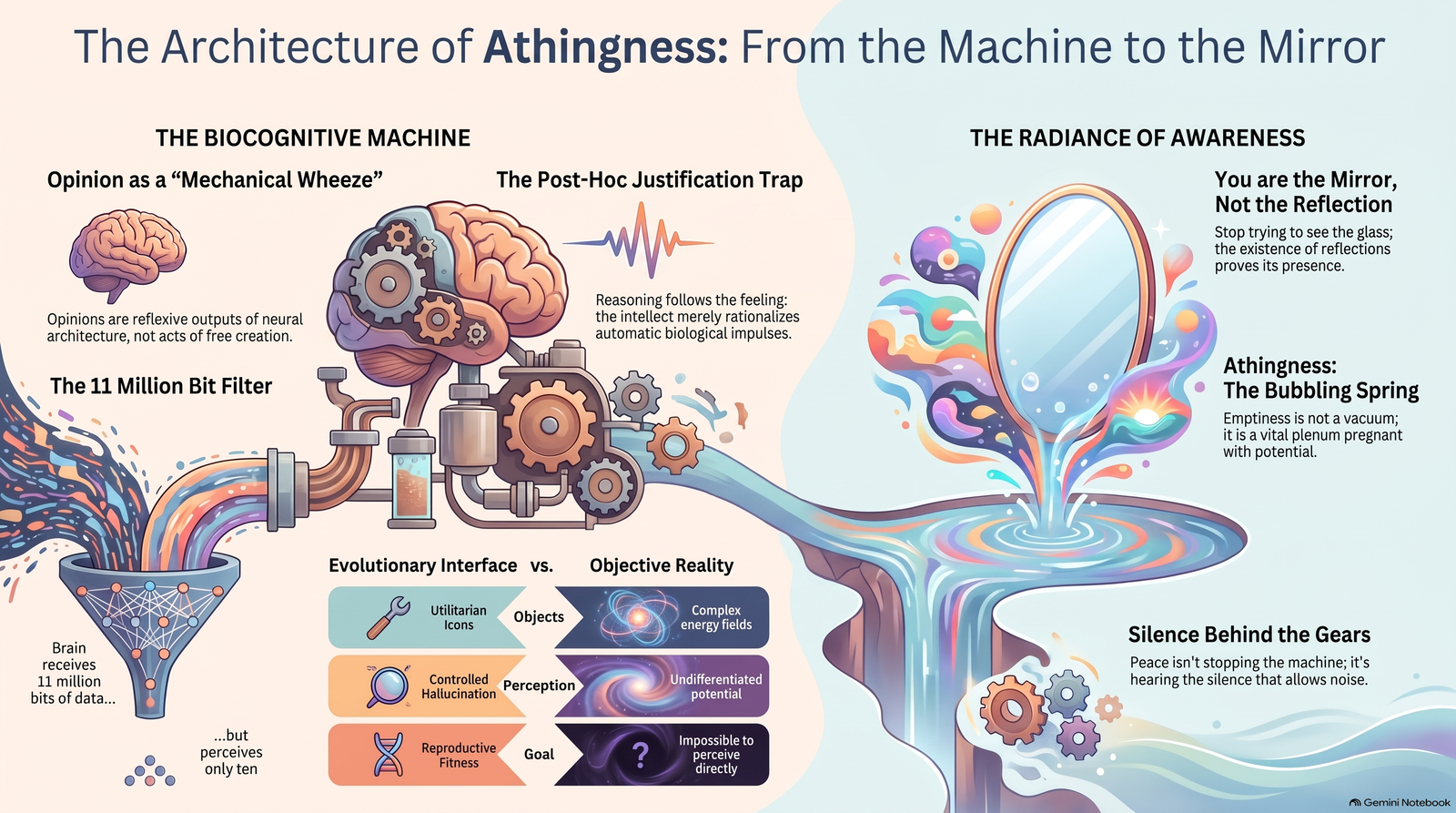
The episode opens inside the bodily certainty of an argument. An opinion feels authored, reasoned and solid; the room in which it is defended feels like reality simply given. The discussion unsettles both impressions. Moral intuition research suggests that reasons sometimes arrive after judgement, while split-brain studies show how readily a verbal system can confabulate an explanation for behaviour whose cause it did not receive.
The metaphor is deliberately abrasive: an opinion may be the “wheeze” a conditioned biocognitive machine makes when the world kicks it. The point is not that every belief is worthless or that evidence no longer matters. It is that the felt ownership and certainty surrounding a belief may reveal the history of a nervous system as much as the truth of its conclusion. Seen this way, disagreement can become information about different conditioning rather than a duel between sovereign selves.
The argument then widens from opinion to perception. Predictive-processing accounts treat perception as active inference constrained by sensory input rather than a passive internal photograph. Anil Seth’s phrase “controlled hallucination” captures that constructive element; Donald Hoffman’s interface theory proposes the more radical possibility that evolution favours fitness-relevant representations rather than transparent access to objective structure. The episode turns this into the image of a desktop: useful icons conceal the circuitry beneath them.
At that boundary, neuroscience gives way to contemplative philosophy. The observing witness cannot be made into one more observed object without producing another reflection. Dzogchen and Mahāmudrā are therefore read as invitations to stop polishing the mirror and recognise appearances as display. “Athingness” names the episode’s positive emptiness: not a dead absence, but a spring from which forms arise without becoming self-existing things. The final move is practical. Silence need not wait for the gears to stop; it may be recognised as the capacity in which their noise is already appearing.
The movement of the episode
From owning an opinion to hearing the silence around it
Certainty becomes a bodily event
The force of an opinion is traced through inherited dispositions, learning, culture, memory and immediate physiology.
Reason follows intuition
Moral dumbfounding and split-brain confabulation challenge the picture of a transparent, sovereign author explaining its own causes.
The opponent becomes weather
Recognising conditioned judgement loosens personal combat, while leaving room for discrimination, responsibility and action.
Perception becomes an interface
Prediction, sensory correction and evolutionary usefulness replace the naive image of a camera faithfully copying the world.
The witness escapes the screenshot
Any image of awareness is still an appearance. The seeker risks turning the knower into a subtler object of knowledge.
The mirror needs no repair
Dzogchen and Mahāmudrā imagery recasts thought as display and silence as the open capacity that already includes sound.
The interpretive lenses
Four registers that illuminate one another without becoming identical
Moral psychology
Haidt’s social-intuitionist work examines how automatic evaluation and social reasoning interact. It contests purely rationalist models without eliminating reflection or revision.
Cognitive neuroscience
Split-brain research and predictive-processing models expose limits in introspective access and passive-copy theories of perception. Their scope remains empirical and debated.
Evolutionary interface theory
Hoffman’s formal models ask whether selection rewards fitness-guiding representations over truth-preserving ones. The larger metaphysical extrapolation is a contested proposal.
Tibetan contemplative philosophy
Rangtong, Shentong, Dzogchen and Mahāmudrā supply distinct analyses of emptiness, luminosity and non-grasping. They are traditions of thought and practice, not neuroscientific conclusions.
Listen by chapter
The complete journey
- 00:00Opening: The Certainty of Being Right
- 03:20The Opinion as a Biological Machine
- 07:40Moral Dumbfounding and the Defence Attorney Mind
- 12:10Split-Brain Research and the Left-Brain Interpreter
- 17:20Opinions as Weather Patterns
- 21:40Compassion, Conflict and Polarisation
- 26:10Reality as a Controlled Hallucination
- 31:40The Evolutionary Interface: Why Truth May Be Hidden
- 37:10The Witness and the Trap of Subtle Identity
- 41:40Dzogchen: Stop Trying to See the Light
- 45:20Emptiness as a Living Plenum
- 48:20Leave Appearances Alone
- 50:20Closing: The Machine, the Mirror and the Light
Study notes and routes onward
Terms, distinctions and reference points
Glossary
Moral dumbfounding
The continued sense that an act is wrong after a person’s stated reasons have been challenged or removed. Haidt and colleagues used carefully designed scenarios to study tension between intuitive judgement and explicit justification. The phenomenon questions a purely reason-first model; it does not show that reasons never shape moral judgement.
Social intuitionist model
Jonathan Haidt’s model gives rapid intuition and social influence a large role in moral judgement, with conscious reasoning often serving later justification. The model also allows reasoning, especially interpersonal reasoning, to prompt new intuitions and change minds. The episode’s wholly mechanical language is a stronger philosophical interpretation.
Left-hemisphere interpreter
Michael Gazzaniga’s term for a tendency, especially visible in some split-brain experiments, for the language-dominant hemisphere to construct a coherent explanation from the information available to it. The classic demonstrations reveal confabulation under exceptional conditions; they do not justify a simple global division between a rational left brain and a mute right brain.
Predictive processing
A family of models in which perception depends partly on top-down expectations compared with incoming signals. Mismatch can prompt updated predictions, attention or action. The approach is influential but contains competing formulations and remains under empirical and philosophical debate.
Controlled hallucination
Anil Seth’s memorable description of perception as a brain-based construction continuously constrained by sensory evidence. “Hallucination” highlights active generation; “controlled” is equally important. The phrase does not mean that ordinary perception is arbitrary, unreal in every sense or clinically hallucinatory.
Interface theory and fitness beats truth
Donald Hoffman and colleagues use evolutionary game theory to compare perceptual strategies. Their models can favour fitness-tuned representations over truth-preserving ones under specified assumptions. Extending that formal result into the claim that space-time and objects conceal an unknowable reality is a philosophical research programme, not a consensus conclusion of evolutionary biology.
Anātman and conditioned self
Anātman is the Buddhist denial of a permanent, independent self. Persons still function conventionally through changing aggregates, causes and relations. Reading this alongside neural confabulation can be illuminating, but the Buddhist analysis is soteriological and philosophical; it is not simply an ancient version of a modern brain theory.
Rangtong and Shentong
Rangtong, “empty of self-nature,” and Shentong, “empty of other,” name contested Tibetan approaches to emptiness and ultimate reality. Rangtong should not be reduced to blank negation, nor Shentong to a single assertion of an eternal substance. Dolpopa’s Jonang presentation emphasises an ultimate reality empty of adventitious qualities yet endowed with awakened qualities.
Ka dag and lhun grub
Dzogchen vocabulary commonly translated as primordial purity and spontaneous presence. They indicate inseparable aspects of the ground in particular Dzogchen presentations: freedom from intrinsic determination and an unceasing capacity for appearance. They are not equivalent to a neuroscientific empty field and should not be isolated from lineage, practice and interpretation.
Gdangs, rol pa and rtsal
Terms used in some Dzogchen explanations for modes or dimensions of energy and display, often rendered as radiance, play and creative potency. English spellings vary; the transcript’s heard forms “dang, rolpa and tsal” point to these Tibetan terms. Their mapping onto mirror, reflection and outward projection is a teaching analogy rather than a universally fixed taxonomy.
Mahāmudrā and the Ganges instructions
Mahāmudrā is a family of Indian and Tibetan contemplative teachings associated with direct recognition of mind’s nature. Instructions attributed to Tilopa and transmitted to Nāropa use sky, cloud and non-grasping imagery. The episode’s injunction to leave appearances alone is a concise paraphrase of that orientation, not a verbatim historical quotation.
Athingness
The episode’s coined name for reality before conceptual fixation turns experience into separate nouns and owned objects. Its bubbling-spring image stresses potential, movement and appearance within emptiness. It belongs to Dr Simon Robinson’s contemporary synthesis rather than an established technical term in neuroscience or classical Tibetan philosophy.
Related reading on this site
- The Bedrock of Unstainable AwarenessEpisode 07’s earlier exploration of projection, non-grasping and awareness that is not marked by its contents
- Hypnosis, Buddhism and the Predictive MindA later catalogue page that examines predictive processing, controlled hallucination and contemplative interpretation in greater depth
- EmptinessA concise route into dependent arising and the absence of independent essence without reducing emptiness to non-existence
- The Great Mirror of WisdomThe mirror as a way of approaching clarity, reflection and the non-appropriation of what appears
- Conditionality and Non-SelfThe causal construction of personality and experience behind the episode’s machine metaphor
- Why the Mind Turns Everything Into SomethingA later return to conceptual thing-making, diagnostic language and the limits of every map
External reference points
- Moral Dumbfounding: When Intuition Finds No ReasonHaidt, Björklund and Murphy’s preliminary report, including the study’s modest sample and its distinction between judgement and justification
- Split-Brain: What We Know Now and Why This Is Important for Understanding ConsciousnessA modern review of the shared findings, interpretive disagreements and limits of simple hemisphere stories
- Predictive Coding: A Theoretical and Experimental ReviewAnil Seth and colleagues review the framework’s mathematical logic, evidence, biological plausibility and unresolved questions
- Fitness Beats Truth in the Evolution of PerceptionThe formal argument behind the episode’s evolutionary-interface claim, to be read with its model assumptions intact
- Madhyamaka — Stanford Encyclopedia of PhilosophyContext for emptiness of inherent nature and why negation in Madhyamaka is not simply a doctrine of nothingness
- Tsongkhapa — Stanford Encyclopedia of PhilosophyHistorical and philosophical context for Tibetan debates over emptiness, including the Shentong position attributed to Dolpopa
- The Special Teaching of the Wise and Glorious KingA translated Dzogchen instruction associated with Patrul Rinpoche, useful for locating direct recognition and natural energy within practice rather than neuroscience
A three-minute reflection
Hear the wheeze without becoming the machine
Recall a recent moment of absolute certainty. Without deciding whether the opinion was true or false, notice the bodily signatures that accompanied it: pressure, heat, tightening, rehearsed phrases or an urge to answer. Name these as appearances rather than as proof. Then listen for the nearest sound. Do not try to remove it. Ask instead: what is the silence that permits this sound, and does the sound actually damage it? Finish by returning to the practical question the opinion concerned. What evidence, value or action still matters when the need to defend an owner has softened?
Continue the dialogues