
Dialogues I · Episode 02
The Physics of a Hopeless Prayer
What remains of prayer when it stops bargaining for a different world?
Watch
The conversation
Central question
Can prayer survive the end of hope as a transaction?
The episode asks whether prayer can cease to be a request for reality to change and become a way of standing within what is already here.
The second episode of Dialogues I begins by reversing one of spiritual language’s most familiar hierarchies. Light usually signifies knowledge, safety and awakening; darkness signifies ignorance or danger. Here, light becomes a demanding neighbour that insists everything must be named, justified and made visible. Darkness is imagined instead as a place where the effort of explanation can settle. This is poetic inversion, not a claim that knowledge, hope or illumination are inherently harmful.
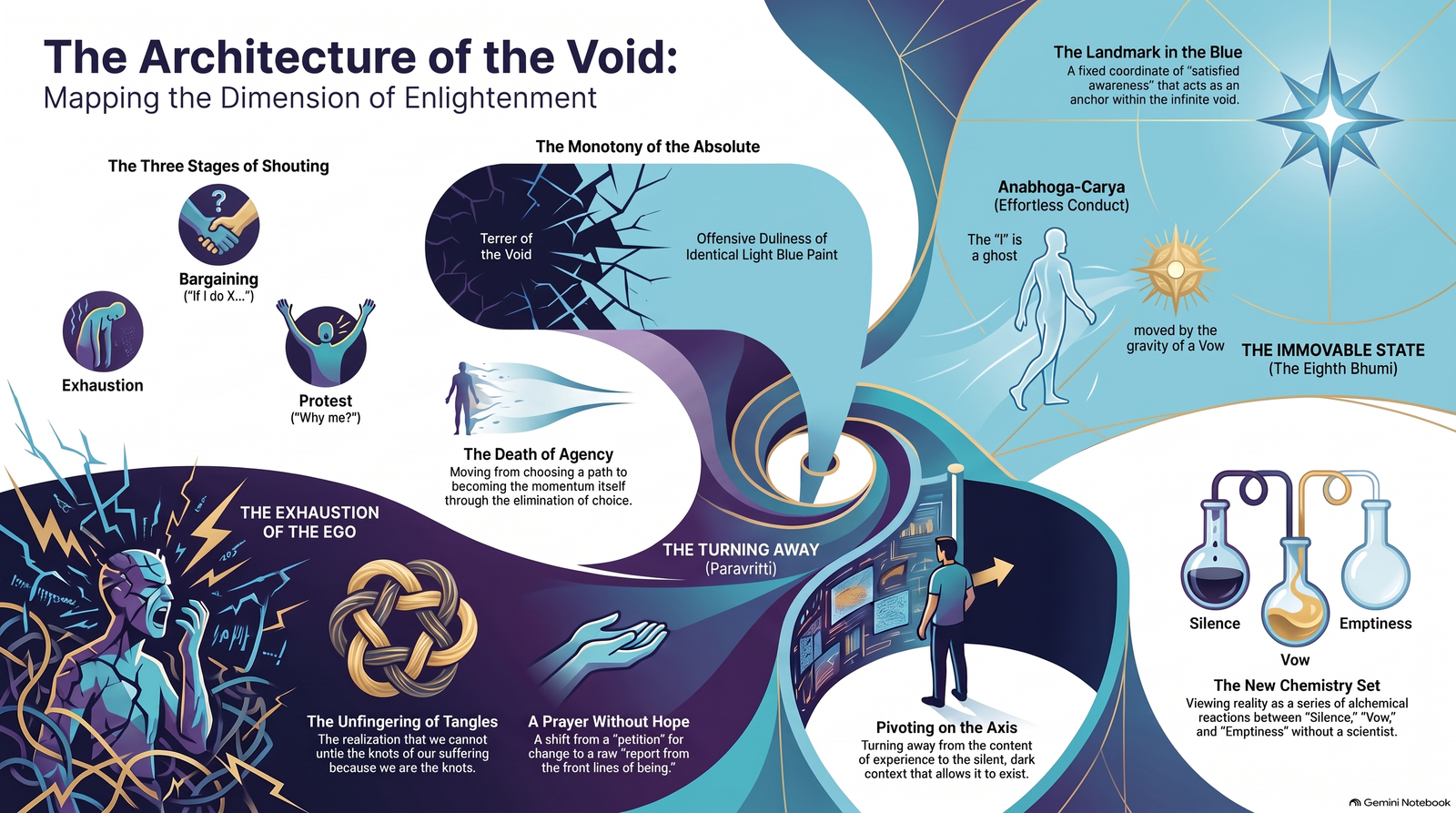
The discussion then reworks prayer. Ordinary petition reaches towards a preferred future: cure this, prevent that, make the present otherwise. A “hopeless prayer” is the episode’s deliberately paradoxical name for what remains when this bargain falls away. Its lighthouse turns although no ships are coming; prayer changes from wish to fact, from negotiation to presence. Bargaining, protest and exhaustion become three stages in the collapse of spiritual shouting, until silence is no longer treated as a missing answer.
From this experiential language, the conversation moves into a highly interpretive account of the Mahāyāna bodhisattva path. It invokes the eighth bhūmi, non-arising and effortless conduct to describe action that no longer feels chosen by a central manager. Prayer pulls forward; vow presses from behind; the “I” is displaced by trajectory. These are evocative analogies rather than a dependable test of attainment. Traditional accounts of the eighth bhūmi belong to a much larger scriptural, ethical and contemplative framework.
The episode deliberately refuses a triumphant ending. The void is not fireworks but the offensive dullness of an already-painted wall: a labyrinth whose apparently different choices are all the same pale blue. Yet disappointment becomes clarifying. When the hoped-for prize fails to appear, awareness may stop searching for a more important coordinate. The practical challenge is modest and severe: where nothing magical needs to happen, can one put down the brush, remain present and still respond responsibly to what life requires?
Argument map
How the conversation moves
Light becomes a demand
The opening poem recasts illumination as the pressure to name, explain and perform.
The shouting spends itself
Bargain, protest and fatigue reveal how hope can keep a transaction with reality in motion.
Prayer becomes presence
The lighthouse with no ships coming continues not to secure an outcome, but because it is what it is.
The manager gives way to trajectory
Prayer and vow are pictured as forces that move conduct without a self standing outside the movement.
The immovable is approached
The eighth bhūmi and non-arising supply a traditional vocabulary for the episode’s account of irreversible change.
The void is offensively dull
Identical blue walls dismantle the expectation that surrender must culminate in spiritual spectacle.
The brush can be put down
When the search for a superior coordinate ends, ordinary presence becomes sufficient without becoming inert.
Editorial lens
How the sources are used
The Obsidian Sanctum
Darkness, the demanding sun and the resting soul establish an imaginative landscape. They disclose a mood and a question rather than factual cosmology.
The eighth bhūmi
The traditional “Immovable” stage gives the episode language for non-retrogression and effortless conduct, but the recording compresses a complex doctrinal map.
Prayer, vow and lost agency
The language of being pulled and pushed describes how action may feel when central authorship weakens. Phenomenological force is not proof of metaphysical mechanism.
The new chemistry set
Silence, vow and emptiness become reagents in an experiment without a separate scientist. This extends the wider project’s symbolism rather than reporting laboratory physics.
Chapter guide
Move through the episode
- 00:00Opening: What If the Light Is the Problem?
- 03:20The Obsidian Sanctum and the End of Performing
- 06:40What Is a Hopeless Prayer?
- 10:30The Lighthouse with No Ships Coming
- 14:20Bargain, Protest, Exhaustion
- 18:20Sinking Instead of Treading Water
- 22:20Pulled by Prayer, Pushed by Vow
- 26:20The Eighth Bhūmi and Non-Arising
- 30:20Offensive Dullness and the Blank Wall
- 33:50The Labyrinth of Light Blue Paint
- 36:50Empty Volition and the Chemistry Set of the Void
- 39:10The Coordinate of Enough
- 40:10Closing Reflection: Put Down the Brush
Glossary
Terms carried by the conversation
Hopeless prayer
Prayer: petition and presence
Vow
Turning away (parāvṛtti)
Bhūmi
The eighth bhūmi: Acalā, “Immovable”
Effortless conduct (anābhoga-caryā)
Receptivity to the non-arising of phenomena (anutpattika-dharma-kṣānti)
Non-arising
Emptiness (śūnyatā)
Volition (cetanā)
The coordinate of enough
Continue within the website
Related pathways
A direct introduction to the Buddhist term that the episode turns into the imagined medium of its “physics”.
Develops the wider project’s distinction between insight and the changing momentum of conditioned life.
Provides a companion framework for the episode’s movement from a choosing “I” towards conditioned trajectory.
Places the episode’s provocative language within the foundational course’s broader and more systematic map.
A later return to awakening without spectacle, where ordinary activity tests every elevated description.
Extends the inquiry into resistance, reaction and the distinction between unavoidable experience and added struggle.
Curated reading shelf
External reference points
A complete translation of the Daśabhūmika, providing the larger scriptural context for the eighth ground that the episode invokes selectively.
A canonical presentation of the ten grounds, their names and associated developments, useful for comparing the traditional map with the episode’s synthesis.
An early Buddhist text on right view, dependent arising and the avoidance of the extremes of existence and non-existence.
A scholarly overview clarifying why emptiness and dependent arising should be understood together rather than as nihilistic blankness.
A practical boundary for the episode’s title: persistent or dangerous hopelessness belongs with real human support, not solitary metaphysical interpretation.
A grounded observation
Notice one small bargain
Choose a harmless, ordinary frustration already present: a delay, an unfinished task or a minor inconvenience. For one minute, notice the sentence that says the moment must be different before you can settle. Do not argue with it and do not abandon any action that is genuinely needed. Simply distinguish the practical next step from the extra bargain that demands reality first become acceptable. Then take the practical step, or return to what you were doing.