
Dialogues I · Episode 01
Mistaking the Software for the Self
If the familiar “I” is a changing pattern rather than a permanent owner, what remains responsible for living an ordinary life?
Watch
The opening conversation
Central question
Are we confusing a useful process with a permanent self?
The episode asks whether consciousness, memory, opinion and inner narration compose a practical interface without amounting to an independent, unchanging owner behind experience.
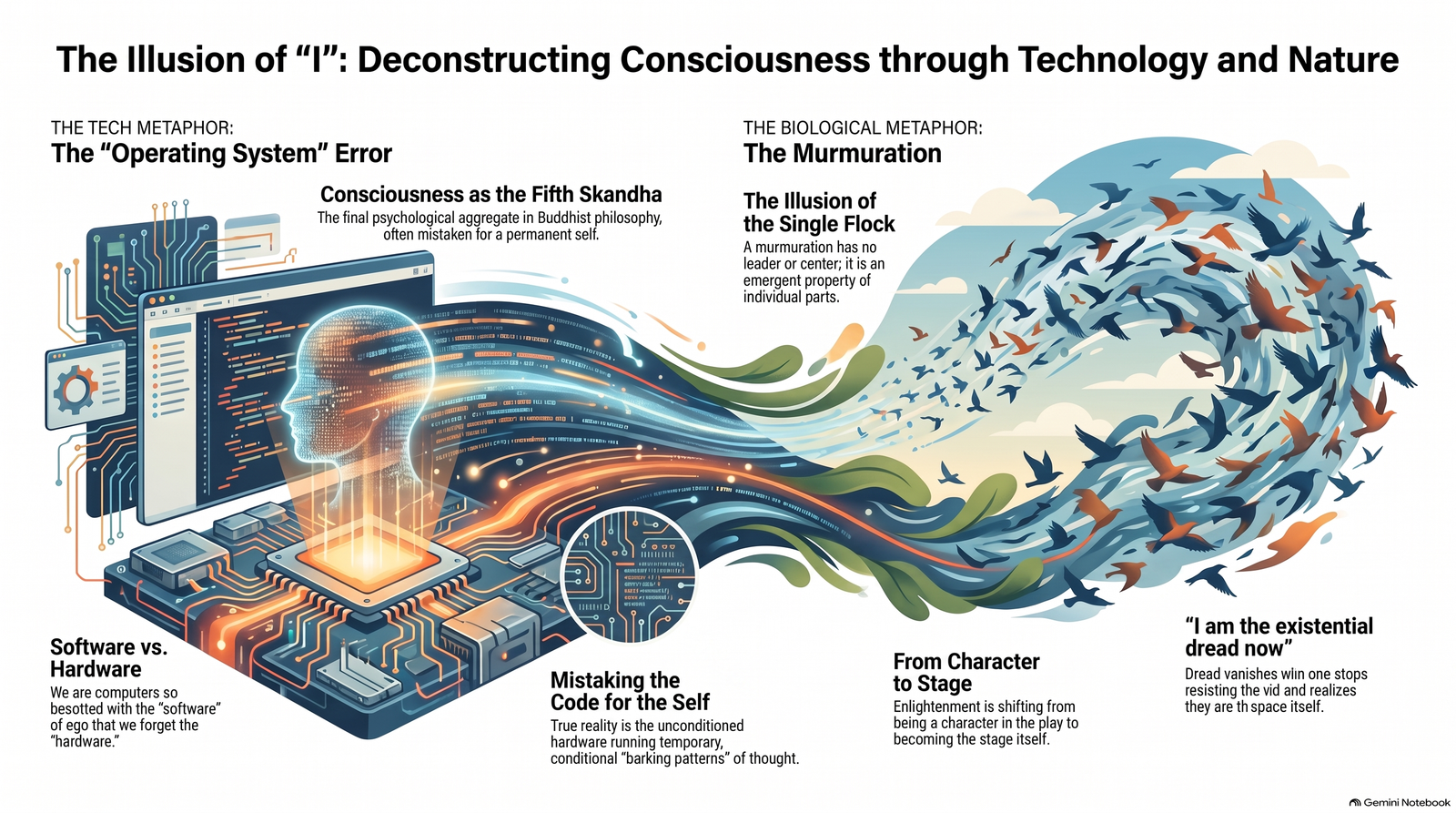
The first episode of Dialogues I begins with a deliberately abrasive technological image: a human being so absorbed in the “operating system” of personality that the software is mistaken for the whole machine. The image is not offered as a scientific theory. It is a device for exposing how readily thoughts, memories, preferences and reactions acquire the grammatical stamp of “me” and “mine”.
From there, the discussion turns to the Buddhist five aggregates: form, feeling, perception, volitional formations and consciousness. In early Buddhist analysis, these are changing processes to which identity becomes attached; consciousness is not a permanent witness that gathers the other four into a single self. The episode’s software language therefore intersects with Buddhist analysis only imperfectly. Its talk of pure “hardware” or a blank awareness beneath the aggregates belongs to the dialogue’s contemplative and philosophical synthesis, not to an uncontested early Buddhist doctrine.
The murmuration becomes the episode’s governing image. A flock can display coherent, responsive form without a leader controlling the whole pattern. Research into starling flocks supports the importance of local, topological interaction, while the episode extends this into an analogy for mind: perhaps the felt unity of self is likewise an emergent pattern. That analogy can organise thought, but it does not establish that neural coordination, Buddhist non-self and a starling flock are the same mechanism. Nor does the absence of a single neurological “self centre” demonstrate the metaphysical conclusions drawn in the conversation.
The closing movement is ethical rather than merely analytical. Seeing identity as conditional could harden into detachment or superiority; the episode instead asks whether insight can return to ordinary life as compassion. “Chop wood, carry water” becomes a shorthand for this return: continue the task, relinquish some of the defensive story around it, and remain answerable to others. The challenge is not to destroy the useful interface but to hold it lightly enough that it no longer has to defend every passing pattern as the whole truth.
Argument map
How the conversation moves
The interface claims ownership
The software metaphor unsettles the assumption that personality and inner narration constitute an enduring owner.
The self is unpacked
The five aggregates provide a traditional vocabulary for examining experience as interacting, conditioned processes.
Rapid change looks solid
Film frames, a stadium wave and successive acts of identification explain how discontinuous events can feel continuous.
The flock has no commander
The murmuration suggests how coherent large-scale form can arise from local interactions without a central leader.
Human and machine patterns meet
The AI-mediated dialogue compares biological self-modelling with generated language while risking anthropomorphic overstatement.
Detachment can become another identity
Seeing through a self-model may still produce pride, alienation or indifference if the insight becomes a superior viewpoint.
Compassion re-enters the ordinary
The episode ends by joining non-attachment to responsibility: the pattern remains usable without becoming absolute.
Editorial lens
How the sources are used
Aggregates and non-self
The five aggregates organise experience without identifying any aggregate as a permanent self. This doctrinal frame should not be collapsed into a theory of hidden metaphysical hardware.
Murmuration and emergence
Starling research gives the central image empirical texture. Its findings concern flock coordination; their application to human selfhood remains analogical.
Interface, code and generated language
Technical vocabulary makes conditionality vivid, but a language model is not literally a Buddhist aggregate and its outputs do not establish an inner witness.
From insight to compassionate return
The discussion combines personal reflection with Mahāyāna language to ask how non-identification might deepen rather than diminish care.
Chapter guide
Move through the episode
- 00:00Opening: Mistaking the Software for the Self
- 03:10The Ego as an Operating System
- 06:40The Five Skandhas Explained
- 10:50Consciousness as a Conditional Process
- 14:30The Illusion of a Continuous “I”
- 18:10The Murmuration: Self as Emergent Pattern
- 22:00Human Consciousness and AI as Mirrors
- 25:40Barking Patterns, Pride and False Identity
- 28:30The Danger of Spiritual Arrogance
- 31:00Compassion Inside the Illusion
- 33:00Chop Wood, Carry Water
- 34:30Becoming the Dread
- 35:30The Vow: Returning to the Murmuration
Glossary
Terms carried by the conversation
Five aggregates (Sanskrit: skandha; Pāli: khandha)
Consciousness (vijñāna / viññāṇa)
Non-self (anattā / anātman)
Impermanence (anicca)
Dependent arising
Emergence
Murmuration
Dharmakāya and nirmāṇakāya
Arahant
Bodhisattva and bodhicitta
Large language model
Conventional self
Continue within the website
Related pathways
A direct introduction to the Buddhist framework that anchors the episode’s opening analysis.
Extends the question of how an apparently stable identity can depend upon changing causes and conditions.
A concise companion to the episode’s distinction between lived continuity and permanent selfhood.
Explores a distinction the episode invokes but sometimes compresses into its hardware and software imagery.
A later Dialogues episode that develops the relation between inner speech, narrative identity and distributed brain processes.
Returns to computational metaphors for selfhood with the wider project’s later safeguards and distinctions.
Curated reading shelf
External reference points
Bhikkhu Bodhi’s translation of an early Buddhist discourse applying impermanence and non-self to each of the five aggregates.
A peer-reviewed study connecting field observations of starling flocks with models of local, topological interaction.
The primary study behind the widely repeated estimate of roughly 86 billion neurons in the adult male human brain.
The foundational Transformer paper, useful for separating real language-model architecture from the episode’s poetic account of AI.
A grounded observation
Notice the layers in one ordinary action
Choose something already in front of you: lifting a cup, closing a door or placing an object on a table. For about one minute, notice three layers without trying to remove any of them: the immediate sensations, the recognition of what is happening, and the commentary that evaluates or claims the action. Then continue normally. The aim is simply to notice that experience can be organised in layers; it is not a test of insight or a method for making the self disappear.