
Albedo · Subject · Chapter 40 of 48
2.4.4. Inner Worlds
An experience can be vivid, meaningful and transformative without proving that its first interpretation is true.
Chapter video
When intensity is mistaken for truth
Book orientation
The chapter in brief
Inner Worlds is an autobiographical inquiry into the malleability of consciousness. Dr Simon Robinson describes chemically induced experiences that moved through sensory distortion, loss of ordinary self-boundaries, infinite space, silence and moral self-appraisal. The chapter does not offer these experiences as metaphysical proof. Its governing caution is that phenomenological richness can coexist with epistemic weakness: an event may reveal how perception and identity reorganise under unusual conditions without establishing what exists beyond the experience. The eventual movement away from chemical experimentation and towards sober contemplative practice is presented as a personal conclusion about stability, integration and character, not as a universal clinical comparison or an instruction to reproduce the experiments.
Transcript-led guide
Experience, interpretation and the discipline of uncertainty
The recording begins with a contrast between the apparent precision of a physical diagnosis and the instability of claims about consciousness. A formative MDMA experience overturned the author’s former assumption that the felt structure of self was fixed. The strongest inference available from that event is modest but important: subjective identity and perception can change dramatically. The experience alone cannot determine whether the resulting imagery discloses an external realm, a hidden architecture of mind or a temporary reorganisation of perception.
This boundary is expressed through the distinction between phenomenology and ontology. Phenomenology concerns how an experience presents itself; ontology concerns what exists. The fact that a presence, light, city or shared consciousness feels undeniable establishes that the experience occurred, but not that the perceived object exists independently. Conversely, describing an event as internally generated does not make its emotional or autobiographical consequences unreal. The task is to preserve the data of experience while suspending claims that exceed it.
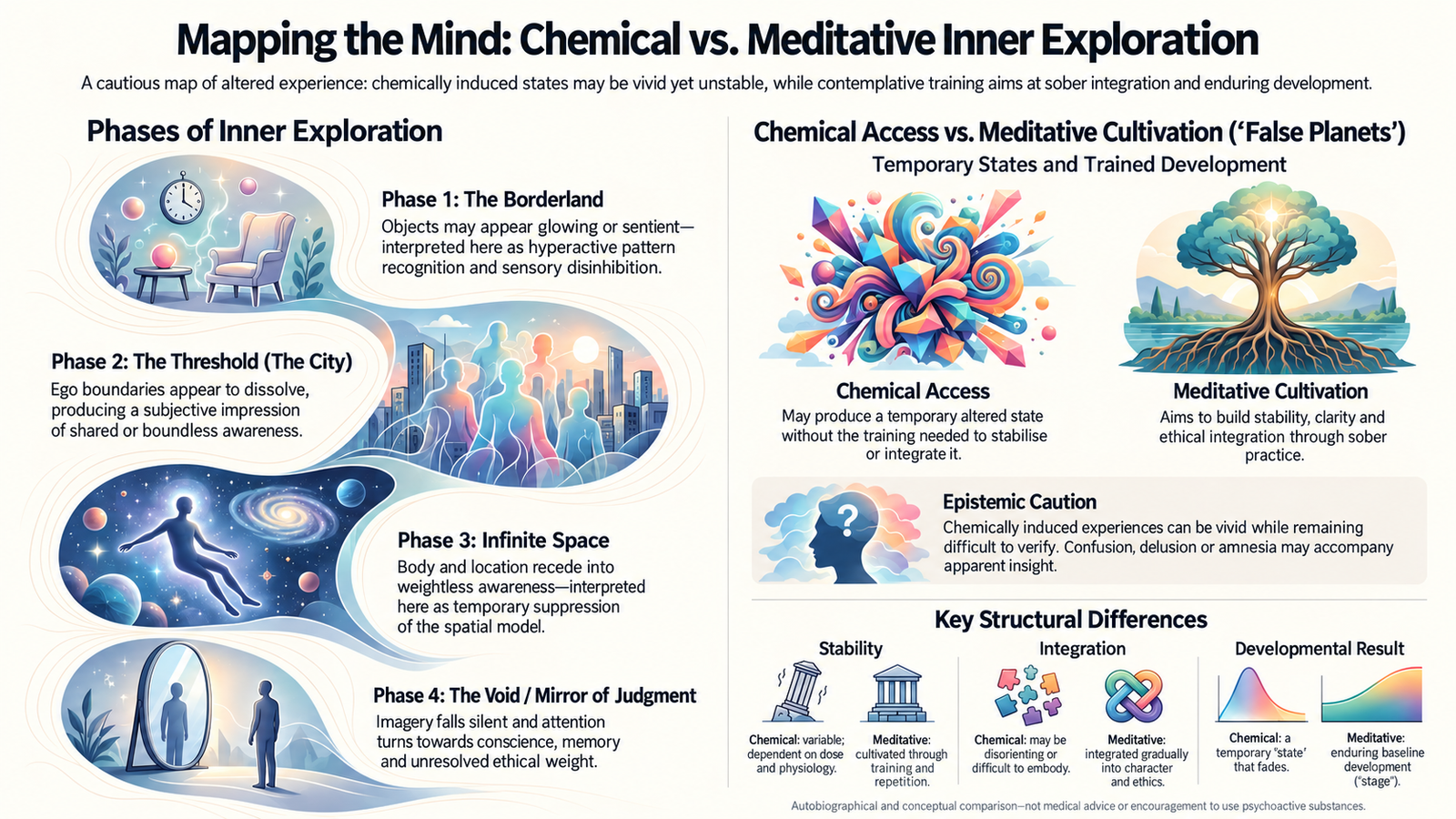
The chapter’s four-part map begins with the Borderland, where ordinary objects seem animated or sentient. It then moves to the Threshold or City, where the boundary between observer and observed appears to weaken; Infinite Space, where body and location recede; and the Void, where sensory and imaginal content gives way to conscience and memory. The book offers structural interpretations involving pattern recognition, ego-boundaries, proprioception and reduced distraction. These are explanatory proposals rather than direct measurements of what happened in the author’s brain, and the transcript’s more definite neurological language should therefore be read cautiously.
At the Mirror of Judgment, the apparent external tribunal becomes an encounter with personal history and unresolved ethical weight. The psychologically useful insight is that self-appraisal can intensify when distraction and familiar defences fall away. It does not follow that every frightening altered-state experience reveals moral truth, nor does the account settle theological questions about judgment. Memory, mood, suggestion, intoxication and prior beliefs can all shape what appears compelling from within a state.
The final turn is the recognition of “false planets”: spectacular inner destinations that cannot be stabilised, verified or reliably integrated. The chapter connects this image with the Bhagavad Gītā. A useful textual qualification is that verses 9.20–21 discuss soma-drinkers reaching heaven and returning when their merit is exhausted, while verse 9.25 distinguishes the destinations associated with different forms of worship. The chapter combines these motifs into its own metaphor for temporary attainment.
The closing contrast between chemical states and meditative stages should likewise remain proportionate. Unsupervised drug use can be unpredictable and harmful, while disciplined meditation may cultivate repeatable skills and ethical integration. Yet meditation is not risk-free, chemical experiences are not uniform, and lasting development cannot be guaranteed by either intensity or spiritual vocabulary. Within the chapter’s framework, the practical test is what becomes available in ordinary life: stability, honesty, responsibility and reduced harm.
Argument map
How the recording moves
The fixed self becomes variable
A chemical intervention reveals that the felt boundaries and parameters of identity can change dramatically.
A boundary is established
Vivid first-person experience is retained as data without being converted automatically into metaphysical knowledge.
The Borderland animates the ordinary
Objects appear alive or aware, interpreted as altered pattern recognition and attribution of agency.
Identity and location loosen
The Threshold and Infinite Space describe the apparent dissolution of personal boundaries, bodily coordinates and ordinary perspective.
The Void becomes a mirror
When imagery and distraction recede, attention turns towards conscience, personal history and ethical self-appraisal.
Spectacle loses authority
Confusion, erratic narratives and poor integration expose the limitations of chemical access and the danger of inflated meaning.
Transformation is tested by baseline life
The recording distinguishes a temporary state from enduring development expressed through conduct, stability and integration.
Book–video relationship
Testimony, expansion and qualification
The chapter establishes
An autobiographical map of four altered-state phases, the Mirror of Judgment and the metaphor of chemically accessed “false planets”.
The video expands
Clinical analogies, evolutionary pattern detection and the palace metaphor make the distinction between experience, interpretation and integration vivid.
The guide qualifies
Proposed mechanisms are separated from direct evidence, the Gītā passages are distinguished, and meditation is not presented as guaranteed or risk-free.
Video chapters
Navigate the discussion
- 00:00Opening: Inner Worlds and Altered States
- 02:20The Discovery That Consciousness Is Variable
- 06:10Phenomenology Without Validation
- 10:50The Borderland: When Objects Seem Alive
- 15:10The Threshold and the City
- 20:00Infinite Space and Loss of Coordinates
- 24:30The Void and the Mirror of Judgment
- 29:10False Planets and Delusive Worlds
- 33:40Chemical Access vs Meditative Cultivation
- 37:20State vs Stage
- 40:00Closing Reflections
Glossary
Terms used in the chapter and recording
Phenomenology
Ontology
Epistemic caution
The Borderland
The Threshold or City
Infinite Space
Proprioception
The Mirror of Judgment
False planets
Soma
State and stage
Integration
Related pathways
Continue within the website
- 2.4.3. Cycles of LearningThe preceding chapter examines why insight may recur without yet becoming stable conduct.
- 2.4.1. ExperimentProvides the earlier autobiographical context and distinguishes chemical disruption from clarified awareness.
- 2.1.10. A New Kind of DemonExamines how striking inner material can become inflated into identity, authority or a special mission.
- 1.2.4. ConsciousnessIntroduces the earlier course account of consciousness as conditioned, variable and dependent on supporting factors.
- 1.3.6. Different Worlds and JhānaSupplies background on meditative absorption and the immaterial spheres invoked by the Infinite Space comparison.
- Fear, Power & the Edge of DelusionA related discussion of unusual experience, interpretation and the need to preserve psychological and ethical boundaries.
External reference points
Texts, health information and evidence boundaries
- Stanford Encyclopedia of Philosophy: PhenomenologyBackground on the philosophical study of structures of experience and the several traditions gathered under the term.
- National Institute on Drug Abuse: MDMAEvidence-based information on MDMA’s effects and risks; useful for separating the chapter’s testimony from general medical conclusions.
- NCCIH: Meditation and Mindfulness—Effectiveness and SafetyA proportionate review of research, limitations and safety considerations; contemplative practice should not be represented as universally benign or clinically sufficient.
- The Jhānas in Theravāda Buddhist MeditationTraditional background for absorptive practice and the immaterial attainments, helping distinguish technical meditative categories from phenomenological resemblance.
- NHS: Drug addiction—getting helpPractical UK guidance on confidential treatment and support. Substance dependence, withdrawal and destabilisation require appropriate care rather than spiritual interpretation alone.
Two-minute interpretation check
What happened, and what have I concluded?
Choose one unusual but non-distressing experience—a vivid dream, a strong intuition, a moment of apparent synchronicity or an unexpected shift in meditation. Divide a page into three lines: what I directly noticed, the meaning I first gave it, and two other explanations compatible with the same facts. Finish by asking what response would remain wise if none of the explanations could be proved.
Do not use this exercise to analyse an experience that is currently frightening, destabilising or impairing sleep and function. In that situation, prioritise grounding and suitable professional support.