
Albedo · Subject · Chapter 39 of 48
2.4.3. Cycles of Learning
A lesson can be genuinely understood and still return: the question is whether repetition becomes shame, escape or a more honest form of learning.
Chapter video
Why familiar patterns return
Book orientation
The chapter in brief
This chapter replaces the image of steady spiritual ascent with a recurring learning cycle: resolve, drift, numbing, collapse and return. Dr Simon Robinson connects that cycle with addiction, crisis, the first three Buddhist fetters and the temptation to use meditative concentration as an anaesthetic. Its central contribution is not that suffering automatically produces wisdom, but that repeated failure can expose the limits of pride, social conformity and purely intellectual understanding. The chapter’s language is an alchemical and autobiographical synthesis rather than a clinical model or a standard Buddhist account of attainment. Its most durable movement is the humble return: beginning again with less drama, greater ethical seriousness and a longer view of the work.
Transcript-led guide
When insight has occurred but integration has not
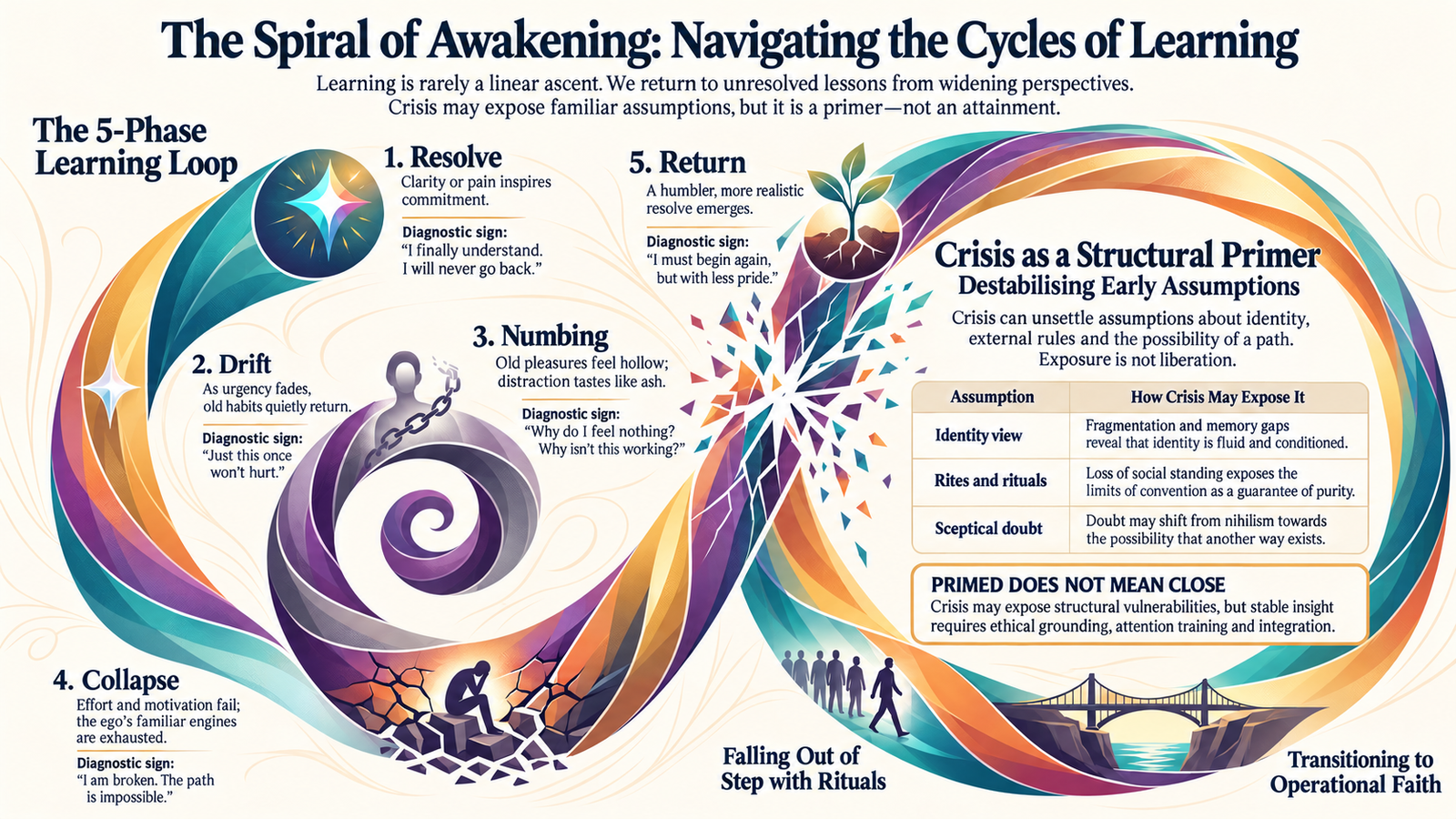
The recording begins with the unsettling experience of recognising a pattern that has already been recognised before. Instead of treating recurrence as proof that nothing was learned, it proposes a widening spiral: the practitioner returns to familiar material from a different position. The central question is therefore not simply, “Why did I fail again?” but, “What did the earlier insight reveal, and what conditions prevented it from becoming conduct?” The five-stage loop gives the inquiry a practical shape. Resolve produces confidence; urgency fades into drift; old pleasures return but taste increasingly hollow; effort collapses; and a quieter recommitment emerges from the exhaustion of grand solutions.
The video then places crisis and addiction beside early Buddhist language about identity-view, grasping at rules and practices, and doubt. Its useful insight is that severe disruption can expose how unstable identity, memory and social belonging actually are. Its stronger claims require restraint. Fragmentation, blackout, loss of status or desperation do not amount to the abandonment of fetters in the traditional sense, and they do not make a person spiritually close to stream-entry. At most, crisis may destabilise assumptions that contemplative practice later investigates under very different conditions. The movement from nihilistic doubt towards confidence that another way may exist is similarly an interpretive bridge, not the complete Buddhist meaning of vicikicchā.
The middle of the recording describes the grey zone in which familiar distractions no longer satisfy but a new way of living is not yet established. That image captures a recognisable form of disillusionment, yet numbness, paralysis and loss of motivation may also accompany depression, trauma, substance dependence or other conditions. They should not be presumed to be the ego’s spiritually necessary exhaustion. The page therefore keeps the chapter’s phenomenological map while refusing to turn symptoms into evidence of progress.
The final movement examines what the chapter calls the “anaesthetic jhāna”: concentration used to avoid emotion, responsibility or ethical repair. The practical warning is valuable, although traditional jhāna is not simply a blissful suppression technique and is normally described as arising through seclusion from unwholesome states. “Concentration used as avoidance” is the more reliable formulation. The recording closes by widening the timescale through the traditional Buddhist cosmology of beginningless Saṃsāra and precious human birth. Whether that cosmology is received literally or symbolically, its ethical challenge is immediate: use recurrence to become more honest, not more exceptional.
Argument map
How the recording moves
Repetition is reframed
A recurring problem is approached as unfinished learning rather than immediate proof of moral or spiritual failure.
The loop is made visible
Resolve gives way to drift, numbing and collapse before a less prideful return becomes possible.
The old anaesthetic loses its taste
Familiar distractions still attract attention but no longer provide the pleasure or forgetting they once promised.
Crisis unsettles assumptions
Disrupted identity, memory and social belonging may reveal contingency without themselves producing insight or attainment.
Doubt changes direction
Despair about the possibility of freedom begins to yield to a limited, practical confidence that another response can be tested.
Meditation acquires an ethical test
Peace and concentration are examined by whether they support responsibility and understanding or merely postpone difficult contact.
The scale becomes humbling
Traditional Buddhist cosmology widens the horizon, while the immediate task becomes modest recommitment in ordinary life.
Book–video relationship
Model, expansion and qualification
The chapter establishes
A five-phase account of recurring learning, a critique of spiritual avoidance and a return made humbler by collapse.
The video expands
Rock-bottom imagery, the locked-door analogy and ordinary habits make the loop vivid and connect it to addiction, identity and motivation.
The guide qualifies
Crisis is separated from attainment, symptoms from spiritual stages, traditional fetters from social breakdown and jhāna from avoidance.
Video chapters
Navigate the discussion
- 00:00Opening: Why You Repeat Patterns
- 02:20The Structure of the Learning Cycle
- 06:10Insight and False Confidence
- 10:40Drift: The Return of Old Patterns
- 15:20Numbing: The Grey Zone
- 20:10Collapse: When Everything Stops
- 24:30Recommitment and Humility
- 28:40Crisis, Addiction, and Early Insight
- 33:10The Trap of Anaesthetic Meditation
- 37:20The Scale of the Work
- 41:00Closing Reflections
Glossary
Terms used in the chapter and recording
Cycle of learning
Widening gyre
Metanoia
Sakkāya-diṭṭhi
Sīlabbata-parāmāsa
Vicikicchā
Operational confidence
Jhāna
Anaesthetic meditation
Sīla
Saṃsāra
Integration
Related pathways
Continue within the website
- 2.4.2. MetanoiaThe preceding chapter examines a change in standpoint; this chapter asks why a genuine shift may still need repeated integration.
- 2.4.1. ExperimentProvides the earlier distinction between disruption and clarification and the autobiographical background to the discussion of crisis.
- 2.3.12. TouristExplores the danger of mistaking relief, distance or a temporary plateau for completed liberation.
- 1.2.8. SaṃsāraSupplies the earlier course context for the cycle of suffering and the larger timescale invoked near the recording’s conclusion.
- 1.3.6. Different Worlds and JhānaIntroduces absorptive meditation and helps distinguish traditional concentration practice from the chapter’s warning about avoidance.
- Why Addiction Can Feel Like SurvivalA related dialogue that approaches addiction as an adaptive pattern without reducing it to failed willpower or spiritual symbolism.
External reference points
Texts and evidence boundaries
- Vajirā Sutta (SN 5.10), translated by Bhikkhu BodhiThe source of the chariot analogy: a “being” is conventionally designated when the aggregates are present.
- Into the Stream: A Study GuideCollects early Buddhist passages on stream-entry and the abandonment of identity-view, doubt and grasping at habits and practices.
- Stanford Encyclopedia of Philosophy: Personal IdentityProvides philosophical context for the different questions hidden inside the language of self, memory and identity over time.
- NCCIH: Meditation and Mindfulness—Effectiveness and SafetyReviews evidence, limitations and reported adverse effects, supporting a proportionate distinction between contemplative practice and healthcare.
- NHS: Drug addiction—getting helpPractical UK guidance on confidential treatment and support; addiction and withdrawal should not be managed as spiritual exercises.
Two-minute pattern audit
What does the habit actually deliver?
Choose one ordinary, low-risk pattern—for example, reflexive scrolling, postponing a small task or staying busy to avoid a conversation. Without judging yourself, write four short phrases: trigger, what the habit promises, what it actually leaves behind, and one smaller response available next time. The aim is observation rather than forced abstinence or a declaration of permanent change.
Do not use this exercise as a substitute for professional help with substance dependence, withdrawal, severe depression or other risky behaviour. Those situations deserve appropriate clinical and practical support.