
Dialogues V · Episode 12
Why Ganesha, Buddha and Metatron Seem Alike | Dialogues V
A broken tusk, an embrace and a heavenly scribe suggest different ways of helping someone cross a threshold.
What makes these figures seem alike?
“Holding Hands” brings three figures into the same conversation. It begins with a Hindu deity who clears obstacles, a Buddhist path concerned with what obstructs awakening, and an angel who writes in the heavenly court. The strongest resemblance is a question about what these figures do. Their stories make different kinds of passage imaginable: beginning a task, meeting an affliction, receiving a teaching or approaching a divine presence. The passage itself changes meaning with each story.
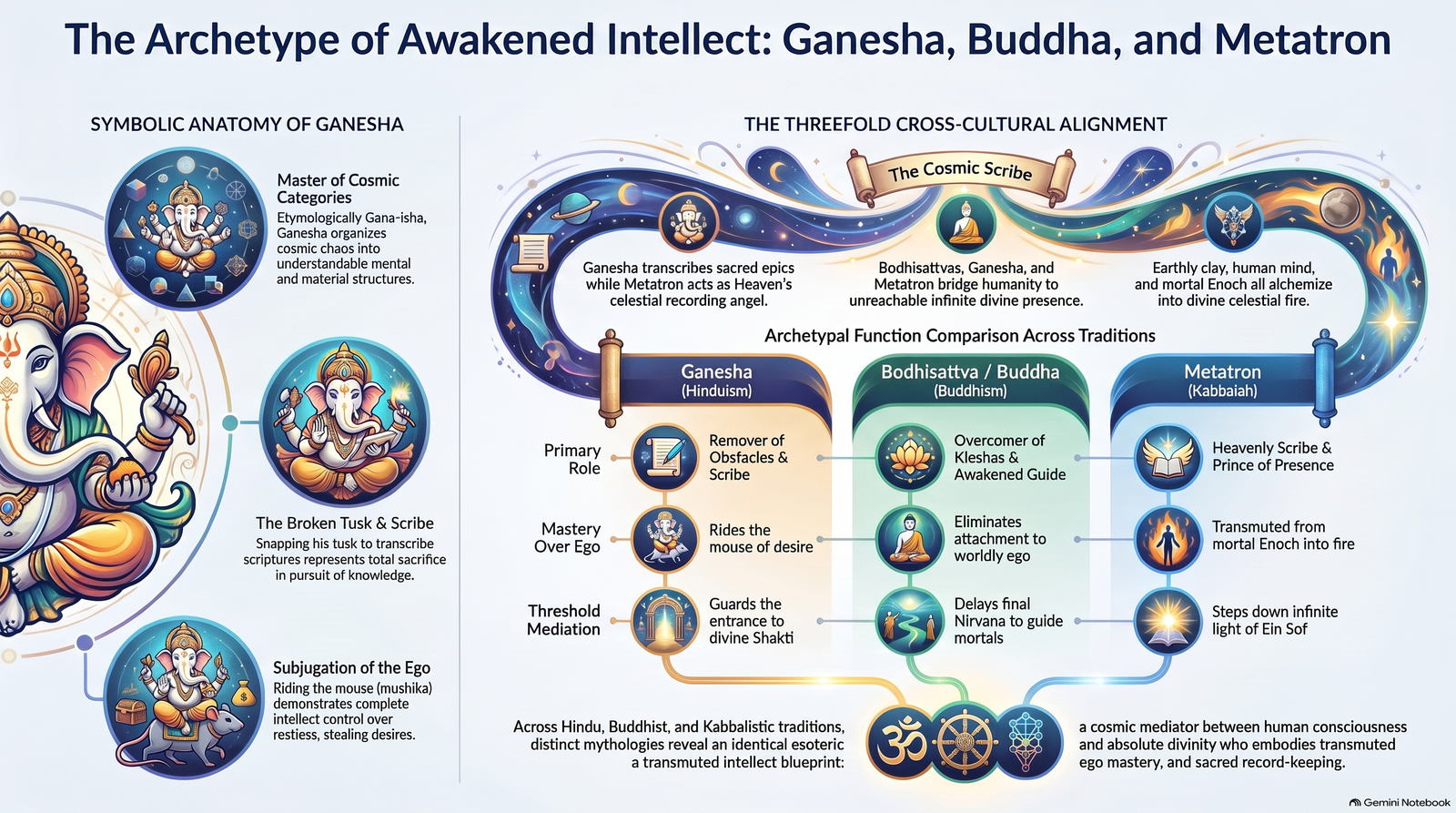
Gaṇeśa gives the episode its most concrete images. His elephant head and capacious belly suggest two kinds of strength in the hosts’ reading: clearing a path and taking in what the path brings. The broken tusk introduces the legend in which he writes down the Mahābhārata for the sage Vyāsa. Then the mouse, improbably small beside its rider, changes the direction of the discussion. If a restless impulse can carry us somewhere, what would it mean to guide it? The hosts take this question into Buddhist territory, where the obstacles under discussion include grasping, aversion and ignorance.
The comparison gains historical depth when Gaṇapati actually appears in Buddhist texts and images. His roles vary, from a figure subdued in some settings to a deity invoked for aid in others. In Japanese esoteric Buddhism, the paired form of Kangiten gives the hosts an image for bringing the energy of overcoming obstacles into relation with compassion. The turn to Jewish mysticism is a different kind of move. Gaṇeśa’s dictation scene and Metatron’s celestial record-keeping can illuminate one another as stories about scribes, while the authority and purpose of the writing belong to their respective texts.
The discussion closes with the fire of Enoch’s transformation in 3 Enoch, read alongside Gaṇeśa’s changed body in a Hindu origin story and the Buddha’s awakening. The hosts use alchemical language to bring these unlike transformations together, then ask what the images might offer a listener amid ordinary distraction. Their suggestion of a universal pattern remains a hypothesis. The more immediate challenge is to see whether the comparison helps us attend to ordinary experience while leaving the differences between the stories in view.
Argument map
Read Gaṇeśa’s form
The elephant head and belly become images of steady discernment and the capacity to take in what life brings.
Put knowledge into words
The broken-tusk story shifts attention from clearing a way to the work of carrying an epic into writing.
Give restlessness a direction
The mouse as a mount lets the hosts ask how desire might carry deliberate action.
Follow Gaṇapati into Buddhism
Changing Buddhist roles complicate the comparison, and Kangiten’s embrace gives the hosts a new way to think about resolve and compassion.
Compare the work of the scribes
Metatron’s place in the heavenly court brings the discussion from the writing of an epic to the limits of delegated authority.
Bring the comparison back to life
The fire of Enoch’s transformation prompts an alchemical comparison and a final question about how we meet distraction and difficulty.
Chapters
- 00:00Holding Hands: Three Traditions, One Question
- 02:44Ganesha Beyond the Good-Luck Charm
- 07:03The Elephant Head, Belly and Equanimity
- 09:54The Broken Tusk and the Cosmic Scribe
- 14:27Riding the Mouse: Mastery, Not Destruction
- 19:17Ganesha Crosses Into Buddhism
- 24:20Kangiten and the Embrace of Opposites
- 27:39Metatron: The Scribe of Heaven
- 31:14Between the Finite and the Infinite
- 33:58Enoch and the Transmuted Human
- 37:11What Might the Archetype Mean Today?
Glossary
Gaṇeśa (Gaṇapati)
An elephant-headed Hindu deity honoured at beginnings and associated with obstacles. Both names join gaṇa, meaning a group or host, with a word for lord or master. “Master of categories” is the episode’s philosophical reading of that name. The devotional Gaṇapati Atharvaśīrṣa addresses Gaṇapati as the visible manifestation of ultimate reality.
Mahābhārata and the broken tusk
The Mahābhārata is a Sanskrit epic traditionally associated with the sage Vyāsa. In a familiar account, Gaṇeśa serves as his scribe and uses his broken tusk as a pen. The episode reads the story as a sacrifice made to sustain transmission. The scribal episode belongs to part of the epic’s transmission, and the broken tusk has other narrative explanations.
Vāhana (mount)
A vāhana is a deity’s vehicle or mount in Indian religious imagery. Gaṇeśa’s companion is commonly called a mouse or rat. The hosts read the act of riding it as a way of giving restless desire a direction. The same image can carry other associations, including the rodent’s ability to get through obstacles.
Equanimity (upekkhā)
In Buddhist usage, equanimity is a quality of steadiness or even-mindedness in the face of changing conditions. The Pāli term upekkhā has several specific uses in Buddhist teaching, including as one of four cultivated attitudes alongside goodwill, compassion and appreciative joy. Gaṇeśa’s belly as a way of “digesting” experience is the episode’s metaphor.
Kleśas (afflictions)
Buddhist texts use this Sanskrit term for conditions such as ignorance, craving and aversion that disturb the mind and sustain suffering. Lists and classifications vary with text and tradition. The episode uses the term to shift the discussion of obstacles from circumstances in the world to patterns that shape how we meet those circumstances.
Buddha and bodhisattva
A buddha is a fully awakened one. In Mahāyāna Buddhism, a bodhisattva undertakes the path to buddhahood for the benefit of beings. Both matter to the episode’s comparison, but they refer to distinct roles. The hosts’ opening reference to a laughing monk evokes Budai, known in Japan as Hotei, a figure distinct from the historical Buddha, Śākyamuni.
Kangiten (and Sōshin Kangiten)
Kangiten is a deity in Japanese esoteric Buddhism associated with Gaṇeśa. Sōshin Kangiten is the paired form, often shown as two elephant-headed figures embracing. In one account the companion is a manifestation of Kannon, the bodhisattva of compassion. The hosts read the embrace in terms of meeting obstacles with both resolve and compassion.
Metatron
An angelic figure in Jewish rabbinic and mystical sources. In the Babylonian Talmud, Chagigah 15a, he receives permission to sit and record the merits of Israel, a privilege that Elisha ben Abuyah takes as a sign of independent power. “Prince of the Presence” is one of Metatron’s titles in 3 Enoch, a separate source.
Ein Sof
A term in Kabbalah meaning “without end”, used for the divine in its infinitude. The hosts picture Metatron as a transformer that lowers a voltage to make the infinite accessible to finite beings. The electrical language is an analogy for the episode’s idea of mediation. Chagigah 15a describes the angel’s scribal duties in different terms.
3 Enoch (Sefer Hekhalot)
A Jewish mystical work in which Metatron recounts that he was once Enoch and describes his transformation in images of fire. The episode reads the transformation through the language of alchemy. This is a comparison made by the hosts, alongside a Hindu narrative of bodily change and a Buddhist account of awakening.
Related reading
- Why do we use symbols in alchemy?Read further on how symbolic images carry more than one meaning.
- 3.1.9. The BodhisattvaFollow the bodhisattva theme into the Citrinitas course.
- Buddha is a Job DescriptionExplore the different meanings of the title “Buddha” across Buddhist traditions.
- When Detachment Looks Like Enlightenment | Dialogues VFollow the question of how to distinguish equanimity from disengagement.
- Rubedo and the Red Work of Ordinary LifeContinue into Rubedo’s concern with how symbolic and contemplative work enters ordinary life.
External reference points
- Ganesha transcribing the MahabharataThe Metropolitan Museum of Art examines a print in which Gaṇeśa writes with a pen, a variation on the familiar tusk story.
- Figure of GaneshaThe Ashmolean catalogues a sculpture with the broken tusk, sweet cakes and rodent mount.
- Protectors and Predators: Gods of Medieval Japan, Volume 2Bernard Faure’s book includes a chapter on Shōten and the making of Kangiten in Japanese Buddhism.
- The Sūtra “Declaring What Is Supreme”The glossary in this 84000 translation explains how the bodhisattva’s aim relates to buddhahood.
- Babylonian Talmud, Chagigah 15aRead the account of Elisha ben Abuyah seeing the seated Metatron and misreading his authority.
One-minute reflection
Where is the mouse taking you?
Choose a small task you already mean to do, such as putting away a cup or finishing a sentence. Notice the next harmless pull away from it. Give that pull a few seconds of attention, then choose one small action. If you want to reach for your phone, for instance, ask what you meant to find before you unlock it. Notice whether recognising the pull changes what you do with it.