
Citrinitas · Mythos · Chapter 9 of 48
The Bodhisattva
What changes when the aim of freedom turns outward, from release for oneself to care for all beings?
Watch the chapter discussion
The Bodhisattva Path Explained | Compassion Beyond the Self
Open this video on YouTube · 39 minutes 49 seconds
This NotebookLM-produced, two-host commentary interprets the chapter; it is not a verbatim reading or an authoritative statement of Buddhist doctrine.
The chapter in brief
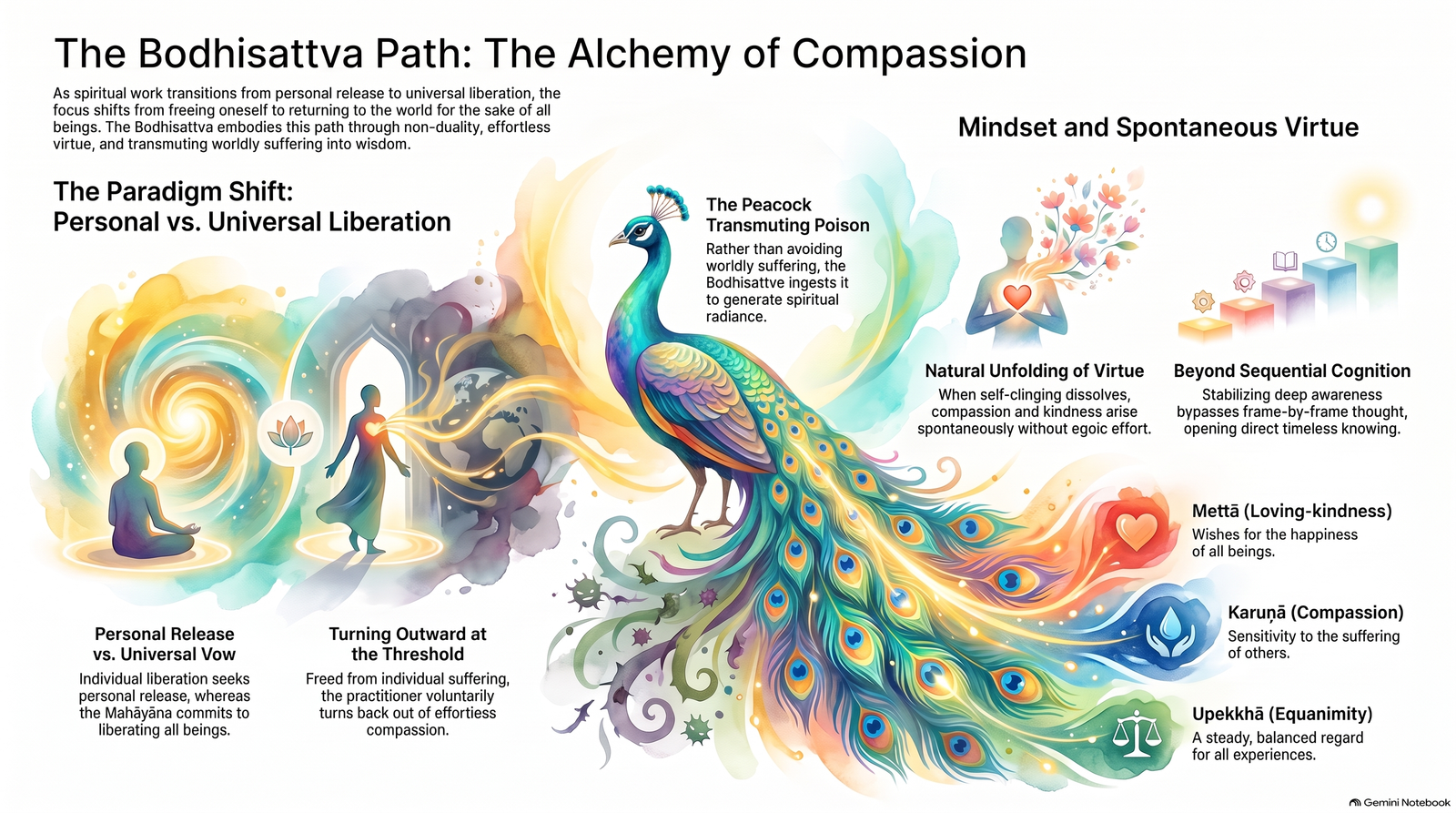
In the revised Citrinitas, chapter nine marks a change of emphasis in the author’s alchemical sequence. Rather than treating freedom from suffering as an exclusively private goal, it asks what liberation means when concern extends to every other being. The bodhisattva becomes the figure of this turning outward. The chapter brings the Mahāyāna aspiration of bodhicitta together with the alchemical peacock, the four immeasurables, the diminishing of self-referential thought and the ten bhūmis.
Its distinctive proposition is that compassion might cease to feel like a virtue one forces and become a more natural response as self-clinging recedes. This is the author’s synthesis across Buddhist traditions and alchemical imagery, not a shared map accepted by all Buddhists. The chapter also moves into speculative territory about consciousness and omniscience; those final claims require separate scrutiny.
Video guide: why return?
The recording begins with an arresting image: someone approaches the exit from the burning house of suffering and, instead of leaving, turns back with water for those still inside. The hosts use this thought experiment to distinguish personal release from the bodhisattva’s aspiration to benefit others. After locating that shift in the author’s Albedo-to-Citrinitas symbolism, they introduce the historical language of “lesser” and “great” vehicles and contrast the arahant with the bodhisattva. This part is vivid but too categorical: Hīnayāna can be pejorative, Theravāda is not simply a path without compassion, and an arahant’s continued physical life is not scientifically dependent upon retained attachments. The seven-day death claim in the commentary must not be read as biology.
The discussion next tests its own picture of radical altruism. Might the rescuing figure simply be a heroic ego in disguise? Its answer is that, within the author’s model, the boundary between self and other is less rigid, so care arises without a performance of superiority. This is an interpretive account of non-self and compassion, not an established neurological mechanism. The central metaphor is the peacock: legendary poison becomes brilliant plumage, mirroring the possibility of responding to hostility with understanding. In ordinary life that does not mean deliberately exposing oneself to abuse or abandoning boundaries. The speakers develop the difference between sharing another’s distress and acting compassionately without becoming overwhelmed.
From the image, the hosts move into bodhicitta and the vow to seek awakening for the benefit of beings. They then survey gradual development, tantric deity imagery and direct-recognition teachings associated with Dzogchen and Mahāmudrā. These are different lineages, not interchangeable fast and slow neurobiological techniques. The recording’s suggestions of “rewiring” through visualisation are analogical rather than demonstrated scientific results, and its discussion is for study, not practice instruction.
The final movement asks what compassionate engagement looks like on an ordinary Tuesday. Through papañca, it explores how a simple workplace message can snowball into anxious self-narration. From there, the four immeasurables supply a vocabulary for kindness, care, shared joy and steadiness; spontaneous virtue need not mean the abandonment of ethical cultivation. The conversation ends by introducing the ten bodhisattva grounds, especially the sixth and eighth, and ventures into a proposed link between the Theravāda life-continuum, non-sequential cognition and omniscience. That last link is the author’s speculative cross-traditional model, not a recognised empirical explanation of perception or time. The lasting challenge is more grounded: can insight become responsible care without turning compassion into another identity?
How the argument develops
- 01
The unexpected return
The hosts begin with the image of liberation reached, then a compassionate turn back towards suffering beings.
- 02
Two ideals, not a hierarchy of people
An arahant-oriented liberation account is contrasted with the Mahāyāna bodhisattva aspiration, although the dialogue overdraws the division.
- 03
What moves compassion?
The discussion asks whether altruism conceals a saviour identity, then offers non-clinging as its alternative.
- 04
The peacock and the poison
A traditional image portrays difficulty becoming an occasion for wisdom, not a licence to seek out harm.
- 05
An aspiration takes form
Bodhicitta and the vow lead to gradual paths, tantric models and direct-recognition teachings, considered rather than instructed.
- 06
Awake in ordinary life
Papañca, the four immeasurables, skilled learning and non-passive equanimity bring the argument back to behaviour.
- 07
The scope and limits of the map
Ten bhūmis and extraordinary knowing close the episode, inviting care about what doctrine, metaphor and evidence can establish.
Explore the video by chapter
The following are supplied timed estimates, not frame-verified chapter boundaries. The links open the relevant approximate position in the final 39:49 video.
Glossary
Open a term for a short explanation and its doctrinal context.
Bodhisattva
In Mahāyāna Buddhism, a person oriented towards complete Buddhahood for the welfare of beings. The term can describe an aspiring practitioner as well as highly developed figures in scripture; it is not a status established by this video.
Bodhicitta
Sanskrit for the mind or aspiration of awakening. In Mahāyāna usage it joins the wish for Buddhahood to the benefit of others, with important distinctions between aspiring and engaged forms in some traditions.
Mahāyāna
The Great Vehicle: a diverse family of Buddhist traditions that centrally value the bodhisattva ideal, wisdom and compassion. Its teachings and classifications are not uniform across all schools.
Hīnayāna
A historical Mahāyāna polemical term, commonly translated as “lesser vehicle”. It is not an appropriate neutral name for contemporary Theravāda, and its use in the recording needs that qualification.
Arahant
In Theravāda and early Buddhist frameworks, one who has uprooted the defilements leading to rebirth. Arahants are not thereby described as incapable of generosity or compassion.
Saṃsāra
The cycle of conditioned birth, death and rebirth in Buddhist teachings, bound up with ignorance and craving. Psychological repetition can serve as an analogy, but does not exhaust its traditional meaning.
Anāgāmī
A “non-returner” in the early Buddhist four-stage path, traditionally having abandoned the five lower fetters. It is not simply a Mahāyāna bodhisattva stage under a different name.
The peacock
An image associated with Buddhist mind-training and with alchemical interpretation: transforming difficult circumstances into occasions for compassion. Stories about poison and plumage are symbols, not reliable zoology.
Papañca
Pāli for conceptual proliferation or elaboration, where experience becomes entangled in self-referential interpretations. The dialogue illustrates it with spiralling anxiety about an ambiguous workplace message.
Brahmavihāras
Four “divine abidings” taught in Pāli Buddhist texts: loving-kindness, compassion, appreciative joy and equanimity. They are actively cultivated in many traditions, rather than existing only after self-clinging ends.
Mettā, karuṇā, muditā, upekkhā
Pāli names respectively for loving-kindness, compassion, appreciative joy and equanimity. Equanimity is balanced concern, not apathy; compassion does not entail neglecting personal boundaries.
Bhūmi
A “ground” or stage of the bodhisattva path, commonly arranged as ten in important Mahāyāna texts. Descriptions, associated perfections and their doctrinal setting must not be mistaken for a clinical rating scale.
Bhavaṅga
The “life-continuum” in Theravāda Abhidhamma commentarial analysis. The episode invokes it in a speculative theory of timeless knowing; it is not an experimentally established bypass of human cognitive processing.
Related pathways in the course
External reference points
A question to carry forward
When someone is struggling, what would it mean to offer help that respects both their agency and your own boundaries, without needing to be the person who saves them?