
Albedo · Subject · Chapter 45 of 48
2.4.9. Dojo
Everyday friction becomes the training ground: not because conflict is inherently ennobling, but because it reveals whether awareness can interrupt reaction and support a cleaner response.
Chapter video
When the obstacle becomes the place of practice
Book orientation
The chapter in brief
Dojo relocates contemplative training from protected settings to the ordinary encounters that expose defensiveness, irritation, greed and the wish to be recognised. Dr Simon Robinson describes an internal “checkpoint” that interrupts automatic reaction and makes a more deliberate response possible. The chapter then tests benevolence against fears of exploitation, distinguishes compassion from compliance, and uses under-appreciation to reveal hidden expectations of thanks, reciprocity or status. Its later movement reframes service as a way of polishing self-importance through participation in the social world. This is Robinson’s practical and autobiographical synthesis. Its connections with Buddhist attainment maps, karma, Christian giving and Daoist virtue should be read as interpretive correspondences rather than a single doctrine shared by those traditions.
Transcript-led guide
From reactive friction to useful action
The recording opens with family arguments, passive-aggressive emails, financial shocks and other events normally treated as interruptions to a calmer life. It reverses that interpretation. A dōjō is no longer only a controlled training hall; it becomes the unpredictable field in which conditioned habits are actually triggered. Solitude may help someone learn a method, but patience, honesty and non-reactivity remain largely untested until another person presses the exact point at which identity wants to defend itself.
The video’s central mechanism is the checkpoint: a small interval between impulse and action, expressed by the question “Are you sure?” The proposed protocol is simple—notice the impulse, pause, and choose with attention to downstream consequences rather than immediate self-protection. The discussion does not imagine that anger or greed disappears. Its practical measure is whether harm is reduced and whether repair follows more quickly when the pause fails. The language of nervous-system activation in the recording is illustrative rather than a complete neuroscientific account; people differ in how much access they have to reflection during stress.
The inquiry then asks whether dropping suspicion makes a person naive. Here the video’s most useful distinction is between compassion and compliance: one may offer what can be given freely, decline what cannot be given, and protect genuine safety without adding hostility. This corrects the idea that kindness requires passivity. At the same time, prudent boundaries are not merely egoic attachment. Financial risk, coercion, abuse and unequal power are real, and calmness does not require remaining available to harm.
The under-appreciation test brings the argument inward. Resentment after helping may disclose an unspoken contract—an expectation of thanks, admiration or repayment. The recording invites the question “Who needs to be thanked?” and contrasts service with transaction. That is a useful audit, but not a verdict: human motives are often mixed, and resentment can also signal exhaustion, unfairness or a boundary crossed. The final movement therefore turns away from moral perfectionism. Practice becomes repeated participation in the “marketplace”: noticing the residue of self-interest, making the cleanest available response, repairing failures and continuing the work without constructing a holy identity from it.
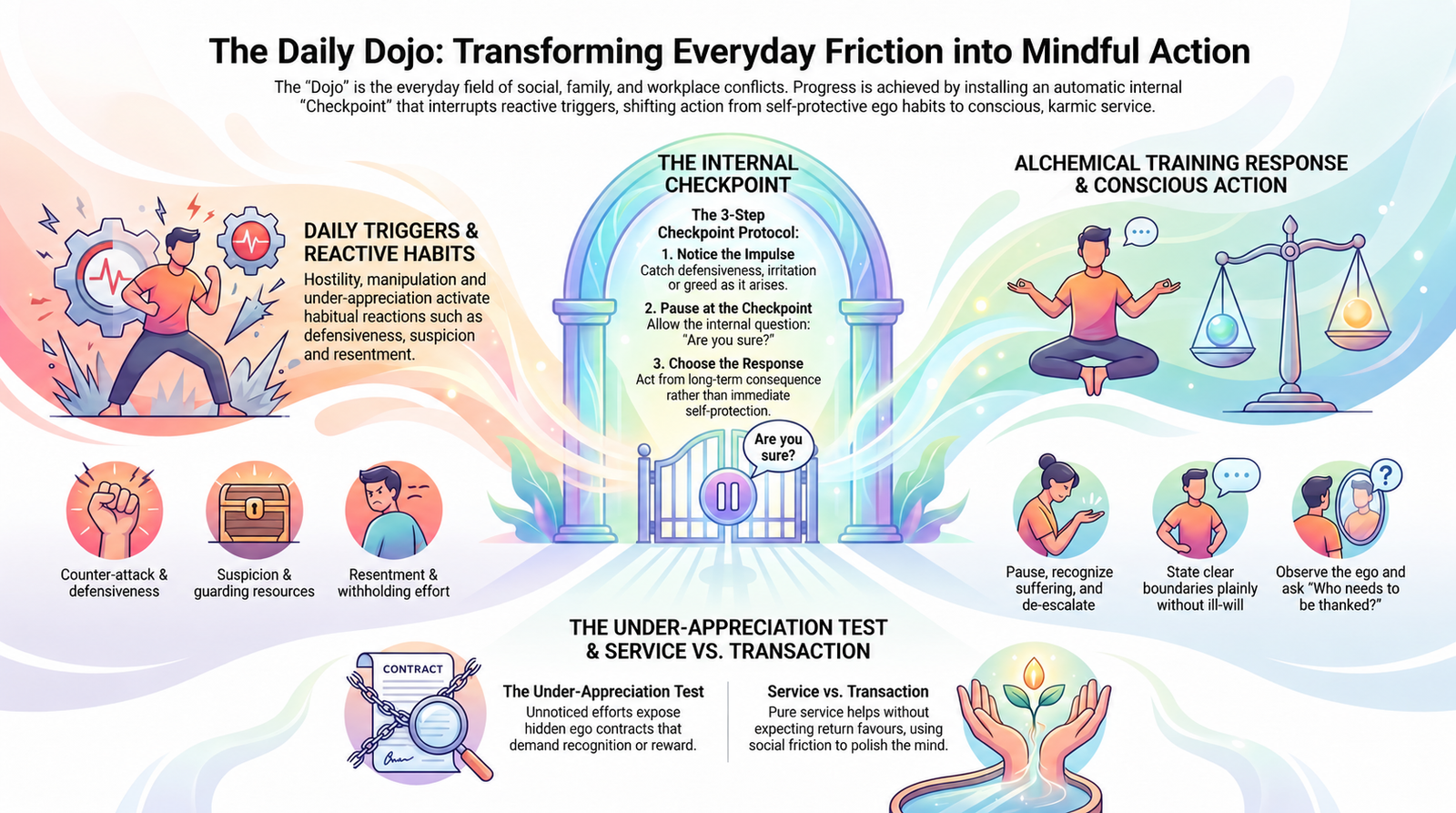
Argument map
How the recording moves
Friction is reclassified
Conflict, inconvenience and misunderstanding cease to be mere obstacles and become occasions on which conditioned reactions are exposed.
The checkpoint interrupts automaticity
A brief awareness of the impulse creates room between feeling defensive and turning that feeling into speech or action.
Consequence replaces immediate victory
The pause asks which available response is least likely to deepen harm, rather than which one most quickly protects pride or wins the exchange.
Repair becomes a practical measure
Progress is located not in permanent serenity but in reducing harm and shortening the interval between a mistake, ownership and repair.
Benevolence acquires boundaries
Compassion is separated from compliance: help can be offered without resentment and declined without guilt or unnecessary hostility.
Under-appreciation exposes expectations
The sting of being overlooked becomes an invitation to examine hopes for thanks, repayment, recognition or spiritual identity.
The marketplace supplies the polish
Ordinary participation repeatedly reveals self-importance, allowing service, discernment and repair to become ongoing practices rather than private ideals.
Book–video relationship
Framework, expansion and qualification
The chapter establishes
Life as the dōjō, the checkpoint protocol, benevolence with boundaries, the under-appreciation test, overwhelm, service as polish and the necessity of participation.
The video expands
Arguments, workplace exchanges, financial anxiety, spam calls and delayed apologies make the written framework concrete and behaviourally recognisable.
The guide qualifies
The checkpoint is not a canonical attainment criterion; karma is not merely social feedback; motives may be mixed; and resentment or overwhelm can have causes other than egoic attachment.
Video chapters
Navigate the discussion
Glossary
Terms used in the chapter and recording
Dōjō
The checkpoint
Automaticity
Sotāpanna
Karma and cetanā
Benevolence with boundaries
Compassion and compliance
The under-appreciation test
Service and transaction
Sakadāgāmī
Repair
The marketplace
Related pathways
Continue within the website
- 2.4.8. AlienThe preceding chapter asks whether distance from conditioned roles remains connected, humane and grounded in shared reality.
- 2.4.5. Cultivating the WayPlaces spiritual cultivation within practice, stability and the gradual integration of insight into conduct.
- 2.2.4. VolitionProvides the course’s earlier account of intention, choice and karma, which underlies the checkpoint’s concern with consequences.
- 2.3.9. Chop Wood, Carry WaterExamines the return from unusual insight to ordinary responsibility, repeated tasks and lived integration.
- 2.1.8. The White StoneExplores non-reactivity and the danger of converting disciplined conduct into a purified spiritual identity.
- The Choice That Defines the Path | Modern AlchemyThe following chapter video turns from the field of practice to the divergent orientations that repeated choices can establish.
External reference points
Traditional texts and philosophical context
- SuttaCentral: AN 6.63, NibbedhikasuttaAn early Buddhist discourse frequently cited for identifying intention as karma, useful for distinguishing the tradition’s terminology from a general law of cause and effect.
- SuttaCentral: Dhammapada 1–20Includes the verse invoked by the chapter on hatred not being ended by hatred, situated within the opening paired teachings of the Dhammapada.
- Matthew 10:8, New Revised Standard Version Updated EditionThe chapter’s opening Christian reference links healing and freely giving; its scriptural context is a commission to the disciples rather than a general psychology of service.
- Stanford Encyclopedia of Philosophy: AltruismA philosophical account of concern for others, mixed motives, self-sacrifice and psychological egoism that complicates any simple division between pure service and transaction.
A brief dōjō practice
Notice, pause, choose, repair
Choose one ordinary interaction today in which irritation, defensiveness or the wish for recognition is likely to arise. When it does, first name the impulse without condemning it. Pause long enough to ask: “What response protects what genuinely needs protecting while adding the least avoidable harm?”
Then choose one small action: speak plainly, set a boundary, delay the reply, acknowledge the other person’s difficulty or admit a mistake. Afterwards, review the result without awarding yourself a spiritual grade. If harm occurred, identify one proportionate repair. If resentment remains, ask what you hoped to receive—and also whether you were overextended or a boundary needed stating.