
The End of Saṃsāra
When the desire to escape begins to ease, how do we stay responsive to suffering?
Revised Edition (2026) · Catalogue reference 3.4.8
Watch the chapter video
The End of Suffering Explained | Grasping, Karma & Nonduality
The chapter in brief
The eighth chapter of Subject continues the inquiry into relinquishment begun in The Last Sorrow. Robinson opens in a personal register, describing the search for freedom losing its urgency. In his reading of the bodhisattva path, saṃsāra and nirvāṇa have “one taste”: both are empty of an independent nature, while the way grasping shapes experience can change. He uses Pleroma, a term for fullness drawn from Gnostic vocabulary, for his own account of this diversity without separation.
The chapter then asks what becomes of action as fixed interpretations lose their grip. A mirror facing a fire pictures contact without being consumed. Spiritual self-importance and the duties of compassionate conduct test that picture. The closing alchemical image of laying down the tools asks what becomes possible when freedom ceases to be something the seeker must manufacture.
The central question: what changes when grasping loosens?
The hosts begin with a mountain and a backpack full of supposed defects, an image of self-improvement as an arduous ascent. They then turn to the chapter’s “one taste” argument. A flash of lightning makes the point concrete: the wish to make it stay changes how its disappearance is experienced. The hosts illustrate this with traffic and difficult conversations, where the circumstances can persist even as the listener’s relation to them changes. The chapter’s image of the Pleroma as a play of conditions before a silent witness then prompts an objection. If the world can be regarded this way, what becomes of the duty to respond to suffering and injustice? The hosts distinguish the urge to control events from ordinary ways of helping, including community involvement.
A second diagram imagines a small gear labelled “meaning” grinding between perception and consciousness. At a stalled supermarket checkout, a momentary delay turns into a story about humiliation, and irritation can spill over onto the employee who comes to help. The mirror and the burning wood illustrate how a response can be proportionate to an event. The hosts then ask what would motivate work or care if fixed meanings no longer supplied the pressure. Their reply is “active waiting”, readiness to act while conditions develop, with bodhicitta giving patience an ethical direction. The discussion extends that aspiration across lifetimes within a traditional framework of rebirth. Its claims about remembering previous lives belong to that framework.
The argument then turns from patience to self-importance. The recording invokes the eighth bodhisattva ground and compares a claim to cosmic authorship with an intern mistaking access to the chief executive’s office for ownership of the company. The example separates the felt scale of an experience from what it can establish. A harder question follows in the discussion of “fearless conduct”. The hosts praise ethical example while entertaining the idea that a realised person could use shock compassionately. Any such claim must be judged in light of consent, safety and the consequences for the people affected. In the closing return to the mountain, alongside Daoist images of non-forcing and alchemical gold, the hosts ask whether the need to arrive can itself keep the search going.
How the argument unfolds
The climb comes into question
The mountain and backpack expose the assumption that freedom must be earned by overcoming a deficient self.
One taste raises an objection
The shift from escape to a different relation with experience prompts a question about what still calls for action in the world.
A delay becomes personal
The checkout example and the mirror show how a practical difficulty can gather a story that changes how we treat another person.
Patience acquires a purpose
The hosts use bodhicitta to explain how someone may keep working and caring while relinquishing control over when results arrive.
Vastness becomes a claim to status
The intern in the chief executive’s office illustrates how an expansive state can become a story of personal superiority.
Freedom is tested in conduct
The hosts ask why someone who claims freedom from compulsion would still observe ethical forms and teach by example.
The image of arrival drops away
The conversation returns to the mountain and asks what happens when peace ceases to depend on a future achievement.
Book and recording
On the page
Robinson’s first-person account opens and closes the chapter. A study guide draws out the distinctions among waiting, grasping and conduct.
In conversation
The hosts develop the brief images into extended examples. Their questions about apathy, motivation and responsibility bring tensions in the chapter into the open.
Video chapters · published markers
These links use the markers in the YouTube description. Treat the starts as approximate when looking for a particular passage.
- 00:00 Opening: The End of Saṃsāra
- 02:20 One Taste: Saṃsāra and Nirvāṇa
- 07:10 The Architecture of the Pleroma
- 12:30 Karma as Meaning-Making
- 17:40 Frictionless Action and the Mirror Analogy
- 22:20 Skandha Demons and Spiritual Inflation
- 27:50 The God Complex Explained
- 32:10 Fearless Conduct and Compassion
- 36:40 The Pathless Path
- 41:20 Letting Go of the Need to Arrive
- 44:10 Closing Reflections
A visual companion
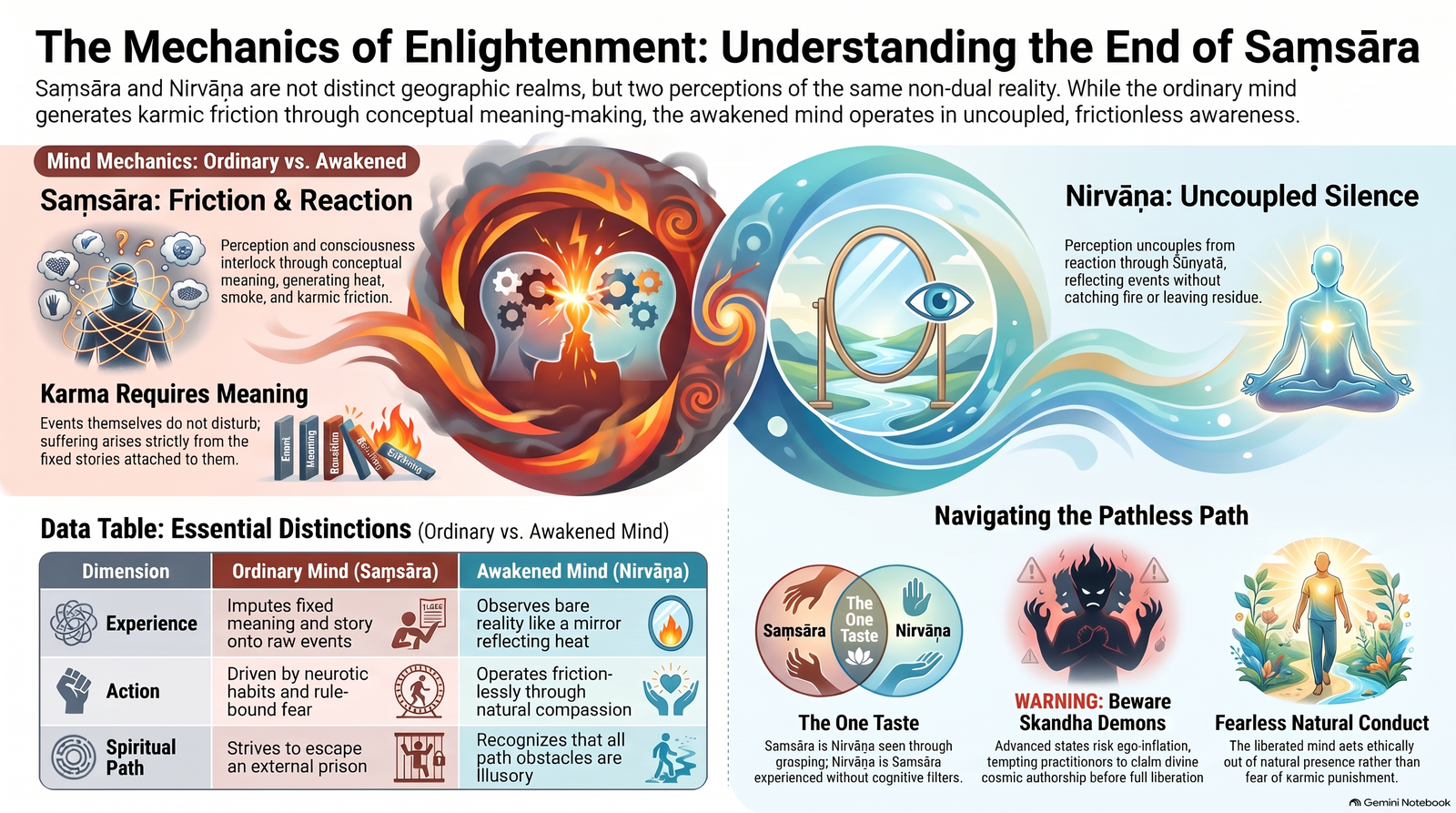
Terms and distinctions
Saṃsāra
In Buddhism, saṃsāra is the continuing round of conditioned existence and rebirth, sustained by factors including ignorance and craving. The chapter uses the familiar experience of wanting a fleeting event to stay as an entry point into that wider doctrinal picture.
Nirvāṇa
Nirvāṇa names liberation in Buddhist traditions. Early Buddhist descriptions emphasise the extinguishing of greed, hatred and delusion. Robinson describes saṃsāra and nirvāṇa through a change of lens. That image is his way into a Mahāyāna question about the relation between cyclic existence and liberation.
One taste
The chapter uses “one taste” for the equal emptiness of saṃsāra and nirvāṇa amid the diversity of appearances. A philosophical point of comparison is Nāgārjuna’s discussion of nirvāṇa in the Mūlamadhyamakakārikā, chapter 25. The chapter’s language of a changed lens is an experiential interpretation. Differences in how actions affect people still matter.
Emptiness (śūnyatā)
In Madhyamaka philosophy, emptiness concerns the lack of an intrinsic, independent nature. Phenomena arise and function through conditions. The recording’s smaller claim about the lack of fixed meaning illustrates one use of that idea. The wider philosophical question concerns the status of things as well as the stories told about them.
Pleroma
Plērōma means fullness. In some Gnostic systems, notably Valentinian traditions, it names the divine fullness. Robinson borrows the word for a perceived fullness that includes the variety of appearances and their emptiness. The meaning here belongs to his cross-traditional vocabulary.
Karma (Pāli kamma)
Karma means action. In AN 6.63, the early Buddhist discourse identifies intention as central to action through body, speech and mind. The recording focuses on a narrower example: how repeatedly treating a delay as a personal affront may reinforce a habit of reacting angrily.
Bodhicitta and the bodhisattva
In Mahāyāna, a bodhisattva is oriented towards buddhahood for the benefit of beings. Bodhicitta, often rendered as “awakening mind”, names the aspiration at the heart of that commitment. The chapter’s golden undercurrent pictures the continuity of that aspiration. Its extension across rebirths belongs to the traditional and interpretive framework.
Pāramitās
In Mahāyāna the perfections are qualities cultivated along the bodhisattva path, such as generosity, ethical conduct, patience and wisdom. Lists vary with the text and tradition. The chapter invokes them to explain why it expects freedom from compulsive reaction to be expressed in conduct.
Bhūmi
A bhūmi, or ground, is a stage in Mahāyāna accounts of the bodhisattva path. The eighth in the ten-ground scheme is Acalā, the Immovable. The recording connects it with the ending of conceptual striving. This is a compressed reading of a stage described in greater detail in The Ten Bhūmis.
Skandhas and “skandha demons”
The five aggregates are form, feeling, perception, formations and consciousness. The East Asian Mahāyāna Śūraṅgama Sūtra discusses unsettling or misleading experiences in relation to them. The video reads “skandha demons” as a warning about spiritual inflation, especially when the felt vastness of an experience turns into a claim about personal status.
“God complex”
The hosts use the phrase informally for the leap from an experience of vastness to a belief in one’s cosmic authorship or exceptional status. The term serves as a critique of interpretation here. The experience itself gives no way to establish the age or origin of the universe.
Pathless path
In this chapter the phrase names a shift in how the search for awakening is understood. Study, ethical discipline and patience have a place, while the project of turning peace into a possession can perpetuate striving. The recording expresses this through Daoist non-forcing and the alchemist setting down the tools.
Related pathways within the website
Places Subject and the study of grasping within Part Three of the course.
Introduces fullness and its relationship to emptiness in Robinson’s synthesis.
Explores how equal emptiness can coexist with different practical consequences.
Examines when striving becomes another form of attachment.
Develops the course’s earlier treatment of compassionate return.
External reference points
- Nibbedhika Sutta (AN 6.63), translated by Ṭhānissaro Bhikkhu. An early Buddhist account of intention and kamma.
- Sallattha Sutta (SN 36.6), translated by Ṭhānissaro Bhikkhu. The image of two arrows distinguishes physical pain from the mental distress that can accompany it.
- Nāgārjuna, The Fundamental Wisdom of the Middle Way, chapter 25 (PDF). Jay L. Garfield’s translation and commentary situate verses 19–20 in the broader argument about nirvāṇa.
- The Ten Bhūmis (Toh 44-31), translated by Peter Alan Roberts for 84000. The Mahāyāna account of the bodhisattva grounds, including the eighth, Immovable.
- Śūraṅgama Sūtra, Buddhist Text Translation Society version with Hsuan Hua’s commentary. The contents lead to the section on the origin of demonic states.
Question to carry forward
When a setback begins to feel like a judgement on you, what does the situation actually call for, and who else is affected by the response you choose?