
Citrinitas · Dharma · Chapter 23 of 48
3.2.11. Returning to Saṃsāra
What would freedom mean if it deepened our care for the world rather than our wish to leave it?
Revised Edition (2026). Catalogue reference 3.2.11 corresponds to book chapter 23. This established webpage retains its earlier public number, 3.2.12.
Watch the discussion
Escape or Return? The Seeker’s Final Choice
The chapter in brief
Near the end of Dharma, chapter 23 turns the image of liberation back towards ordinary existence. The bodhisattva’s return, sustained by a vow to benefit beings, becomes Robinson’s model for a solar work that culminates in engagement. The chapter contrasts gradual cultivation of merit and wisdom, tantric transformation, and direct recognition of mind’s nature. Its ranking by speed and risk is a schematic presentation, rather than a shared classification across Buddhist traditions.
The final sections connect self-comparison, the lion-and-dog metaphor, later bodhisattva grounds and the approach to Rubedo. This is the author’s alchemical synthesis of Buddhist ideas and psychological interpretation. Its value as a question about compassion does not depend on accepting its claims about depression, literal cognitive collapse or guaranteed progress. It prepares the book’s next chapter, Five Paths, without establishing a universal ladder of attainment.
Guide to the video
The recording begins with a climber reaching the summit and then turning back. Its central question is whether liberation ends in personal escape or changes how we participate in suffering. River, burning-building and video-game analogies contrast the arahant with the returning bodhisattva. These images communicate the chapter’s ethical tension, but the suggestion that an arahant simply abandons others is a polemical simplification: Theravāda liberation does not exclude compassion, teaching or service. The discussion presents emptiness as the ground of fearlessness and the vow as a sustaining commitment. Emptiness here concerns the absence of independent, inherent existence; it does not make suffering inconsequential.
The hosts then compare three approaches: gradual cultivation, the intensity of tantra, and the apparent paradox of “non-meditation”. Marathon running, investment and machinery make the contrasts vivid. The recording expands the chapter’s brief references to transgression into a sweeping account of Indian and Tibetan religious history. Its references to Kāpālikas and Aghoris concern Śaiva contexts and cannot establish the history or normal practice of Buddhist Vajrayāna. Nor does psychological shock supply a demonstrated mechanism of liberation. Mahāmudrā and Dzogchen are distinct traditions; their language of uncontrived recognition does not mean that preparation, ethics or instruction are dispensable.
A further expansion describes a “karmic filter”: sensory input passes through personal conditioning and self-reference before becoming grasping, resistance or disengagement. A partner’s ambiguous text message illustrates how interpretation can intensify distress. As a symbolic account, this clarifies the difference between an event and the story surrounding it. The hosts’ identification of the diagram with neurobiology goes beyond what they establish. Karma is not simply another name for synaptic wiring, and the diagram is not a validated model of the brain. Likewise, the claim that all depression is maintained by comparing a failed self with an ideal self is medically inadequate.
The lion-and-dog image shifts the inquiry from pursuing each thought to questioning its assumed owner. The hosts present this as an immediate remedy and include a first-person anecdote; neither is clinical evidence. This page discusses that move without repeating the recording’s self-deconstruction challenge. The final movement interprets the eighth bhūmi, transformed consciousness and extraordinary powers through the approach to Rubedo. Jazz improvisation illustrates responsiveness without constant self-commentary, but it cannot demonstrate omniscience, a permanent neurological change or freedom from physical laws. The conclusion returns to ordinary life as material for compassion: a useful challenge when read as an invitation to responsibility, rather than a promise that hardship must become spiritual fuel.
The argument, in seven movements
Turn back from the summit
The opening recasts liberation as a question about returning to relationship rather than securing a private refuge.
Give the return a direction
Emptiness and the bodhisattva vow supply the recording’s explanation for engagement without compulsive grasping.
Compare the vehicles
Gradual cultivation, tantric transformation and uncontrived recognition become three contrasting approaches in the author’s map.
Trace the interpretive filter
The ambiguous-message example shows how conditioning and self-reference can turn uncertainty into a personal threat.
Question the failed-self story
The hosts extend their filter model to despair and depression, moving beyond what the model can clinically establish.
Introduce the lion’s look
The animal metaphor shifts attention from thought content to assumptions about a thinker, without proving a therapeutic effect.
Approach integration
Later bhūmis and the red sun of Rubedo frame the closing return to care within ordinary life.
Book, recording and interpretation
The chapter’s emphasis
The vow, a threefold comparison of approaches, the lion metaphor and later bhūmis give the chapter its compact structure.
The recording’s expansion
Contemporary analogies and a narrated karmic-filter diagram develop the inquiry; the extended historical and neurological explanations are additional claims.
The alchemical connection
The turn towards Rubedo is Robinson’s interpretation of integration. It does not make Buddhist paths equivalent to the stages of this course.
Visual map: return, vehicles and self-comparison
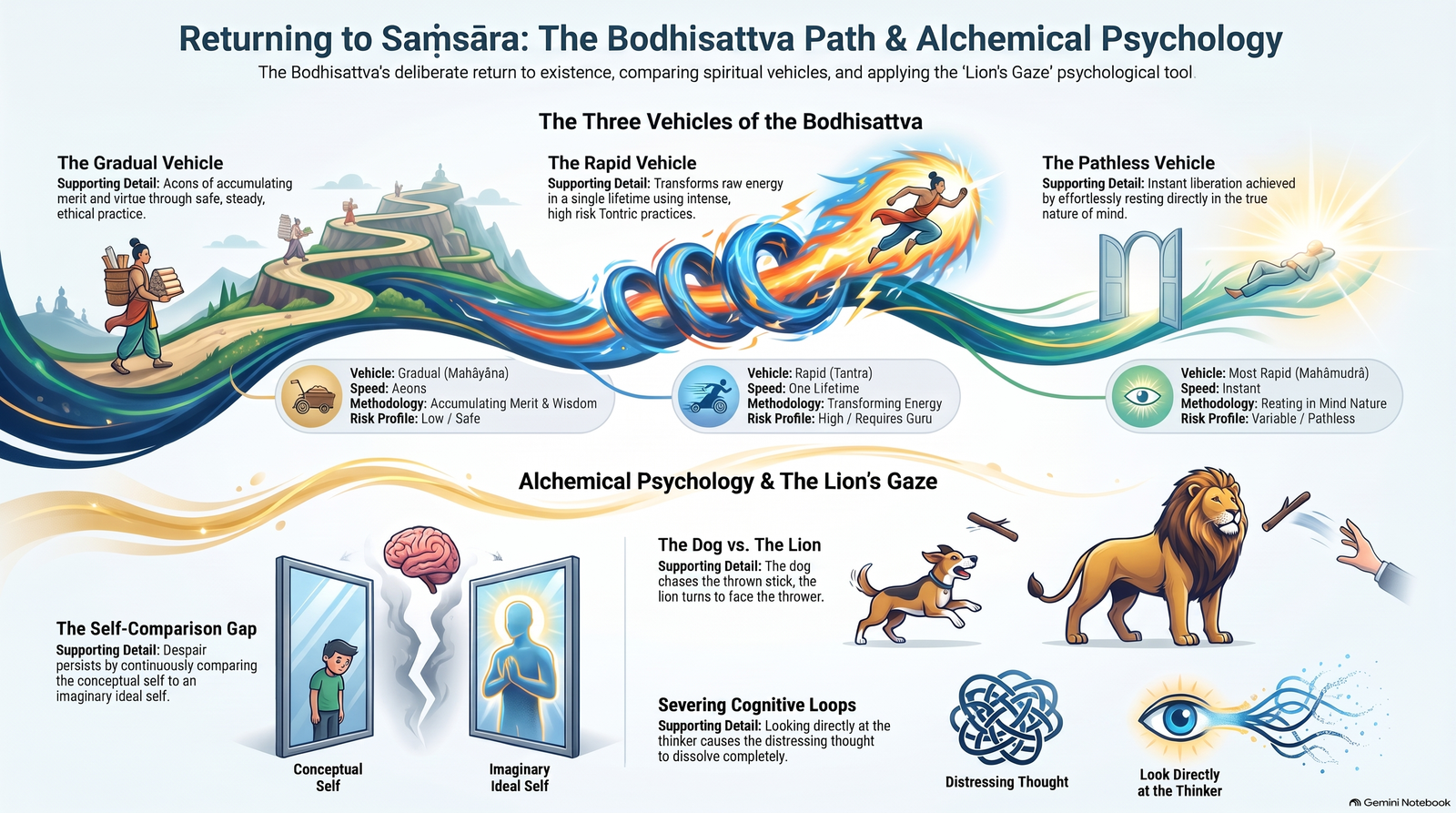
The supplied infographic brings together the three approaches and the lion-and-dog image. Its main relationships are explained in the guide and glossary; the image is supplementary.
Terms and distinctions
Saṃsāra
In Buddhist traditions, the recurring cycle of conditioned existence and rebirth sustained by ignorance and craving. Robinson also uses it for familiar patterns of reactive living. That psychological use is an interpretation, not a replacement for the term’s traditional rebirth context. “Returning” expresses compassionate engagement, rather than a recommendation to seek suffering.
Bodhisattva and bodhicitta
In Mahāyāna, a bodhisattva pursues buddhahood for the benefit of beings. Bodhicitta is the resolve to awaken for their sake. The path joins wisdom and compassion; it is not simply an arahant’s liberation followed by an additional ethical stage. Accounts of vows, rebirth and progress differ among texts and schools.
Praṇidhāna: aspiration and vow
A Sanskrit term for an aspiration, resolve or vow, including a bodhisattva’s commitment to awakening and the welfare of beings. The chapter’s image of an “energetic anchor” is symbolic. It does not identify a measurable force that holds consciousness in a body or demonstrates control over rebirth.
Arahant and nirvāṇa
Arahant is the Pāli term for one liberated through ending the defilements; arhat is its Sanskrit counterpart. Nirvāṇa names liberation, not mere nothingness or the annihilation of a true self. Living arahants can teach and care for others. The recording’s contrast with the bodhisattva is a simplified Mahāyāna-oriented framing, not Theravāda’s self-description.
Emptiness: śūnyatā
In Mahāyāna philosophical contexts, emptiness concerns the absence of inherent, independent existence. It does not mean that people, pain or consequences are simply unreal. Dependence and conventional distinctions still matter. The recording’s game, hologram and fire imagery should not be taken as proof that individual minds create the world or escape its physical conditions.
The three “vehicles” in this chapter
Robinson groups gradual Mahāyāna cultivation, tantric methods and direct-recognition approaches by their claimed speed. This is his schematic comparison. It differs from other Buddhist uses of “three vehicles”. Vajrayāna belongs within Mahāyāna commitments, and Mahāmudrā and Dzogchen cannot be reduced to interchangeable shortcuts with predictable time or risk ratings.
Pāramitās, merit and wisdom
Mahāyāna commonly presents six perfections: generosity, ethical discipline, patience, energetic perseverance, meditative stability and wisdom; tenfold lists also occur. Pāramī is the related Pāli form, with its own traditional enumeration. Merit concerns beneficial intentional conduct and its results. These are cultivated together, rather than ethics being merely a slow preliminary to more impressive methods.
Vajrayāna and “poison as medicine”
Vajrayāna includes diverse Buddhist tantric traditions using ritual, symbolism and contemplative methods within ethical and lineage settings. Transformation of affliction is a traditional theme; “high-voltage energy” is the chapter’s metaphor. Neither the book’s transgressive examples nor the recording’s shock narrative establishes a general history, clinical mechanism or safe method to imitate.
Mahāmudrā, Dzogchen and non-meditation
Mahāmudrā, “great seal”, is especially associated with Kagyu lineages, though taught elsewhere; Dzogchen is especially associated with Nyingma and Bön traditions. Their distinct presentations concern recognition and stabilisation of mind’s nature. Rigpa is a Dzogchen technical term. Non-meditation refers to freedom from contrivance in particular teaching contexts, not a general instruction to abandon learning, ethics or responsibility.
The karmic filter and the lion metaphor
The recording’s filter diagram models how personal meaning can shape reactions. Its lion turns towards the thrower while its dog pursues the stick: an image for questioning assumptions behind thoughts. Neither image is verified brain anatomy. The claimed ancient sūtra provenance of the animal comparison is not established by a named passage in the supplied material.
Bhūmis, manas and the two obscurations
Bhūmis are bodhisattva grounds in Mahāyāna path systems. Afflictive obscurations concern disturbing states and their roots; cognitive obscurations concern subtler obstacles to buddhahood’s knowing. In Yogācāra’s eight-consciousness model, the seventh is afflicted manas, associated with self-grasping, not the entirety of ordinary cognition. Transformation does not mean losing perception, competence or moral responsibility.
Iddhi, siddhi and Rubedo
Iddhi is Pāli for extraordinary abilities discussed in Buddhist texts; Sanskrit siddhi has a wider range of accomplishment-related uses. Such reports do not demonstrate that physics becomes optional after insight. Rubedo, the alchemical reddening, represents integration in Robinson’s course. Connecting it to later bhūmis is his synthesis, not a universally recognised attainment correspondence.
Related pathways
- 3.2.10. The Veil of IsisThe previous revised-book chapter considers the interpretive veil that the return now brings into relationship.
- 3.1.9. The BodhisattvaThe earlier Mythos chapter introduces the bodhisattva ideal and compassionate commitment.
- 3.2.8. The Perfections (Pāramīs)Cultivation of the perfections supplies a practical ethical counterweight to the language of speed.
- 3.2.6. Afflictive and Cognitive ObstructionsA closer companion for distinguishing afflictive obstacles from cognitive obscurations.
- Dharma — Part Two of Citrinitas | Spiritual Alchemy Course | Dr Simon RobinsonReturn to the section containing this chapter; its established public numbering may follow an older sequence.
- Citrinitas – Part ThreeLocate the discussion within Part Three of A Course in Modern Alchemy.
External reference points
- The Teaching of Vimalakīrti — 84000Robert A. F. Thurman’s translation, first published in 1976 and revised for this electronic edition: a primary Mahāyāna reference for the bodhisattva’s engagement with the world. This is supporting reading, not a text identified as the source of this recording.
- Karma Kagyu Mahamudra: Enhancing the Meditation — Study BuddhismBeru Khyentse Rinpoche’s lineage commentary places non-meditation within a developed path and relates advanced stages to the bhūmis. Consult as doctrinal context, rather than extracting practice instructions.
- Causes: depression in adults — NHSAn authoritative clinical counterpoint to the recording’s single-cause account: depression can have varied and interacting causes.
Question to carry forward
In a difficult ordinary relationship, what would caring engagement look like if it included both compassion and a clear boundary? What small, concrete response would help more than proving that you are spiritually untroubled?
This is a question about conduct, not a test of attainment or an instruction to dismantle your sense of self.