
Albedo · Dharma · Chapter 14 of 48
2.2.2. Fate and Determinism
If behaviour arises through causes and conditions, is freedom an illusion—or can seeing the mechanism create a genuine capacity to respond?
Watch the chapter discussion
Breaking the karmic script
Book orientation
The chapter in brief
This chapter asks what freedom could mean inside the “crystalline universe” introduced in the preceding lesson. It distinguishes fate—an outcome imagined as fixed regardless of intervention—from conditionality, in which outcomes depend upon supporting causes that may sometimes be changed. Apparent autonomy is questioned through Buddhist accounts of ignorance, karma and the first stages of awakening, while the Promethean image of forethought names the practical opening between impulse and action. The result is a model of functional freedom: not exemption from causality, but reduced compulsion within it. This is Dr Simon Robinson’s contemplative synthesis, not a settled scientific solution to the philosophical problem of free will.
Transcript-led guide
From mechanical reaction to conditional agency
The recording opens with a disquieting everyday question: when a thought, fear or decision appears, did “I” choose it, or am I enacting a script assembled long before the present moment? Its governing image places a meditating figure at the centre of a vast clockwork wheel. The gears represent biological, psychological and social causation; the still figure represents the possibility of seeing those forces without being carried by every one of them.
The first distinction is between conditioned reality and apparent reality. Conditioned reality is the web of events and dependencies through which experience unfolds. Apparent reality is the personalised world constructed through memory, expectation, fear and social meaning. The video uses a mirage to explain the difference: the appearance is not malicious, and its causes are real, but its interpretation can be mistaken. The point is not that emails, relationships or institutions are unreal. It is that the meanings and threats attributed to them may exceed what is immediately present.
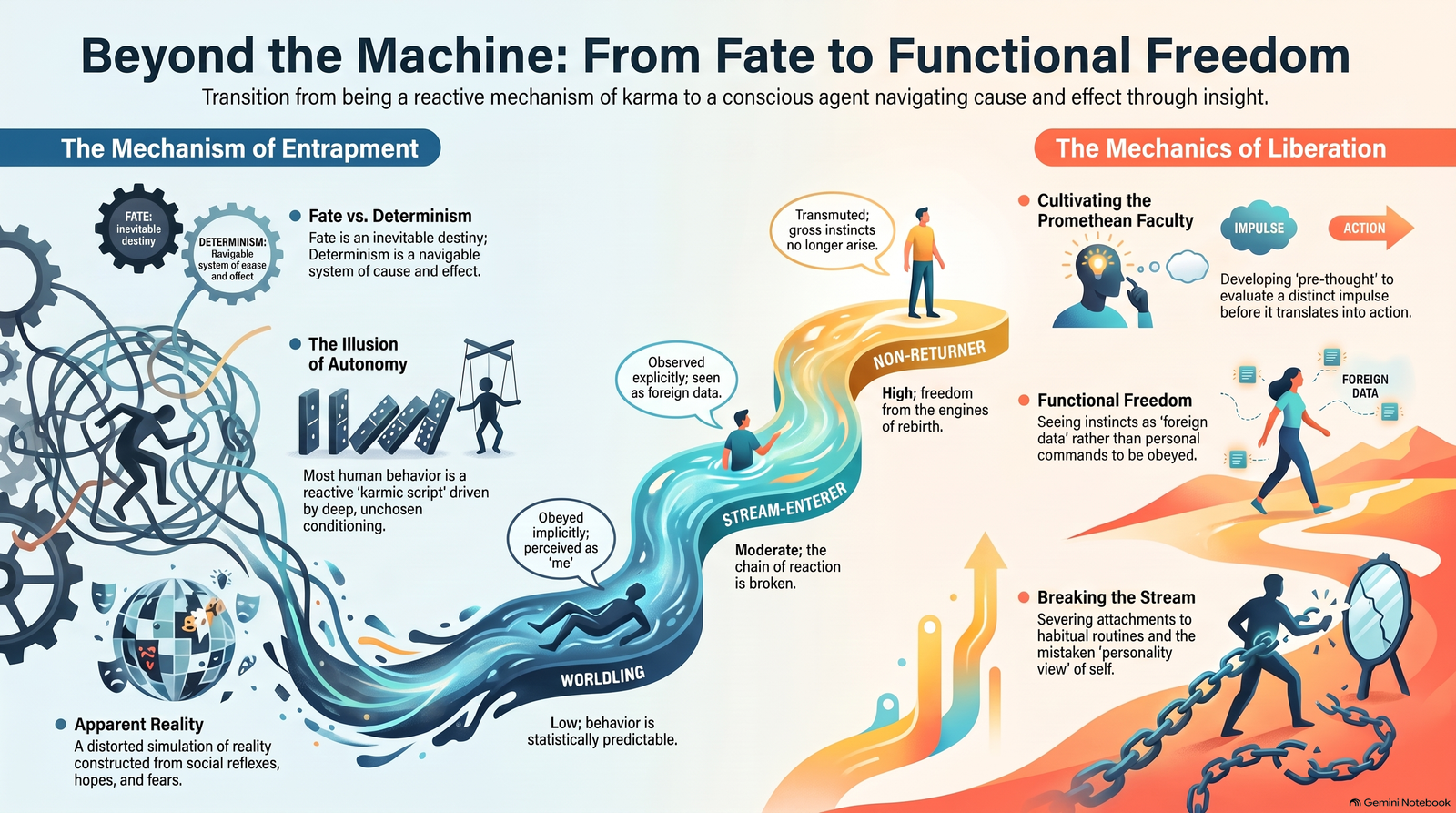
This leads to the chapter’s operational separation of fate and determinism. Fate is presented as an outcome that cannot be altered; determinism as lawful dependence upon antecedent conditions. The sinking ship becomes the test case. If sinking is fated, intervention is pointless. If it depends upon a hole admitting water, changing that condition can change the outcome while the laws of physics remain intact. This is a useful course distinction, although philosophy does not use “determinism” in only one way. Whether freedom is compatible with causal determinism remains disputed.
| Frame | Central claim | Practical consequence |
|---|---|---|
| Fate | The outcome is fixed independently of understanding or intervention. | Passivity appears rational because altered conditions cannot alter the destination. |
| Conditionality | Phenomena arise when supporting causes and conditions are present. | Investigating and changing a relevant condition may change what follows. |
| Functional freedom | Causes continue to operate, but an impulse need not be identified with or obeyed automatically. | A pause makes observation, restraint and a more deliberate response possible. |
The middle movement examines the “illusion of autonomy”. In the Buddhist framework used here, avijjā is not a simple shortage of information but a structural misapprehension of self and experience. Craving for control, safety and validation then appears as personal choice even when it is heavily conditioned. The transcript provocatively describes human beings as “puppets pulling our own strings”: attempts to protect an imagined permanent self may deepen the very patterns that constrain us.
Prometheus and Epimetheus organise the practical response. Epimetheus—“afterthought”—acts first and explains afterwards. Prometheus—“forethought”—symbolises the capacity to notice an impulse before it becomes speech or action. In modern psychological language this resembles response inhibition, metacognitive awareness and emotion regulation, though the mythic image should not be treated as a neuroscientific mechanism. The course calls the resulting interval “pre-thought”: the cultivated gap in which anger can be recognised as an event rather than received as an order.
Karma is then presented as biological and psychological programming. The transcript’s childhood example—a person silenced by repeated criticism who later freezes in a safe meeting—shows how learned threat responses can persist beyond their original context. This comparison can illuminate conditioning, but Buddhist karma is traditionally concerned with intentional action and its consequences; it is not reducible to trauma, memory or nervous-system learning. Nor does contemporary clinical evidence establish memories from past lives. Trauma-related reactions are real and treatable, and persistent distress deserves appropriate professional support rather than a purely karmic interpretation.
The final movement turns to sotāpanna, or stream-entry. The video focuses on the weakening of blind identification and ritualised attempts at control, describing impulses as “foreign data” rather than commands from a fixed self. Classical early Buddhist accounts, however, associate stream-entry with the ending of three fetters: identity view, doubt, and grasping at rules and observances. It is a doctrinal attainment with ethical and soteriological dimensions, not simply a cognitive pause, a therapeutic skill or a self-assigned personality category.
Within the course’s three-level map, the worldling obeys instinct implicitly, the stream-enterer observes it explicitly, and the non-returner has transmuted coarser impulses so that sensual craving and ill will no longer arise in the same way. The video’s language of low, moderate and high freedom is an interpretive teaching device rather than a standard diagnostic scale. Its durable practical question is simpler: when an impulse appears, can it be known clearly enough that another action becomes possible?
Argument map
How the karmic script is interrupted
Question apparent autonomy
The recording asks how much everyday choice is an immediate expression of inherited, learned and social conditioning.
Separate fate from conditions
A fixed destiny permits no leverage; a conditioned event can change when one of its supporting factors changes.
See the operating system
Avijjā is framed as a structural misperception through which craving and defence are mistaken for autonomous choice.
Cultivate forethought
The Promethean pause brings an impulse into awareness before it becomes automatic speech or behaviour.
Reframe the impulse
“Anger is arising” identifies a conditioned event; “I am angry, therefore I must shout” turns it into identity and command.
Break identification
The behavioural loop weakens when thoughts and feelings are experienced fully without being treated as a permanent self.
Use friction as information
Human difficulty is recast as the workable tension in which both suffering and reflective capacity are present.
Practise functional freedom
Freedom becomes the ability to navigate causes and conditions, not a fantasy of standing outside them.
Video chapters
Follow the discussion
- 00:00Introduction: does freedom exist?
- 04:15Fate versus determinism: the vital distinction
- 09:30The illusion of autonomy and the mechanical mind
- 15:45Prometheus and the gap: cultivating pre-thought
- 22:10Karma as biological and psychological programming
- 29:35The sotāpanna: breaking the stream of fate
- 35:50Functional freedom and three levels of liberty
- 41:30Summary and final reflections
Working vocabulary
Glossary
Fate
Causal determinism
Conditionality
Apparent reality
Avijjā
Karma / kamma
Pre-thought
Sotāpanna
Sakkāya-diṭṭhi
Sīlabbata-parāmāsa
Vicikicchā
Anāgāmī
Functional freedom
Source map
Book, video and wider traditions
The written chapter
Distinguishes fate from conditionality, introduces Promethean forethought and relates functional freedom to the Buddhist stages of stream-entry and non-return.
The video’s expansion
Adds the mirage, sinking ship, workplace conflict and childhood criticism examples, turning a doctrinal argument into an examination of ordinary reaction.
The comparative frame
Stoic acceptance, Greek myth, early Buddhist karma and awakening, trauma-informed language and systems metaphors are compared without being presented as one established mechanism.
Continue within the course
Related pathways
- Dharma — Part Two of Albedo | Spiritual Alchemy Course | Dr Simon RobinsonThe section landing page for the twelve chapters on consciousness, karma and the mechanics of experienced reality.
- 2.2.1. The Crystal UniverseThe preceding chapter introduces conditioned and apparent reality, providing the perceptual setting for this inquiry into agency.
- 2.2.3. Different Types of ConsciousnessThe next chapter begins a more technical examination of consciousness within the Abhidhamma-informed course map.
- 2.2.4. VolitionA later Dharma chapter that develops intention, choice and the karmic significance of action.
- Albedo – Part TwoThe main course page situating Dharma within all four sections of the whitening stage.
Reference points
Texts and distinctions
- Seneca, Moral Letters to Lucilius, Letter 107The Stoic setting in which Seneca transmits the line translated as “the willing soul Fate leads, but the unwilling drags along”.
- Causal Determinism — Stanford Encyclopedia of PhilosophyA philosophical overview clarifying that determinism concerns necessitation by prior conditions and laws, and is not simply synonymous with fatalism.
- Compatibilism — Stanford Encyclopedia of PhilosophyAn introduction to the family of views according to which meaningful freedom or responsibility may be compatible with determinism.
- MN 2: Sabbāsava SuttaAn early Buddhist source connecting appropriate attention to the ending of identity view, doubt, and grasping at rules and observances.
- Dhammapada 63A translation of the verse behind the chapter’s contrast between recognising foolishness and conceiving oneself to be wise.
- Post-traumatic stress disorder — NHSClinical information on trauma-related symptoms and routes to support, useful for keeping the course’s karmic analogy distinct from diagnosis and treatment.
A ninety-second pause
Find one changeable condition
Choose a mild, recurring reaction rather than a traumatic memory or urgent decision. The purpose is observation, not suppression.
- Name the event plainly: “tightness is arising”, “defensiveness is arising”, or “the urge to interrupt is arising”.
- Notice one supporting condition—fatigue, pace, hunger, an assumption, the setting or the words being used.
- Take one slow breath before speaking or acting. Let the feeling remain present without turning it into a command.
- Ask: “Which condition, if any, can I alter now?” It may be timing, tone, distance, clarification or simply delaying the response.
The test is not whether the impulse disappears. It is whether seeing its conditions creates even a small increase in choice.