
Albedo · Dharma · Chapter 21 of 48
2.2.9. The Cognitive Series
If reaction unfolds almost before it can be noticed, where can training alter the conditions from which intention arises?
Watch the chapter discussion
Where karma forms in the mind
Book orientation
The chapter in brief
This chapter places karma inside the developed Theravāda Abhidhamma account of a sense-door cognitive process. A passive life-continuum (bhavaṅga) is disturbed by an object; adverting, sense consciousness, receiving, investigating and determining follow; seven javana moments carry the ethically active response; and a sufficiently strong object may be followed by two moments of registration. The chapter uses this sequence to shift attention from an apparently continuous self towards conditioned events arising and passing with great rapidity. Its practical claim is that training can change the conditions shaping response before a familiar reaction gathers force. The detailed seventeen-moment scheme belongs to the later Theravāda commentarial and manual tradition. It is a contemplative and doctrinal analysis, not an experimentally established timing diagram of the brain.
Transcript-led guide
Can the movement from contact to reaction be understood without inventing a controller?
The recording begins with familiar experiences—anger in traffic, an automatic reach for food, a sudden wave of anxiety—and asks why reaction can feel as though it happens before anyone chooses it. Its central image is stroboscopic consciousness: apparent continuity compared with a film whose still frames pass too quickly to be distinguished. In the traditional model, each citta performs a momentary function and gives way to another. This challenges the picture of a single, unchanging observer, while leaving ordinary personal responsibility and lived continuity intact.
The video then contrasts the background flow of bhavaṅga with an active cognitive series (citta-vīthi). When an object is strong enough, the life-continuum vibrates and is arrested; attention turns towards a sense door; bare sensory consciousness registers data; and receiving and investigating prepare the transition to determining consciousness. The recording rightly stresses impersonality: these labels do not describe a miniature person inside the head examining inputs. They name conditioned functions within a scholastic account of cognition.
Determining consciousness is presented as the strategic fulcrum, followed by seven javana moments in which the response becomes karmically active. This is a useful practice metaphor, but the phrase “the exact instant of free will” is stronger than the doctrine or evidence can bear. In Abhidhamma, determining itself is functional, while wholesome or unwholesome ethical quality is expressed in the javana run. Mindfulness does not normally insert a sovereign chooser into one measurable microsecond; repeated training alters the habits, attention and understanding that condition how the sequence unfolds.
The final movement considers object strength. A “very great” object is said to complete the series with registration, a “great” object to end after javana, and weaker objects to stop earlier. This helps explain, within the model, why some stimuli become vivid while others barely enter awareness. Registration (tadārammaṇa) should not, however, be equated without qualification with modern neurological memory formation. The practical challenge is more modest and more useful: notice recurring conditions, create a little space around reaction, and train responses that do not reinforce greed, hatred or delusion.
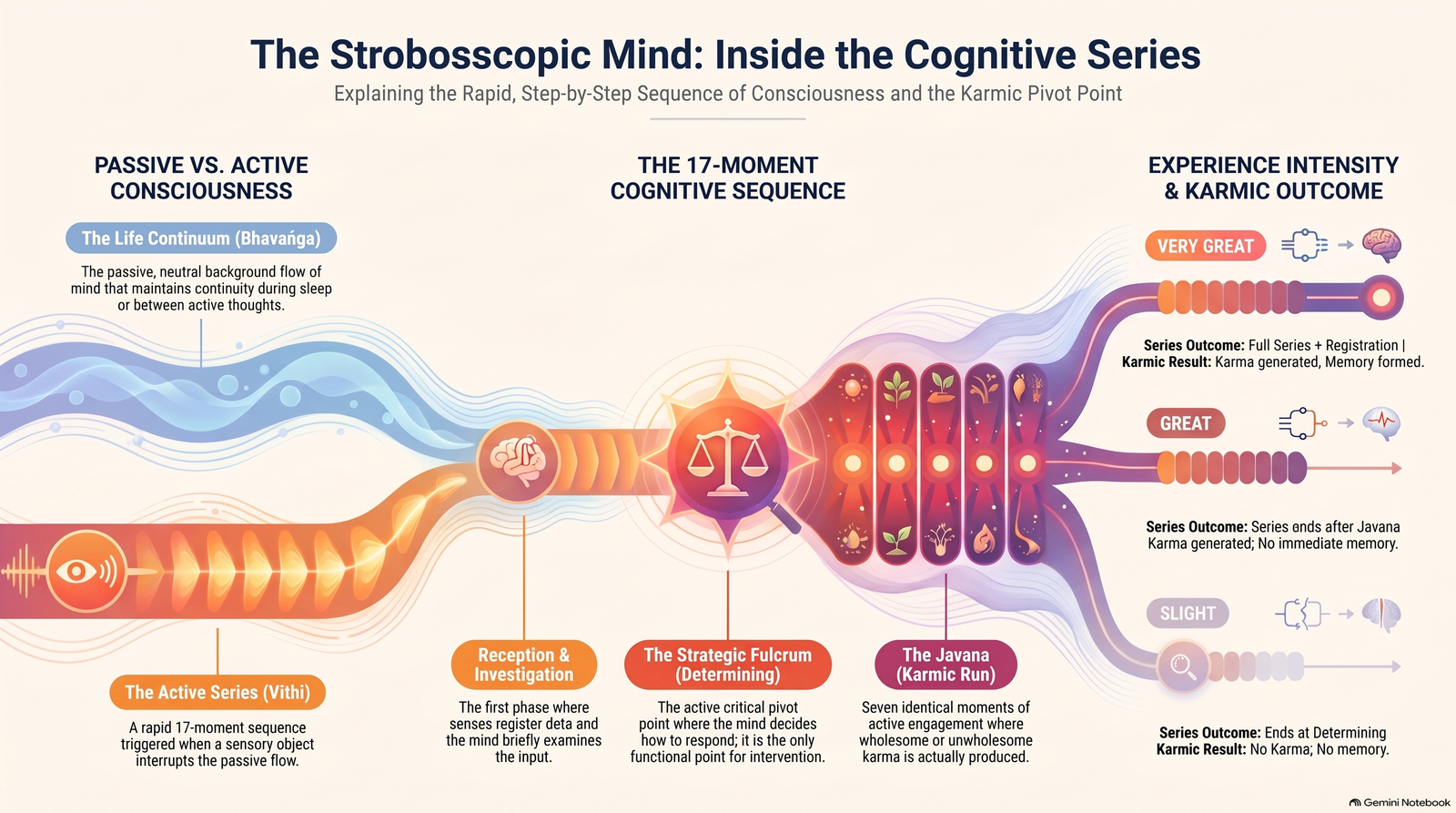
| Stage | Function in the model | Careful reading |
|---|---|---|
| Bhavaṅga disturbance | Past, vibrating and arrest moments mark the interruption of the passive life-continuum. | The life-continuum is a Theravāda doctrinal category, not a subconscious entity or a brain state established by neuroscience. |
| Adverting and sense consciousness | Attention turns towards the relevant sense door and bare sensory consciousness registers the object. | “Bare data” is a simplifying description. Perception in modern cognitive science should not be mapped directly onto these cittas. |
| Receiving and investigating | The object is received and examined within the sequence. | These are conditioned functions, not the actions of an inner observer standing apart from experience. |
| Determining | Voṭṭhapana fixes or determines the object before impulsion. | It is strategically important in the video’s interpretation, but not a measurable instant containing an independent chooser. |
| Javana | Seven impulsion moments carry wholesome, unwholesome or, for an arahant, functional activity. | This is where the model locates karmically productive response; the exact sequence remains a traditional doctrinal claim. |
| Registration | Two tadārammaṇa moments may follow when the object is sufficiently strong. | “Registration” is safer than treating these moments as a complete scientific theory of memory encoding. |
Argument map
How the recording develops its case
Begin with involuntary reaction
Everyday anger, craving and anxiety raise the question of why the mind can seem to act before reflective choice appears.
Replace the stream with frames
The film-reel analogy introduces consciousness as momentary events whose rapid succession produces an appearance of continuity.
Distinguish rest from active processing
The life-continuum provides the passive baseline; an object strong enough to interrupt it initiates the active cognitive series.
Follow the conditioned sequence
Adverting, sensing, receiving and investigating show cognition proceeding through functions without a homunculus directing them.
Locate the ethical pivot
Determining sets the trajectory and javana carries the wholesome, unwholesome or functional response described by the model.
Turn structure into practice
Object strength, registration and repeated impulsion lead to a practical conclusion: change the conditions of reaction rather than defending a fixed personality.
Book, video and interpretive frame
Three layers of the lesson
The chapter establishes
A concise Theravāda Abhidhamma map of the sense-door process, from bhavaṅga through javana and possible registration, with karma located in volitional impulsion.
The video expands
Traffic, food, anxiety, dominoes, film frames, machinery and footprints make a technical sequence accessible and connect it to habit and reactivity.
Albedo reframes
The author’s synthesis treats the sequence as a map for purification: not proof of a hidden controller, but an invitation to alter the conditions that repeatedly produce the same response.
Video chapters
Navigate the discussion
- 00:00Introduction: The Stroboscopic Mind
- 02:15Beyond Static Awareness: The Illusion of Continuity
- 05:30Passive vs. Active: Understanding the Bhavaṅga
- 10:45The Anatomy of a Thought: 17 Mental Moments
- 15:20The Pivot Point: Determining Consciousness
- 22:40The Javana Phase: Where Karma Is Created
- 30:15Object Strength: Why We Ignore the World
- 35:50Breaking the Cycle: Using Structure for Purification
- 40:00Conclusion and Practice
Glossary
Key terms in the cognitive series
Abhidhamma
Bhavaṅga — life-continuum
Citta — moment of consciousness
Citta-vīthi — cognitive series
Adverting (āvajjana)
Receiving and investigating
Determining (voṭṭhapana)
Javana — impulsion or running
Tadārammaṇa — registration
Object strength
Kamma or karma
Arahant and functional consciousness
Related pathways
Continue within the course
- Albedo: Dharma — The Mechanics of RealityReturn to the section containing the course’s sequence on consciousness, volition and karma.
- 2.2.4. VolitionExamine cetanā, intention and the early Buddhist statement that intention is karma.
- 2.2.6. The Life ContinuumExplore bhavaṅga, the passive mode interrupted when an active cognitive series begins.
- 2.2.8. Wholesome KarmaDistinguish karmically productive wholesome cittas from resultant and functional consciousness.
- 2.2.10. Types of KarmaContinue to the traditional hierarchy of weighty, death-proximate, habitual and residual karma.
- Dialogues IV 12: Why Reality Lasts 17 Mind Moments (video)A related dialogue revisits momentariness and the seventeen-moment map in a broader philosophical conversation.
External reference points
Sources for context and careful study
- Aṅguttara Nikāya 6.63: PenetrativeA translation of the early discourse containing the influential formulation that intention is kamma; it anchors the ethical emphasis without supplying the later seventeen-moment scheme.
- Bhikkhu Bodhi, A Comprehensive Manual of AbhidhammaThe principal modern English manual behind the chapter’s taxonomy, with the traditional compendium, revised translation, explanatory guide and consciousness-process tables.
- Barre Center for Buddhist Studies: Outline of AbhidhammaA concise educational overview of moment-to-moment analysis and the conventional seventeen-moment series, useful before approaching the more detailed manual.
- Stanford Encyclopedia of Philosophy: AbhidharmaA scholarly overview of Abhidharma traditions, momentariness and the development of analytical Buddhist philosophy, useful for distinguishing historical layers and schools.
Two-minute practice
Map one ordinary reaction
Recall a small, recent irritation—nothing overwhelming or traumatic. This is a reflection on conditions, not an attempt to perceive literal cittas or test spiritual attainment.
- Name the event in neutral terms: what was seen, heard or remembered?
- Notice the first interpretation that appeared: threat, insult, inconvenience, loss or something else.
- Identify the impulse that followed: defend, withdraw, grasp, dismiss, explain or retaliate.
- Ask which condition might have changed the trajectory: more time, better information, rest, a remembered value or a less rigid interpretation.
- Choose one small condition to cultivate before a similar situation recurs.
The aim is not to catch seventeen invisible moments. It is to recognise that a familiar reaction has conditions—and that conditions can be trained.