
The Six Knots
If our senses are different, what makes their experiences feel like one life—and why does attention become entangled in them?
Watch the chapter discussion
How Perception Traps the Mind | The Six Knots Explained
Open the video on YouTubeThe recorded discussion is 45 minutes 21 seconds. It is an AI-generated interpretation of the chapter, not a recitation of the book or a verified neuroscientific account.
The chapter in brief
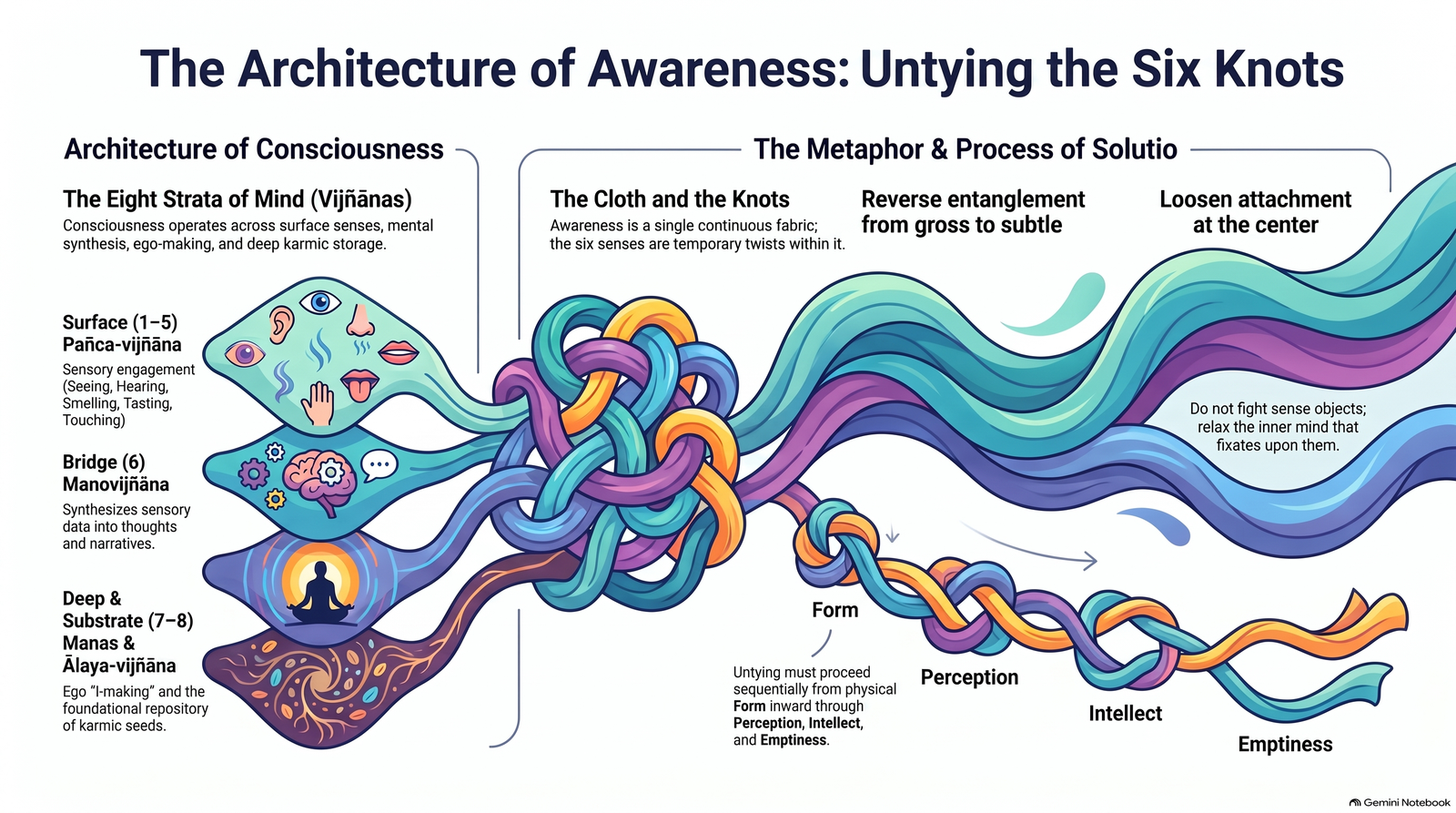
Chapter 14 belongs to the Dharma section of the 2026 revised Citrinitas. Its central image comes from the Śūraṅgama Sūtra: six knots made in one piece of cloth. Seeing, hearing, smelling, tasting, touching and thinking are experienced differently, yet the metaphor asks whether their apparent separation exhausts the nature of knowing. Dr Robinson places this image beside a Yogācāra account of eight consciousnesses and the alchemical pair of coagulation and Solutio. The chapter concentrates on the first six modes, postponing further discussion of self-making and storehouse consciousness. It also gives an interpretive sequence from form to increasingly subtle attachment, culminating in the warning not to grasp even at cessation. This is a contemporary contemplative synthesis, not a historically standard anatomical or neuroscientific model.
Video guide: what is being untied?
The conversation opens with a deliberate difficulty. Optic and auditory systems are biologically distinct, so how can the chapter propose that seeing and hearing are expressions of a common awareness? Rather than solving that philosophical problem, the speakers use it to introduce Solutio, the alchemical image of dissolving rigidity. The claim of an identical, underlying knower is presented confidently in the recording, but it remains a contemplative and metaphysical proposal, not a finding demonstrated by the existence of the senses.
To make the image intelligible, the speakers move through the Yogācāra classification of eight consciousnesses. The first five register sensory modalities; the sixth, manovijñāna, brings together cognition and interpretation. The seventh, manas, is associated with appropriation as “I” and “mine”, while the eighth, ālaya-vijñāna, provides a traditional account of karmic dispositions. A cherry-pie example makes the distinctions memorable. The conversation also equates the storehouse with the cloth itself; that is Dr Robinson’s explanatory analogy, not an identity established in Yogācāra scholarship. Descriptions of trauma as a stored karmic seed are similarly illustrative, not a clinical account.
The pivotal narrative is the six-knotted cloth shown to Ānanda. Distinct knots arise without requiring six separate pieces of fabric. The dialogue expands this with the analogy of household electricity powering different appliances, then asks how competing sensations, cravings and judgements can feel like an inner war. The late-night cake example matters because it moves the argument from doctrine to ordinary experience. Suppressing the craving, obeying it, and allowing it without fixation are carefully distinguished. The point is not that impulses cease, but that identification with them may soften.
The recording then unfolds a six-stage progression: form, perceptual continuity, conceptual naming, the knower–known distinction, attachment to emptiness and attachment to cessation. It presents this order as absolute and invokes modern neuroscience to support an image of perception flickering in frames. Neither the precise sequence nor the asserted scientific correspondence should be treated as settled facts. In the final movement, a blaring car alarm illustrates “pulling the loops” by resisting the sound, whereas “working at the centre” means examining the grasping response. A coffee-and-music inquiry follows; the closing distinction is between unity and uniformity, before a speculative look ahead to the deeper conditioning represented by the storehouse and Rubedo.
How the argument unfolds
A provocative question
The speakers contrast distinct biological senses with the chapter’s proposal that their knowing can be understood through one fabric.
A model of eight consciousnesses
The five senses, mental synthesis, self-appropriating manas and storehouse consciousness are introduced through everyday examples.
Ānanda and the knotted cloth
The Śūraṅgama story asks how six distinct knots can arise in one undivided length of fabric.
When knots become conflict
Electric appliances and the attraction of cake illustrate the difference between sensory variety and identification with competing responses.
From coarse to subtle
The conversation follows the chapter’s six-part interpretive scheme: form, continuity, intellect, knowledge, emptiness and extinction.
Why insight cannot be borrowed
Spiritual bypassing becomes the warning against treating advanced vocabulary as proof of embodied understanding.
Loosening without suppression
A car alarm, the chapter’s coffee-and-music inquiry and the concluding distinction between unity and uniformity lead to questions about deeper conditioning.
Video chapters
These chapter start times are estimates based on the final transcript and the confirmed 45:21 runtime; they have not been checked against video playback. Each link opens YouTube at the estimated point.
- 00:00Is Awareness Really Divided?
- 01:45The Six Knots and Alchemical Solutio
- 03:50The First Six Consciousnesses: Senses and Mind
- 05:35Ego-Making and the Storehouse Consciousness
- 09:00Why Begin with the Six Sensory Knots?
- 11:20The Buddha’s Cloth and Six Knots
- 13:50One Source, Many Experiences: The Electricity Analogy
- 16:20Coagulation: How Awareness Becomes Trapped
- 19:00The Cake: Craving, Judgement and Internal Conflict
- 22:25The Six Stages of Untying: From Form to Extinction
- 25:30Intellect, Knowledge and the Subject-Object Divide
- 28:40The Final Knots: Emptiness and Extinction
- 30:10Spiritual Bypassing: Why Understanding Is Not Liberation
- 32:00Untying from the Centre: Stop Pulling the Loops
- 35:00The Car Alarm: Releasing the Grasper
- 37:05The Thread of Knowing: Coffee, Music and Awareness
- 40:00Unity Without Uniformity: Living with the Senses
- 43:10Beyond the Six Knots: The Deeper Work of Rubedo
Glossary
Śūraṅgama Sūtra
An influential Mahāyāna scripture especially important in East Asian Buddhism. Its account of six knots tied in one cloth supplies the central image. Its textual history and traditional attribution are debated; the episode’s reconstruction should not be mistaken for a verbatim scholarly translation.
Six knots
In the chapter, six knots stand for seeing, hearing, smelling, tasting, touching and mental cognition. The six-fold sensory structure is one interpretive layer; the chapter also draws a more speculative progression from form to cessation.
Vijñāna
A Sanskrit word usually rendered as consciousness or discriminative awareness. In classical Buddhist accounts particular kinds of consciousness arise dependently, rather than constituting one demonstrable permanent substance.
Pañca-vijñāna
The five modes of sense consciousness: visual, auditory, olfactory, gustatory and bodily. Their distinction remains useful even where the cloth metaphor invites reflection on their shared conditions.
Manovijñāna
The sixth, mental consciousness: knowing thoughts and mental objects and, in Yogācāra accounts, relating and judging sensory information. The video calls it the synthesising narrator, an accessible but simplified analogy.
Manas
In Yogācāra’s eight-consciousness account, the seventh, afflicted mind is associated with clinging to a sense of self. Calling it an ego engine is the recording’s explanatory shorthand, not clinical anatomy.
Ālaya-vijñāna
Storehouse or substratum consciousness in Yogācāra theory, used to explain continuity and karmic potential without assuming a permanent self. It should not be equated straightforwardly with pure, unconditioned awareness.
Bīja
Literally seed: in Yogācāra, a disposition or potentiality associated with karmic maturation. The computer hard-drive and psychological-trauma comparisons in the discussion are metaphors, not established neurological storage models.
Solutio
Latin for dissolution, an operation in alchemical symbolism. Here Dr Robinson uses it for softening rigid identification with sensations and thoughts. It is not a literal universal solvent in the nervous system.
Coagulation
The alchemical counterpart to dissolution: an image of fluid experience becoming fixed into a pattern. In the recording it describes how attention can harden around aversion, craving or self-judgement.
Emptiness (śūnyatā)
In Mahāyāna thought, the absence of independent inherent existence, not a literal void or proof that things do not exist. The recording warns against taking even emptiness as something to possess.
Subject and object
The conceptual distinction between a person who knows and something known. Nondual philosophical inquiry can question the rigidity of that division without disproving external objects or eliminating everyday responsibilities.
Continue the inquiry
External reference points
A question to carry forward
When a sensation is unpleasant, what can be distinguished between the sensation itself and the story that it is ruining the moment? Does recognising that difference alter the response without requiring the sensation to disappear? This is a question for ordinary reflection, not a test of attainment or an instruction to endure harmful conditions.
Course navigation
Previous and next follow the revised book sequence. Older published WordPress page numbers do not always match that sequence.