
Citrinitas · Dharma · Chapter 17 of 48
Catalogue 3.2.5 · Revised Edition 2026
17. Papañca
How does one uncertain encounter become an elaborate and convincing story about ourselves and other people?
Watch the chapter discussion
How the Mind Builds a Second Reality | Papañca Explained
Open the individual video on YouTube
The discussion is an AI-generated interpretation of the chapter, not a direct lecture or a substitute for the source texts.
The chapter in brief
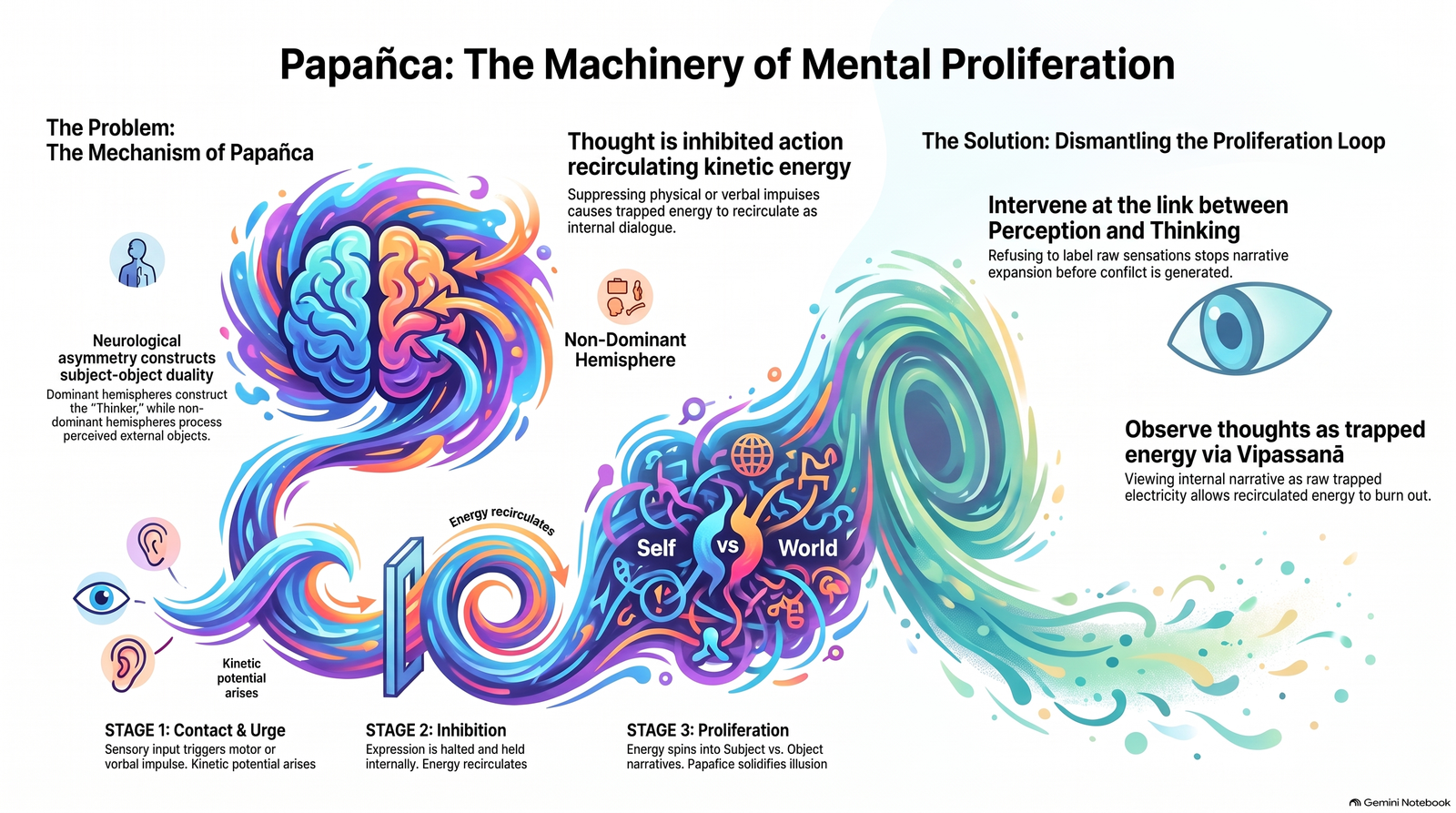
Chapter 17 moves from the preceding chapters on the subtle body towards the way an ordinary perception can become a seemingly complete world of interpretation. In early Buddhist sources, papañca names a tendency towards conceptual elaboration or proliferation that can contribute to conflict. The chapter pictures this process as a feedback loop: a small incident becomes an inner conversation, then a persuasive account of what others think and what the self must defend.
To give that pattern a contemporary shape, Dr Simon Robinson brings together the Madhupiṇḍika Sutta, the image of an arrow in the Attadaṇḍa Sutta, an account of speech inhibition, hemispheric brain asymmetry and alchemical imagery. The Buddhist texts provide an analysis of experience and conflict; the neural machinery and trapped-energy descriptions are the author’s speculative explanatory synthesis, not established mechanisms of papañca.
Video guide: from one frown to an imagined world
The recording begins with a deliberately ordinary scene: someone frowns in a corridor, and the observer races from uncertainty to a conviction of rejection. The hosts use this everyday example to ask how so little information can produce such a large, emotionally compelling narrative. They name this amplification papañca, then adopt the book’s machine metaphor: sense contact is an input, and self-referential interpretation is the feedback that creates a second, imagined situation. The metaphor is illuminating precisely because the original incident and the story built around it are not the same thing.
Next the hosts develop the chapter’s more controversial thesis, treating thinking as inhibited speech or action. They describe inner dialogue as the bodily energy of an unexpressed impulse, and then enlist dominant and non-dominant cerebral hemispheres to explain the apparent division between a perceiving subject and an external world. These claims are presented forcefully in the audio, including references to hallucinations and psychiatric conditions. They should not be taken as accepted neuroscience: inner speech is not simply trapped electricity, hemispheric specialisation does not divide the brain into a self-producing half and a world-producing half, and complex psychiatric experiences cannot be reduced to that proposed split.
After this excursion, the discussion returns to its strongest historical foundation. The image of an arrow lodged in the heart comes from the Attadaṇḍa Sutta (Sutta Nipāta 4.15), where fear and contention form the setting; the transcript reuses that image to characterise compulsive mental running. It then turns to the Madhupiṇḍika Sutta (Majjhima Nikāya 18), the ‘honeyball’ discourse. There the Buddha responds to a provocative question, and Mahā Kaccāna offers a detailed analysis of how contact, feeling, perception and thought lead into proliferation, with proliferated perceptions subsequently besetting a person. This is a Buddhist analysis of conflict and experience, not a measurement of milliseconds in the brain.
The closing movement argues for recognising an emerging narrative rather than endlessly debating its details. The dialogue adapts the book’s model into a strong prescription about feeling inhibited bodily impulses until the imagined story fades. That advice is not established treatment for anxiety, and the recording’s certainty exceeds the evidence. A more cautious takeaway is an interpretive distinction: what was actually observed, what was inferred, and how might one respond responsibly when those interpretations remain uncertain? The video thereby returns to its opening frown without requiring us to deny real interpersonal harm or to regard every concern as self-generated.
The argument, step by step
The tiny trigger
One fleeting frown is enough for the hosts to illustrate the gap between an observation and its alarming interpretation.
The proposed machine
The discussion introduces papañca as an amplifying loop that constructs a persuasive second narrative.
Thought and inhibition
The book's interrupted-speech hypothesis offers a vivid, but unverified, biological explanation of inner talk.
The divided observer
Hemispheric asymmetry is used to explain the self/world split, although the analogy overstates neuroscientific evidence.
The arrow in the heart
An image from Sutta Nipāta 4.15 gives the proliferating story its emotional and ethical stakes.
The honeyball sequence
Majjhima Nikāya 18 supplies a textual account of how perception, thinking and proliferation can lead to conflict.
Leaving room for uncertainty
The closing question is whether we can distinguish a fact from the accumulating story without ignoring the real world.
Video chapters
These are supplied editorial timing estimates for the 39:54 recording, not frame-verified chapter markers.
- 00:00 Introduction: The Glitch in the System
- 02:10 What Is Papañca?
- 06:00 Thinking as Interrupted Speech
- 10:30 Blocked Action and Inner Dialogue
- 14:40 The Subject/Object Split
- 19:20 How One Perception Becomes a World
- 23:50 The Arrow in the Heart
- 27:20 The Honeyball Sutta Explained
- 31:30 Contact, Feeling, Perception, Proliferation
- 35:00 How to Stop Feeding the Loop
- 37:20 Closing Reflection: The Story Dissolves
Glossary and textual orientation
Papañca
In early Buddhist Pāli discourse, a difficult-to-translate term often rendered as proliferation, conceptual elaboration or objectification. Here it concerns how interpretation can multiply around experience and help sustain conflict; it does not mean that all useful thought is harmful.
Madhupiṇḍika Sutta
The "Ball of Honey" discourse, Majjhima Nikāya 18. The Buddha's compact statement on non-contention is explained by Mahā Kaccāna; the title is associated with Ānanda's comparison of the teaching to something sweet throughout.
Attadaṇḍa Sutta
Sutta Nipāta 4.15, often called "The Rod Embraced" or "Taking Up the Rod". Its arrow lodged in the heart appears amid reflections on fear, violence and quarrelling; the chapter applies it to proliferating inner narratives.
Phassa
Pāli for contact: the conjunction of a sense faculty, its object and the corresponding consciousness in early Buddhist accounts. Contact is not itself a physical collision, and it does not prove that the surrounding world is imaginary.
Vedanā
Pāli for feeling tone, usually pleasant, unpleasant or neither. It is not simply a complex emotion or personal life story; the sutta treats it as part of the conditions accompanying experience.
Saññā
Pāli for perception or recognition. It denotes the marking or recognition of what is encountered and is distinct from elaborate judgement, though later thought may grow from it.
Vitakka
A Pāli term for thinking, application of thought or directed thought, depending on context. In MN 18 it belongs to the movement from perceiving to conceptual proliferation; it should not automatically be equated with inhibited motor commands.
Mahā Kaccāna
An early Buddhist disciple especially associated with unfolding compressed teachings. In MN 18 he gives the extended analysis that the monks subsequently present to the Buddha.
Inner speech
The familiar experience of words or verbal thought without audible speaking. Some cognitive processes of inner speech relate to language and motor planning, but this does not make every thought a suppressed action or a store of trapped electricity.
Hemispheric lateralisation
The uneven distribution of some functions across the two cerebral hemispheres, such as aspects of language. This does not establish the chapter's claim that one hemisphere exclusively manufactures the subject and the other the perceived world.
Subject and object
Philosophical terms for the knower or perceiver and what is known or perceived. A distinction in experience can be examined without claiming that particular brain halves create these two poles.
Citrinitas
The yellowing or solar phase in this author's four-part alchemical model. Here it serves as a framework for examining thought and self-identification, not a clinically or historically universal developmental stage.
Related pathways on this website
Dharma — Part Two of Citrinitas
Return to the verified section index.
3.2.4. An Introduction to the Subtle Body
Previous chapter in the revised book sequence, with an older public page title.
3.2.6. Afflictive and Cognitive Obstructions
Next chapter: distinctions among obscurations.
The Metaphor of the Film Projector
Another model of how experience becomes interpretively constructed.
Citrinitas – Part Three
Return to the course archive.
Papanca
A separate introductory essay on the Pāli concept.
External reference points
MN 18: The Ball of Honey
Thanissaro Bhikkhu's translation and introduction to the foundational proliferation discourse.
Sutta Nipāta 4.15: The Rod Embraced
Thanissaro Bhikkhu's translation of the text behind the arrow image.
MN 18: The Honey-Cake
Bhikkhu Sujato's translation for comparison of wording and emphasis.
Question to carry forward
When a conversation leaves you uncertain about someone else’s intentions, which part is something you actually know, which part is an interpretation, and what would a careful, compassionate response look like?