
Catalogue reference: 3.2.6 · Revised Edition (2026)
Afflictive and Cognitive Obstructions
If emotional suffering loosens, what might still shape the way experience appears?
Watch the chapter discussion
Ego vs Perception: What Still Blocks the Mind After Ego Falls Away?
An AI-generated, two-host interpretive discussion of the source chapter. It is a companion, not a verbatim reading or independent doctrinal authority. Open the 40:25 video on YouTube.
The chapter in brief
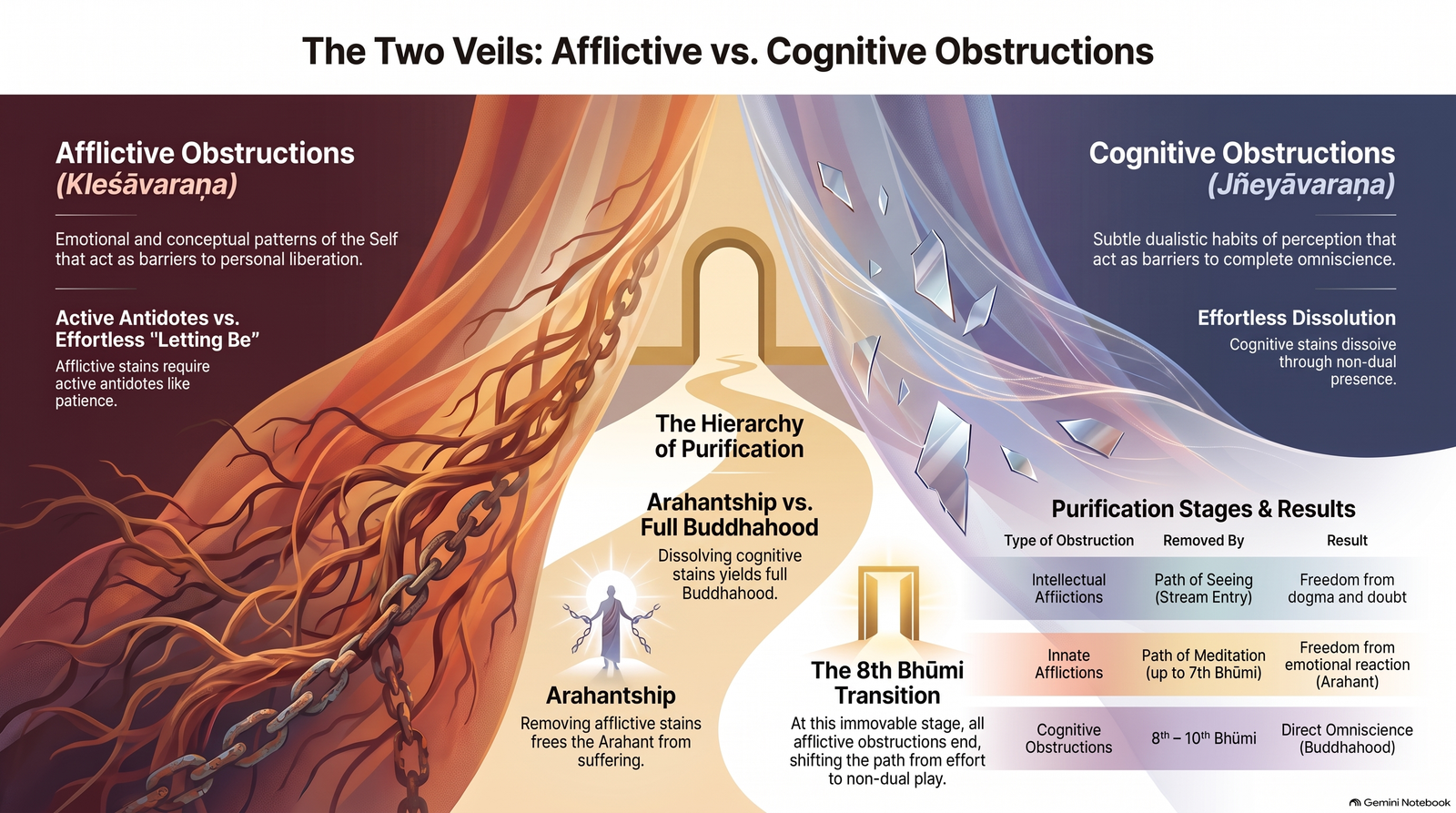
Chapter 18 of the revised Citrinitas turns from overt habits of selfhood towards the question of what may still obscure knowledge when reactivity has been addressed. The author draws on a Mahāyāna distinction between afflictive obscurations, associated with suffering-producing defilements, and cognitive obscurations, associated with limitations upon complete awakened knowledge. A gold buried in rock and the image of a mirror being polished present awakening as removal rather than acquisition.
The chapter then differentiates acquired and deeply rooted dispositions, introduces the seed (bīja) as a way to understand dormant tendencies, and places an important transition at the eighth bodhisattva bhūmi. It concludes with a contrast between vigorous antidotes and a gentler language of non-grasping. This is the author’s alchemical interpretation of Buddhist sources; its stage chart is not a universally accepted map shared by all Buddhist traditions.
Video guide: what remains after the obvious ego?
The recording opens with an argument about the language of self-improvement. We habitually speak of building a better self, as if clarity were another possession to acquire. Against this, the two hosts introduce the chapter’s gold-in-the-rock image, alongside a saying attributed in the source chapter to the Hevajra Tantra about beings obscured by adventitious stains. The point is a contrast within Buddhist soteriology: what is obscured is not necessarily something that needs to be manufactured. The dialogue then asks how one can distinguish the emotional disturbances that plainly cause suffering from less conspicuous assumptions about perceiver and perceived.
Its most extended explanatory device is a computer. Learned beliefs become corrupted applications; habitual, less articulate patterns become operating-system code; and the subject–object distinction becomes the machine’s binary hardware. These are illustrative comparisons devised for the episode, not Buddhist translations of brain structures or an evidence-based taxonomy of psychological disorders. The hosts link acquired patterns to a path of seeing and deeper patterns to a path of meditation, at moments loosely comparing those concepts to stream-entry and psychological change. The correspondence is not exact: Mahāyāna and Theravāda use related but distinct path accounts, while therapies have different aims and evidence.
The dialogue next contrasts the liberation of an arahant with the Mahāyāna bodhisattva’s aspiration towards full Buddhahood. The spinning fan of an unplugged computer is offered as an image of residual cognitive habits, while a burning house illustrates the urgency of ending suffering. The recording stresses bodhicitta and the distinction between wishing to help others and having the wisdom or skill to help well. However, its portrayal of arahants as concerned only with themselves, and omniscience as a necessary diagnostic instrument, reflects a polemical Mahāyāna framing rather than an account all Buddhists would endorse.
The latter movement makes the question more intimate. Dormant dispositions are figured as bīja, seeds activated by conditions: a peaceful morning changes when an unwelcome email appears. An optical illusion then distinguishes intellectually understanding a distortion from continuing to perceive through a familiar pattern. The eighth bhūmi is presented as a transition from labouring against affliction towards the subtler work of letting be; the discussion closes with the raft metaphor and a paradox about striving to stop striving. Its final direct-inquiry instructions should be heard as part of the recording, not as a test for locating spiritual obscurations in oneself. The worthwhile question is how greater clarity might coexist with responsibility, kindness and the limits of any map.
How the argument unfolds
Why add another achievement?
The hosts challenge the assumption that awakening means constructing a perfected personality.
Suffering and knowing
Afflictive reactions are set beside subtler obstacles to complete knowledge in a Mahāyāna account.
Files, system, architecture
Learned convictions, durable dispositions and dualistic presentation become three levels of analogy.
Freedom and service
The discussion contrasts the arahant ideal with bodhicitta and the bodhisattva aspiration.
Why anger can return
A trigger is imagined as moisture that brings a latent disposition into activity.
The illusion persists
An optical illusion highlights a possible difference between knowing about a pattern and its habitual appearance.
The raft is set down
The dialogue turns from antidotes and the eighth-stage model to its closing paradox of letting be.
Video chapters
Editorially supplied timed estimates for the final 40:25 recording, not independently verified frame-accurate chapter boundaries.
Glossary and distinctions
Afflictive obscurations — kleśāvaraṇa
In several Mahāyāna scholastic accounts, mental afflictions and their associated ignorance obstruct liberation from suffering. The Sanskrit compound concerns afflictions or defilements, not simply having ordinary feelings or a personal identity.
Cognitive obscurations — jñeyāvaraṇa
In Mahāyāna accounts of the two obscurations, impediments to a Buddha’s complete knowledge. Interpretations differ across schools; it is misleading to reduce the term to the mere fact that perception distinguishes objects.
Āvaraṇa
A Sanskrit word for a covering, obstruction or obscuration. Its precise doctrinal role depends on the text; it does not identify a physical barrier in the brain.
Kleśa
A Buddhist term for afflictive mental qualities such as craving, hostility and delusion. The Pāli cognate is kilesa. It should not be equated without qualification with every biological reflex or clinical symptom.
Bīja — seed
In Buddhist causal and scholastic models, a metaphor or technical account of dispositions that may manifest when conditions arise. Yogācāra develops sophisticated seed theories; the episode makes this accessible through everyday irritation.
Acquired and innate obscurations
Some Mahāyāna explanations distinguish intellectually acquired distortions from dispositions said to be present without conscious instruction. These should not be taken as a proved division between computer software and inherited neurobiology.
Arahant
In Theravāda, a person understood to have completed liberation from the defilements binding beings to rebirth. The recording contrasts this with the Mahāyāna Buddha ideal, but that comparison is an inter-tradition interpretation, not a verdict on arahants’ compassion.
Bodhisattva
In Mahāyāna Buddhism, one who cultivates the aspiration and practices directed towards complete Buddhahood for the welfare of beings. Ethical conduct and compassion remain important, not merely a means of acquiring exceptional knowledge.
Bodhicitta
The aspiration towards Buddhahood for the benefit of all beings, often discussed alongside wisdom and compassion. The video calls it the motivation of the Great Vehicle; doctrinal accounts are richer than this single functional distinction.
Bhūmi
Literally ground or level; in influential Mahāyāna systems, one of ten bodhisattva stages. The eighth, Acala or Immovable, is given particular importance in the recording. Stage details vary by text and commentary.
Paths of seeing and meditation
Technical stages in Mahāyāna path systems, not straightforward synonyms for Theravāda stream-entry or psychotherapy. Their relation to acquired and innate obscurations is explained differently in different scholastic traditions.
Dharmakāya
The truth body or reality body of a Buddha in Mahāyāna accounts of the Buddha bodies. Not a proven substance, cosmic consciousness or an empirically measurable state.
Omniscience
A traditional attribute of Buddhahood whose scope and interpretation are debated within Buddhist philosophy. The recording frames it as compassionate capacity; it is not an empirically established human ability to know every fact.
Citrinitas
The yellowing stage of alchemical symbolism, used in this course as an interpretive metaphor for clarification and illumination. It is not itself a Buddhist bhūmi or an attainment independently validated by science.
Related pathways in the course
- 3.2.5. PapañcaThe previous chapter on proliferating thought and constructed stories.
- 3.2.7. The Treasury of Precious JewelsThe established next page, accompanying the video on the three traps of meditation.
- 3.2.1. The Threshold of Non-ReturnAn earlier Dharma page considering liberation and the subtler questions that follow.
- 3.1.10. The BodhisattvaRetains the older website numbering for the revised book’s bodhisattva topic.
- 3.2.8. The Perfections (Pāramīs)Virtue and compassionate orientation alongside contemplative understanding.
- Citrinitas – Part ThreeThe course landing page and wider 48-chapter structure.
Reference points
- 84000: The Two Stanza DhāraṇīTranslator’s introduction and glossary describe the general distinction between afflictive and cognitive obscurations; this is not the episode’s source text.
- 84000: The Tantra of the Great SkyTranslation glossary for the meaning and usage of mental afflictions in Buddhist literature.
- 84000: Glossary of TermsA reference for checking Sanskrit and Tibetan terminology across translated Buddhist texts.
The episode paraphrases and attributes a stain-and-Buddhahood saying to the Hevajra Tantra; the precise English wording and edition used in the recording have not been independently established here.
Question to carry forward
When someone reacts in a way I do not understand, how might I distinguish a story I have formed about them from what I actually know, while remaining compassionate and accountable for my response?