
Citrinitas · Dharma · Chapter 19 of 48 · Catalogue 3.2.7
The Treasury of Precious Jewels
When bliss, clarity and silence become possessions, even a beautiful meditative experience can become another form of grasping.
Watch the chapter discussion
Why Bliss Isn’t Enlightenment | The Three Traps of Meditation
A two-host AI-generated interpretation of the chapter; the discussion can simplify or overstate its source material.
The chapter in brief
Chapter 19 of the revised Citrinitas turns from seeking extraordinary meditative experiences to examining the attachment that can survive inside apparently refined states. Using the language of calm abiding (śamatha), insight (vipaśyanā) and the ālaya, the chapter introduces bliss, clarity and non-thought as striking experiences that can also become objects of grasping. Its account of formless absorptions, cessation and the five bodhisattva paths brings several Buddhist maps into dialogue with the author’s alchemical stages.
The book’s central image is the mirror: it can reflect pleasurable, vivid and quiet experiences without treating any of them as its permanent possession. The comparisons are interpretive; they do not establish a universal sequence of contemplative development or a scientifically demonstrated architecture of consciousness.
Guide to the video
The recording begins with a deliberately ordinary problem: a GPS locates a person in physical space, but no equivalent grid makes the inward landscape easy to navigate. This contrast leads to its distinction between the “gross gold” of experiences deliberately sought and the “subtle gold” of recognising the conditions in which experience occurs. Drawing on an epigraph attributed in the chapter to Machig Labdrön, the conversation examines non-grasping, adversity and the Chöd tradition. Its treatment of these themes is a modern interpretive paraphrase, not a verified line-by-line explanation of a specific Tibetan edition.
The hosts next distinguish tranquillity from insight. Śamatha is described through the image of a pond settling without its ripples being pressed flat. Vipaśyanā is then presented as a mode of discernment rather than a further attempt to produce silence. The conversation’s descriptions of “naked”, “locationless” and unmediated perception belong to its contemplative vocabulary; they do not demonstrate that consciousness lacks a biological basis or that sensory experience bypasses all cognitive processing. From there the recording turns to ālaya, comparing the storage of habits and dispositions to data on a hard drive. This is a useful explanatory metaphor, but ālayavijñāna, the Dzogchen ground and dharmakāya belong to different doctrinal discussions and cannot simply be declared one substance.
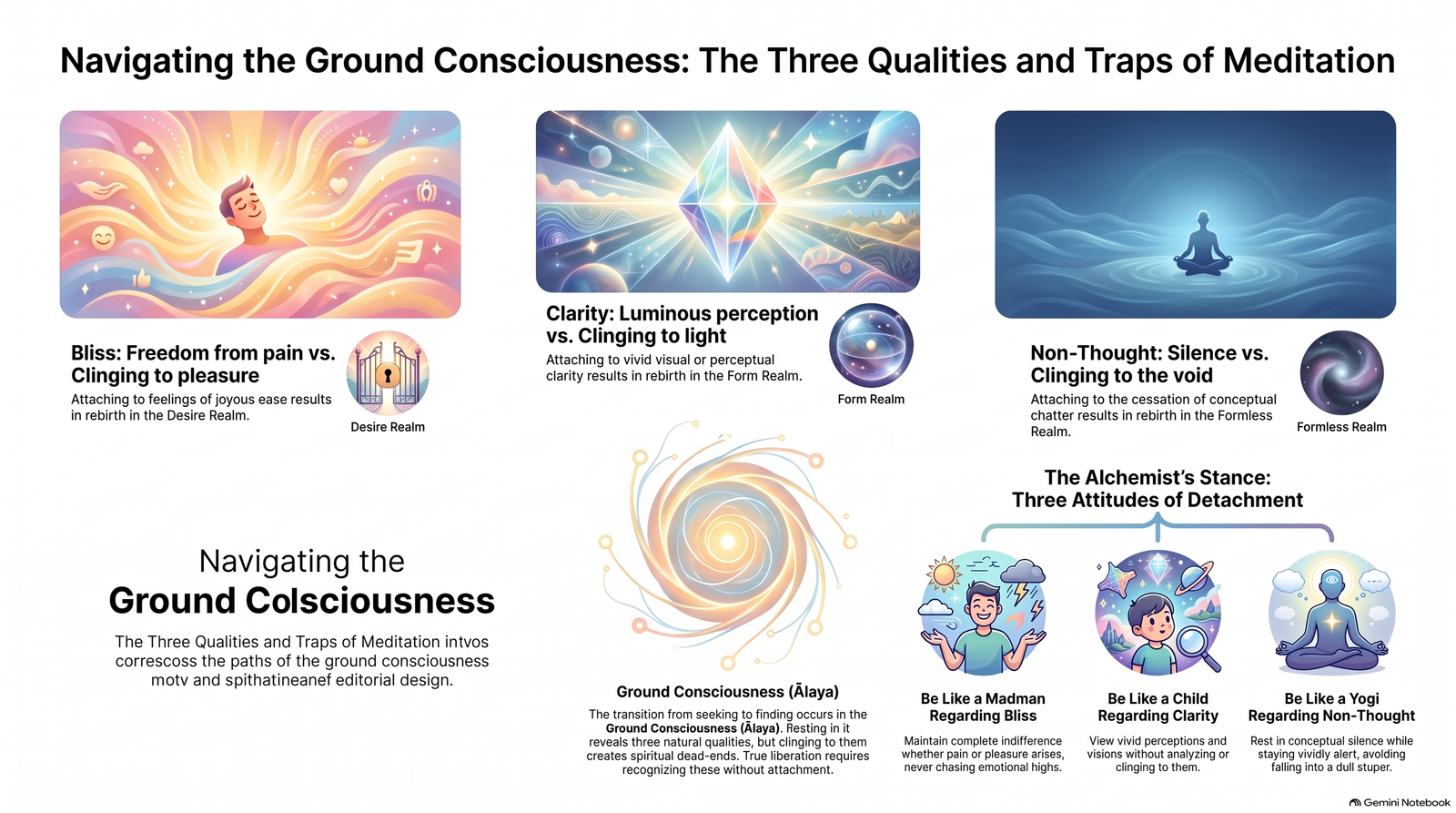
The episode’s main dramatic turn arrives with three attractive conditions: bliss, vivid clarity and non-thought. It asks why taking possession of any one of them would undermine the freedom ostensibly sought. The subsequent “jhānic pitfalls” section gives vivid accounts of four formless attainments and the danger of treating them as final liberation. The predicted rebirths and vast durations belong to traditional religious cosmology as interpreted by the source, rather than established observations about meditation or evidence that a person has entered a particular realm. Nor should a period of quiet, visionary imagery or unusual awareness be treated as a diagnostic or attainment test.
Finally, the speakers interpret three memorable attitudes — the madman unmoved by bliss, the child not grasping at clarity and the yogi alert amid silence — as images of non-attachment, not prescriptions to imitate behaviour. They compare two forms of cessation and introduce the Mahāyāna five paths, before closing with the image of an unstained mirror and a suggested self-inquiry. This page retains the reflective question while avoiding the recording’s deeper experiential instruction. Its durable challenge is practical and ethical: can clarity and comfort be appreciated without making either into an identity, and can ordinary responsibilities remain intact?
The argument, in seven movements
From GPS to the inner map
The hosts contrast physical orientation with the temptation to find a permanent coordinate inside experience.
Seeking and finding
The distinction between gross and subtle gold questions the wish to consume an ideal meditative state.
Stillness and insight
Śamatha and vipaśyanā are presented as complementary, not as interchangeable synonyms for calm.
The storehouse metaphor
The discussion introduces ālaya through conditioned habits and a computer hard-drive analogy.
Three seductive qualities
Bliss, clarity and non-thought become traps when they are appropriated as possessions or accomplishments.
Absorption and the formless spheres
Four refined states are used to distinguish temporary absorption from the traditional ideal of liberation.
Non-attachment and the five paths
Three archetypal attitudes lead into cessation, Mahāyāna path stages and the final mirror image.
Visual map: qualities and attachments
Video chapters
Author-supplied timed estimates for the 52:55 final recording; the transcript has no embedded timecodes. These are navigation aids rather than independently verified edit points.
- 00:00 Opening: The Treasury of Precious Jewels
- 02:20 Seeking vs Finding
- 06:10 Śamatha: Stillness Without Force
- 11:40 Vipassanā: Seeing Awareness Clearly
- 16:50 The Ālaya: Ground Consciousness
- 22:10 Bliss, Clarity, and Non-Thought
- 28:40 The Three Meditation Traps
- 34:10 The Jhānic Pitfalls Explained
- 39:50 Madman, Child, and Yogi
- 45:20 Analytical vs Non-Analytical Cessation
- 50:10 The Five Bodhisattva Paths
Glossary and distinctions
Śamatha
A Sanskrit term for calm abiding or tranquillity meditation, called samatha in Pāli. It cultivates a stable, settled mind; methods differ by tradition. Here it is used to contrast gentleness and non-forcing with the pursuit of exceptional experiences.
Vipaśyanā / vipassanā
Sanskrit and Pāli terms respectively for insight or clear seeing. Buddhist systems explain their objects and relationship to tranquillity differently. The episode emphasises the discernment that a quiet mind is not necessarily liberated.
Ālaya / ālayavijñāna
Ālaya means a basis or repository; ālayavijñāna is usually translated as storehouse consciousness in Yogācāra. Dzogchen uses related terms with important distinctions. A repository of karmic imprints is not simply identical to the ultimate ground or to dharmakāya.
Dharmakāya
The truth or reality body within Mahāyāna teachings of the Buddha bodies. Its interpretation varies across systems. Calling it a pristine hard drive in the recording is an analogy rather than a literal Buddhist definition or anatomical description.
Bliss, clarity and non-thought
Three kinds of meditative experience discussed in Tibetan contemplative settings. They can arise during practice, but pleasant feeling, vivid knowing and reduced thinking are not individually reliable evidence of insight or awakening.
Jhāna / dhyāna
Pāli and Sanskrit words for meditative absorption. Classical Buddhist sources describe multiple absorptions and formless attainments; they are not straightforwardly equivalent to clinical dissociation, coma or neurological shutdown.
Four formless attainments
The dimensions of boundless space, boundless consciousness, nothingness, and neither-perception-nor-non-perception. In Buddhist cosmology they can also be associated with rebirth realms. The episode narrates their possible misuse as objects of attachment.
Saṃsāra
The cycle of conditioned existence and rebirth in Buddhist traditions, marked by suffering and ignorance. It can also be discussed as a metaphor for habitual patterns, but the metaphor does not replace the traditional cosmological meaning.
Nirvāṇa
Liberation from the causes of suffering, not merely peaceful feeling, blankness or a pleasant place to visit. Buddhist philosophical schools differ in their interpretations; the episode contrasts liberation with acquiring an experience.
Machig Labdrön and Chöd
Machig Labdrön is traditionally associated with the Tibetan Chöd tradition, often translated as cutting through. Accounts of demons and fearful settings have historical, ritual and symbolic dimensions. The programme is not an instruction to enact confronting or hazardous practices.
Prajñāpāramitā
Perfection of wisdom in Mahāyāna Buddhist literature. Central themes include the emptiness of independent, intrinsic existence. Emptiness does not mean that everyday events, suffering, or ethical obligations are unreal or irrelevant.
Pratisaṃkhyā-nirodha
Often translated as cessation through discernment or analytical cessation in Abhidharma discussions. The episode compares this to non-analytical cessation, but its simple active-versus-passive distinction should not be treated as a complete account of different schools.
Bodhisattva five paths
Accumulation, preparation, seeing, meditation, and no more learning form a common Sanskrit Mahāyāna path map. The first bhūmi is usually associated with seeing. Equating these stages with Nigredo, Albedo, Citrinitas and Rubedo is the author’s comparative model, not a traditional equivalence.
Explore within the course
- 3.2.6. Afflictive and Cognitive ObstructionsThe preceding discussion of obstacles that may remain after apparently important insights.
- 3.2.8. The Perfections (Pāramīs)The next book chapter, on virtues and the bodhisattva orientation.
- Dharma — Part Two of CitrinitasReturn to the twelve-chapter Dharma collection.
- Citrinitas – Part ThreeThe course archive and its wider structure.
- 3.2.4. An Introduction to the Subtle BodyA neighbouring historical catalogue page, with a different focus and older chapter arrangement.
Further reference points
Background reading to clarify terms and differing path systems; these sources are not presented as quotations or references verified to occur within the recording.
- Five paths — Encyclopedia of BuddhismOutline of the Sanskrit tradition’s five-path scheme and its vehicle-specific uses.
- Bodhisattva five paths — Encyclopedia of BuddhismFurther context for seeing, bhūmis and the meditation path.
- Vipaśyanā — Encyclopedia of BuddhismTerminology and the relationship between calm, insight and the path.
- Path of no more learning — Encyclopedia of BuddhismClarifies how this endpoint is understood differently across vehicles.
Question to carry forward
When an ordinary experience feels particularly pleasant, illuminating or quiet, what changes when you start wishing it would last? Can you value that experience without measuring yourself by it — while remaining available to the people and responsibilities around you?