
Citrinitas · Mythos · Chapter 6 of 48 · Catalogue 3.1.6
Sudden Methods
Can a sudden break in familiar thinking disclose insight, and what is lost when shock is mistaken for a reliable path?
Watch the chapter discussion
Sudden Enlightenment Explained | Zen, Koans & Ego Collapse
The chapter in brief
Chapter 6 of the 2026 revised Citrinitas turns from the preceding discussion of insight meditation to the possibility of an abrupt change in how the self is understood. The author uses the alchemical crucible to imagine a moment when conceptual explanations no longer sustain an accustomed identity. A Chán encounter story, the use of kōans, demanding monastic discipline, despair and accounts of crisis provide contrasting examples. The book argues that these may converge in a sudden disclosure of awareness beneath habitual self-description.
Its most forceful proposition is that engineered failure and unexpected trauma can produce the same transformation. That is the author’s interpretive hypothesis, not a demonstrated common mechanism. Zen accounts have particular literary and religious settings; reactions to trauma are diverse and may be profoundly harmful. The chapter is best read as a challenging exploration of the limits of conceptual control, not a practical programme for causing breakdown.
Video guide: when the mind cannot solve itself
Central question: does a collapse of the habitual story of “me” amount to awakening, or must we distinguish a momentary disruption from sustained wisdom? The discussion begins with a traditional story about Linji and a monk called Ting, who asks for the meaning of the Buddha’s teaching and receives an unexpected slap. The hosts treat the story as an example of non-conceptual interruption. As a narrative from Chán literature it expresses a religious teaching; it does not provide a controlled account of what occurred in the monk’s brain.
The recording then questions whether gradual insight can become another achievement for the self. Its memorable metaphors contrast polishing a dilapidated house with bringing down the walls, and a carefully decorated mountain with rock splitting open to reveal light. The concern is substantial: even meditation can become part of an identity built around being a good meditator. Yet vipassanā is not merely self-improvement, and the video’s contrast between a slow Theravāda path and a fast Zen path is deliberately stark. Historical Buddhist practices and awakening models are more varied than those two categories.
From there the conversation expands the book’s alchemical image of a crucible into a detailed and sometimes extreme depiction of monastery admission, sitting, the encouragement stick, private interviews and repeated unsuccessful answers to kōans. The hosts describe shock as switching off the narrative self and exhaustion as depriving the brain of energy needed to maintain ego defences. Such accounts are useful as metaphors for the limits of conceptual problem-solving, but the specific references to the default mode network, prefrontal cortex and amygdala do not establish the causal mechanism claimed. Nor should the episode’s deprivation-based picture be mistaken for standard or necessarily safe Zen teaching.
The most difficult turn comes with surrender, despair and traumatic experience. A kōan is described as a question that cannot be answered by accumulating more ideas; a crisis may similarly disrupt ordinary expectations. The dialogue compares sudden lucidity reported during life-threatening events with contemplative insight, then distinguishes “giving up” from “letting go”. These are different phenomena and cannot be identified simply by how they feel. In particular, traumatic stress responses, dissociation and a temporary sense of calm do not establish liberation; crisis may require care rather than spiritual interpretation. The closing comparison with Dzogchen and Mahāmudrā offers an alternative to the sledgehammer image: recognition without deliberate shock. Its suggestion that pointing-out requires a near-anāgāmī stage is not a general doctrinal prerequisite. The most fruitful conclusion is not to seek a break, but to question the assumption that a dramatic break proves understanding.
How the argument unfolds
The interruption
A Linji encounter story opens the problem of insight that cannot be delivered as another explanation.
The refined self
The dialogue asks how gradual improvement can become another form of spiritual self-image.
The crucible
An alchemical image frames a severe challenge to the mind’s preferred methods of control.
The kōan
Repeated conceptual failure is presented as a challenge to habitual intellectual solutions.
Defeat and relinquishment
The hosts distinguish a story of personal failure from relinquishing the demand for a winning answer.
Unexpected crisis
The discussion compares reports of sudden clarity under threat with contemplative awakening, an uncertain analogy.
Beyond spectacle
It ends by contrasting brute-force narratives with Tibetan pointing-out and the question of what remains after surprise.
An illustrated map of the inquiry
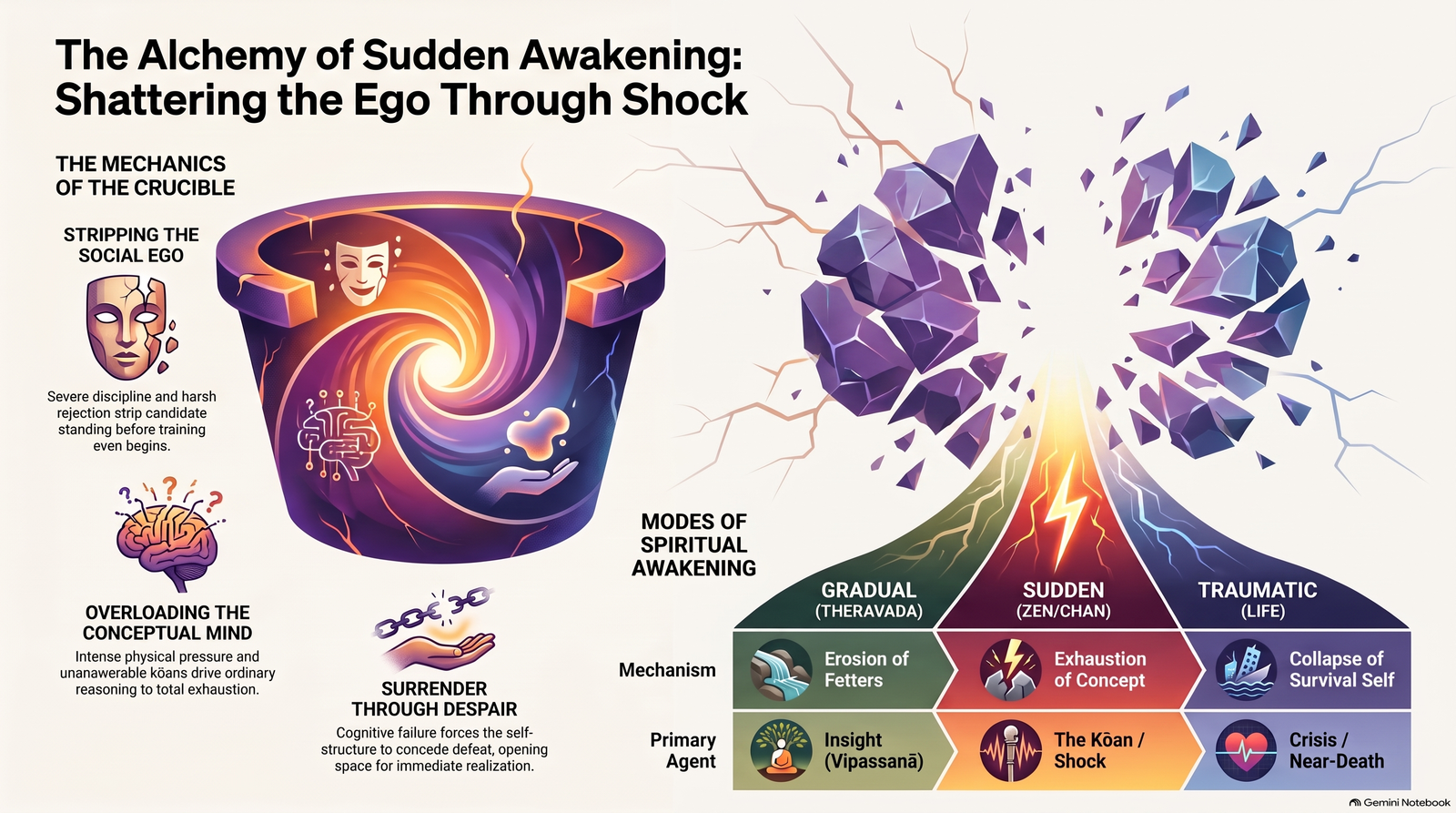
Book and recording: different emphases
In the revised chapter
The crucible, encounter literature and three-mode comparison organise a concentrated argument about abrupt changes in self-understanding.
In the recording
The two hosts amplify the mountain, house and operating-system metaphors, describe a hypothetical week of kōan work and speculate about brain networks and trauma.
Video chapters
Terms in context
Chán / Zen
Chán developed in China; Zen names its Japanese developments. Both include varied schools and styles, not one uniform system of harsh training. The episode draws particularly on encounter stories and kōan traditions.
Kōan
A traditional case or question studied especially in the Rinzai Zen lineage. A kōan is not merely a riddle with a hidden clever answer; its function belongs to an extended practice of inquiry and testing within a specific teaching context.
Linji (Rinzai)
Linji Yixuan is associated with a Chinese Chán lineage later influential in Japanese Rinzai Zen. Encounter stories attributed to him are religious and literary records, not clinical case reports or evidence of a reproducible neurological response.
Great doubt
In later kōan-centred Zen, an intense questioning that unsettles fixed conceptual assumptions. It should not be equated with anxious rumination, general distrust or an instruction to destabilise oneself.
Vipassanā
Insight meditation, especially prominent in Theravāda traditions and modern insight movements. It investigates changing experience, causation and not-self; it is not simply leisurely observation or a slower, inferior counterpart to Zen.
Samatha
Calming or tranquillity cultivation within Buddhist practice. It can support steadiness and concentration and is not accurately reducible to an amygdala-downregulation procedure.
Zazen
Zen seated meditation. Forms and schedules vary by institution and lineage. The video depicts one extreme monastic training scenario; it should not be understood as a universal timetable or an invitation to reproduce it.
Kenshō / satori
Zen terms associated with seeing one’s nature or awakening. Their significance and relation to continued practice vary across traditions. A startling experience alone cannot verify either of them.
The crucible
The author’s alchemical metaphor for conditions that expose the limits of self-protective habits. It is an interpretive image, not a standardised intervention or validated psychological technology.
Dark night of the soul
A phrase associated especially with Christian contemplative literature, notably John of the Cross, repurposed here for a crisis of meaning. It does not establish that depression, despair or trauma is a necessary spiritual phase.
The watcher
The episode’s metaphor for awareness when habitual self-narration falls quiet. Buddhist no-self teachings should not be replaced by a claim that an independently existing inner observer has been scientifically discovered.
Dzogchen and Mahāmudrā
Distinct Tibetan Buddhist contemplative traditions that include approaches to recognising mind’s nature. They cannot be reduced to a non-returner prerequisite, and the video’s proposed equivalence of stages is an authorial comparison, not a traditional rule.
Related pathways on this website
- 3.1.5. The Path of Insight — The preceding book chapter examines vipassanā and the limits of treating insight as a possession.
- 3.1.7. The Heart Sutra — The next chapter develops the Mahāyāna language of form and emptiness.
- Mythos — Part One of Citrinitas | Spiritual Alchemy Course | Dr Simon Robinson — Return to the twelve-chapter Mythos section.
- Citrinitas – Part Three — See how the chapter belongs to the wider third book.
- Citrinitas (book) — Read about the revised print edition rather than relying only on the discussion.
External reference points
For further reading and context:
- Stanford Encyclopedia of Philosophy — Japanese Zen Buddhist Philosophy — Distinguishes kōan-based Rinzai training from Sōtō just-sitting and explains the place of lived conduct.
- NCCIH — Meditation and Mindfulness: Effectiveness and Safety — An evidence-based overview of benefits, limitations and reports of adverse effects.
- NCCIH — Stress and Mind–Body Practices — Provides a cautious discussion of possible negative experiences from relaxation practices.
Question to carry forward
When an explanation or identity unexpectedly fails, what would distinguish a useful revision of assumptions from a moment of confusion, and how could compassion, safety and ordinary responsibility help us tell?