
Citrinitas · Mythos · Chapter 5 of 48
The Path of Insight
What changes when the search for a peaceful state becomes an inquiry into the habits that make experience feel like “me”?
Catalogue reference 3.1.5 · Revised Edition (2026)
Watch the chapter video
How Insight Meditation Reveals the Illusion of Self | Vipassanā Explained
The chapter in brief
Following The Path of Tranquility, chapter 5 asks whether becoming calm is the same as understanding the conditions of suffering. Robinson presents vipassanā as an inquiry into impermanence, unsatisfactoriness and not-self: the changing events of mind and body, and the tendency to claim them as a stable identity. His “structural irritant” image expresses how an insight can challenge assumptions rather than simply add another comforting idea. The chapter moves through a condensed Theravāda insight map, the lightning metaphor for momentary experience, and the assembly analogy of a watch. It ends with disenchantment and the possibility of less grasping. The alchemical contrast between valley and summit is the author’s interpretation; it does not turn calm and insight into mutually exclusive Buddhist paths, or make distress a requirement for freedom.
A guide to the recording
Central question: Can an inquiry that unsettles our assumptions about continuity and identity lead to greater ease, rather than simply replacing comfort with fear? The two-host recording opens with existential restlessness and develops the chapter’s image of insight as a “structural irritant”. A boom microphone entering a film scene becomes its first illustration: once the construction is noticed, the story is harder to take at face value. The hosts then contrast tranquility with insight through valley-and-summit, anaesthetic-and-surgery, and rope-and-snake analogies. These communicate the difference between temporary relief and a change in understanding, but their rhetoric should not be mistaken for a clinical account or a dismissal of calm.
The discussion next moves to momentary experience. Standing up, seeing a cup and watching a film illustrate how a seemingly unified event can be examined as a sequence of sensations, intentions and interpretations. The hosts connect these examples to a Theravāda commentarial account of cognition and the chapter’s lightning image. Their references to photons, the “heart-base” and biological explosions extend a traditional explanatory model into scientific-sounding language; the recording supplies no empirical demonstration of that mechanism. A changing experience of seeing also does not establish that the external moon vanishes between moments of awareness.
A disassembled watch then shifts the question from continuity to identity. The hosts ask whether a person is an independently existing manager behind the components of experience, and use anger in traffic and present recollection to examine that assumption. This is most usefully read as a challenge to identification with changing processes, rather than a declaration that people, memory or responsibility do not exist. The subsequent map introduces discernment of mind and matter, conditionality, the three characteristics, arising and passing away, and dissolution. It also discusses attachment to rapture and clarity before moving through fear and disenchantment towards equanimity. These are features of a particular Theravāda explanatory tradition, not a universal timetable or a diagnostic checklist.
The final movement locates the difficulty in trying to hold changing experience still: the clenched-fist image becomes an open hand. This expresses the chapter’s movement from agitation towards less clinging, without explaining every source of human suffering. The recording concludes with a prolonged inquiry into gaps between thoughts. Here that ending is treated as material for interpretation, rather than repeated as a practice assignment: an absence of verbal thought does not by itself prove the disappearance of a person or certify liberation.
The argument in six movements
Notice the story’s construction
The boom-microphone analogy turns restlessness into a question about assumptions that usually remain unnoticed.
Distinguish relief from understanding
Valley, surgery and rope-and-snake images contrast calming experience with reconsidering its interpretation.
Question apparent continuity
Standing, seeing and film frames introduce the lightning metaphor for changing events.
Examine the claimed owner
The watch, anger and memory examples challenge the idea of a permanent manager behind experience.
Locate the inquiry within a map
The hosts trace arising and passing, attachment to pleasant states, dissolution and disenchantment in a Theravāda framework.
Reconsider the grip
The open-hand image points towards equanimity, before the closing thought-gap inquiry raises a further question about the observer.
Book, recording and source tradition
The chapter’s emphasis
A compact account of insight as a challenge to continuity and ownership, framed through the author’s Citrinitas model.
The recording’s expansion
Extended everyday analogies, questions about memory and anger, and a more dramatic narrative of dissolution make the chapter conversational.
The traditional map
The named insight knowledges belong to Theravāda commentarial and later meditation literature. Mahāsi Sayadaw’s presentation places equanimity about formations after re-observation, as the eleventh knowledge in that sequence; the chapter’s repeated “6” is not a reliable stage number.
The author’s synthesis
Alchemy, Christian restlessness, Stoic judgement and a Vedāntic rope-and-snake image are interpretive comparisons. Their resonance does not make Buddhist not-self identical with a metaphysical Self.
A visual overview
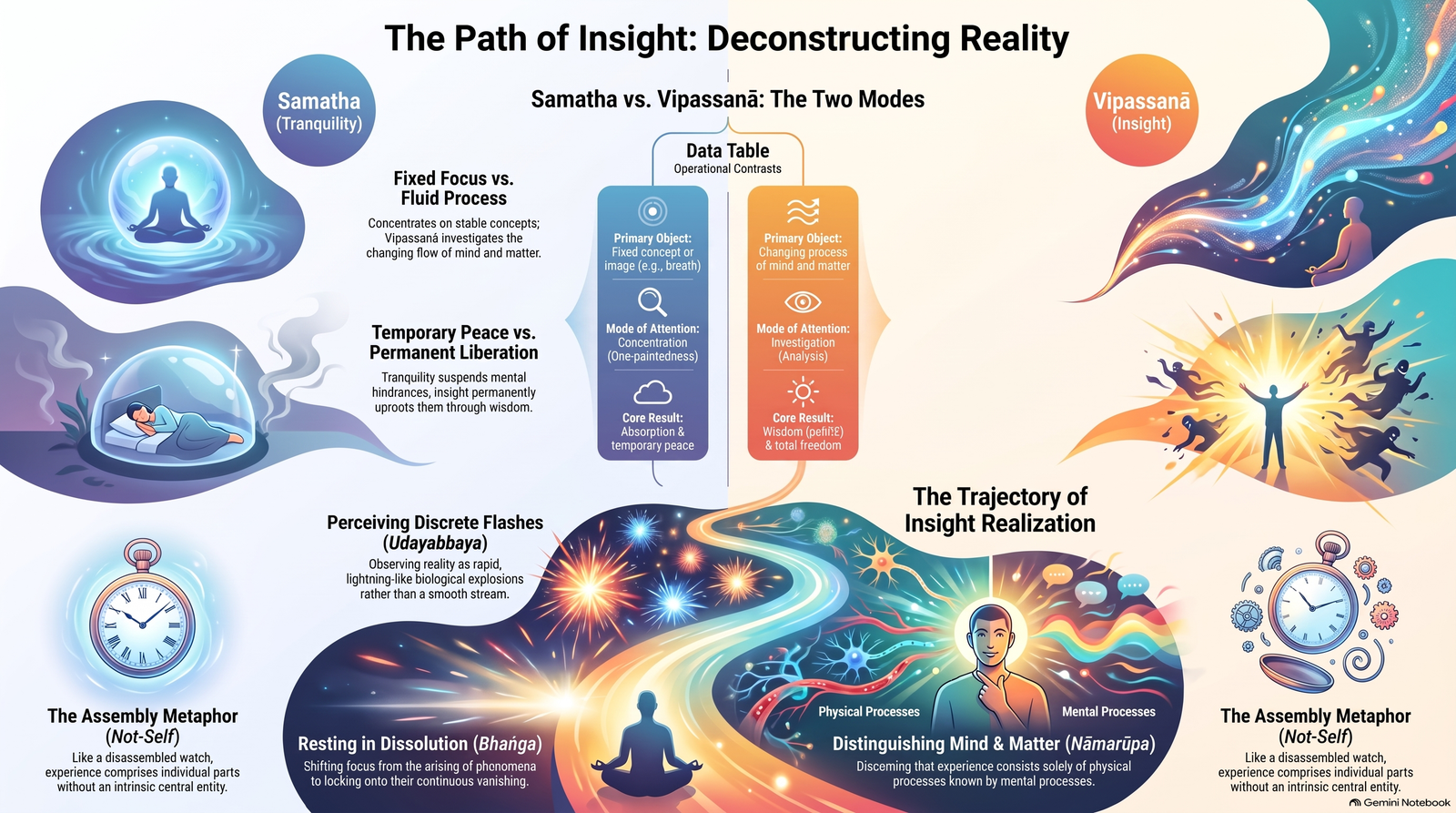
Terms for careful reading
Vipassanā · insight
In Buddhist usage, insight concerns discerning the nature of experience, especially its impermanence, unsatisfactoriness and not-self. Theravāda traditions explain its cultivation in different ways. Robinson emphasises its capacity to unsettle identification; this does not mean that insight must be frightening or that intellectual analysis alone is liberation.
Samatha and jhāna · calm and absorption
Samatha means calm or tranquility; jhāna names meditative absorption in Buddhist traditions. Their interpretation and relationship to insight vary. The recording’s anaesthetic comparison is deliberately sharp, but early Buddhist texts also describe calm and insight developing together or in different orders, rather than as rival paths.
The three characteristics · anicca, dukkha, anattā
These Pāli terms are commonly rendered impermanence, suffering or unsatisfactoriness, and not-self. They concern how conditioned experience changes and fails to provide secure ownership or lasting satisfaction. Dukkha does not mean that every moment is consciously miserable; anattā does not cancel ordinary personhood, ethical responsibility or relationships.
Nāmarūpa · mind and material form
In Theravāda analysis, nāma refers to mental aspects and rūpa to material form. Their exact scope depends on the textual context. In insight literature, distinguishing them helps examine experience without assuming an independent owner. Mental events know objects; the chapter’s wording about physical processes “knowing” mental processes reverses that explanatory role.
The five aggregates · khandhas / skandhas
The Pāli and Sanskrit terms name five groupings: material form, feeling tone, perception, mental formations and consciousness. The watch analogy challenges identification with an independently existing core. It does not establish that a person is worthless, that an assembled watch cannot function, or that conventional distinctions should be abandoned.
Ñāṇa · knowledge in an insight map
Ñāṇa means knowledge. Compounds such as insight-knowledge name particular ways of discerning experience within Theravāda meditation literature. The chapter condenses one such sequence. These terms are explanatory categories rather than tests that a reader can use to certify an attainment from a striking experience.
Udayabbaya-ñāṇa · arising and passing away
This Theravāda insight-knowledge concerns the arising and passing of conditioned events. Some meditation manuals discuss accompanying clarity, rapture and illumination, and the risk of attachment to them. Such experiences are not by themselves proof of liberation, and the term does not describe a verified frequency of neural or physical events.
Bhaṅga-ñāṇa · dissolution
In Theravāda insight literature, this names knowledge in which the passing away of events becomes especially prominent. It is a description within a contemplative map, not a claim that matter ceases to exist whenever it is observed. Nor does it imply that fear or loss of functioning should be pursued.
Nibbidā · disenchantment
This Buddhist term points to a loss of enchantment with what has been grasped as a secure source of satisfaction or identity. In this chapter it prepares the discussion of less clinging. It is not interchangeable with depression, contempt for life or withdrawal from the responsibilities of care.
Saṅkhārupekkhā-ñāṇa · equanimity about formations
In the Theravāda map discussed here, this means a balanced relation to conditioned phenomena, with less grasping and resistance. It follows several intervening knowledges after dissolution. It is not automatically identical with Dzogchen recognition or every use of “nondual awareness”, and calm behaviour cannot certify it.
Heart-base · hadaya-vatthu
This is a concept in Theravāda commentarial accounts of the material support for mental consciousness. It belongs to a traditional explanatory system. The recording uses it alongside eye-consciousness and sparks; it should not be treated as validated cardiac neuroscience, a subtle electrical relay or an established anatomical mechanism.
“Dark night” · a cross-tradition analogy
The Christian phrase is used here by analogy for challenging passages in an insight map. It is not the traditional Pāli name for those knowledges, a clinical diagnosis or evidence that all contemplative paths involve the same crisis. Intense distress should not be retrospectively certified as attainment by attaching this label.
Related pathways
- 3.1.4. The Path of Tranquility
Read the preceding chapter’s account of tranquility and its relationship to insight. - 2.2.9. The Cognitive Series
Explore the author’s account of a cognitive sequence while keeping its traditional status distinct from neuroscience. - 1.2.5 The Mental Factors
Return to the mental factors used to analyse experience in Nigredo. - 3.1.6. Sudden Methods including Traumatic Enlightenment
Continue to the revised book’s Sudden Methods topic; the public page retains its older, longer title, which does not make trauma a recommended route. - Mythos — Part One of Citrinitas | Spiritual Alchemy Course | Dr Simon Robinson
Locate this chapter within the twelve Mythos topics. - Citrinitas – Part Three
Browse the wider Citrinitas course catalogue.
External reference points
These sources provide context and checks on the page’s interpretation; they are not a claim that the hosts consulted these particular editions.
- AN 4.170 · In Tandem
Translated by Ṭhānissaro Bhikkhu. An early Buddhist account of several relationships between calm and insight, including their joint development. - SN 22.59 · The Five (Brethren)
Translated by Ṭhānissaro Bhikkhu. Examines the five aggregates in relation to change, affliction and the claim that they are self. - Mahāsi Sayadaw · The Progress of Insight
Translated with notes by Nyanaponika Thera. A modern Theravāda presentation of the commentarial insight map, clarifying the order of dissolution, difficult knowledges and equanimity.
Question to carry forward
In an ordinary disagreement, what might change if you held the description “I am an angry person” less tightly, while still taking responsibility for your words and their effect on someone else?
This is a question about interpretation and conduct. No prolonged observation of thought-gaps, perceptual deconstruction or attainment test is needed.