
Citrinitas · Mythos · Chapter 8 of 48 · Catalogue 3.1.8
The Bardo
Can a traditional map of the intervals around death illuminate the habits through which we meet uncertainty in life?
Watch the chapter discussion
The Bardo Explained: Death, Rebirth & Clear Light in Tibetan Buddhism
Open on YouTube ↗This two-host, AI-generated interpretation discusses the chapter’s traditional and symbolic material. It is not an account of established events after death or a guide to advanced practice.
The chapter in brief
Chapter eight of the 2026 revised Citrinitas introduces the bardo, an intermediate condition or interval, through Tibetan Buddhist accounts of living, dreaming, dying and rebirth. Its sixfold map moves from the familiar transitions of everyday life to the dissolution of the elements at death, the appearance of clear light, the visionary display of the intermediate state and the process called becoming. The chapter draws particularly on the literature commonly called the Tibetan Book of the Dead, while comparing its imagery with passages from other religious traditions. Those comparisons belong to the author’s alchemical synthesis: they do not make the accounts historically identical or demonstrate continuity of consciousness after death. The map is most useful here as a study of impermanence, recognition, fear and habit, rather than a clinical description of dying.
Video guide: what does the interval reveal?
The recording opens in an imagined hospital room, contrasting outward signs of physical decline with vivid internal images described in Tibetan death literature. The hosts use the chapter’s lamp-and-dawn motif to set up the central question: what does a tradition mean when it treats death as an interval rather than a single instant? The discussion is explicit in its challenge to a simple lights-out picture. That challenge, however, is philosophical and traditional, not evidence that subjective experience continues after brain death.
It then moves to the six bardos. Crucially, these are not all post-mortem territories: the bardo of life, the dream state and meditation belong to the living, while death, the appearance of reality and becoming belong to the account of dying and rebirth. The speakers connect these intervals with the idea of habitual mind. They also range across biblical, Qur’anic and other philosophical allusions from the chapter. Resonance across texts provides a comparative reading, not proof of a common doctrine.
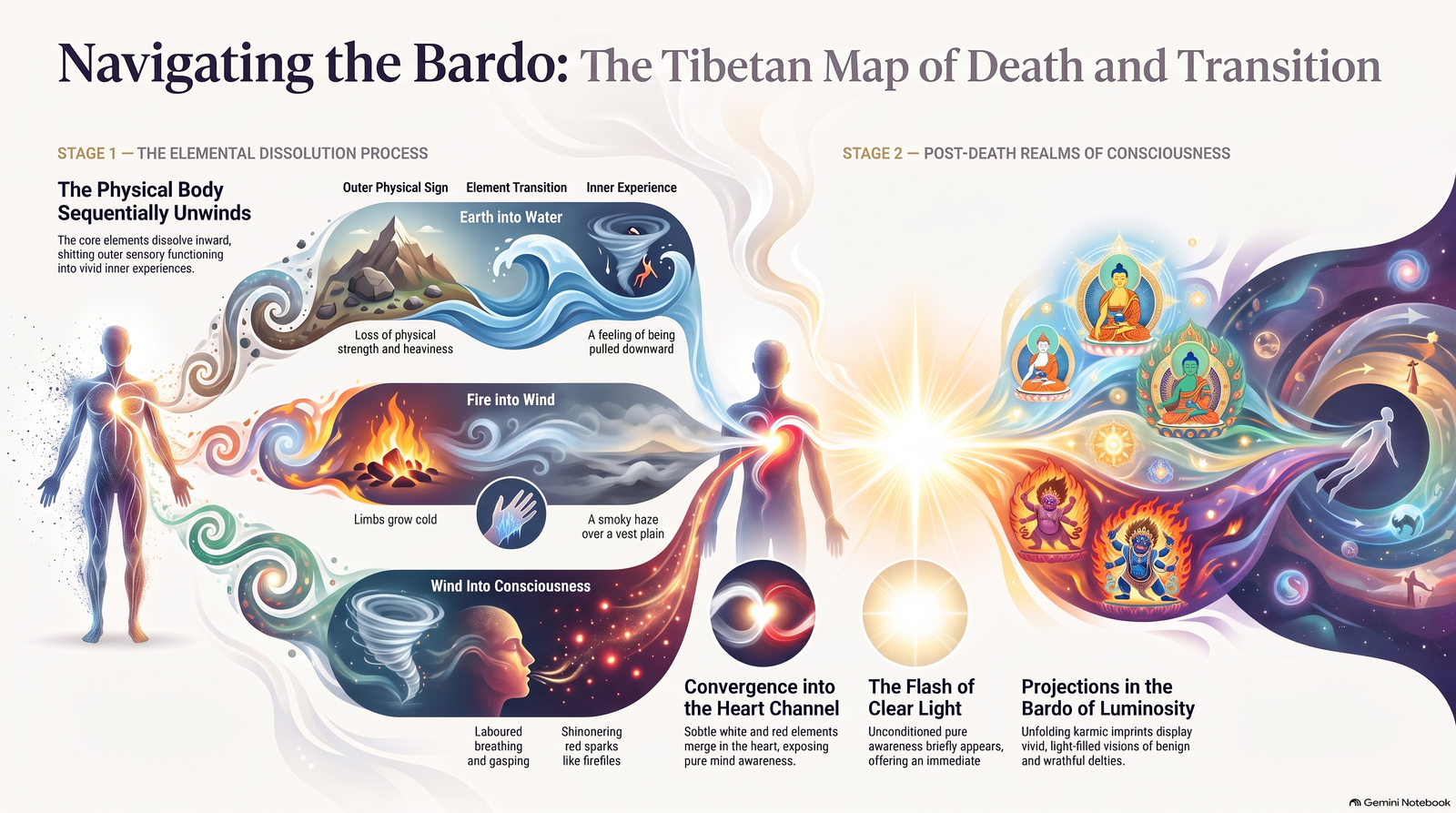
The middle of the conversation gives the traditional dissolution account its fullest treatment. Earth, water, fire and wind represent a succession of changes, with imagined or reported inner signs such as heaviness, rainfall, smoke and sparks. The recording also describes white and red subtle essences meeting at the heart and an appearance of clear light. These are elements of tantric contemplative physiology, not medically validated stages, anatomical structures or observable equivalents of dying patients’ experiences. The ensuing question is why recognition might fail: the hosts interpret fear and ingrained responses as obstacles in the traditional narrative.
Finally the discussion follows visionary deities and frightening forms, the gandharva or intermediate being, karmic momentum and the bardo of becoming. A virtual-reality headset becomes its governing modern analogy: mistaking projections for independently threatening things perpetuates panic. The hosts end with a particularly strong spatial metaphor, describing refuge as turning away from a forward-facing display. That passage paraphrases advanced Tibetan consciousness-transference imagery and is not a practical instruction to visualise or manipulate subtle channels. The final, grounded question concerns the everyday tendency to interpret uncertainty through hope and fear, while remembering that other people and real-world harms are not merely one’s projections.
A necessary distinction
Traditional accounts are not clinical observations
The sequence of elemental dissolution, clear light, post-mortem visions and rebirth is presented here as Tibetan Buddhist teaching and the author’s interpretation. Changes in breathing, temperature and responsiveness can be medically observed; claims about what a person perceives after death cannot be established from those signs. The recording’s VR and projection metaphors help explain a doctrinal model, but do not show that external events, relationships or suffering are imaginary. Advanced refuge and consciousness-transference imagery is included for study, not practice.
The argument in seven movements
The clinical and the luminous
The hosts contrast physical signs at a deathbed with the chapter’s imagined inner sequence, introducing the question of what death means.
The interval is already familiar
They explain why life, dreams and meditation are counted alongside the post-mortem bardos.
A procession of dissolutions
They trace elemental signs and subtle-body imagery as a traditional account rather than a verified medical timeline.
The possibility of recognition
Clear light becomes a way to ask why habits and fear might overpower a moment of clarity.
Visions and projected threats
Peaceful and wrathful appearances lead into the analogy of experience filtered by expectations and conditioning.
Momentum towards another life
The intermediate being and the bardo of becoming are interpreted through karma and traditional rebirth narratives.
From the death map to today
The conclusion returns to recognition, distraction and responsibility in ordinary life, leaving the metaphysical claims open.
Book and recording
The chapter
Provides a six-bardo table, an elemental-dissolution table, post-mortem imagery and comparative religious quotations.
The discussion
Builds a sustained analogy between the projected bardo world, a virtual-reality headset and habits of perception while alive.
Video chapters
The chapter starts below are supplied timed estimates, not frame-checked final edit points.
- 00:00 Opening: Death as Transition
- 02:20 What Is the Bardo?
- 06:10 The Six Bardos Explained
- 10:30 The Dissolution Process
- 15:40 The Clear Light Moment
- 20:10 Why Recognition Fails
- 24:30 Bardo Visions and Mind Projection
- 29:40 Karma and the Pull Towards Rebirth
- 33:20 The Bardo of Becoming
- 36:40 Closing Reflections
Glossary: terms in context
Bardo
Tibetan for an intermediate state or interval. In the traditions discussed, it can refer to life and dreams as well as phases associated with death and rebirth; it is not simply a synonym for an afterlife.
Six bardos
A familiar Tibetan presentation distinguishes life, dreams, meditation, dying, the appearance of reality and becoming. Lists and emphases vary across teaching lineages and texts.
Bardo Thödol
Often called the Tibetan Book of the Dead in English, a body of funerary teachings associated with the Nyingma tradition. It is not a single scripture with one universally fixed text or translation.
Chikhai bardo
The interval associated with dying, particularly accounts of the dissolution of bodily and mental processes. Its descriptions are traditional contemplative accounts, not a clinical staging system.
Chönyi bardo
The interval connected with the appearance or display of reality, including peaceful and wrathful forms in some Tibetan accounts. The chapter uses visions as a way to discuss recognition and misrecognition.
Sidpa bardo
The bardo of becoming, traditionally described as the transition towards another rebirth. The speakers interpret its force through karmic habits; the post-mortem narrative is a religious teaching.
Clear light
A term used in Tibetan tantric and Dzogchen-related accounts of luminous awareness and the death process. It is not literal illumination measurable in the dying brain or proof of survival beyond death.
Elemental dissolution
The traditional sequence in which earth, water, fire and wind qualities dissolve. These elements belong to a contemplative explanatory scheme; they are not chemical elements or a substitute for physiological descriptions.
Dhātu
A Sanskrit term meaning element, constituent or domain. In this chapter the white and red essences are described in the language of traditional subtle-body physiology, rather than verified anatomy.
Gandharva
A Sanskrit term with several meanings across Indian sources. In discussions of intermediate existence it may denote a being associated with rebirth; the book’s ghost-like gloss should not be treated as an empirically observed entity.
Karma
In Buddhist traditions, intentional action and its consequences, understood through different doctrinal systems. The recording relates it to habitual attraction and aversion; karma is not a measured physical force.
Recognition and projection
In the cited Tibetan framework, liberation is associated with recognising a visionary display rather than reacting in fear. The VR metaphor is the recording’s comparison; it does not mean that actual interpersonal harms are unreal.
Consciousness transference
The specialised Tibetan practices often called phowa concern the transition at death. The recording mentions directional and channel symbolism, but this page provides no instructions for performing such practices.
Related pathways within the website
- 3.1.7. The Heart SutraPrevious revised-book chapter: emptiness and the five aggregates.
- Mythos — Part One of Citrinitas | Spiritual Alchemy Course | Dr Simon RobinsonThe section landing page and its twelve chapter links.
- 3.1.2. Tögal and RainbowsEarlier Mythos material on Dzogchen luminosity, requiring careful doctrinal distinctions.
- 3.1.12. TrekchöA related contemplative tradition, for study rather than unguided practice.
- 3.1.10. The BodhisattvaThe established public page for the revised book’s next topic, The Bodhisattva; the old website number differs.
- Citrinitas — Part ThreeReturn to the full course structure.
External reference points
- Oxford Research Encyclopedia: Tibetan Book of the Dead (Bardo Thödol)Casey Alexandra Kemp discusses the literature’s Nyingma context and the complexities of its Western reception.
- Bryan J. Cuevas, The Hidden History of The Tibetan Book of the Dead (Oxford University Press)Scholarly historical study of the transmission and interpretation of this funerary literature.
- University of Virginia Library: The Tibetan Book of the Dead translationsAn institutional exhibit tracing the influential early English editions and translation history.
Question to carry forward
When uncertainty appears in ordinary life, how do expectations and memories shape your response — and how might you hold those interpretations more lightly without dismissing real responsibilities or other people’s experiences?