
Citrinitas · Object · Chapter 34 of 48
Beyond Duality
Revised Edition (2026) · Catalogue reference 3.3.10
Can the division between self and world loosen without diminishing our responsibility to the people within it?
Video title, duration and publication month supplied by the author; catalogue numbering identifies this chapter within the course.
Watch the chapter discussion
Nonduality and Emptiness Explained | The Bodhisattva Path
The chapter in brief
Chapter 34 asks what remains of the apparent division between a perceiving self and a world of separate objects. Within Object, it moves from the widening perspective of Vastness towards the possibility of participating in ordinary life without treating its divisions as absolute. Robinson brings the Heart and Diamond Sūtras into conversation with the bodhisattva ideal, tantric subtle-body language, the Veil of Isis and alchemical transformation. His central figure is the lucid dreamer: engaged in experience while no longer taking its appearances at face value. The chapter’s descriptions of flickering light and its assignments to the eighth and ninth bhūmis belong to his interpretive framework. They should be distinguished from a standard doctrinal account or a physical explanation of the universe.
Video guide: insight without withdrawal
The recording begins with an ordinary certainty: the table feels solid, and the person touching it seems separate from it. It asks how much of that certainty belongs to experience and how much to the mind’s organisation of experience. A broken vase introduces the difference between an event and the additional story of ownership, blame and loss. The imagined sports commentator makes the same point: interpretation can dominate what is happening. This is a useful inquiry into identification, but the recording’s stronger assertion that all suffering is only narrative exceeds what its examples establish. Pain, harm and practical needs cannot be dismissed by removing a label.
The inquiry then turns towards the bodhisattva’s difficulty: how might insight become helpful to someone else? The lucid-dreamer metaphor connects understanding with skilful responsiveness rather than withdrawal. A parent tending a child’s scraped knee and a worker answering a hostile email make this concrete. The recording distinguishes compassion from pity and equanimity from apathy. Its language of illusory suffering needs care: someone else’s distress still calls for listening, protection and appropriate action. Nor does the Diamond Sūtra’s teaching of non-attachment establish the recording’s proposed sensory “uncoupling” mechanism.
A comparison of gradual and esoteric paths leads into deity symbolism, winds and channels. The dialogue extends the chapter through computer-reboot and ecosystem analogies, then presents the Veil of Isis as an image of perceptual breakthrough. These are interpretations, not demonstrations of biological mutation or a default-mode network being switched off. Tantric deities also cannot be reduced to psychological components on the authority of this discussion. The subsequent matrix of lights describes the source’s proposed phenomenology; the film-projector analogy does not prove that reality has a measurable refresh rate.
Finally, the recording assigns alternating meditative and everyday modes to the eighth bhūmi, and their integration to the ninth. A grocery-store transaction illustrates its central aspiration: functioning among appearances without grasping them as independent things. The traditional ten-ground map includes a tenth bhūmi; the dialogue’s shortened progression to Buddhahood is not a complete account. Peacock, copper, gold and a radiant bowl bring the discussion back to transforming one’s relationship with daily difficulty. The closing optical exercise is not reproduced here: detecting visual grain or flicker would not establish liberation. The question carried forward is whether less possessive interpretation can support more attentive care.
The argument in six movements
01
Question the solid divide
The table and broken vase open a distinction between sensory events and the stories organised around “me” and “mine”.
02
Ask what freedom would change
The commentator metaphor raises the problem of responding intelligently without compulsive self-reference.
03
Bring insight into relationship
The lucid dreamer, parent and workplace examples test whether equanimity can remain actively compassionate.
04
Compare routes and their imagery
Gradual cultivation and tantric language lead into psychological, computer and ecosystem analogies for transformation.
05
Examine the proposed breakthrough
The Veil of Isis and flickering-light account shift the discussion from conceptual analysis to claimed phenomenology.
06
Return to ordinary participation
The author’s bhūmi model, the grocery shop and alchemical images make integration the aim before the closing optical challenge.
Book and recording
The chapter’s emphasis
A compact account of non-conceptual awareness, the lucid bodhisattva and the proposed integration of meditative insight with appearances.
The recording’s expansion
The sports commentator, hostile email, computer reboot and grocery shop add explanatory scenes. Its neural claims and forceful language about suffering go beyond what these analogies can verify.
Explore the video
These are author-supplied estimated chapter starts, not audio-verified timings. The supplied transcript has no timecodes; links are approximate listening aids. The titles reflect the recording’s claims, which are qualified in the guide above.
- 00:00 · Opening: Beyond Duality
- 02:10 · How Cognition Creates Suffering
- 06:20 · Saṃsāra and Nirvāṇa Explained
- 10:40 · The Bodhisattva as Lucid Dreamer
- 15:50 · Why Compassion Changes in Nondual Awareness
- 20:30 · Exoteric vs Esoteric Paths
- 25:40 · Tantra, Subtle Bodies, and Consciousness
- 31:20 · Piercing the Veil of Isis
- 36:10 · The Matrix of Lights Phenomenology
- 40:30 · The 8th and 9th Bhūmis
- 44:20 · The Union of Form and Emptiness
- 47:10 · Closing Reflections
Terms for careful listening
Nonduality
A family of philosophical and contemplative descriptions, rather than one doctrine shared unchanged across traditions. Here it concerns loosening the experienced opposition between a separate observer and an independently existing world. It does not establish solipsism, abolish practical distinctions or demonstrate that individual minds create the universe.
Emptiness · śūnyatā
In Mahāyāna Buddhist philosophy, especially Madhyamaka, emptiness concerns the lack of intrinsic, independent existence. It is not nothingness or a hidden cosmic self. Robinson connects it with descriptions of non-conceptual awareness, but the experience of light is not itself a definition or proof of emptiness.
Saṃsāra and nirvāṇa
In Buddhist traditions, saṃsāra names conditioned cyclic existence, bound up with ignorance and suffering; nirvāṇa names liberation. Mahāyāna discussions of their non-separation require a philosophical context. The author’s formulation in terms of cognition ceasing is a particular interpretation, not an exhaustive definition accepted across Buddhism.
Bodhisattva and skilful means
In Mahāyāna Buddhism, the bodhisattva is oriented towards Buddhahood for the benefit of beings. Skilful means concerns responding appropriately to their differing needs and capacities. The chapter’s lucid dreamer is an explanatory metaphor for this engagement, not a criterion by which a reader can identify an attained teacher.
Compassion and equanimity
Compassion is concern for suffering and its alleviation; equanimity brings steadiness without requiring emotional indifference. The recording uses a parent comforting a child to explain their relationship. Its sharp opposition between pity and compassion is its own rhetorical distinction, not a universal Buddhist definition of either word.
Nirodha and analytical cessation
Nirodha means cessation, with its precise object depending on the teaching. Cessation of perception and feeling is a specific meditative attainment, not simply reduced commentary. “Analytical cessation” also has technical Abhidharma uses concerning cessation through discernment. The recording’s microsecond sensory-uncoupling account should not be mistaken for a standard translation or established neural mechanism.
Bhūmi
Sanskrit for ground or level. The influential Mahāyāna ten-bhūmi model describes bodhisattva development towards Buddhahood. The eighth is commonly called Immovable or Unwavering, the ninth Good Intelligence or Perfect Understanding, and the tenth Cloud of Dharma. Robinson’s light-matrix and blending assignments are his interpretation, not universal diagnostic criteria.
The two truths
In Madhyamaka, conventional truth concerns how things function dependently; ultimate truth concerns their lack of intrinsic nature. Interpretations vary. The two truths are not simply two visual layers, one solid and one luminous. The chapter uses their “union” to picture integration, without thereby establishing a standard ninth-bhūmi definition.
Tantra, winds and channels
Vajrayāna traditions use ritual, deity practices and subtle-body models within specific lineages. Winds, or prāṇa, and channels, or nāḍīs, belong to traditional contemplative physiology. They are not established equivalents of nerves or electrical circuits. The recording’s psychological reading of deities is one interpretation, rather than a complete account of tantric understandings.
Jñāna and non-conceptual wisdom
Jñāna means knowledge or wisdom; its technical significance varies across Indian traditions. In this chapter it names knowing that is not dominated by conceptual division. That use should not be confused with jhāna, a Pāli term for meditative absorption, or read as evidence that ordinary reasoning and communication become unnecessary.
The Veil of Isis
A Western image of concealed nature or truth, used here to signify a breakthrough in the author’s account of perception. It is not a Buddhist technical term or independent evidence of a shared ancient mechanism. Its connection with bodhisattva development belongs to Robinson’s comparative synthesis.
Peacock, poison and alchemical gold
The recording uses peacock imagery to describe responding differently to difficult experience, and copper becoming gold to picture transformation. These are symbolic connections, not a zoological explanation of feather colour. They do not imply that trauma, mistreatment or illness is necessary, beneficial or something a person should deliberately endure.
A visual summary of the author’s model
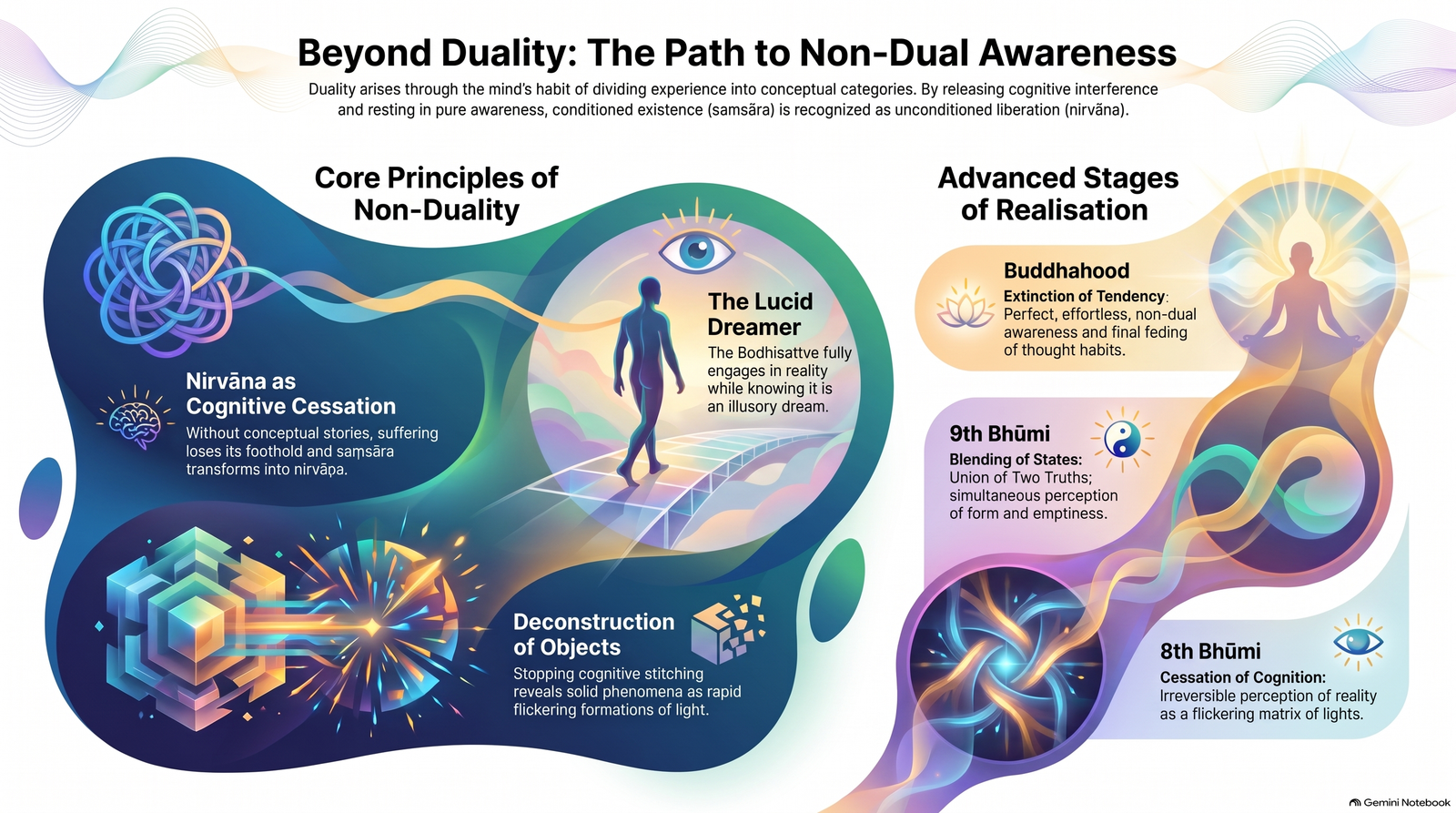
The graphic links conceptual cessation, a lucid dreamer and the deconstruction of objects with a progression through the eighth and ninth bhūmis to Buddhahood. Read this as the chapter’s interpretive diagram. Its claims that nirvāṇa is cognitive cessation and that the eighth bhūmi is irreversible perception of flickering lights are not universal doctrinal definitions. The traditional ten-ground map includes a tenth ground, omitted from this graphic. “Final feding” appears in the supplied image; the intended sense is the fading of habitual thought.
Related pathways
- 3.3.9. VastnessThe preceding book chapter: a wider perspective on self-reference and suffering.
- 3.3.10. The Sound of SilenceThe following book chapter, 35: hearing and awareness; its public title retains older numbering.
- 3.3.2. SolipsismDistinguish nonduality from the claim that only one individual mind exists.
- 3.2.9. The Metaphor of the Film ProjectorAn earlier perceptual metaphor that helps locate the recording’s film analogy.
- 3.2.10. The Veil of IsisThe symbolic image reused here for perceptual breakthrough.
- Object — Part Three of Citrinitas | Spiritual Alchemy Course | Dr Simon RobinsonReturn to the published Object section landing page.
External reference points
These sources provide context and comparison; their inclusion does not imply that the recording cites these particular editions.
- The Heart of the Perfection of Wisdom, the Blessed Mother84000; Dharmachakra Translation Committee, Catherine Dalton and Andreas Doctor. A recognised translation and introduction for the Heart Sūtra’s relation between form and emptiness.
- The Ten Bhūmis84000; translated by Peter Alan Roberts from Tibetan with reference to Sanskrit. A primary Mahāyāna source for comparing the full ten-ground account with this chapter’s selective model.
- Nāgārjuna — Stanford Encyclopedia of PhilosophyJan Westerhoff’s scholarly introduction to intrinsic nature, emptiness and Madhyamaka argument. A philosophical reference point rather than a source for the recording’s neural or optical claims.
Question to carry forward
When someone is distressed, how might you hold your interpretation of the situation more lightly while taking their experience, boundaries and practical needs seriously?
No altered state is required to consider this question. The aim is clearer listening and responsible action, rather than proving a spiritual insight.