
Citrinitas · Object · Chapter 33 of 48
Vastness
Revised Edition (2026) · Catalogue reference 3.3.9
Can a wider perspective loosen self-importance while leaving care for this particular life intact?
The reference 3.3.9 is catalogue notation. Video title, final duration and publication month are supplied by the author.
Watch the chapter dialogue
Vastness, Deep Time & the Illusion of Self | Modern Alchemy
The chapter in brief
Vastness widens Object’s inquiry from action and selfhood to the scale within which a life is imagined. Robinson places ordinary worries against immense lifespans, cosmic cycles and Buddhist accounts of rebirth. His phrase “medicinal application of scale” describes a hoped-for loosening of personal preoccupation; it is a contemplative metaphor, rather than evidence of a treatment.
The chapter then turns inward. Greed, aversion and delusion organise experience around what seems desirable, threatening or obscure. A Theravāda classification of twelve unwholesome consciousness types gives this discussion its analytical centre. The later warning about spiritual inflation asks whether apparent release can become another claim to importance. Finally, the chapter introduces the three Buddha bodies, concentrating on dharmakāya. These transitions belong to Robinson’s alchemical synthesis: Theravāda liberation, Mahāyāna Buddhahood and an experience of spaciousness remain distinct concepts.
Video guide · What changes when the frame widens?
The recording begins with the familiar attempt to solve anxiety by accumulating more protection: routines, plans and a more fortified identity. A copper coin held close enough to obscure the sun becomes its opening image for a worry occupying the whole field of attention. The hosts also describe a blurred empty chair as a symbol of a fixed self losing its sharp outline. Their central question is whether changing the frame around a concern can alter its felt weight. Cosmic timescales and the Tibetan bardo broaden that frame, before an objection gives the inquiry its ethical centre: if a house disappears from view when seen from space, does its leaking roof cease to matter? The answer preserves the work of caring for the house.
The discussion then asks why a mind capable of imagining immensity remains caught by emails, possessions and irritation. It turns to saṃsāra, nirvāṇa and the three unwholesome roots. Greed pulls, aversion pushes, and delusion obscures; the hosts elaborate these images through shopping examples and a malfunctioning smartphone. Their account follows the Theravāda eight–two–two grouping of unwholesome consciousness, but its computer and gravitational language is metaphorical. The classification is ethical as well as analytical. Everyday examples do not reliably identify a precise citta, and quantum measurement does not establish that conscious attention creates physical reality or that time is unreal.
Next, a shift in perspective becomes a warning about claiming special status. The recording calls this the “middle zone”: the self can appropriate an insight as evidence of being chosen or uniquely wise. Its question about helping others versus wanting recognition is valuable. Its placement of mania between specific Theravāda attainments, followed by a reference to the eighth bodhisattva bhūmi, is not an established clinical sequence. Nor can a spiritual declaration distinguish illness from freedom. The discussion subsequently contrasts suppression with release and introduces the three kāyas, focusing overwhelmingly on dharmakāya. A cinema screen untouched by the film illustrates the proposed stillness; it should not be converted into an eternal inner self or a claim that real suffering is imaginary.
The final movement develops the book’s lunar-view reflection into a forceful, step-by-step visualisation. It promises bodily relief by imagining an immediate problem from space and centuries ahead, then returns to the opening chair image and a hypothetical multitude of past lives. These are proposals within the dialogue, not demonstrated effects or verified memories. The exercise cannot establish dharmakāya or remove a fetter. This page carries forward the more grounded challenge beneath it: can perspective reduce the demand to be central while making room for the next responsible action? Relief, if it occurs, need not deny the seriousness of loss, injustice or another person’s distress.
Perspective, evidence and care
A change in felt scale may be meaningful without proving a theory of consciousness. Rebirth and bardo accounts are traditional teachings; repeating cycles of cosmic collapse are not an established description of our universe. The recording’s appeal to a conscious observer collapsing a quantum state does not demonstrate that minds create the world or that time has no physical reality. Its claims of inevitable, immediate anxiety relief exceed the evidence it presents.
“Spiritual inflation” names the appropriation of insight as personal superiority. It is not a diagnosis. Mania is a clinical condition, not a necessary stage of awakening, and no bhūmi or attainment provides a clinical guarantee of immunity. Markedly reduced need for sleep, racing thoughts, unusual certainty or impaired judgement warrant appropriate professional assessment; a claim of insight should not dismiss concerns from people who know someone well. The NHS reference below offers a separate clinical account.
The movement of the discussion
Question the armour
The opening asks whether adding more routines and identity can ever resolve the pressure of self-protection.
Move the coin away
Deep time and cosmic distance reframe the prominence of a worry, while the leaking-roof objection preserves ordinary responsibility.
Examine the reactions
The three roots and twelve unwholesome consciousness types describe how experience becomes organised around attraction, rejection and confusion.
Question the claim to specialness
The middle-zone discussion asks whether an insight has become a new reason to seek recognition or instruct others.
Distinguish release from suppression
The ten-fetter discussion leads to dharmakāya and a cinema-screen analogy for a less appropriative relationship to experience.
Bring perspective back to life
The closing lunar-view visualisation returns to the original worry, leaving the question of how perspective informs care.
Book and recording
The chapter’s emphasis
Robinson moves from immense scale to the roots of unwholesome consciousness, spiritual inflation and the three Buddha bodies.
The recording’s expansion
The coin, blurred chair, leaking roof, smartphone and cinema screen make the inquiry conversational; the closing visualisation greatly expands the study guide.
Traditions in conversation
Theravāda mind classifications, Tibetan bardo teachings and Mahāyāna Buddha-body accounts contribute different maps; alchemy supplies the author’s connecting frame.
Video chapters · supplied estimates
These are the author-supplied estimated chapter starts, not timings verified against the final audio. Links open approximate locations on YouTube; headings retain the supplied wording, including “The Three Kāyas Explained”, although the discussion chiefly concerns dharmakāya.
- 00:00 — Opening: The Edge of Vastness
- 02:20 — Deep Time and the Smallness of Self
- 06:40 — Saṃsāra, Nirvāṇa, and Self-Reference
- 11:20 — The Three Roots of Suffering
- 16:10 — The Twelve Unwholesome Mind States
- 20:30 — Why the Mind Chases Objects
- 24:40 — Spiritual Inflation and the Middle Zone
- 29:20 — The Three Kāyas Explained
- 33:10 — Dharmakāya and Boundless Awareness
- 36:10 — The Relief of Perspective
- 38:00 — Closing Reflections
Visual companion
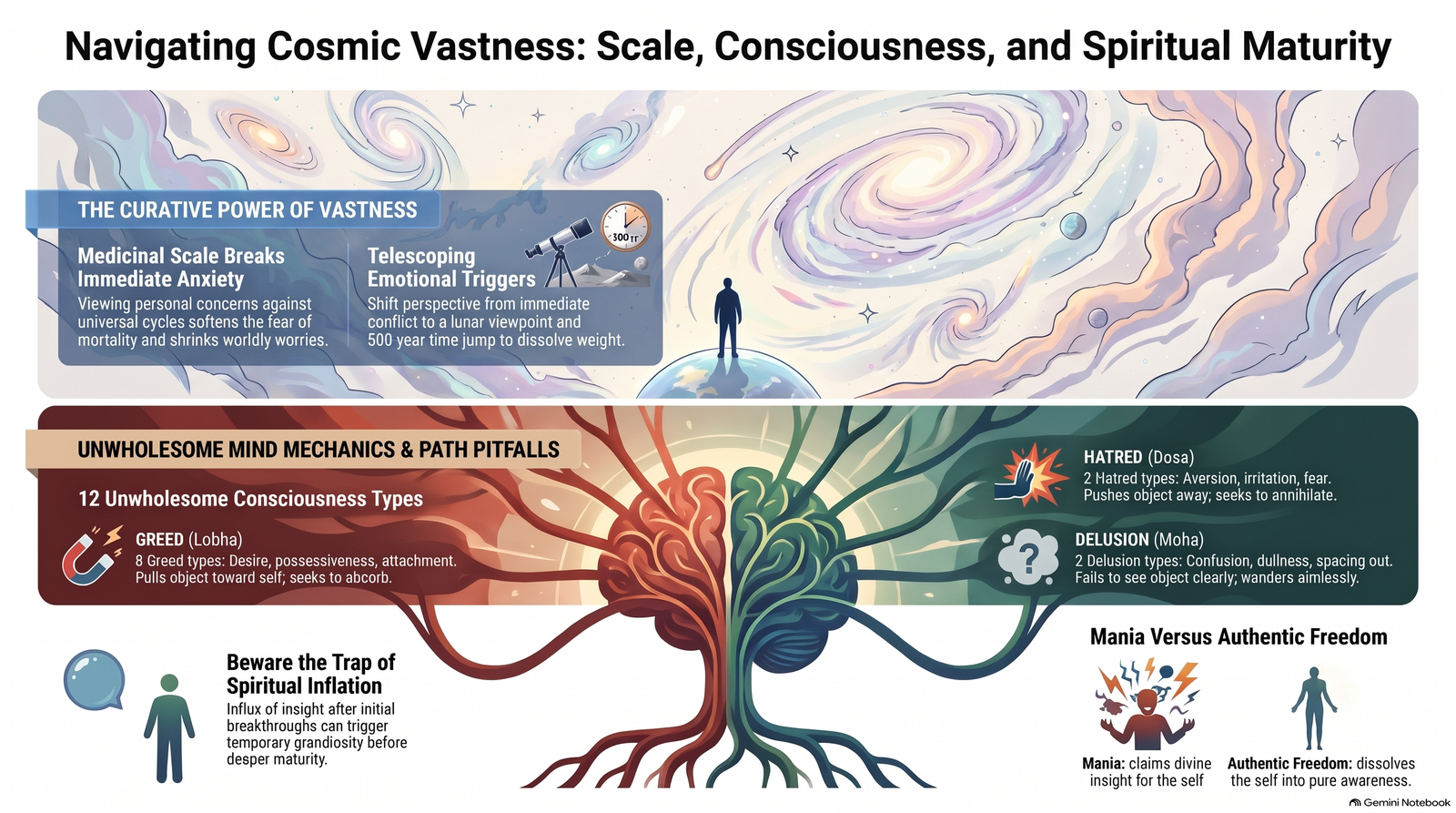
Text companion: the image moves from cosmic perspective to the eight–two–two classification, then to the risk of claiming insight as special status. In the Theravāda scheme, delusion accompanies all twelve unwholesome types, not only the two named after it. The broad emotional labels and the clinical contrast in the graphic require the qualifications given above.
Terms for the inquiry
Vastness and deep time
In this chapter, vastness means a widening of the frame in which a personal life is considered. Deep time concerns timescales far beyond a human lifespan. Their contemplative use is Robinson’s proposal; imagining immense duration is different from demonstrating endless cosmic cycles, rebirth or a particular spiritual attainment.
Saṃsāra and nirvāṇa
Buddhist traditions describe saṃsāra as cyclic existence conditioned by ignorance and craving, and nirvāṇa as liberation from those conditions. The recording emphasises how experience is appropriated as “mine”. That emphasis does not reduce all suffering to an attitude or mean that changing perspective alone completes liberation.
Akusala citta
In Theravāda Abhidhamma, this means unwholesome consciousness. The familiar twelvefold classification groups eight types under greed, two under aversion and two under delusion. These are categories within a traditional ethical analysis of mind, not twelve brain circuits, personality types or clinically validated diagnostic states.
Lobha, dosa and moha
These Pāli terms denote greed or attachment, aversion or hatred, and delusion. The recording’s pulling, pushing and fog images make them memorable. Delusion accompanies all unwholesome consciousness in this model; the roots are not three independent mechanisms, and their ethical significance is not removed by mechanical metaphors.
Prompted and unprompted
In the Theravāda classification, some consciousness types are distinguished by whether they arise with prompting or inducement. Prompting can involve oneself or another person. The recording’s advertising example illustrates one possibility, but “external stimulus” is not an exact definition, and a purchase does not establish its underlying classification.
Vicikicchā and uddhacca
These Pāli terms refer to doubt and restlessness in the Abhidhamma scheme. They distinguish the two types rooted in delusion alone. Here “doubt” is a technical hindering uncertainty, not a rejection of careful questioning. Ordinary distraction or indecision cannot by itself confirm a precise doctrinal category.
Bardo
A Tibetan term for an intermediate or transitional state, used in several contexts, including the interval between death and rebirth. The dialogue draws on that latter meaning to widen the story of a life. This is a traditional religious account, not empirical confirmation of continued consciousness after death.
Ten fetters and the arahant
In Theravāda accounts, ten fetters are bonds to cyclic existence, progressively abandoned along four stages of liberation culminating in arahantship. Robinson uses this map to discuss release from compulsive appropriation. It does not follow that an arahant stops perceiving, that perspective proves liberation, or that arahantship is identical with Mahāyāna Buddhahood.
Bhūmi
In Mahāyāna Buddhism, a bhūmi is a level of bodhisattva development; ten is a widely used enumeration. The recording invokes the eighth level as a threshold of stability. This belongs to a different map from Theravāda stream-entry and once-returning, and does not identify a threshold beyond which mental illness is impossible.
Trikāya and dharmakāya
Mahāyāna accounts distinguish dharmakāya, the Dharma body; saṃbhogakāya, the enjoyment body; and nirmāṇakāya, the emanation body. Interpretations vary. The dialogue concentrates on dharmakāya as still, boundless awareness. Its screen analogy is an interpretive aid, not proof of an eternal substance, a hidden observer or three physical bodies.
Spiritual inflation
Here this means turning a compelling experience into a claim of special identity, superiority or authority. The useful question concerns conduct: does an insight make someone more receptive and considerate? The term is not interchangeable with mania, and either modest or grandiose spiritual language is insufficient to establish a clinical condition.
Telescoping
The recording’s name for imagining a problem from a much wider spatial and temporal perspective. It expands a reflection in the book’s study guide. The page discusses that proposal without prescribing its visualisation sequence, promising physical relief, or treating it as a way to recognise dharmakāya or remove the final fetter.
Related pathways
- 3.3.8. DualityThe body now accompanies Wu Wei, the preceding revised-book chapter; its public title retains older wording.
- 3.3.9. Beyond DualityThe next revised-book chapter examines conceptual division and emptiness.
- 3.1.10. The Three BodiesA companion account of the three Buddha bodies, distinct from the Theravāda consciousness classification.
- 3.1.8. The BardoContext for the Tibetan teaching invoked when the recording widens the horizon beyond one life.
- Object — Part Three of Citrinitas | Spiritual Alchemy Course | Dr Simon RobinsonReturn to the section containing this inquiry into objects, perception and identification.
- Citrinitas – Part ThreeLocate Object within the four-section Citrinitas course.
External reference points
These sources clarify terminology and evidence boundaries. They are reference points for this companion page, not a claim that the hosts consulted or cited them.
- Nārada Mahā Thera · A Manual of AbhidhammaTranslation and explanatory notes on Anuruddha’s Abhidhammattha Saṅgaha, fifth edition (1987). Chapter I presents the twelvefold classification; this is a Theravāda manual, not experimental psychology.
- 84000 · The Sūtra of the Sublime Golden Light (Toh 555)Peter Alan Roberts’s translation of the thirty-one-chapter Tibetan version, largely derived from Yijing’s Chinese. Chapter 3 distinguishes the three kāyas; a textual reference point, not a source claimed by the recording.
- S. Yu and D. Nikolić · Quantum mechanics needs no consciousness (2011)A research paper in Annalen der Physik examining and challenging a proposed necessary link between conscious observation and wave-function collapse; it does not settle every interpretation of quantum theory.
- NASA Science · Universe overviewAn empirical cosmological reference distinguishing the expanding universe from the chapter’s imagery of repeated creation and collapse.
- NHS · Bipolar disorderA separate clinical description of mania and hypomania, including changes in sleep, energy, judgement and behaviour. It does not validate a spiritual attainment map.
Question to carry forward
When a concern fills the whole horizon, what wider context might help you meet it more patiently—and what concrete responsibility still needs your attention?
A broader view need not make the event trivial, require a belief in past lives, or cancel another person’s pain.