
Citrinitas · Object · Chapter 28 of 48
3.3.4. False Prophets
What happens when the search for truth becomes another way of protecting a preferred image of ourselves?
Book: Citrinitas, Revised Edition (2026), chapter 28, “False Prophets”. Reference 3.3.4 is catalogue notation.
Watch the discussion
Why Spirituality Becomes Self-Deception | Modern Alchemy
A two-host AI discussion interpreting the supplied chapter.
The chapter in brief
In Object, False Prophets turns the course’s concern with perception towards the authority we grant our own interpretations. Robinson’s “false prophet” is the inward narrator that announces progress, judges others and mistakes confidence for knowledge. The chapter distinguishes the simulacrum, a constructed self-model, from the simulation, the interpreted world experienced through it. Its central paradox is that teachings can loosen attachment while also becoming a new spiritual identity. Christian mirror and wolf imagery, Buddhist maps and a Qur’anic warning about unsupported claims provide different reference points for this inquiry; their alchemical alignment is the author’s synthesis. The practical emphasis falls on consequences: greater care, willingness to revise a belief and less need to defend a spiritual reputation. The chapter applies that provisional status to the book itself.
The video’s central question
Can a mind seeking liberation turn the search itself into another defence? The recording opens with an imagined golden tunnel that proves to be a cylinder of mirrors: an image of mistaking repeated self-reflection for an independently understood world. It places this discovery within Robinson’s solar stage, then introduces the eighth bodhisattva ground as the chapter’s proposed threshold beyond distortion. That threshold is an alchemical interpretation of a Mahāyāna map, not a neurological milestone or a test of anyone’s reliability. The hosts’ claim that historical alchemy was always spiritual metaphor is also too sweeping to serve as a history of the subject.
The discussion next separates the inward model of an observer from the world interpreted through it. A cinema projector makes the distinction tangible: memory and expectation contribute to the story through which an ambiguous email acquires a personal meaning. The hosts extend this into claims about sensory delay, predictive processing and the default mode network. Those comparisons do not establish that manas is a brain network, that perception is wholly fabricated, or that other people’s actions cannot harm us. Paul’s mirror and Shabistari’s poetic imagery are then reread through the same alchemical lens. Paul’s passage is 1 Corinthians 13:12; its Christian context concerns partial knowledge and love, rather than a theory of neurological projection.
A second problem follows: the ambition to eliminate ego can become another achievement claimed by ego. The proposed answer is a “corrective illusion”, a teaching used provisionally rather than possessed as an identity. The Buddhist raft supplies a precedent for relinquishing attachment to a useful teaching; it does not establish that the Dhamma is simply a falsehood. The hosts’ vaccine comparison is an analogy, not a medical explanation. Their inward reading of the wolf in sheep’s clothing then asks whether spiritual vocabulary conceals unchanged habits of superiority. Investigative doubt, the Kālāma discourse and Qur’an 17:36 shift attention from impressive claims towards grounds for trusting them.
The final movement develops Table 40 through ordinary disagreements: seeking contrary evidence, observing a reaction, tolerating ambiguity, examining defensiveness and receiving new information. A games tester becomes an image of looking for weaknesses in a favoured model. The recording distinguishes this inquiry from anxious self-suspicion, then moves into the study guide’s intensive “glitch in the mirror” exercise and a closing question about the projector running out of film. Here the useful challenge is kept ordinary: can a belief remain revisable while care, judgement and boundaries remain intact? No attempt to destabilise perception or erase a self is needed to consider that question.
Examining interpretation without dismissing harm
The recording sometimes treats distress as entirely self-generated and criticism as merely sound or data. That conclusion does not follow from recognising interpretation. A message may involve a misunderstanding, but it may also contain a real threat, manipulation or unfair treatment. Examining one’s assumptions can accompany checking facts, maintaining boundaries and holding another person accountable.
Likewise, “false prophet”, “illusion” and “delusion” are used here as philosophical images. They are not diagnoses. Persistent self-interrogation or an unsettled sense of reality is not evidence of spiritual progress, and the chapter’s gold-testing imagery is not an instruction to seek distress.
How the argument unfolds
The reassuring map becomes a mirror
The golden tunnel introduces the possibility that spiritual certainty is reflecting a preferred self-image.
Separate the model from its world
The simulacrum and simulation distinguish the imagined inward observer from the meanings attributed to experience.
The reformer joins the picture
Trying to defeat ego through personal achievement can reproduce the claim to specialness it seeks to remove.
Use the raft without owning it
A useful teaching can support inquiry while becoming another possession or badge of superiority.
Give doubt a limited job
Gold-testing and game-testing images turn doubt towards checking a claim rather than distrusting oneself indiscriminately.
Bring the inquiry into relationships
Table 40 and the closing mirror exercise move from metaphysical language towards reactions, evidence and everyday conduct.
Book and recording
The chapter’s emphasis
A compact account of the inward false prophet, the corrective teaching and five contrasts in Table 40. Its references to the Ground of Being and Subject section are thematic, not the immediate sequence of this revised edition.
The recording’s expansion
The hosts develop the mirrored tunnel, cinema, email, vaccine and game-testing examples, making the chapter more conversational while adding claims that require qualification.
The interpretive setting
The sources remain Buddhist, Christian, Islamic and Sufi texts in their own settings. Their shared use in this alchemical inquiry does not establish a single original doctrine.
Five shifts in stance
| The chapter’s contrast | A grounded reading |
|---|---|
| Validation → falsification | Ask what evidence could change the view, rather than collecting only reassurance. |
| Identification → observation | Notice a reaction without making it a verdict on personal worth. |
| Certainty → clarity | State what is known, inferred and still uncertain. |
| Defence → dissection | Examine the disputed claim and one’s response while retaining appropriate boundaries. |
| Projection → reception | Make room for information about the other person that the familiar story leaves out. |
Video chapters · estimated positions
These supplied chapter links are approximate listening aids, not audio-verified boundaries. The untimed final transcript supports the themes but cannot confirm the exact positions or every heading’s order.
- 00:00Opening: The False Prophet Within
- 02:20Why the Mind Creates Illusions
- 06:10Seeing Through a Glass, Darkly
- 10:40Simulacrum vs Simulation
- 15:30The Ego as Spiritual Authority
- 20:40Corrective Illusions and the Raft
- 25:20The Wolf in Sheep’s Clothing
- 30:10The Epistemology of Doubt
- 35:00Projection, Mirrors, and Reality
- 39:40False Prophet vs Alchemist
- 44:10The Glitch in the Mirror
- 47:00Closing Reflections
A visual companion
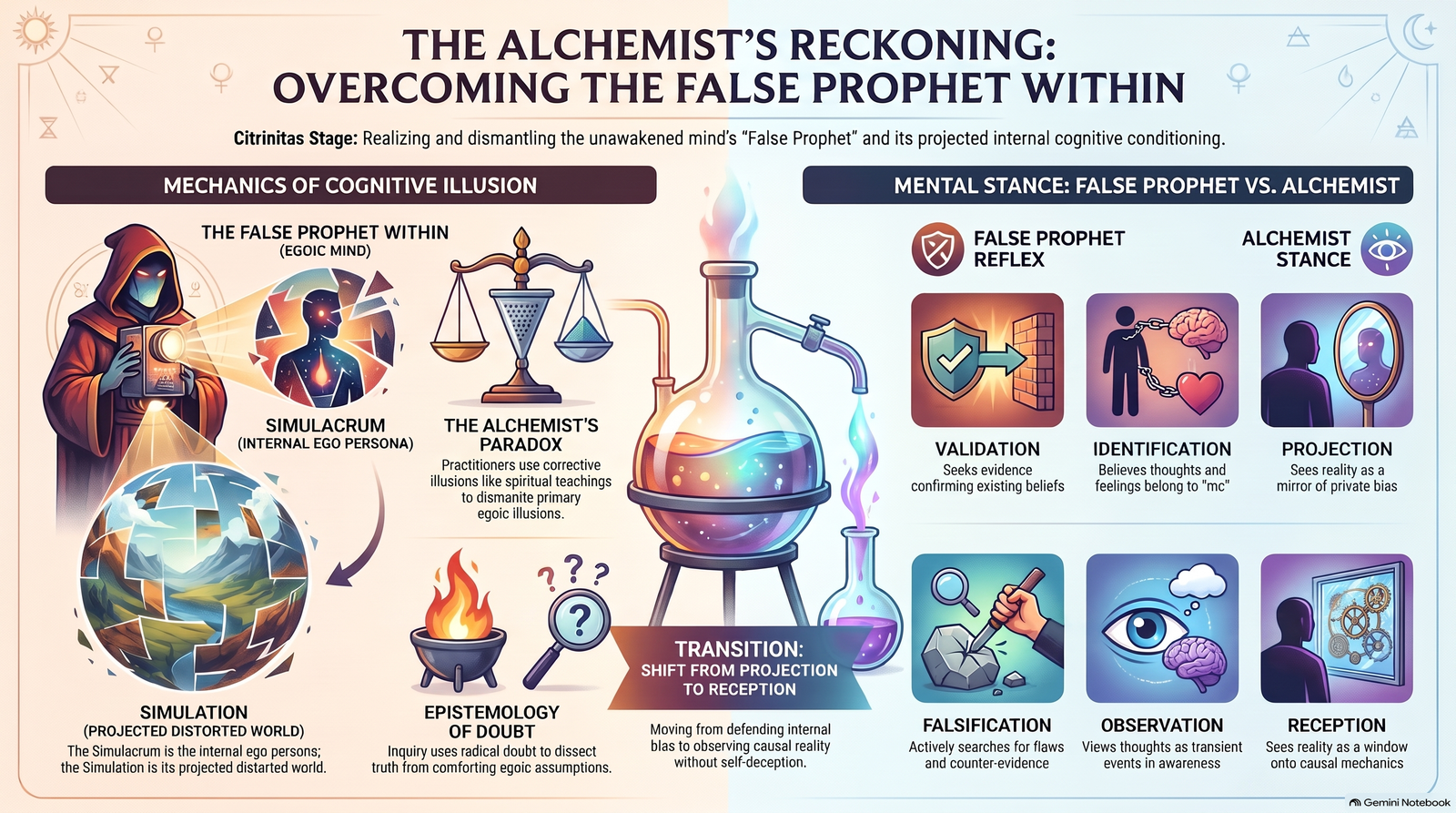
Terms for careful reading
False prophet
Robinson’s inward metaphor for the voice that grants itself spiritual authority while protecting its own status. It is not a claim that ordinary inner speech is malicious, an entity to be expelled, or a clinical symptom. The biblical warning about false prophets is being redirected inward; that reinterpretation does not remove the need to assess external teachers and institutions.
Simulacrum and simulation
In this chapter, the simulacrum is a constructed model of an inward observer; the simulation is the experienced world as interpreted through it. These are the author’s stipulated uses, not a universal technical vocabulary. They describe an inquiry into self-reference and interpretation, without demonstrating that the external world is software or that other people are private inventions.
Manas · the seventh consciousness
In Yogācāra’s influential eight-consciousness model, afflicted manas concerns the habitual appropriation of experience as self. It is not simply a name for every thought or for a little observer in the head. The recording’s comparison with the brain’s default mode network is speculative; a doctrinal category and a measured neural network cannot be treated as interchangeable.
Nāma-rūpa · name and form
In early Buddhist dependent origination, this term concerns mental and material factors of experience. In a standard early-discourse analysis, “name” includes feeling, perception, intention, contact and attention, while consciousness is distinguished from it. The chapter’s “cognitive persona” is a broader interpretive use, not an exact translation or a simple synonym for the five aggregates.
Bhūmi and Acalā
A bhūmi is a ground of the bodhisattva path in Mahāyāna traditions. Acalā, the eighth in a prominent ten-ground presentation, is often rendered “Immovable” or “Unwavering” and associated with freedom from effortful dualistic engagement. Robinson’s placement of the end of the “false prophet” here is his synthesis. It neither establishes a brain change nor certifies anyone’s attainment.
Afflictive and cognitive obscurations
Mahāyāna explanations commonly distinguish impediments associated with affliction from those obstructing the fullest knowledge of a buddha. Their precise removal is explained differently across systems. The recording compresses these distinctions when it makes the eighth ground the end of distortion as such. Reduced anger or an unusual experience is not proof that either class has been eliminated.
Saṃsāra
In Buddhist traditions, saṃsāra concerns conditioned wandering and repeated birth sustained by ignorance and craving. The chapter uses it more broadly for conditioned, self-referential experience. That rendering should not be substituted for the full traditional meaning. Conditioning does not make every observation false, and ordinary ethical judgement remains relevant within the discussion.
Corrective illusion and the raft
“Corrective illusion” is Robinson’s term for a conceptual framework used to loosen another framework’s grip. MN 22 compares the Dhamma to a raft for crossing rather than clinging. The original simile concerns grasping a teaching appropriately and relinquishing attachment; calling that teaching an illusion is a further interpretation, not the wording or full meaning of the Buddhist source.
Epistemology of doubt · vicikicchā
Epistemology asks what warrants knowledge or belief. The chapter’s investigative doubt tests reasons and consequences without requiring constant suspicion of oneself. Vicikicchā names a hindrance in early Buddhist accounts and is not simply identical with all questioning. The contrast is between paralysing uncertainty and purposeful investigation, rather than a licence to turn every feeling into a problem.
Kālāma Sutta · AN 3.65
This early Buddhist discourse addresses conflicting teachers and examines harmful and beneficial qualities. It does not endorse whatever feels personally convincing: the judgement of the wise and the consequences of conduct also matter. The chapter’s opening epigraph is a loose paraphrase, not a verified verbatim translation. Comparing the discourse with scientific inquiry is a modern analogy.
ʿIlm and ẓann
In the Islamic material invoked here, ʿilm concerns knowledge, while ẓann can concern supposition or conjecture, depending on context. Qur’an 17:36 warns against pursuing what one lacks knowledge of and emphasises accountability. It contains the term for knowledge; the chapter supplies the contrast with conjecture. Neither Arabic term denotes a neuroscientific mechanism such as predictive coding.
Mirror, illusion and delusion
Paul’s mirror in 1 Corinthians 13:12 and Shabistari’s Sufi imagery are given an inward alchemical reading. That comparison does not establish identical teachings. Likewise, the chapter’s contrast between recognised illusion and unrecognised delusion is a philosophical simplification, not a clinical definition or a way to diagnose a reader. Recognising interpretation does not guarantee accurate judgement.
Related pathways
- 3.3.3. The MagusThe preceding revised-book chapter develops the self-model and simulation imagery used here.
- 3.3.2. SolipsismDistinguishes questions about perception from claims that only one private mind exists.
- 3.2.9. The Metaphor of the Film ProjectorProvides the course’s fuller context for the projector metaphor.
- 2.4.1. ExperimentAn Albedo connection for treating an account as open to inquiry rather than beyond challenge.
- The SimulacrumAn earlier account of the constructed inward persona; read alongside this chapter’s more specific distinctions.
- Object — Part Three of Citrinitas | Spiritual Alchemy Course | Dr Simon RobinsonReturn to the published Object section overview; its older chapter ordering differs from this revised-book sequence.
External reference points
- Kālāma Sutta · AN 3.65 · Ṭhānissaro Bhikkhu translationThe discourse and translator’s note place inquiry alongside ethical consequences and the judgement of the wise.
- The Water-Snake Simile · MN 22 · Ṭhānissaro Bhikkhu translationRead the raft alongside the warning about grasping a teaching wrongly, rather than as a declaration that every teaching is false.
- The Ten Bhūmis · Peter Alan Roberts translation for 84000A Mahāyāna scriptural setting for the bodhisattva grounds and the eighth ground, distinct from a modern neurological model.
- 1 Corinthians 13 · New Revised Standard Version Updated EditionVerse 12 supplies the mirror image within Paul’s discussion of love and partial knowledge; the alchemical application is a later reading.
- Qur’an 17:36 · Mustafa Khattab, The Clear QuranA warning against unsupported claims, in its Islamic ethical setting; not a statement about cognitive simulation.
A question to carry forward
In a small disagreement, what is directly known, what have you inferred, and what new information would lead you to revise your interpretation?
Consider one ordinary situation. Leave room both for a mistaken assumption and for a legitimate concern that deserves a clear response.