
Citrinitas · Object · Chapter 29 of 48
3.3.5. The Transmutation of Suffering
Can difficult experience deepen compassion without becoming a reason to excuse harm?
Revised Edition (2026): chapter 29, The Transmutation of Suffering. The reference 3.3.5 is catalogue notation. Duration and publication month are supplied by the author.
Watch the discussion
How Suffering Becomes the Path | Modern Alchemy
The chapter in brief
Within Object, this chapter moves from the examination of spiritual self-deception to the difficulties of living with other people. Robinson asks how attraction, aversion and the defence of an inward “judge” can add suffering to experience. The same object can become treasure or rubbish through different histories of interpretation; recognising this invites scrutiny of the meanings we take for granted.
The peacock provides the chapter’s organising image. Alchemical iridescence and the poison imagery of Tibetan Buddhist mind training become a “digestive fire”: adversity reconsidered as material for wisdom and compassion. The Wheel of Sharp Weapons, conditioned agency, equanimity and a final image of demolished walls develop that reversal. These connections are Robinson’s synthesis. They do not establish that every misfortune is deserved, that trauma is necessary, or that a person becomes physically invulnerable through insight.
The video’s central question
How can a person meet adversity without either feeding retaliation or surrendering judgement? The recording opens with a malicious workplace accusation and the disturbing proposal of accepting false blame. It then steps back to ask what makes an event hurt. An antique-shop trinket and an ambiguous “Fine.” message illustrate how knowledge, expectation and insecurity shape significance. The hosts also use OCD to explain projection; that example is an oversimplification, not a clinical account. Interpretation matters, but neither objects nor harmful actions become inconsequential because people experience them differently.
The next movement contrasts withdrawal with the bodhisattva’s engagement, then introduces the peacock’s tail, poisonous snakes and Neo facing Agent Smith. These are symbolic and cinematic comparisons. The recording’s description of venom becoming feather colour is not established biology, and its portrait of arahants as retreating from others is not an adequate account of Theravāda liberation. The useful tension is between protecting a private state of peace and remaining available to others; it need not become a ranking of traditions or a demand to invite danger.
The Wheel of Sharp Weapons supplies the hardest turn. Hunger, compulsion and false accusation are read as returning consequences of self-cherishing, with the eighth bhūmi invoked to explain fearless compassion. The hosts raise objections to accepting blame, yet answer with claims of an unreal, invulnerable self. Those claims cannot establish that someone caused their own mistreatment or should confess to wrongdoing they did not commit. The subsequent account of conditioned agency, reinforced through a social-media analogy and MN 19, asks how habit narrows response. Its language of algorithms and neuroplasticity remains analogy; the discourse does not prove neurological determinism or abolish responsibility.
The discussion then reads the peacock’s anatomy as a symbolic repertoire of foresight, steadiness and integrated impulse. Christian forgiveness, the demolition of walls and Tārā’s traditional vow broaden the comparison before equanimity is distinguished from indifference. The closing returns to everyday irritations and explicitly cautions against seeking pain or remaining in abuse. Its final interpretation of exhaustion as ego-resistance, however, is not a reliable account of fatigue. Rest, protection and appropriate support remain legitimate. The chapter’s challenge can be carried into ordinary relationships as a question about clearer, less retaliatory action, without treating injury as a spiritual meal one is obliged to consume.
Responsibility without self-blame
The “boomerang” is a forceful image within a Tibetan mind-training text, not evidence that a particular person’s illness, poverty or mistreatment was caused by their past wrongdoing. Early Buddhist SN 36.21 explicitly rejects the view that everything felt is entirely due to past action, recognising other causes. Different textual settings must remain distinguishable.
Examining one’s response does not transfer responsibility away from someone causing harm. Correcting a false accusation, leaving danger and addressing injustice can be compassionate actions. Emptiness does not cancel injury, consent or consequences. Neither trauma nor exhaustion is proof of progress; the image of demolished walls should not be used to discourage recovery, rest or care.
The argument, in seven movements
Begin with unjust blame
A workplace accusation makes the proposed reversal of self-defence immediately difficult.
Examine the reflected value
The trinket and text-message examples distinguish an event from the significance brought to it.
Introduce the peacock
Poison, iridescence and the Matrix turn adversity into a metaphor for transformation.
Confront the returning weapon
The mind-training formula tests the difference between taking responsibility and accepting false blame.
Question automatic reactions
Conditioned agency and the algorithm analogy lead into the image of a digestive fire.
Read the bird and the broken wall
Anatomical symbolism, forgiveness and Tārā frame the movement towards equanimity.
Return to ordinary limits
Everyday friction and cautions about abuse precede a provocative, questionable interpretation of exhaustion.
Book, recording and interpretation
The chapter’s emphasis
Reflection, the peacock, two tables and The Wheel of Sharp Weapons organise a compact argument about adversity.
The recording’s expansion
Workplace accusation, ambiguous messages, traffic and recommendation algorithms make the argument concrete while adding clinical and neurological overstatements.
The comparative framework
Alchemical colours, Tibetan mind training, Christian forgiveness and modern cinema meet in Robinson’s interpretation; their similarities do not establish identical doctrines.
A visual companion
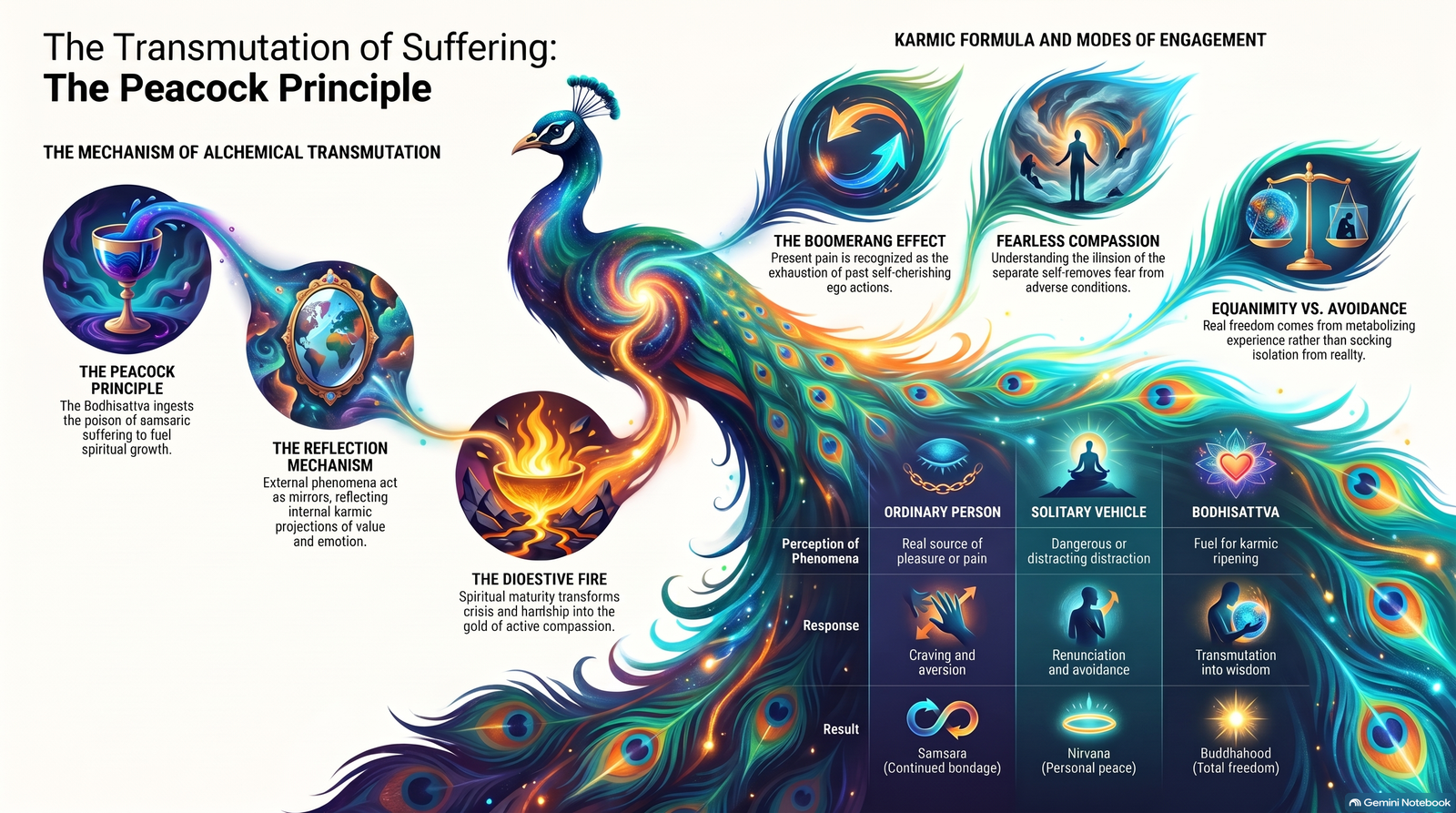
Terms for careful reading
Saṃsāra
In Buddhist traditions, saṃsāra is the cycle of conditioned existence and rebirth sustained by ignorance and craving. Robinson also uses it for familiar patterns of reactive living. This psychological interpretation does not exhaust the traditional meaning, and calling experience conditioned does not make other people’s suffering unreal.
Reflection of phenomena
Robinson’s term for the way an object becomes desirable, repulsive or significant through conditioning. It is useful here as an inquiry into valuation. It does not mean that all facts are subjective, that an external world has been disproved, or that injury is only a projection of the injured person’s mind.
Cauda pavonis · the peacock’s tail
Latin for the peacock’s tail, used in alchemical imagery for a many-coloured appearance in the work. Robinson connects it with transformation through adversity. The detailed meanings he assigns to the bird’s anatomy are presented here as his symbolic reading, rather than a single universal alchemical code or a description of biological processes.
Lojong · mind training
A Tibetan Buddhist genre and tradition of training attitudes, especially in relation to self-centredness, adversity and concern for others. Its forceful rhetoric is addressed to the practitioner’s own orientation. It should not become a judgement imposed on a victim or a reason to deny another person practical help.
The Wheel of Sharp Weapons
A Mahāyāna mind-training work attributed to Dharmarakṣita. Its returning weapon directs attention towards self-cherishing and harmful conduct. The linked poetic rendering is credited to Alexander Berzin and Sharpa Tulku, with Jonathan Landaw and Khamlung Tulku, based on Geshe Ngawang Dhargyey’s explanations. Its peacock imagery concerns poisonous plants; the recording’s snake narrative is an elaboration.
Karma and self-cherishing
In Buddhist ethical contexts, karma concerns intentional action and its consequences; it is not a synonym for fate or punishment. Self-cherishing, in this mind-training context, means prioritising oneself at others’ expense. It should not be equated with all self-care. No identifiable past wrongdoing can be inferred merely from present suffering.
Bodhisattva and bodhicitta
In Mahāyāna traditions, a bodhisattva pursues buddhahood for the benefit of beings; bodhicitta is the resolve to awaken for their sake. The ideal joins wisdom and compassion. The chapter’s poison metaphor expresses that commitment, without making suffering compulsory or treating the bodhisattva as an arahant with an additional qualification.
Arahant and solitary realiser
An arahant is liberated through ending the defilements in Theravāda accounts; a solitary buddha or paccekabuddha is a distinct category, not a synonym. The recording compresses them into a withdrawal model. Renunciation need not entail emotional indifference, and living arahants can teach, care and participate in community.
Eighth bhūmi
Bhūmi means a ground of the bodhisattva path in Mahāyāna. The eighth is commonly called Acalā, the Immovable, in a ten-ground presentation. Robinson uses it to explain fearless engagement. That is a doctrinal and interpretive placement, not a clinical state, an exemption from ethics, or a way to certify someone’s attainment.
Emptiness · śūnyatā
In Mahāyāna philosophical settings, emptiness concerns the absence of inherent, independent existence. It does not make conventional persons and consequences irrelevant. The Matrix comparison is a modern illustration; it cannot establish a literal simulation or show that a person can escape injury by recognising the self as empty.
Upekkhā · equanimity
A Pāli term for balanced, even-minded engagement. Equanimity is cultivated in early Buddhist and later traditions, alongside kindness and compassion; it is not exclusive to the bodhisattva. The recording’s hurricane image conveys steadiness, but feeling fear or needing distance does not demonstrate spiritual deficiency. Protective action and emotional responsiveness remain compatible with balance.
Vedanā · feeling-tone
In early Buddhist analysis, the pleasant, painful or neutral tone of experience, distinguished from the fuller stories and emotions built around it. Non-reactivity need not erase these distinctions. The recording’s image of feeling-tones flattening should not be read as requiring emotional numbness, reduced sensation or the suppression of ordinary needs.
Conditioned agency and digestive fire
The chapter links habitual reaction with a metaphor of metabolising adversity into compassion. MN 19 describes how repeated thinking inclines the mind; it does not describe neurons or prove that all choice is predetermined. “Digestive fire” belongs to the author’s alchemical interpretation, not physiology or a validated method of treating distress.
Related pathways
- 3.3.4. False ProphetsThe preceding book chapter examines how spiritual certainty can protect self-image.
- 3.2.8. The Perfections (Pāramīs)Generosity, patience and wisdom place the discussion of adversity in an ethical context.
- 3.2.10. The Veil of IsisA neighbouring metaphor for the distinction between experience and its interpretation.
- Object — Part Three of Citrinitas | Spiritual Alchemy Course | Dr Simon RobinsonReturn to the Object section and its enquiries into perception and the observer.
- Citrinitas – Part ThreeLocate this chapter within the four sections of Citrinitas.
External reference points
- The Wheel of Sharp Weapons · poetic renderingDharmarakṣita, in the Berzin–Sharpa Tulku rendering with collaborators credited above. Read the peacock and returning-weapon rhetoric in its mind-training setting.
- SN 36.21 · To SīvakaTranslated by Ṭhānissaro Bhikkhu. An early Buddhist counterpoint to the claim that every painful feeling is entirely caused by past action.
- MN 19 · Two Sorts of ThinkingTranslated by Ṭhānissaro Bhikkhu. A source for the relationship between repeated thinking and mental inclination, without the recording’s added neuroscience claims.
Question to carry forward
In an ordinary disagreement, what would it mean to take responsibility for my next action while remaining truthful about what happened and attentive to everyone’s safety?