
Nigredo · Dharma · Chapter 21 of 48
1.2.9 The Four Noble Truths
What changes when suffering is approached neither as punishment nor as personal failure, but as a conditioned problem that can be understood?
Watch the chapter discussion
Why Suffering Exists—and How It Ends
The book
The chapter in brief
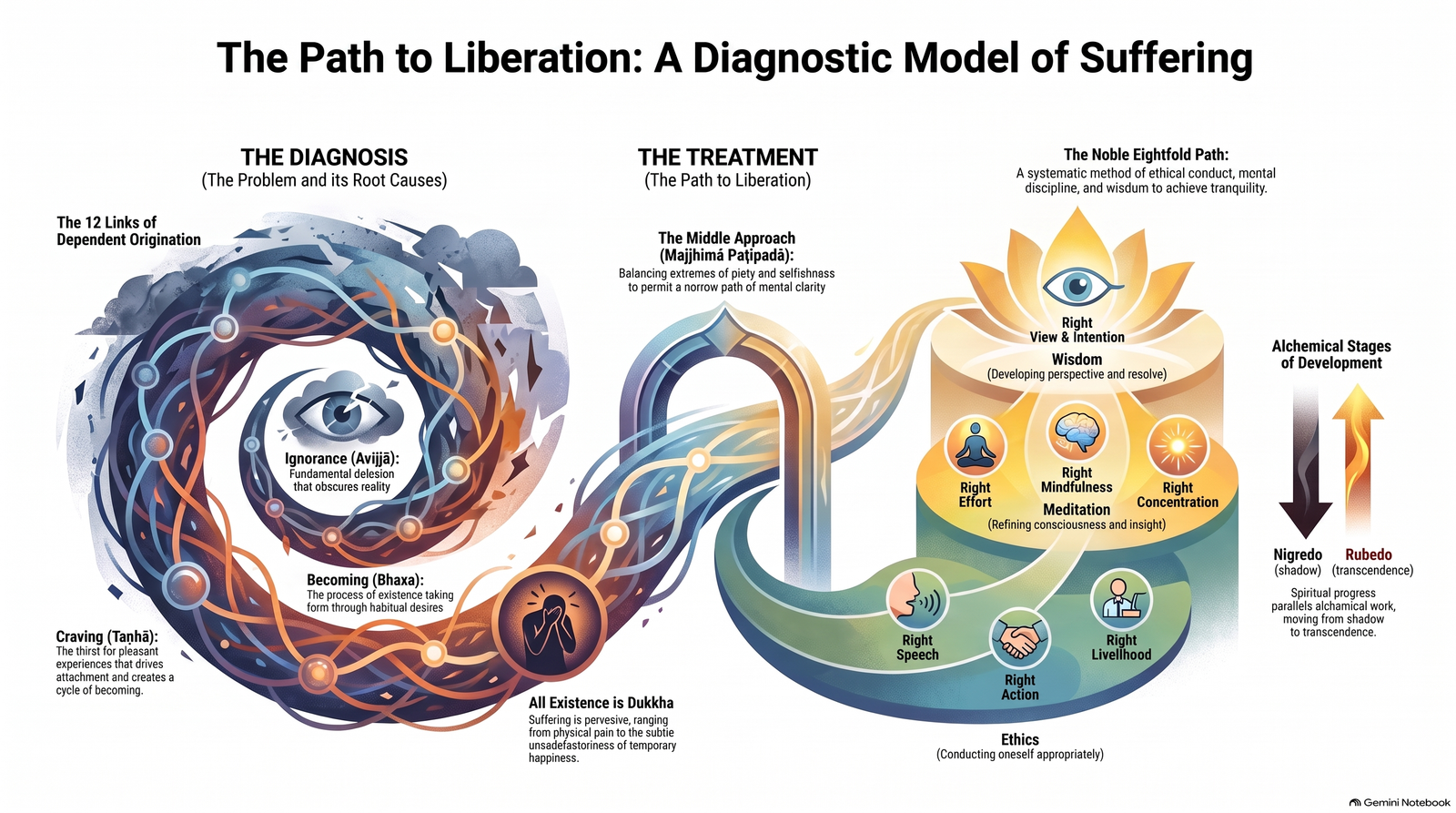
This ninth Dharma chapter presents the Four Noble Truths as a diagnostic map: dukkha is identified, craving is traced as its origin, cessation is held to be possible, and the Noble Eightfold Path provides the way of practice. The chapter introduces dependent origination to show how feeling, craving and clinging participate in the continuation of suffering.
It then connects the path with the course’s movement through Nigredo, Albedo, Citrinitas and Rubedo. That alignment is Dr Robinson’s modern alchemical synthesis rather than a standard Buddhist doctrine. The chapter is therefore most useful as both an introduction to a foundational Buddhist framework and an invitation to examine how dissatisfaction is repeatedly constructed in experience.
Visual orientation
Diagnosis, treatment and liberation
Video guide
Can suffering be understood as a process?
The recording begins by challenging the abbreviated, reassuring version of the Four Noble Truths often encountered in popular culture. It presents the Buddha as a physician and the truths as a four-part diagnostic pattern: identify the illness, locate its cause, establish that recovery is possible, and prescribe a treatment. This medical comparison has a long place in Buddhist interpretation. The stronger historical claim that the truths simply reproduce a fixed Indian medical protocol should be treated as an explanatory analogy rather than a settled account of their origin.
The first truth is explored through dukkha. The English word “suffering” catches pain and distress but can obscure subtler instability. The video’s uneven-wheel and disappearing-pizza images show how a pleasant experience may be genuine while remaining unable to provide lasting security. Early Buddhist formulations do not merely declare that every instant feels miserable: they identify birth, ageing, illness, death, separation, frustrated desire and, in summary, the five aggregates subject to clinging as dukkha.
The second truth names craving—taṇhā, literally “thirst”—as the origin of dukkha. The discussion broadens this from wanting an object to relying on sensations, relationships, roles and ideas to complete or stabilise a self. It then moves into dependent origination. The river vortex becomes the central image: a recognisable pattern exists conventionally, yet no separate, unchanging object can be removed from the moving water. This offers an accessible way to approach no-self without claiming that people, choices or consequences do not exist.
The twelve-link account is presented as the machinery beneath the diagnosis. Ignorance conditions formations; formations condition consciousness; and the sequence continues through name-and-form, the six sense bases, contact, feeling, craving, clinging, becoming, birth, ageing and death. The recording’s language of hard drives, subroutines and “hacking the program” is contemporary metaphor. Traditional schools and interpreters differ over whether the links are read across lives, within a single life, moment by moment, or through several complementary timescales.
Particular attention falls on the movement from contact to feeling and from feeling to craving. Vedanā here means pleasant, painful or neither-painful-nor-pleasant feeling tone, not a complex emotion. The bakery example makes habitual momentum vivid: a pleasant sensation can be followed rapidly by pursuit, self-story and a projected future. The speakers’ language of “zero free will” and “biochemical puppets” is deliberately dramatic, however. It is neither required by the Buddhist model nor established by the recording as a scientific conclusion.
The third truth, cessation, changes the tone of the inquiry. If dukkha depends on causes, it is not an eternal sentence: when the relevant craving and clinging cease, the suffering sustained by them ceases. The recording describes this as dismantling a mechanism rather than acquiring a perfected spiritual identity. Its vortex metaphor culminates in “just the water”—a vivid expression of release from rigid self-construction, not a denial of conventional personhood, ethical responsibility or human care.
The fourth truth introduces the Noble Eightfold Path. In its conventional order the factors are right view, intention, speech, action, livelihood, effort, mindfulness and concentration. They are commonly gathered under wisdom, ethical conduct and mental cultivation, and develop together rather than as a simple ladder. The video usefully explains why speech, action and livelihood matter to mental life, but their significance is wider than conserving attention or avoiding internal “CPU usage”: non-harming and ethical relationship are integral to the path.
The closing movement maps the course’s four alchemical colours onto spiritual transformation. Nigredo names disillusionment and decomposition; Albedo, analysis and clarification; Citrinitas, integration; and Rubedo, release beyond defensive identification. This gives the course a coherent symbolic architecture. It should not be mistaken for an equivalence established by early Buddhism or historical European alchemy, and neither depression nor crisis is a required gateway to insight.
Argument map
How the inquiry develops
Read the truths diagnostically
The fourfold structure moves from recognising dukkha to its origin, cessation and a path of practice.
Distinguish pain from instability
Dukkha includes overt suffering but also the inability of changing, conditioned experiences to provide permanent security.
Trace craving beyond desire
Craving includes the effort to secure identity and completion through sensations, possessions, relationships, status and views.
Follow the conditioned sequence
Dependent origination places feeling, craving and clinging within a wider account of how suffering and becoming are sustained.
See cessation as possible
Because the process depends on conditions, weakening and ending its causes offers a path beyond compulsive repetition.
Practise an integrated path
Wisdom, ethics and mental cultivation work together; the course then interprets this movement through its four alchemical stages.
Book, video and context
Three layers of the discussion
The written chapter
Introduces dukkha, craving, cessation and the Eightfold Path; sketches dependent origination; and relates path consciousness and the fetters to the course’s alchemical sequence.
The video’s expansion
Adds the physician, uneven wheel, pizza, vortex, bakery and computer-code analogies, giving particular attention to automatic feeling, craving and the construction of a future self.
The evidence boundary
The Four Noble Truths and dependent origination are Buddhist teachings. Claims about programming, cognitive engineering and alchemical equivalence are explanatory metaphors or course synthesis, not demonstrated neuroscience.
The main correction
The path is conventionally ordered from right view through right concentration and is not reducible to interrupting one mental signal. Ethics, wisdom and cultivation remain mutually supporting dimensions.
Clickable chapters
Navigate the video
These markers come from the supplied YouTube catalogue and follow the recording’s principal movements. The final runtime was not separately supplied, so no duration is stated on this page.
Key language
Glossary
Dukkha
Taṇhā
Nirodha
Magga
Dependent origination
Vedanā
Upādāna
Bhava
Noble Eightfold Path
Path consciousness
Nigredo, Albedo, Citrinitas and Rubedo
Continue through the course
Related pathways
- 1.2.8 SaṃsāraThe preceding chapter examines karma, continuity and rebirth, providing the immediate setting for the problem of dukkha.
- 1.2.10. The Cycle of BecomingThe next chapter develops dependent origination and the sequence through which craving, clinging and renewed becoming arise.
- 1.2.7 The Forces that Drive The MatrixIntroduces karma and conditional relations behind the present chapter’s account of repeated patterns.
- 1.2.12. The Eightfold Noble PathReturns in detail to the practical path introduced here as the fourth truth.
- Dharma — Part Two of NigredoThe section index for the twelve chapters analysing conditioned experience, suffering and liberation.
Context beyond the course
External reference points
- SuttaCentral — Setting in Motion the Wheel of the Dhamma (SN 56.11)An early discourse presenting the Four Noble Truths, their tasks and the Buddha’s account of awakening to them.
- SuttaCentral — Dependent Origination (SN 12.1)A concise statement of the twelve-link sequence and its cessation.
- SuttaCentral — The Characteristic of Not-Self (SN 22.59)A foundational early discourse examining why changing and afflictive aggregates should not be taken as self.
- Buddhist Publication Society — The Noble Eightfold PathBhikkhu Bodhi’s systematic introduction to the path factors as wisdom, ethical discipline and mental development.
A two-minute observation
Notice the difference between feeling and demand
Choose an ordinary, low-stakes experience: a pleasant taste, an irritating sound or the urge to check a message. Without suppressing anything, notice the initial feeling tone and what follows. Does the mind lean towards repetition, push the experience away, or construct a story about what it means for “me”? The aim is not to eliminate preference. It is simply to see whether feeling and craving can be distinguished more clearly.