
Nigredo · Mythos · Chapter 2 of 48
1.1.2. The Alchemist
What draws a person beyond ordinary dissatisfaction into sustained enquiry—and when does curiosity illuminate suffering rather than romanticise it?
Watch the chapter discussion
Why You’re Drawn to This
The book
The chapter in brief
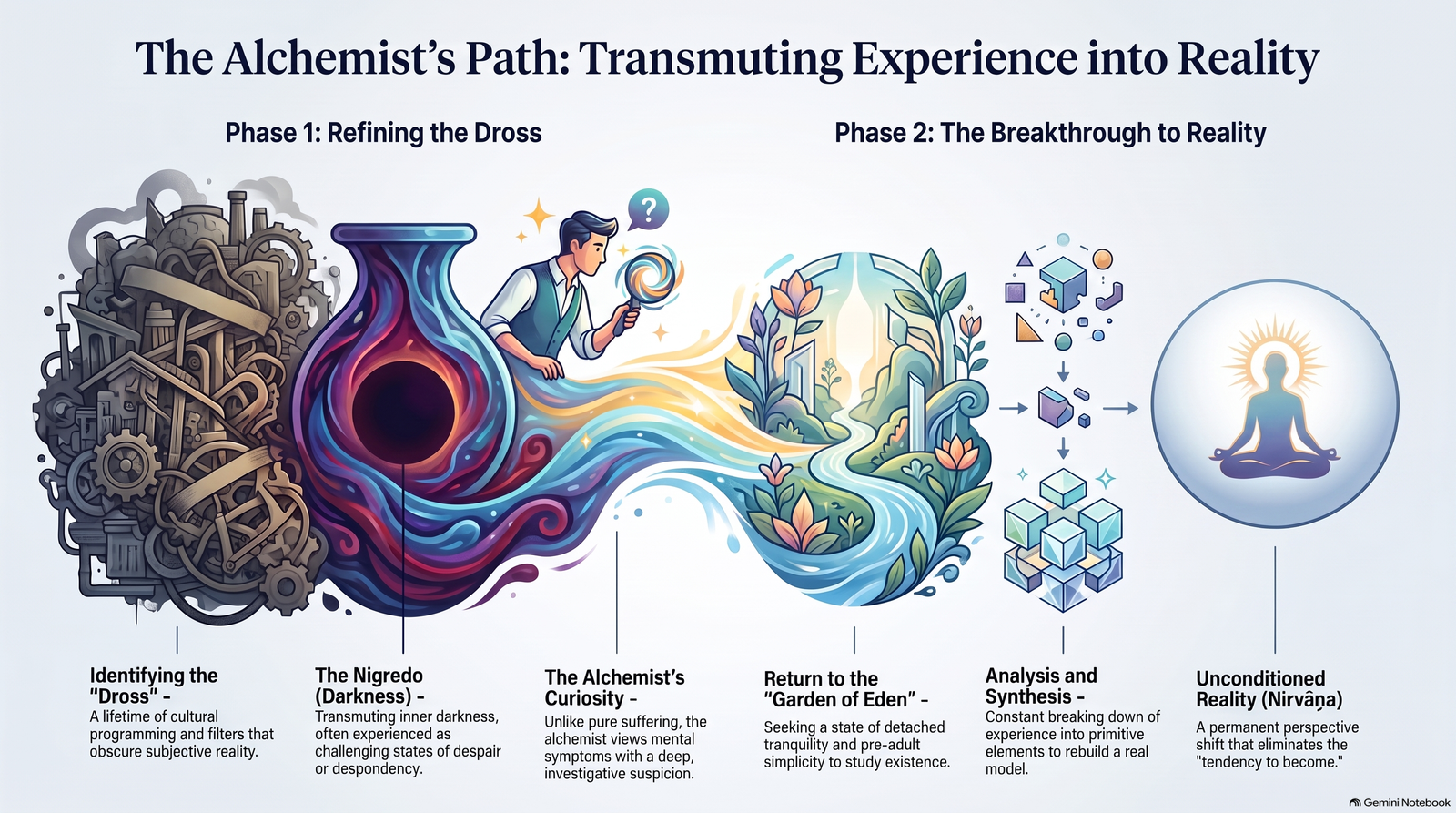
The Alchemist asks what kind of person becomes deeply interested in transformation. It presents the aspiring alchemist as a persistent investigator of subjective experience: someone disenchanted with purely external accounts of life, drawn to analyse how perception, thought, identity and suffering are constructed, and willing to rebuild a more serviceable model through synthesis.
The chapter then sketches the direction of the course. It moves from conditioned “dross” and the darkness of Nigredo towards a recovered simplicity symbolised by the Garden of Eden, a stable perspective from which experience may be observed, and an eventual encounter with Nirvāṇa or the unconditioned. Rebirth, Eden and alchemical transmutation belong here to Dr Simon Robinson’s spiritual synthesis; they should not be mistaken for established psychological findings or a single account accepted across alchemy and Buddhism.
Video guide
Who is the alchemist in a modern inner work?
The recording begins by setting aside the popular picture of alchemy as a failed attempt to manufacture gold. For this chapter, “alchemy” names a modern inward discipline and “the alchemist” a type of seeker rather than a historically uniform profession. The hosts address listeners who feel that conventional descriptions of life are insufficient, then interpret the opening line—“This is not your first rodeo”—through both literal rebirth and the more accessible idea that a present self stands on years of earlier searching. The first reading is a metaphysical commitment; the second is a psychological metaphor.
From there, the discussion defines existence through first-person continuity, using the discontinuity of falling asleep and waking as its central example. It correctly emphasises that lived experience includes perception, feeling, memory and thought, but sometimes moves too quickly from the privacy of experience to claims about what existence ultimately is. Subjective and objective descriptions answer different questions: the personal meaning of a sound is not reducible to its measurable features, yet those features do not become imaginary because listeners respond differently.
The episode next presents disenchantment as a catalyst. If a person identifies entirely with body, role, possessions or status, change and mortality can make life feel precarious. The proposed method is the “retort” of analysis and synthesis: separate an event from the story attached to it, notice sensations, impulses and thoughts, then construct a less engulfing interpretation. The traffic example resembles forms of mindful observation and cognitive distancing, but the video’s language of escaping “animal nature” is rhetorical rather than a biological account.
The most evocative movement concerns language and childhood. Labels can make perception habitual, and deliberately noticing shape, light and texture before naming an object can refresh attention. The stronger claim—that literacy diminishes our capacity to grasp reality or that infants inhabit an undivided bliss—is not established by the discussion. “Returning to Eden” is therefore best treated as a contemplative metaphor for meeting experience with fewer automatic assumptions, not as literal regression or a developmental theory.
The closing movement distinguishes transient bliss from a steadier equanimity, describes Nirvāṇa as unconditioned reality, and turns towards the dross of Nigredo. Here the video is at its riskiest: despair, depression and psychosis are discussed as possible forms of inner darkness, while curiosity is proposed as the feature that makes someone an alchemist. Curiosity may help a person observe experience, but it is not a diagnostic test and does not make severe symptoms spiritually necessary. The responsible conclusion is not to reinterpret illness in isolation, but to let philosophical enquiry coexist with appropriate care, reality testing and support.
Argument map
How the discussion moves
Alchemy redefined
The episode replaces the stereotype of metallic transmutation with the course’s psychological and spiritual use of alchemical language.
The veteran seeker
“Not your first rodeo” frames attraction to the work through rebirth, accumulated experience or a personal history of searching.
Existence from within
Sleep, waking and different responses to the same stimulus distinguish first-person life from external description.
Disenchantment as catalyst
Anxiety about change, loss and mortality is presented as the pressure that makes a purely object-based identity feel inadequate.
The mental retort
Analysis separates sensation, thought and narrative; synthesis builds a perspective in which experience can be observed without total identification.
Eden without regression
The “return” to childhood becomes a metaphor for simpler perception held together with adult knowledge and responsibility.
From stability into darkness
The goal shifts from bliss to equanimity before the episode introduces Nigredo, dross and the need for clinical caution around distress.
Book and video
The source and its expansion
The written chapter establishes
The alchemist’s curiosity, subjective existence, analysis and synthesis, Eden as recovered simplicity, detached tranquillity and Nigredo as work with conditioned dross.
The video expands
Popular alchemy stereotypes, the seeker as a personality type, fireworks and traffic examples, the “prison of language” and an observer-on-an-island metaphor.
The synthesis proposes
A path from dissatisfaction through inward analysis towards unconditioned reality, using alchemical, Buddhist, biblical and contemporary cultural images together.
The evidence boundary
Rebirth, infant non-separation, irreversible breakthrough and spiritual readings of severe distress remain doctrinal, metaphorical, speculative or clinically unsafe if treated as diagnosis.
Clickable chapters
Navigate the video
The supplied markers below fall within the confirmed 34:34 duration. A supplied “Closing Reflections” marker at 36:40 has been omitted because it falls after the video ends.
Terms for orientation
Expandable glossary
Alchemy
Alchemist
Subjective experience
Disenchantment
Retort
Analysis and synthesis
Garden of Eden
Detached tranquillity
Nirvāṇa
Dross
Nigredo
Curiosity towards symptoms
Continue within the website
Related course pathways
- 1.1.1. The LandscapeThe preceding chapter establishes the terrain of subjective experience, identity and transformation.
- Mythos — Part One of NigredoThe section landing page for all twelve symbolic and mythic chapters.
- 1.1.3. Evolution of AdulthoodThe next chapter follows the promised map into the formation of adult consciousness.
- Nigredo (book)An overview of the revised volume, its forty-eight chapters and supporting material.
- A Course in Modern AlchemyThe wider structure linking Nigredo, Albedo, Citrinitas and Rubedo.
Context beyond the course
External reference points
- Encyclopaedia Britannica — AlchemyA concise historical introduction that keeps laboratory, philosophical and religious strands in view.
- Stanford Encyclopedia of Philosophy — Personal IdentityA scholarly survey of competing accounts of persons, persistence and continuity through change.
- SuttaCentral — Udāna 8.3, About ExtinguishmentAn early Buddhist discourse using the language of the unborn, unmade and unconditioned; useful context for, not proof of, the course’s synthesis.
- NHS — Low mood, sadness and depressionPractical UK guidance on symptoms, self-care, professional support and when to seek urgent help.
A two-minute observation
Separate event, sensation and story
Choose a mild, ordinary irritation—not traumatic material or an overwhelming state. Write three short lines: what happened in publicly observable terms; what sensations and emotions are present; and what story the mind adds about you, another person or the future.
You do not need to dismiss the story or declare yourself a detached observer. Simply notice that event, response and interpretation can be distinguished. If the experience becomes destabilising, stop and return to an ordinary grounding activity or appropriate support.