Nigredo · Mythos · Chapter 4 of 48
1.1.4. The Symbols and their Meanings
Symbols can carry what literal explanation cannot, but the map becomes another obstacle when its images are mistaken for fixed truths.
Watch the chapter discussion
Why Alchemy Speaks in Symbols
The book
The chapter in brief
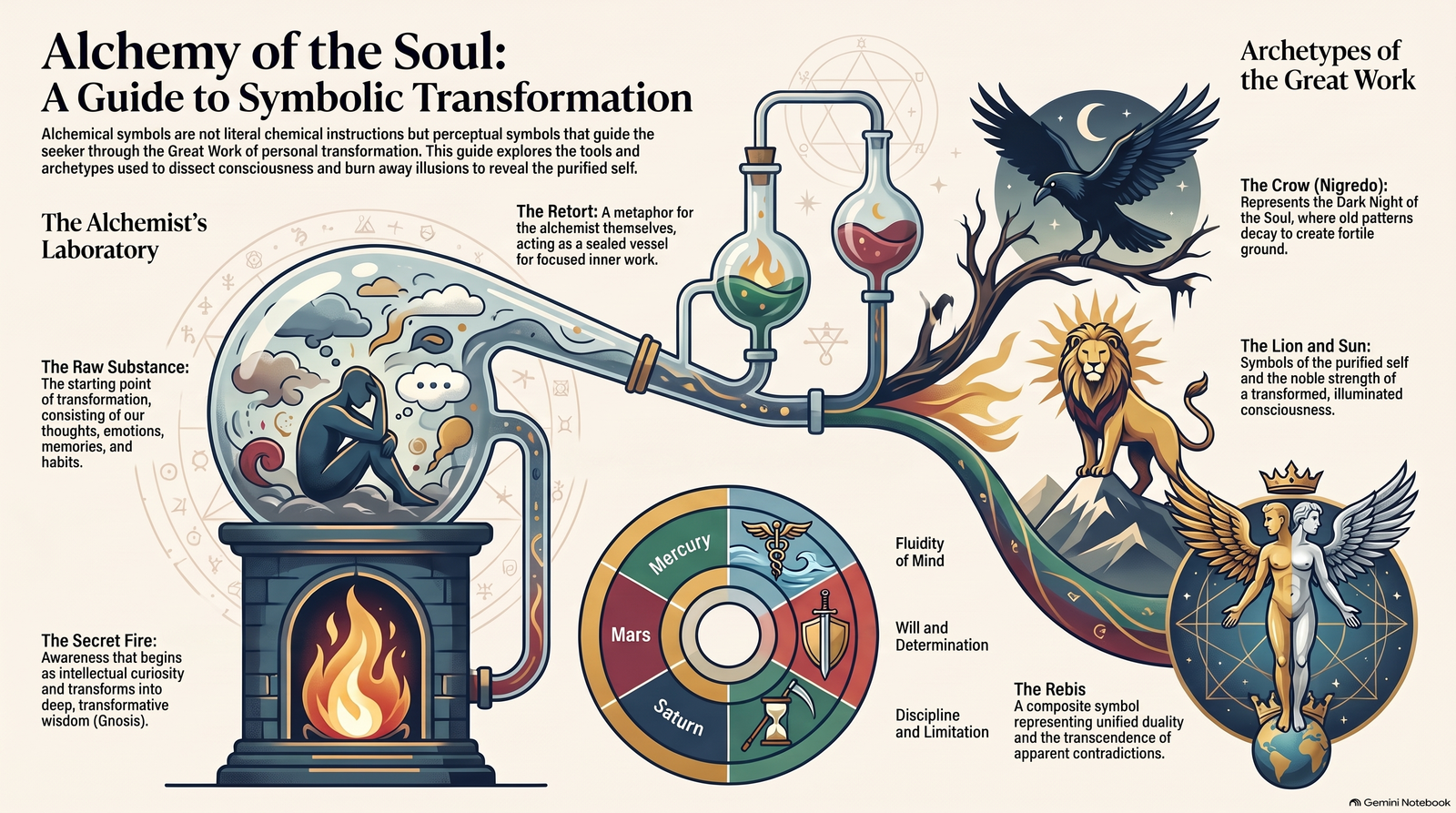
The Symbols and their Meanings introduces the vocabulary through which the remaining work can be read. Words themselves are treated as learned signs whose meanings alter with experience. Alchemical images can therefore hold several possibilities at once: the retort becomes contained attention, raw substance the conditioned material of a life, fire sustained inquiry, and the crow the darkness associated with Nigredo.
The chapter’s contribution is also cautionary. A symbol points; it does not settle an interpretation or replace direct experience. Biblical, Buddhist and alchemical correspondences are used as part of Dr Simon Robinson’s synthesis rather than as proof of one universal hidden doctrine. Historically, alchemy included practical laboratory work, medicine, natural philosophy, religious speculation and many competing symbolic systems.
Video guide
Learning to read without becoming trapped by the code
The recording begins with the familiar picture of an alchemist attempting to turn lead into gold, then asks whether this literal caricature can account for the density of the tradition’s images. Its organising question is not simply “What does each symbol mean?” but “Why might a tradition need symbols at all?” The hosts answer in two ways. Symbolic language can hold experiences that ordinary explanation reduces too quickly, and coded or allusive writing can restrict access to knowledge. The second point is historically plausible in some settings but should not be universalised: secrecy, guild practice, religious caution, literary convention and deliberate obscurity varied across authors and periods.
The discussion then turns from general language to an inner laboratory. The retort is read as the practitioner: a contained field in which attention can remain with experience long enough for its parts to become visible. Raw substance is interpreted as thoughts, memories, habits, emotions and inherited conditioning. Fire is not emotional violence but curiosity, doubt, observation and gradually deepening insight. Darkness, the crow and Nigredo name the unsettling loss of old certainties. These are contemplative metaphors, not clinical mechanisms, and distress does not become spiritually necessary merely because darkness appears in the imagery.
The planetary figures, lion, sun, moon and Rebis broaden the symbolic field. The episode uses them to distinguish qualities such as receptivity and agency, limitation and expansion, fragmentation and integration. Its reading of Eden likewise recasts the serpent as discriminative awareness and the Fall as a movement from naive unity into self-consciousness. That is a modern symbolic interpretation, not the single meaning of Genesis in Jewish or Christian tradition. The video also turns to Alciato’s caduceus emblem to explore the binding of mild and fierce qualities; the emblem belongs to the wider early modern culture of moral imagery and does not by itself prove a hidden alchemical system.
The recording finally reverses its own lesson. Fluency matters, but collecting ever more elaborate correspondences can become another form of avoidance. The practical challenge is to let a symbol return attention to lived experience: not merely to admire the retort, crow or Rebis, but to ask what is being contained, questioned, divided or reconciled now.
Argument map
How the discussion moves
Beyond the caricature
The failed chemist in a basement gives way to a broader question about why alchemical writing became so densely symbolic.
Words already mediate
Language is presented as a learned system of signs whose meanings change as experience and understanding develop.
Myth becomes inward
Eden and the serpent are reread as images of undivided awareness, discrimination and the emergence of self-consciousness.
The practitioner is the vessel
The retort becomes contained attention, while raw substance names the psychological and habitual material brought into observation.
Doubt becomes fire
Curiosity and questioning erode inherited certainties before confidence can arise from sustained inquiry rather than borrowed belief.
Opposites seek relation
Moon and sun, mild and fierce, darkness and illumination culminate in the Rebis as an image of integration without simple erasure.
The map is relinquished
The final warning turns symbolic mastery back into practice: use the image, notice what it reveals, and do not worship the signpost.
Book and video
The source and its expansion
The written chapter establishes
Symbols as provisional markers, the retort, raw substance, fire, crow, planets, Rebis, lion and moon, and the need eventually to move beyond symbolic language.
The video expands
Why symbolic language may be necessary, Eden as a developmental image, doubt as a corrosive force, and the caduceus as a pattern of reconciling mild and fierce qualities.
The synthesis proposes
Early modern images can be read as a practical vocabulary for attention, conditioned experience, disruption and integration in contemporary inner work.
The evidence boundary
The reading does not establish one fixed dictionary of symbols, a secret identity among religions, or an exclusively spiritual purpose behind historical laboratory practice.
Clickable chapters
Navigate the video
The eight markers below fall within the supplied final duration of 35:15. The supplied 35:40 and 39:10 markers were omitted because they occur after the stated end of the video.
Terms for orientation
Expandable glossary
Symbol and sign
Alchemy
Retort
Raw substance or prima materia
Secret fire
Nigredo and the crow
Planetary correspondences
Rebis
Caduceus
Gnosis
Discriminative wisdom
Continue within the website
Related course pathways
- 1.1.3. Evolution of AdulthoodThe preceding chapter examines how language, memory and conditioning alter the way experience is interpreted.
- 1.1.5. The Fable of AlchemyThe next chapter applies symbolic reading to the laboratory story of transmutation and the philosopher’s stone.
- Mythos — Part One of NigredoThe section landing page for all twelve mythic and symbolic chapters.
- The Majesty of Inexplicability | Dialogues IA later exploration of language, conceptual ownership and the point at which a useful explanation must be released.
- Nigredo Part OneThe course landing page for the first volume of A Course in Modern Alchemy.
Context beyond the course
External reference points
- Encyclopaedia Britannica — AlchemyA broad historical overview that keeps alchemy’s laboratory, philosophical and religious dimensions in view.
- University of Glasgow — Alciato at GlasgowDigitised editions of Andrea Alciato’s Emblemata from 1531 to 1621, useful for examining the early modern emblem tradition directly.
- Semiotics for Beginners — SignsAn accessible account of icon, index and symbol that clarifies why the relationship between a sign and its meaning is not always simple or natural.
- Stanford Encyclopedia of Philosophy — Isaac NewtonHistorical context showing that alchemical study could involve texts, apparatus and chemical experimentation alongside theology and natural philosophy.
A three-minute reflection
From symbol back to experience
Choose one ordinary symbol you encounter today: a notification badge, uniform, logo, road sign or familiar phrase. Notice the immediate meaning it seems to carry, then ask what that meaning depends upon. What have you learned to associate with it? Does another person or culture necessarily read it in the same way?
Finally, bring the question closer to the chapter. If one alchemical image—vessel, fire, crow, moon or Rebis—has caught your attention, name one concrete feature of present experience to which it points. Keep the observation modest. The purpose is not to decode yourself, but to let the image sharpen attention before setting it down.