
Nigredo · Mythos · Chapter 5 of 48
1.1.5. The Fable of Alchemy
If alchemical gold was never principally a metal, what kind of transformation did the furnace, vessel and philosopher’s stone encode?
Watch the chapter discussion
Alchemy Was Never About Gold
The book
The chapter in brief
The Fable of Alchemy asks the reader to look beyond literal stories of turning lead into gold. The retort, regulated heat, changing colours and repeated separation and recombination become a symbolic account of sustained inner work. Gold, healing and immortality are then read as images of freedom from want, suffering and the fear of death rather than promises of unlimited wealth or biological invulnerability.
The chapter links this reading with Buddhist liberation and with Greek, Kabbalistic and other contemplative traditions. Its contribution to Nigredo is methodological: physical operations can be read as a vocabulary for attention, analysis and synthesis. This is Dr Simon Robinson’s interpretive synthesis. Historical alchemy also included practical laboratory work, medicine, metallurgy, natural philosophy and religious speculation; it should not be reduced to one hidden doctrine.
Video guide
From laboratory promise to inner transmutation
The recording opens with the familiar caricature of alchemy as a failed attempt to manufacture gold. It accepts that nuclear transmutation is possible under conditions remote from the historical workshop, but argues that this does not explain why alchemical literature is saturated with spiritual, mythic and cosmological language. The hosts therefore propose a change of question: instead of asking whether the recipe works literally, ask what kind of practitioner the work was intended to form.
The vessel then becomes a model of contained attention. Reflux, long observation and gently increasing heat are interpreted as staying present with difficult material without immediately discharging it through reaction or distraction. This is a vivid contemplative metaphor, but it needs a safety boundary. Emotional containment is not the same as suppressing feeling, and overwhelming trauma should not be deliberately intensified alone. Psychological stability, pacing and appropriate professional support take precedence over fidelity to an alchemical image.
Solve et coagula—dissolve and recombine—provides the episode’s central movement. Habitual identity, inherited beliefs and defensive patterns are analysed, then reorganised into a more integrated life. The video sometimes describes this as dissolving the ego and warns that remaining “dissolved” can resemble despair or psychosis. These are metaphors, not clinical mechanisms: psychosis and depression are serious, multifactorial conditions, not failed stages of an esoteric process.
The philosopher’s stone gathers the promise of the work into three legendary powers. Gold is read as freedom from felt poverty through contentment; the elixir as psychological healing and greater wholeness; immortality as a transformed relationship with death. These interpretations can illuminate the story without becoming medical or biological claims. Meditation does not make a person physically immortal, and psychological integration does not cure all illness.
The final movement compares these promises with Buddhist accounts of ageing, sickness, death and release from suffering. The parallel is suggestive rather than proof that Hermetic alchemy, Buddhism, Platonism and Kabbalah teach an identical hidden system. Each tradition has its own texts, practices, histories and disagreements. The video’s strongest conclusion is therefore modest: alchemical imagery can function as a practical language for inner transformation, provided the map is not mistaken for a universal historical key.
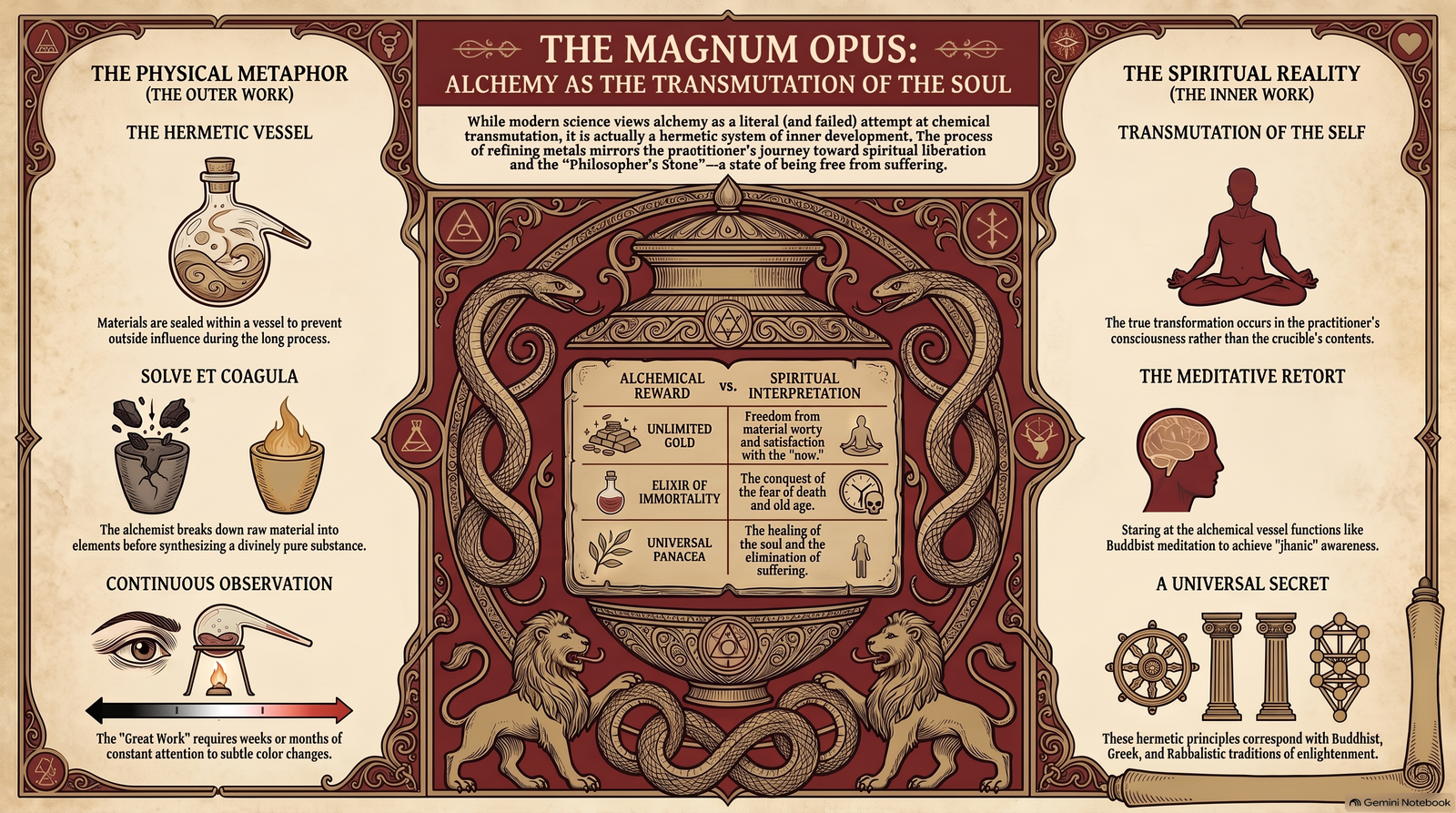
Argument map
How the discussion moves
The literal problem
Modern physics makes elemental transmutation intelligible, but not by the means available in an early modern furnace.
The practitioner
Attention turns from recipes and alleged marvels towards the discipline, imagination and spiritual aims of the alchemist.
The sealed vessel
Reflux and containment become images of sustained attention that does not immediately escape into distraction or reaction.
The regulated fire
Mild, patient heat represents disciplined practice and warns against forcing transformation through intensity alone.
Solve et coagula
Analysis loosens a rigid construction; synthesis recombines what has been understood into a more coherent way of living.
The red stone
The legendary product condenses the work into images of vitality, integration and a transformation capable of influencing the whole.
Three promises
Gold, panacea and immortality are re-read as contentment, healing and freedom from domination by the fear of death.
Comparative synthesis
Buddhist, Greek and Kabbalistic parallels broaden the map while requiring care not to erase the traditions’ differences.
Book and video
The source and its expansion
The written chapter establishes
The case for reading transmutation inwardly, the laboratory pattern of vessel, heat, observation and recombination, and the three legendary rewards of the philosopher’s stone.
The video expands
Prima materia as shadow material, containment as psychological practice, ego dissolution and reintegration, the rubedo, fear of death, institutional power and perennial philosophy.
The synthesis proposes
Alchemy’s physical story can be used as a practical map in which disciplined attention transforms the practitioner’s relationship with lack, conflict, illness and mortality.
The evidence boundary
The metaphor does not establish a single secret doctrine behind all alchemy, prove equivalence among traditions, confer biological immortality or support universal claims of psychological or physical cure.
Clickable chapters
Navigate the video
The eight markers below fall within the supplied final duration of 35:02. The supplied 35:50 closing marker has been omitted because it occurs after the video ends.
Terms for orientation
Expandable glossary
Alchemy
Great Work (opus magnum)
Prima materia
Hermetic vessel and reflux
Solve et coagula
Philosopher’s stone
Nigredo and rubedo
Kasina and jhāna
Dukkha and nibbāna
Psychological integration
Continue within the website
Related course pathways
- 1.1.4. The Symbols and their MeaningsThe preceding chapter introduces the symbolic language through which material operations can carry psychological and spiritual meanings.
- Mythos — Part One of NigredoThe section landing page for all twelve symbolic and mythic chapters.
- 1.1.6. EnlightenmentThe next chapter asks how conceptual language can point towards liberation without being mistaken for the reality it describes.
- NigredoThe course landing page for Part One of A Course in Modern Alchemy.
Context beyond the course
External reference points
- Encyclopaedia Britannica — AlchemyAn overview of alchemy’s material aims, laboratory traditions, philosophical dimensions and long, culturally varied history.
- Stanford Encyclopedia of Philosophy — Carl JungScholarly context for Jung’s psychology, including the broader framework within which his interpretation of alchemy developed.
- Access to Insight — The First Noble TruthCanonical passages concerning dukkha, ageing, illness, death and the unsatisfactory nature of clinging, for comparison with the video’s alchemical parallel.
- Henepola Gunaratana — The Path of Serenity and InsightAn introduction to Buddhist concentration and insight, useful for distinguishing jhāna practice from the chapter’s analogy of attending to a retort.
- NHS — Medically unexplained symptomsClinical context for the relationship among bodily symptoms, distress, anxiety and depression without reducing physical illness to a single psychological cause.
A three-minute reflection
Separate, then recombine
Choose a small, ordinary frustration rather than a traumatic memory. First, notice its parts: bodily sensation, emotion, recurring words, remembered event and expected outcome. This is the solve movement—not destroying the experience, simply distinguishing what has arrived together.
Then ask what a steadier response would retain, release or reframe. Recombine the parts into one modest next action: pause, clarify, apologise, decline, rest or seek help. This is coagula as everyday integration. Stop if the exercise becomes overwhelming; difficult or persistent distress deserves appropriate support rather than intensified self-exposure.