
Dialogues I · Episode 08
Cain’s Jawbone and the Ego
A murder weapon absent from Genesis becomes a map of symbolic thought, divided consciousness and the strange effort by which the self tries to outgrow itself.
Central question
What if Cain’s missing weapon tells us less about the first murder than about the mind that cannot leave a gap unfilled?
Genesis says that Cain attacked Abel and killed him, but it does not identify a weapon. European artists nevertheless supplied one. A donkey’s jawbone became especially prominent in Northern Renaissance images, giving material form to an absence in the text. The episode begins with that historical puzzle, then asks why an imagined implement can acquire the authority of remembered fact.
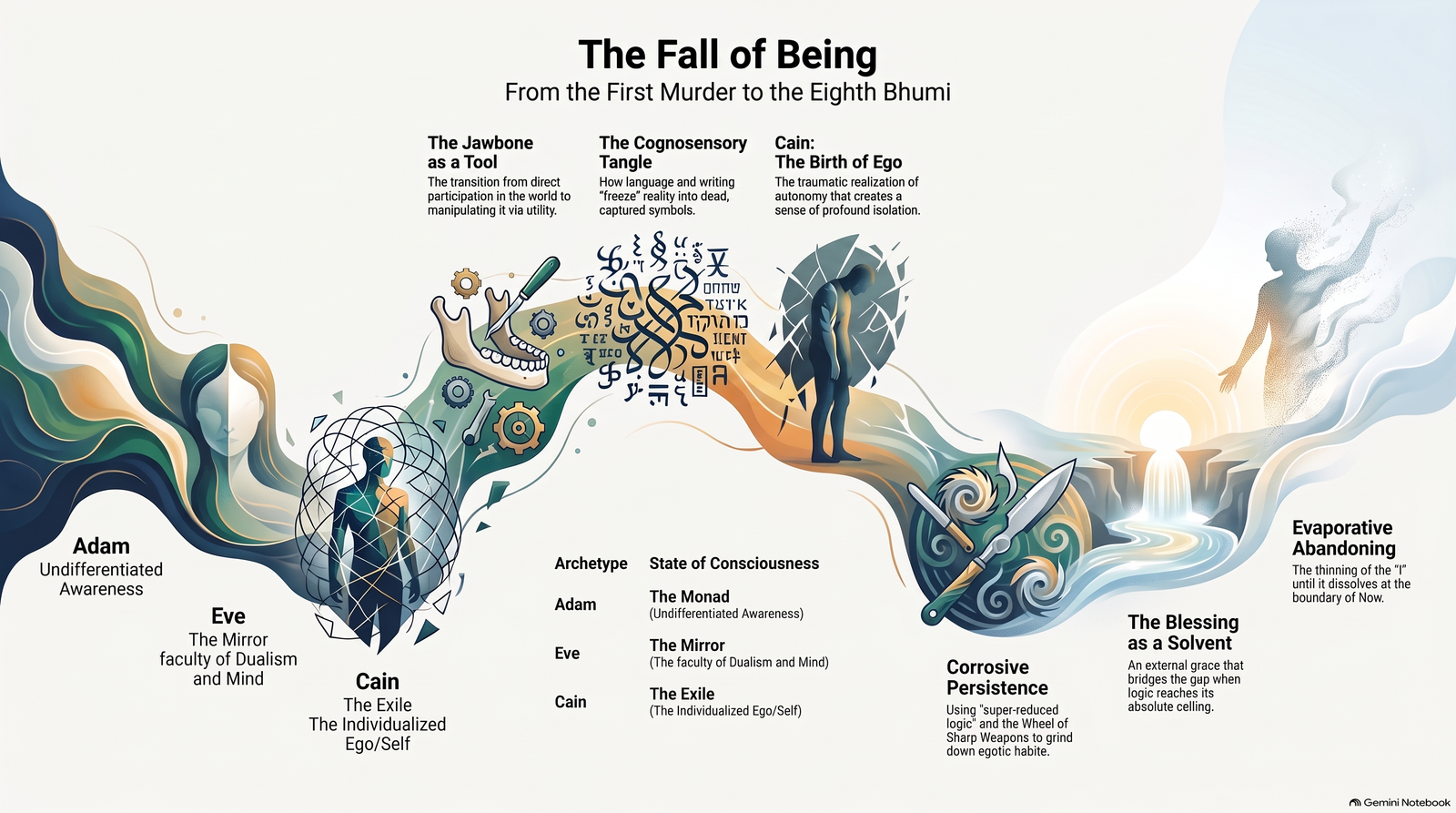
The missing weapon opens into a deliberately unconventional reading of Eden and its aftermath. Adam is treated as undifferentiated awareness; Eve as the mind that mirrors and organises experience; Abel as incarnated innocence; and Cain as the exiled, individualised ego. Writing then becomes a decisive image of the fall: living sound is captured as visible object, and representation begins to stand in for the reality it names. The episode calls the resulting knot a “cognosensory tangle”.
Within this symbolic map, the jawbone is more than a weapon. It is a tool—an extension of intention through which the field can be worked and the world made useful. Cain therefore represents both a loss and an achievement: autonomy, labour, planning and conceptual discrimination emerge together with isolation, control and the sense of being a separate observer. The task is not to pretend that this development never occurred, but to discover whether its own capacities can be turned towards release.
The final movement follows that paradox into Buddhist and Zen language. Logic interrogates the self that uses logic; corrosive persistence wears down the stories to which identity adheres; yet deliberate surrender remains another act of will. The episode’s answer is not a technique for destroying an ego. It is the image of a phase change: when effort reaches its limit, the apparently solid “I” may lose the duration, resistance and ownership by which it seemed to stand apart.
Argument map
From the blank in the story to the evaporation of the storyteller
Genesis leaves the instrument unnamed
The sparseness of the account creates an interpretive vacancy. Later readers and artists furnish the scene with the objects their own cultures make imaginable.
An image hardens into inherited memory
Northern European art gives Cain a spectacular implement. Repetition makes a visual convention feel as though it had always belonged to the text.
Characters become modes of consciousness
Adam, Eve, Abel and Cain are reread as undivided awareness, reflective mind, innocent action and the autonomous self separated from its ground.
Representation freezes living experience
Writing preserves speech but also turns it into an object. Babel names the layered conceptual worlds that arise when symbols are mistaken for what they indicate.
Utility brings power and exile together
The jawbone extends intention into the world. It symbolises agriculture, control and human ingenuity, but also the distance created by treating reality as material to manipulate.
Discrimination interrogates its owner
The peacock and wheel of sharp weapons frame a practice of metabolising affliction and turning judgement towards the stories by which the ego sustains itself.
The self cannot command its own absence
Voluntary surrender preserves a volunteer. At the limit of conceptual effort, blessing or grace is imagined as the solvent through which solidity becomes unlocatable presence.
The interpretive lenses
Four distinct bodies of material meet in the episode
A sparse text and its artistic afterlife
The episode distinguishes the biblical account from later images of Cain with a jawbone. The history of representation grounds the opening question without converting iconography into forensic evidence.
Writing, memory and the semblance of wisdom
Plato’s Phaedrus supplies Socrates’ reported warning that writing may encourage reliance on external marks and the appearance of understanding. The episode radicalises this into a theory of symbolic estrangement.
Affliction, non-arising and forgetting the self
Bodhisattva bhūmis, Tibetan mind-training images and Dōgen’s Zen language enter from different lineages. They provide points of comparison, not a single authorised sequence of practice.
The linguistic metaverse and temporal “I”
The surfer, salt doll, MP3, deictic marker and thinning of psychological time are modern explanatory images. Their role is philosophical and diagnostic rather than historical, clinical or scientific.
Watch by chapter
Episode chapters
- 00:00Cain’s Missing Murder Weapon
- 03:30Why Artists Gave Cain a Jawbone
- 07:30The Blank Spaces in Genesis
- 11:20Myth as Psychological Mirror
- 14:40Adam, Eve, Cain, and Abel as Consciousness
- 18:50Language, Writing, and the Fall
- 23:00The Jawbone as Tool, Ego, and Control
- 26:20Socrates, Writing, and Frozen Wisdom
- 29:30Babel and the Linguistic Metaverse
- 32:20The Surfer of Confusion
- 34:40Using Ego’s Tools Against Itself
- 37:30Spiritual Bypass and the Trap of Surrender
- 39:20Evaporative Abandoning and the Eighth Bhūmi
- 41:00The Collapse of “I” and Final Reflection
Glossary
Terms and images used in the discussion
Cain’s jawbone
Genesis 4:8 says that Cain killed Abel but does not identify the means. A jawbone appears in later European visual and literary traditions; Lucas van Leyden’s 1524 engraving is one documented example. Samson does use a donkey’s jawbone in Judges 15, making conflation one plausible explanation, while the object’s agrarian associations remain interpretive rather than proven.
Minimalist biblical narrative
A description of the Hebrew Bible’s frequent economy of detail: action, speech and consequence may be presented without the descriptive fullness expected by a modern reader. The episode treats such gaps as spaces into which cultures project their own objects and assumptions. That literary observation does not establish that every omission encodes an esoteric meaning.
Monad and undifferentiated awareness
Monad has different meanings across Greek philosophy, Neoplatonism, Leibniz and later esoteric thought. Here it names the episode’s Adamic image of awareness before a subject–object division. This is a contemporary symbolic use, not a claim that Genesis, Buddhist philosophy and Western monadologies employ one identical concept.
Sixth consciousness and manas
Many Buddhist accounts speak of five sensory consciousnesses followed by mental consciousness as a sixth. Yogācāra often distinguishes this sixth mental consciousness from an afflicted manas, enumerated as seventh, and from storehouse consciousness. The episode’s Eve combines reflective, coordinating and self-forming functions for symbolic purposes; it should not be read as a technical summary of every Buddhist model.
Cognosensory tangle
An episode-specific name for the knot formed when audible, visual, remembered and conceptual signs reinforce one another until the representation feels more available than the experience represented. It is a philosophical metaphor, not a standard term in cognitive science, linguistics or Buddhist psychology.
Socrates and writing
Socrates left no writings of his own, and Plato’s Phaedrus presents a myth in which writing is criticised for producing forgetfulness and the appearance rather than the reality of wisdom. The dialogue is subtler than a simple ban on literacy: Plato communicates the warning in writing, and the question concerns what a fixed text can and cannot do without living understanding.
Babel and the linguistic metaverse
Babel is reread here as fragmentation within the conceptual field rather than only a story explaining the diversity of languages. The “linguistic metaverse” is the episode’s phrase for the internally modelled world of labels, memories and anticipated futures. Neither expression is offered as a historical or neuroscientific account of language development.
Wheel of Sharp Weapons
A Tibetan mind-training poem traditionally attributed to Dharmarakṣita. Its sharp imagery turns attention from blaming external conditions towards the self-cherishing habits through which suffering is perpetuated. The episode intensifies this into “internal policing”; that language should not justify self-hatred, humiliation or compulsive psychological attack.
Peacock and poison
Tibetan Buddhist mind-training literature uses the peacock’s legendary ability to thrive on poison as an image for transforming afflictive conditions into the path. The point is not literal toxicology and not the deliberate pursuit of trauma. It concerns a changed relationship to difficult states rather than suppression, indulgence or avoidable harm.
Spiritual bypass
A modern psychological and spiritual term for using beliefs, practices or elevated language to avoid unresolved emotional, relational or practical difficulties. In this episode it describes performing the serenity of Abel while Cain’s structures of control remain intact. The term is diagnostic shorthand, not a licence to dismiss another person’s practice from outside.
Eighth bhūmi and immovability
In Mahāyāna accounts of the ten bodhisattva grounds, the eighth is commonly called the Immovable. It represents an advanced stage described through non-retrogression, effortless activity and insight into non-arising. The episode translates this into the loss of “egotic burrs”; that is a modern phenomenological reading rather than a complete doctrinal definition or a claim of attainment.
Anutpattika-dharma-kṣānti
A Sanskrit expression rendered in several ways, including acceptance, forbearance or insight concerning the non-arising of phenomena. “Non-arising” does not ordinarily mean that appearances cease or that a person becomes inert. It belongs to Mahāyāna reflection on emptiness and the absence of independent origination.
Evaporative abandoning
The episode’s phase-change metaphor for a relinquishment that is not performed by a triumphant agent. Water does not decide to become vapour; under sufficient conditions, its mode of appearing changes. The phrase is evocative rather than technical and should not be mistaken for dissociation, depersonalisation or a guaranteed result of intense self-analysis.
Deictic “I”
In linguistics, deixis concerns expressions whose reference depends on context, such as “I”, “here” and “now”. The episode uses this to loosen the idea that the pronoun must name a permanent inner object. Grammar alone does not prove a metaphysical theory of self, but it can reveal how identity is continually positioned in relation to speech, memory and time.
Dōgen and forgetting the self
Dōgen’s Genjōkōan links studying the Buddha Way with studying and forgetting the self, then being actualised by the myriad things. The episode hears this as the movement from isolated identity into unowned participation. “Forgetting” does not require amnesia, self-neglect or the destruction of ordinary personhood.
Continue within the website
Related pathways
An earlier Dialogues I treatment of Eden as an interior map of divided consciousness, language, exile and the attempt to reunite what conceptual thought separates.
Develops the question of how subject, object and verb organise experience and make a separate observer seem structurally inevitable.
A later exploration of inner speech, predictive construction and the way a linguistic model becomes the narrator it appears merely to describe.
Returns to the brothers through comparison, moral exposure and shame, extending the myth without requiring the present episode’s jawbone symbolism.
A concise route into the website’s wider treatment of selfhood as constructed, changing and dependent rather than a fixed object behind experience.
Places language about ego-death within the Albedo course while distinguishing transformation of identification from literal or psychological destruction.
External reference points
A small reading shelf
The primary biblical passage. Verse 8 reports Cain’s attack and Abel’s death without naming a weapon, making the distinction between text and later image visible.
The museum record identifies the print, date and jawbone raised in Cain’s hand: direct evidence for the visual tradition discussed at the episode’s opening.
A complete public translation containing the story of Theuth and Thamus and the dialogue’s reflections on writing, memory, instruction and living speech.
A Sōtō Zen study collection centred on Shohaku Okumura’s translation, giving context for the episode’s movement from studying the self to forgetting the self.
Question to carry forward
Where does the mind quietly add the jawbone?
Choose one recent event about which you feel certain. Separate what was directly seen or heard from what was inferred, remembered, labelled or supplied afterwards. The aim is not to distrust experience, but to notice how quickly a coherent story acquires details that were never present in the original moment.
Then notice the owner of the story. Does the word “I” point to something immediately locatable, or does it gather continuity from a remembered past and an anticipated future? Nothing needs to be forced away. For a few breaths, allow the gap to remain unfilled and see whether experience requires the jawbone you normally place in its hand.