
Dialogues I · Episode 07
The Star-Eater and the Enlightenment Trap
A glimpse may interrupt the seeker, but the memory of the glimpse can become the seeker’s most convincing new identity.
Central question
Can recognition be precipitated without turning the experience into another possession of the self?
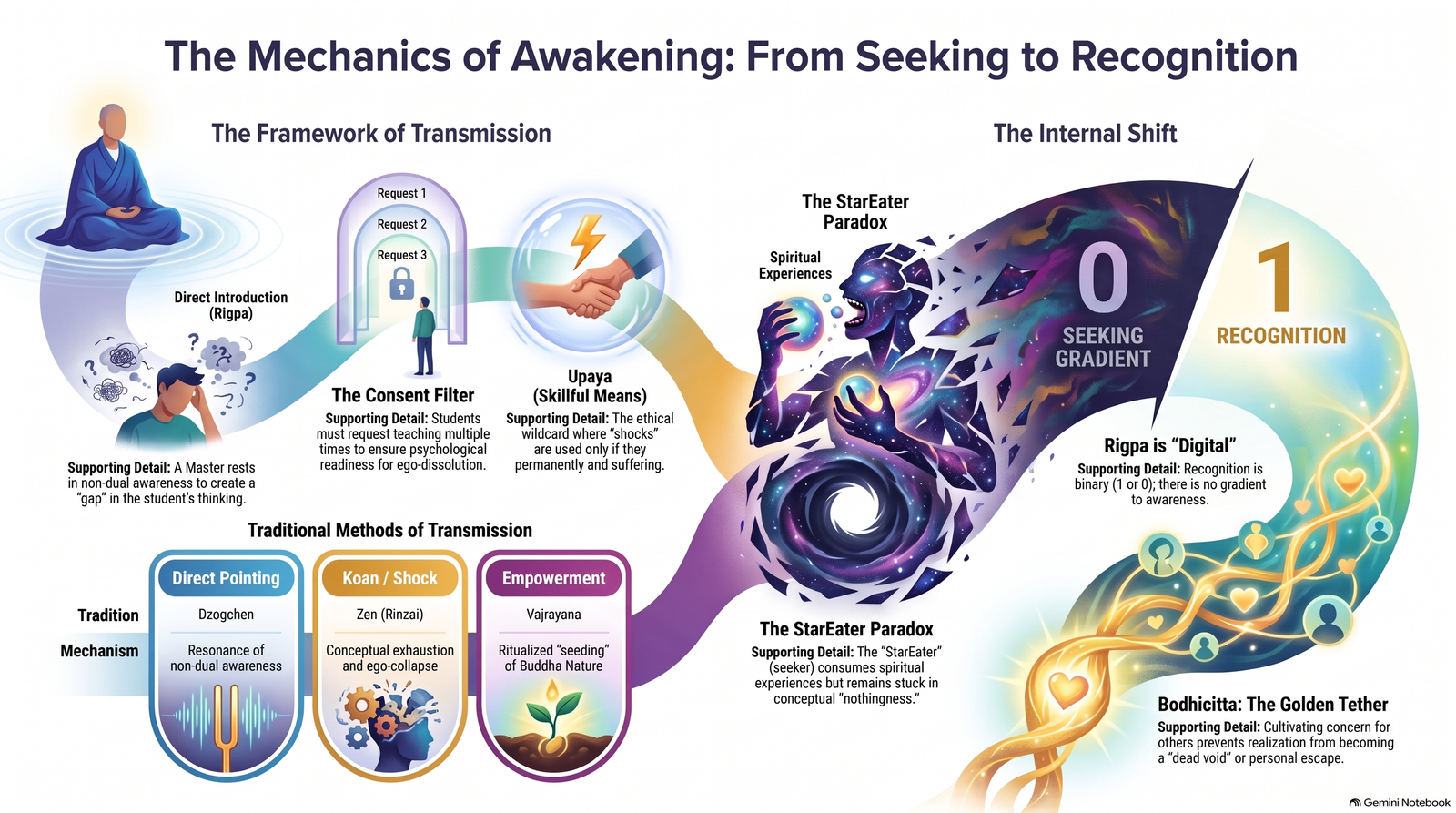
The episode begins with a deceptively practical question: can one person “enlighten” another? Its answer moves between Tibetan direct introduction, Zen stories of interruption and the ethical limits of any method that claims to bypass ordinary reflection. The decisive distinction is between causing a startling experience and enabling recognition within a prepared relationship. A teacher may point; no gesture can substitute for discernment, integration or the student’s continuing responsibility.
The discussion then turns inward. Once a glimpse has passed, the conceptual mind may preserve it as evidence of progress. The “watcher” judges ordinary life against an exceptional state, while the “Star-Eater” builds an identity from the memory of having entered the sphere of nothingness. The episode’s best metaphor is the postcard: a memory can testify that an experience occurred without reproducing the place, proving its interpretation or conferring ownership of it.
What follows is not a rejection of profound experience but a change in its status. Nothingness is treated as an experience that arose and ceased, not as a throne for a cosmic self. “Pointlessness without loss” names the easing of compulsive purpose rather than nihilism. Bodhicitta then supplies the relational counterweight: awakening is imagined not as private disappearance but as a commitment oriented towards the awakening of all beings.
The closing image is deliberately austere. Calling recognition “digital” contrasts immediate recognition with the seeker’s love of rankings, percentages and spiritual accumulation. It is the episode’s own philosophical metaphor, not a scientific theory or a standard doctrinal definition of rigpa. The final return to writing, coffee and ordinary work matters precisely because no remembered void can live a life on our behalf.
Argument map
From the promise of transmission to the relinquishment of ownership
The mind cannot stand wholly outside itself
Methods that work on objects become unstable when the investigator, instrument and problem are entangled in the same act of awareness.
Pointing is not possession
Dzogchen and Zen are used to ask whether preparation, encounter and interruption can reveal what instruction cannot simply add.
Power requires limits
Consent, readiness and accountability matter because a teacher’s claim to skilful means can otherwise conceal coercion, dependency or harm.
A glimpse creates a subtler seeker
After an insight fades, the mind may divide experience into pure and impure, creating a spiritual supervisor who tightens the knot it hopes to release.
The void becomes a biography
A remembered experience of nothingness is preserved as a postcard and recruited into an enlarged identity that now claims exceptional spiritual history.
Emptiness remains relational
Bodhicitta redirects the path from private escape towards awakening for all beings, although the episode’s hydraulic explanation remains a modern metaphor.
Recognition returns to ordinary life
The final movement releases the gradient of acquisition: memory loses its throne, purpose loses its compulsion and work can simply be done.
The interpretive lenses
Four kinds of material are in conversation
Recognition, lineage and advanced practice
Rigpa, direct introduction, trekchö, tögal and bodhicitta are inherited concepts with distinct textual, ritual and institutional settings. The episode borrows them for a contemporary inquiry but does not transmit their practices.
Interruption and conceptual exhaustion
Kōans, shouts and striking stories illustrate the limits of discursive problem-solving. Their literary and training contexts are wider than the episode’s model of momentarily stopping a cognitive engine.
Nothingness, memory and the Star-Eater
The central image grows from reflection on a previous contemplative experience and the identity that formed around it. It is autobiographical interpretation, not an attainment diagnosis.
Postcards, software and the binary switch
Psychological, hydraulic and computational metaphors organise the dialogue. They can expose patterns of grasping without proving that consciousness is literally mechanical, digital or computational.
Watch by chapter
Episode chapters
- 00:00The Wrench Melts in Your Hand
- 03:20Transmission, Rigpa, and Direct Introduction
- 07:10Shock, Kōans, and Cognitive Interruption
- 11:20Why Spiritual Power Requires Ethical Restraint
- 15:40Consent, Skilful Means, and Spiritual Violence
- 20:30The Ontological Knot and the Watcher
- 25:40Trekchö: Cutting Through by Letting Go
- 29:20High-Frequency Oscillation and the Waiting Room
- 33:10The Perfect Mirror and the Limits of AI
- 36:00The Star-Eater and the Postcard of the Void
- 39:20Pointlessness Without Loss
- 41:20Bodhicitta as the Golden Chain
- 43:10The Digital Nature of Recognition
- 44:10Put Down the Postcard
Glossary
Terms used in the discussion
Rigpa and ma rigpa
In Dzogchen, rigpa denotes knowledge or awareness that recognises the nature of mind; ma rigpa is non-recognition or unawareness. Translating the pair simply as “one” and “zero” is the episode’s clarifying metaphor. Traditional accounts also distinguish initial recognition, stabilisation and integration, so the metaphor should not erase the path’s complexity.
Direct introduction or pointing-out instruction
A lineage-based introduction to the nature of mind in Dzogchen and Mahāmudrā contexts, ordinarily given by a qualified teacher within preparation, relationship and subsequent practice. It is not adequately described as transferring a substance, hypnotising a student or producing enlightenment by shock. This page discusses the idea historically and philosophically; it does not reproduce the instruction.
Buddha-nature (tathāgatagarbha)
A family of Mahāyāna teachings concerning the possibility or presence of buddhahood in sentient beings. Interpretations vary: some stress an innate luminous capacity, others read the language through emptiness and the absence of fixed defilement. The episode uses Buddha-nature to frame recognition as uncovering rather than manufacturing, but this does not settle the tradition’s internal debates.
Kōan
A recorded saying, encounter or case used especially in Chan and Zen training. A kōan is not merely a nonsensical riddle designed to overload the brain; it belongs to traditions of commentary, interview and disciplined inquiry. The episode emphasises interruption because it serves its argument about conceptual effort, while the historical practice is more varied and structured.
Upāya (skilful means)
A Mahāyāna concept describing teachings or actions adapted compassionately to the capacities and circumstances of beings. It does not provide a general exemption from ethical scrutiny. Claims that harm, coercion or humiliation are “skilful” require particular caution, because the teacher’s claimed intention cannot by itself establish benefit or informed consent.
Trekchö and tögal
Advanced contemplative approaches within Dzogchen’s Seminal Heart traditions. Trekchö is commonly rendered “cutting through”; tögal is often translated “direct crossing” or “leap-over” and involves complex visionary material. They require lineage context and qualified guidance. The episode’s language of letting go and projected imagery is interpretive, not sufficient practical instruction.
Jhāna and the sphere of nothingness
Jhāna refers to meditative absorptions in Buddhist traditions. In a common eight-attainment scheme, the sphere of nothingness is the third immaterial attainment and is therefore sometimes called the seventh jhāna. It remains a conditioned, temporary attainment; neither its intensity nor its memory independently establishes awakening, Dzogchen recognition or freedom from self-identification.
Bhavaṅga
A technical term in Theravāda Abhidhamma and later commentary, often translated as “life-continuum”. It helps account for continuity when an active cognitive process is absent. The episode extends it metaphorically into a seed-like spiritual identity formed around nothingness. That extension is not the term’s standard doctrinal meaning and should not be confused with a clinical subconscious.
Ālayavijñāna
The “storehouse consciousness” of Yogācāra Buddhist thought, used to explain continuity, karmic seeds and the arising of experience. The podcast imagines it as a torrent or hard drive whose contents can be redirected. Those are modern analogies: ālayavijñāna is a contested philosophical model, not an anatomically located reservoir or a scientifically verified data store.
Bodhicitta
The Mahāyāna orientation towards buddhahood for the benefit of all sentient beings, commonly discussed through aspiration and engaged practice and, in some traditions, through relative and ultimate dimensions. The “golden tether” and cognitive displacement strategy are this episode’s interpretations. Bodhicitta is not simply thinking obsessively about other people or erasing legitimate care for oneself.
Śrāvaka and bodhisattva
A śrāvaka is a disciple or “hearer” pursuing liberation through a Buddha’s teaching; a bodhisattva is committed to buddhahood for the welfare of beings. Some Mahāyāna polemics contrast their aims, but describing śrāvaka liberation as selfish disappearance oversimplifies living Buddhist traditions and should not be treated as a neutral historical verdict.
Star-Eater and the postcard of the void
Episode-specific images for spiritual identity formed around an exceptional state. The Star-Eater consumes experiences as evidence of magnitude; the postcard is the memory later mistaken for the place itself. Neither is a traditional Buddhist category. Their value is diagnostic and literary: they ask how recollection becomes ownership without dismissing the original experience.
“Digital” recognition
The episode’s metaphor for the contrast between recognition and non-recognition. It resists the fantasy that spiritual identity grows linearly with experiences, vocabulary or years of practice. It is not a neurological claim, a computational model of consciousness or proof that integration is instantaneous. The effects of any insight still unfold through conduct, relationship and ordinary time.
Continue within the website
Related pathways
Extends the question of sudden interruption while keeping psychological risk and interpretation visible.
Places the episode’s “golden tether” within the wider Mahāyāna commitment to awakening for all beings.
A later discussion of the identity that can gather around spiritual difference, status and exceptional experience.
Develops the same paradox: practices may weaken one identity while furnishing a subtler one with better credentials.
Continues the return from extraordinary interpretation to unadorned, embodied and ordinary activity.
A concise route into the website’s earlier distinction between gradual cultivation and apparently sudden change.
External reference points
A small reading shelf
An academic overview of Dzogchen’s history, diversity, rhetoric of naturalness and the development of trekchö and tögal in the Seminal Heart traditions.
Provides philosophical context for Zen’s non-dual standpoint, language, practice and embodied understanding beyond the podcast’s shorthand of shock and interruption.
A primary early Buddhist text in which the Buddha declines a request for monks to display psychic wonders, useful context for the episode’s concern about spectacle and recruitment.
A specialist educational resource offering texts, scholarship and multiple interpretations of tathāgatagarbha rather than a single simplified definition.
Question to carry forward
What happens when the postcard is allowed to remain a postcard?
Choose one memory you regard as especially important, successful or transformative. Without trying to diminish it, notice the difference between the event, the present memory of it and the identity that says, “This proves something about me.”
Then return to one ordinary sensory fact in the room—the weight of an object, a sound at a distance or the temperature of your hands. Nothing needs to be recreated or resolved. The question is simply whether the past can be honoured without being asked to govern the present.