
Dialogues I · Episode 10
Why Seeing Colour Is a Biological Lie
Colour, language and the perceptual edges from which a world of objects—and a continuous self—seem to emerge.
Central question
If perception constructs colour and edges, how much of the apparently solid self is constructed with them?
The episode begins with an ordinary coloured object and a deliberately excessive claim: the colour before us is a “biological lie”. Its more careful insight is that colour experience is neither a tiny copy of the world nor an arbitrary fiction sealed inside the skull. Light, surfaces, eyes, neural processing, context and learned categories participate in making a stable perceptual world.
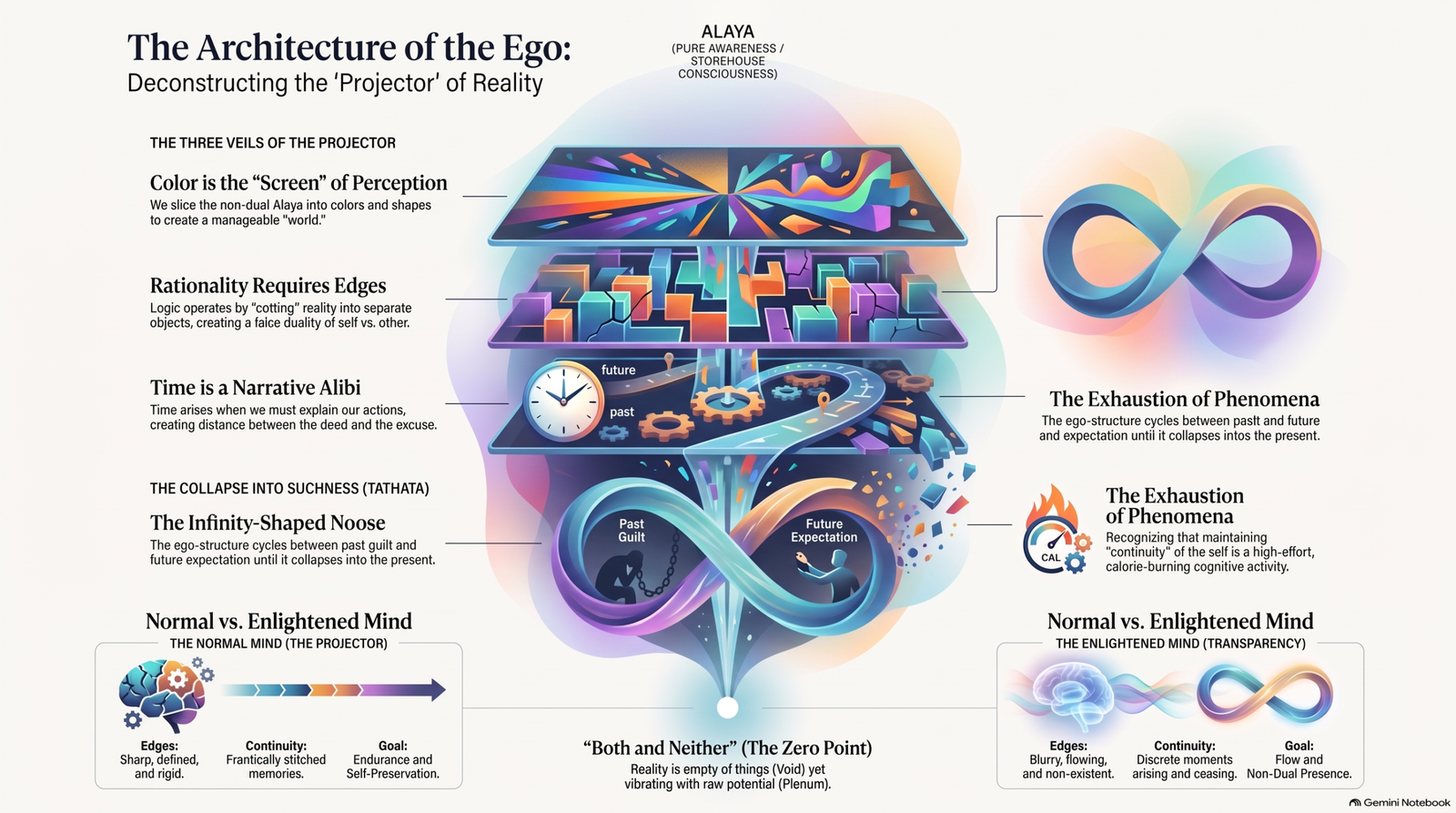
From colour, the discussion moves towards division. Naming a hue establishes a category; contrast helps an object stand out from its surroundings; a boundary permits shape, location and orientation. These useful perceptual operations then become the basis of the episode’s wider metaphor: perhaps the ego is not a separate entity behind experience, but the continuing work of rendering edges, relations and a story of endurance.
Yogācāra supplies one philosophical lens. The ālaya-vijñāna, or storehouse consciousness, is brought into conversation with conceptual discrimination and the way habitual tendencies condition experience. The recording sometimes turns this doctrine into an unfiltered non-dual ground beneath perception. Historically, however, Yogācāra accounts are more specific and contested: the storehouse consciousness supports causal continuity and karmic seeds; it is not simply identical with pure awareness, matter, energy or an empirically demonstrated substrate.
The inquiry then extends into Homeric colour language, the fruit of knowledge, camouflage, the fovea, the construction of time and nibbidā—disenchantment or turning away. Its culminating image is an infinity-shaped loop between guilt about the past and expectation of the future. When the energy invested in that loop falls away, the episode asks whether the present is empty, full, both or neither—and whether even this elegant answer immediately becomes another possession.
Argument map
From coloured surfaces to the effort of being someone
Experience is rendered, not merely recorded
Colour becomes the opening demonstration that perception is relational and constructive. The provocative word “lie” points towards mediation, though it overstates what perceptual construction means.
Naming cuts a continuous field
A hue-name gathers variations into a usable class and distinguishes it from what it is not. Language can sharpen categorical attention without creating the underlying sensory differences from nothing.
Contrast turns variation into objects
Colour, luminance, depth and context help visual systems segment scenes. The episode converts this practical achievement into a metaphor for the boundary between self and other.
Orientation asks for a durable observer
Once the world is divided into located things, the discussion imagines a centre from which their relations are measured. Rationality, position and continuity assemble the episode’s architecture of ego.
The self explains itself across a sequence
Memory and anticipation stitch moments into a biography. The phrase “time is the distance between the deed and the excuse” treats psychological time as narrative alibi, not physical time as an illusion.
Continuity begins to feel expensive
Nibbidā names disenchantment with conditioned phenomena. The episode interprets it as exhaustion with continually rendering the same identity, while the page keeps that contemplative reading distinct from clinical states.
The loop collapses when it is no longer powered
Past guilt and future expectation form the two lobes of an infinity symbol. Their crossing is the present, imagined as a knot that disappears when the effort maintaining it ceases.
Empty, full, both and neither
The Buddhist tetralemma becomes a protection against turning the zero point into one more metaphysical object. Its logical and doctrinal uses are richer than a general formula for ineffability.
Explanation rebuilds the observer
The final trap is mastery through description. Even accurate contemplative vocabulary can restore the distinction between the person who knows and the reality supposedly possessed.
The interpretive lenses
Four kinds of claim are woven together
Cones, context and perceptual constancy
The episode draws on the constructive character of colour vision, central and peripheral differences, scene segmentation and the brain’s efficient use of incomplete sensory information. These mechanisms support dependable action as well as illusion.
Homer, Gladstone and colour categories
Ancient Greek colour descriptions and cross-linguistic vocabularies raise genuine questions about how language organises attention and memory. They do not show that language mechanically determines what the eye can detect.
Storehouse consciousness and four-cornered analysis
The ālaya-vijñāna and the catuṣkoṭi come from different Buddhist philosophical contexts. The episode places both within one modern synthesis; resonance should not be mistaken for doctrinal identity.
Eden, projector, ice and infinity loop
The fruit of knowledge represents differentiation; colour becomes a screen; the self becomes ice resisting an ocean; time becomes a noose. These images organise the inquiry without functioning as historical exegesis or empirical demonstration.
Watch by chapter
Episode chapters
- 00:00Colour as Constructed Experience
- 03:00Ālaya and Conceptual Discrimination
- 06:00Homer, Blue and Linguistic Relativity
- 09:25Apples, Colour Constancy and Compression
- 11:00The Forbidden Fruit as Perceptual Division
- 13:50The Projector, the Fovea and Manufactured Clarity
- 18:00Edges, Camouflage and Survival
- 21:00Rationality, Orientation and Endurance
- 26:30Time as the Narrative Alibi of Self
- 29:20Nibbidā and the Cost of Continuity
- 33:30The Zero Point and the Infinity Loop
- 38:00Both, Neither and the Golden Chains of Explanation
- 44:00Closing Reflection: What Is Looking Back?
Glossary
Terms and metaphors used in the discussion
Colour perception
The visual system’s experience of chromatic differences, beginning with the responses of cone photoreceptors and developing through retinal and cortical processing. Perceived colour depends upon illumination, reflectance, surrounding colours, adaptation and the observer. Construction does not mean invention without external constraint.
Colour constancy
The tendency for a surface to appear approximately the same colour despite changes in illumination. It illustrates how vision estimates stable properties through context rather than reporting the wavelength distribution reaching one retinal point in isolation.
Fovea
A small central retinal region specialised for high-acuity vision and rich in cone photoreceptors. Eye movements repeatedly bring points of interest onto it. Acuity and chromatic sensitivity vary across the visual field, but peripheral vision is not simply absent or fabricated wholesale.
Linguistic relativity
The family of hypotheses that a language’s categories can influence thought, attention, memory or perception. Contemporary findings usually support selective, task-dependent effects rather than the strong claim that language imprisons speakers in wholly different realities.
Homer’s “wine-dark sea”
A conventional rendering of Greek oinops pontos. Nineteenth-century discussion, including William Gladstone’s work, drew attention to the distribution of colour terms in Homer. Modern interpretation considers brightness, material, texture, poetic convention and different colour-category systems; it does not infer universal Greek colour-blindness.
Yogācāra
A major Mahāyāna Buddhist philosophical and contemplative tradition concerned with cognition, appearance, habitual construction and the transformation of experience. Its positions are internally varied and should not be compressed into the modern slogan that consciousness literally manufactures physical reality.
Ālaya-vijñāna
The “storehouse consciousness” proposed in influential Yogācāra accounts to explain causal continuity, karmic seeds and the background conditions of experience. It is conditioned and transformable; it is not a permanent self, a physical energy field or simply a synonym for pure non-dual awareness.
Vikalpa
Conceptual construction, discrimination or imagination, depending on context. The episode uses it for the mind’s division of a continuous field into named categories. It is broader than colour naming and cannot be reduced to one perceptual mechanism.
Nāma-rūpa
“Name-and-form”, an old Buddhist expression used in accounts of dependent arising and embodied experience. Interpretations vary across early Buddhist and later traditions. It is not simply the act of attaching verbal labels to coloured objects.
Nibbidā
A Pali term commonly translated as disenchantment, revulsion or turning away. In Buddhist path descriptions it concerns a changed relationship to conditioned phenomena. It should not be diagnosed from tiredness, boredom, low mood or diminished functioning, which may have ordinary or clinical causes.
Tathatā
“Suchness” or “thusness”: a Mahāyāna term pointing towards phenomena as they are apart from imposed conceptual fabrication. The episode describes a collapse into suchness, but this is philosophical and contemplative language rather than a measurable visual state.
Catuṣkoṭi
The four-cornered schema that considers a proposition through affirmation, negation, both and neither. It has important uses in Buddhist argument, especially Madhyamaka. “Both and neither” in the episode evokes this pattern, but the tetralemma is not merely a mystical riddle declaring every answer true.
The projector
The episode’s master metaphor for the perceptual and narrative activity that renders a coherent world and self. It is useful if it highlights active construction; it misleads if it implies a hidden spectator watching an inner screen or a single brain mechanism responsible for experience.
The infinity-shaped noose
A geometric metaphor in which one loop represents past guilt, the other future expectation and their crossing the present. It describes recursive identification only. The image is not literal, is not a practice instruction and carries no claim about self-harm.
Golden chains
An image for ideas that are refined, accurate or spiritually attractive yet still held as possessions. The problem is not knowledge itself, but the use of knowledge to secure the identity of the one who knows.
Continue within the website
Related pathways
An earlier Dialogues I inquiry into how language, syntax and conceptual habits participate in organising the world that appears available to thought.
Develops the series’ symbolic reading of Eden, knowledge and divided consciousness—the mythic thread resumed here through colour and the forbidden fruit.
The preceding episode asks when accumulated explanation blocks recognition. Episode 10 broadens that problem from spiritual concepts to the perceptual categories that make a world manageable.
A later discussion of predictive perception and the relationship between sensory evidence, expectation and the experienced world.
Returns to constructed experience through hypnosis and prediction while marking the boundary between scientific models and Buddhist interpretation.
Examines subjective duration and neural prediction without confusing the brain’s construction of temporal experience with the production of physical time itself.
External reference points
A small reading shelf
A substantial survey of colour realism, subjectivism, relationalism and projectivism. It shows why “colour is not out there” opens a philosophical problem rather than settling one.
An accessible vision-science account of cone responses, opponent processing and the mechanisms through which chromatic experience begins to be organised.
A scholarly introduction to the tradition’s arguments about cognition, three natures, storehouse consciousness and the transformation of the basis.
A review of evidence concerning language, categorisation and perception, including colour vocabulary. It supports effects of language without requiring absolute linguistic determinism.
A brief experiment in description
What changes when the label relaxes?
Choose an ordinary coloured object and look at it without trying to induce a special state. First notice the ready-made label: “red mug”, “blue book”, “green leaf”. Then attend to variation rather than category—brightness, shadow, reflection, texture and the way the apparent boundary changes against its background.
Do not try to abolish colour or prove that the object is unreal. Notice instead what the name achieves. It compresses difference into a stable, usable thing. Now ask where else that operation is helpful, and where it becomes too rigid: in a memory, an opinion, a role or the description of oneself.
Finally, let the analysis end. Can the object remain available without immediately turning the pause into a conclusion about pure awareness, emptiness or enlightenment? The exercise is not to defeat perception, but to see both the usefulness and the incompleteness of the map.