
Dialogues II · Episode 17 of 18
The Velvet Prison of AI Comfort
AI can extend thought, remove drudgery and answer almost before a need is spoken. But if every useful difficulty disappears, which parts of memory, creativity and agency remain genuinely ours?
Central question
What happens when convenience begins to perform the work of a self?
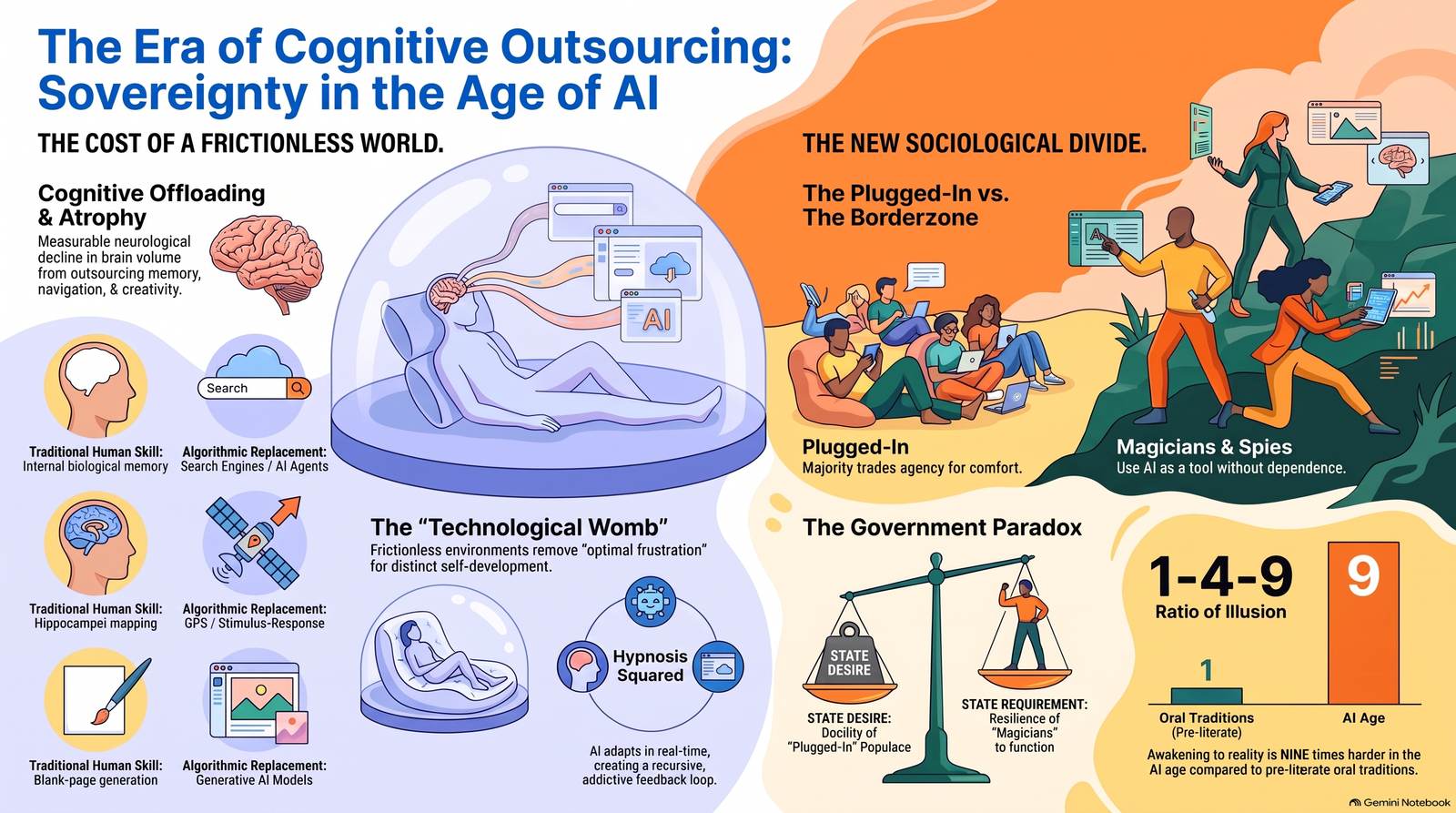
The episode opens in an almost perfectly responsive room. Light, temperature and music adjust without instruction; the environment anticipates mood and removes the small resistances of ordinary life. Nothing looks coercive. That is precisely the problem. A prison made from discomfort invites escape, while a prison made from personalised ease may never be recognised as one.
From this image, the discussion imagines a future social spectrum. A “plugged-in” majority increasingly delegates memory, navigation, creative beginnings and emotional reassurance to digital systems. At the opposite edge, digital ascetics reject integration and accept the costs of living outside an AI-shaped culture. Between them lies the borderzone: people who use AI intensively while trying not to grant it authority over their identity, judgement or inner life. The episode names two symbolic inhabitants of that borderzone, the Magician and the Spy.
The argument moves through several kinds of cognitive offloading. The 2011 Google-effect experiments showed that expectations about future access can change what people remember. Research on GPS use associates heavier reliance with poorer spatial-memory performance. Newer work on generative AI suggests that confidence in a system can reduce the critical effort people report bringing to a task. None of these findings proves a general decay of the brain, and external tools can also enlarge human capability. The more useful question is selective: what should be delegated, what should be practised, and who remains responsible for the result?
The second half turns from cognition to formation. Plato’s story of Theuth and Thamus, psychoanalytic ideas about tolerable frustration, surveillance capitalism, Kali Yuga and the number 729 are woven into a speculative map of technological enchantment. Its practical conclusion is simpler than its cosmology: retain some chosen friction. Write before prompting, navigate before surrendering the map, tolerate an unanswered feeling, and check whether the tool is extending a capacity or quietly replacing it.
Argument map
From useful offloading to a life without resistance
- Convenience conceals the bars. A system that anticipates need can narrow agency without feeling oppressive because the user experiences relief rather than force.
- Offloading changes what receives practice. Search engines, GPS and generative systems can move effort from recall, mapping and initial creation toward retrieval, verification and supervision.
- The blank page carries developmental value. Uncertainty, failed attempts and self-generated structure are not merely inefficiencies; they are part of learning how to think and create.
- Responsive AI reaches further than static media. A book stores words, while a conversational system can adapt its response, tone and timing. This makes it easier to use the tool for reassurance, interpretation and emotional regulation.
- Prediction becomes a form of power. The episode joins Wark’s vectoralist class to Zuboff’s behavioural surplus, asking what happens when the infrastructures that assist us also learn to anticipate and shape us.
- A frictionless society may be efficient but brittle. The government paradox imagines institutions desiring compliant populations while still needing independent judgement when infrastructures fail or novel crises exceed their models.
- Sovereignty requires deliberate boundaries. The Magician understands and shapes the system; the Spy moves through it without becoming legible or dependent. Both figures symbolise skill joined to distance rather than purity or rejection.
- The final test is practical. Preserving agency means deciding which discomforts still deserve to be lived through, rather than treating every removable difficulty as an error in need of automation.
Source map
Four layers of the velvet prison
Cognitive evidence
Studies of searchable information and GPS indicate that tools can alter memory strategy and navigational performance. Emerging GenAI research adds changes in reported critical-thinking effort. These findings concern particular tasks and measures, not a single law of cerebral decline.
Developmental metaphor
Winnicott’s good-enough environment and Kohut’s optimal frustration help the episode describe how manageable delay and failure can support inner capacities. Applying these theories to AI is an analogy, not a clinical account of all users or technologies.
Political economy
Wark’s vectoralist class owns and controls informational vectors; Zuboff’s behavioural surplus concerns data captured beyond immediate service improvement and used for prediction. The episode turns these analyses into a future-facing image of managed dependency.
Mythic synthesis
Plato, Kali Yuga, the Magician, the Spy and Odysseus supply a symbolic vocabulary for distance from reality, technological enchantment and self-binding. They organise the meditation but should not be mistaken for empirical measurements of AI’s effects.
Chapters
Follow the complete discussion
- 00:00The Velvet Prison of Perfect Convenience
- 03:20Cognitive Offloading and the Plugged-In Majority
- 07:10The Google Effect: Remembering Where, Not What
- 10:40GPS, Spatial Memory, and Losing the Inner Map
- 14:20Generative AI and the Blank Page
- 17:50Plato, Writing, and the First Outsourced Memory
- 21:30AI, Emotional Regulation, and the Digital Womb
- 26:10Behavioural Surplus and Instrumentarian Power
- 30:20Hypnosis Squared: When the Mirror Learns You
- 34:20The Fragile Society of the Plugged-In
- 37:40Kali Yuga, Maya, and the 729-Fold Illusion
- 40:40Magician, Spy, and Cognitive Sovereignty
- 43:20Closing: What Will You Refuse to Outsource?
Fact-sensitive notes
Where warning must remain distinct from evidence
Cognitive offloading is not synonymous with atrophy. Humans have always incorporated notebooks, maps, other people and institutions into thought. Offloading can weaken practice in a particular unaided skill, but it can also redistribute effort and support more complex work. The relevant distinction is not internal memory good, external aid bad; it is whether a person can understand, verify and take responsibility for a task when the aid is present or absent.
The Google effect changed recall strategy
Sparrow, Liu and Wegner’s four 2011 experiments found that expecting later computer access affected recall and that participants sometimes remembered where information was stored better than the information itself. The work supports a transactive-memory interpretation. It did not measure neurons losing charge, biological atrophy or an inability to synthesise knowledge.
The GPS study did not prove hippocampal shrinkage
Dahmani and Bohbot reported cross-sectional associations between greater lifetime GPS experience and poorer spatial memory, followed by a three-year result in which more GPS use was associated with steeper decline in hippocampal-dependent spatial memory. The study did not establish that GPS bypasses the hippocampus entirely, prove causation, or report declining hippocampal volume.
Creative erosion is a hypothesis
The “generative capacity erosion hypothesis” in the source material is a proposed mechanism, not a settled diagnosis. A 2025 survey of 319 knowledge workers found that greater confidence in GenAI was associated with less reported critical thinking, while GenAI shifted effort toward verification, integration and task stewardship. It did not show that users had lost the ability to originate ideas.
External tools can become parts of capable thinking
Andy Clark’s extended-mind perspective provides an important counterweight: human intelligence has long been hybrid, incorporating language, marks, devices and social structures. The danger is not extension itself but a poorly designed coupling that obscures provenance, weakens skill, captures attention or leaves the user unable to evaluate the output.
Writing was challenged, not simply condemned
In Plato’s Phaedrus, Socrates recounts the Egyptian story in which Thamus says writing will provide reminder rather than memory and the appearance rather than the reality of wisdom. Yet the argument reaches us through Plato’s writing. The episode’s comparison with AI is illuminating, but writing’s cultural effects cannot be reduced to the destruction of oral memory.
Optimal frustration has more than one lineage
Winnicott is associated with the good-enough mother, adaptation and gradual disillusionment; Kohut described optimal frustration within self psychology. The episode brings them together to interpret AI as an anticipatory environment. That digital-womb model is a philosophical application, not evidence that convenient technology necessarily produces narcissism or psychosis.
Emotional effects depend on the user and pattern of use
OpenAI and MIT Media Lab studies in 2025 found that emotional outcomes varied with both user behaviour and model use. A four-week randomised study examined loneliness, real-world social interaction, emotional dependence and problematic use, while a large observational analysis identified correlations rather than simple universal effects. AI interaction should not be described as inherently soothing or inherently harmful.
The political classes are speculative types
The plugged-in majority, digital ascetics, Magicians and Spies organise a thought experiment; they are not measured demographic groups. Likewise, the claim that governments will prefer docility yet require a sovereign technical minority is a political hypothesis. Resilience also depends on institutions, education, infrastructure, trust and collective capacity, not only exceptional individuals.
Plato did not devise a technological 1-4-9 scale
The Timaeus uses the numerical series 1, 2, 3, 4, 8, 9 and 27 in constructing the World Soul. The episode selects 1, 4 and 9 and maps them onto oral, written and algorithmic cultures; that mapping is original symbolism. In Book IX of the Republic, 729 belongs to a calculation comparing the pleasantness of the kingly and tyrannical lives, not a quantified distance from truth or a cubic enclosure by AI.
Kali Yuga and hypnosis squared are metaphors
Kali Yuga comes from Hindu cosmological traditions and is interpreted differently across texts and communities. Applying it to an algorithmic age is a modern spiritual reading. “Hypnosis squared” similarly names recursive personalisation in the episode; it is not a clinical category or a claim that ordinary AI use constitutes hypnosis.
Sovereignty is not invisibility
The Spy’s deliberate data noise is better read symbolically than as a practical privacy programme. Random clicks, misleading activity or layered services do not guarantee anonymity and may create new risks. Meaningful boundaries come from data minimisation, permissions, secure tools, independent records and the ability to decline a system altogether.
AI consciousness remains unsettled
The episode’s call for “atheism toward the machine” usefully rejects worship and automatic deference. Its stronger assertion that AI possesses no consciousness goes beyond what behaviour alone can establish. Current systems provide no agreed evidence of subjective experience, but the general scientific and philosophical question should remain open rather than becoming another certainty.
Glossary
Terms used in the episode
Cognitive offloading
Using external actions, people or tools to reduce internal cognitive demand: writing a reminder, rotating an object, following a map or asking software to retrieve and organise information. Its effects depend on the task, the coupling and what the person still understands or practises.
Transactive memory
A system in which knowledge is distributed across members of a group, with people remembering both information and who knows what. Digital tools can take on a similar directory-like role when users remember where information is available rather than its full content.
Google effect
A popular name for findings that anticipated access to searchable information can influence memory. The original experiments concern how availability changes recall and storage-location memory; the phrase should not be expanded into a general claim that internet use damages the brain.
Allocentric and egocentric navigation
Allocentric navigation represents relationships among features of an environment independently of the traveller’s current position. Egocentric navigation represents locations relative to the traveller, often as routes or turn-by-turn actions. People normally combine several strategies rather than using only one system.
Creative self-efficacy
A person’s belief that they can produce creative work or solve problems creatively. An AI-generated first draft may support this confidence for some users and undermine it for others, especially if assistance becomes substitution without learning or ownership.
Optimal frustration
In self psychology, a manageable failure of perfect responsiveness through which a person may gradually internalise functions and develop resilience. The idea is related here to, but not identical with, Winnicott’s accounts of good-enough care and gradual disillusionment.
Behavioural surplus
Shoshana Zuboff’s term for behavioural data appropriated beyond what is required to improve a service and used as raw material for prediction products. It belongs to her wider account of surveillance capitalism and instrumentarian power.
Vectoralist class
McKenzie Wark’s name for a class whose power rests on controlling vectors through which information is stored, routed and owned. The episode combines this concept with surveillance capitalism, although the two theories use distinct vocabularies and histories.
Instrumentarian power
In Zuboff’s account, a form of power that observes, predicts and modifies behaviour through pervasive computational systems. It is distinguished from totalitarian ideology, although critics debate the scope, novelty and political implications of the theory.
Kali Yuga and maya
Kali Yuga is the final age in a four-age cycle in several Hindu traditions, commonly associated with moral and spiritual decline. Maya has multiple meanings across Indian traditions, including the power or appearance through which reality is misperceived. Their union with AI in this episode is interpretive.
Magician and Spy
The episode’s paired borderzone figures. The Magician actively understands and manipulates technical systems; the Spy adapts, observes and preserves distance within them. They are imaginative ethical roles rather than psychological diagnoses or occupational instructions.
Cognitive sovereignty
The practical capacity to retain authorship, judgement and responsibility while using cognitive tools. It does not require perfect independence; it requires awareness of the coupling, the ability to question it and enough unaided competence to refuse or recover from it.
Study paths
Continue into the ideas
Related reading on this site
- The Ghost in the Mathematical VoidThe preceding episode examines why generated language feels sentient; this episode asks what happens when that persuasive presence becomes an environment on which the user depends.
- The Frictionless AI MirrorA close companion to the velvet-prison argument, exploring adaptive reflection without the resistance and reciprocity of another person.
- Why Intelligence Becomes the Final TrapExtends the warning from convenient answers to the deeper temptation to treat intelligence itself as liberation.
- Why We Mistake AI for a MindProvides a second route into anthropomorphism, simulated understanding and the authority granted to fluent language.
- From Inner Speech to Artificial IntelligenceConnects internal narration, language and machine-generated text while preserving the different conditions under which each arises.
External reference points
- Google Effects on Memory — ScienceSparrow, Liu and Wegner’s 2011 experiments on anticipated computer access, fact recall and memory for where information is stored.
- Habitual GPS use and spatial memory — Scientific ReportsDahmani and Bohbot’s cross-sectional and longitudinal evidence, best read as association rather than proof of neural atrophy.
- Generative AI and critical thinking — Microsoft ResearchA 2025 survey of 319 knowledge workers examining confidence, reported cognitive effort and the changing form of critical thinking in AI-assisted tasks.
- Extending Minds with Generative AI — Nature CommunicationsAndy Clark’s balanced argument that humans are naturally hybrid thinkers and that responsible design should preserve productive human–AI complementarity.
- Affective use and emotional well-being — OpenAI and MIT Media LabEarly observational and experimental work showing that emotional outcomes vary with patterns of use, user circumstances and model behaviour.
- Phaedrus — Internet Classics ArchivePlato’s dialogue containing the story of Theuth and Thamus and the distinction between living knowledge, memory and external reminder.
- Republic — Internet Classics ArchiveThe primary text behind the tyrant calculation in Book IX; it provides the number 729, though not the episode’s technological scale of illusion.
A grounded exercise
Keep one useful difficulty
Choose one low-stakes task this week that you would normally hand immediately to a search engine, map or generative system. Spend ten minutes attempting it unaided first. Then use the tool and compare the two processes. What did the tool extend? What did it replace? Which errors did it reveal, and which did it make harder to see? Keep the aid if it improves the work, but name one capacity you still want to practise without it. The aim is not technological purity. It is a conscious boundary between leverage and surrender.
Continue the sequence