
Dialogues IV · Episode 04
How Distress Becomes Compulsion
A harmful repetition may begin as relief; the difficulty is understanding how relief becomes a demand.
Watch here, or continue on YouTube with chapters and comments. Open on YouTube ↗
The central question
How can an attempt to regulate distress become a compulsion that persists after pleasure fades?
A behaviour that causes harm may nevertheless have begun as an intelligible attempt to alter an unbearable state. This episode asks what happens when rapid, predictable relief is recruited to manage fear, agitation, numbness or uncertainty—and then becomes a source of distress in its own right.
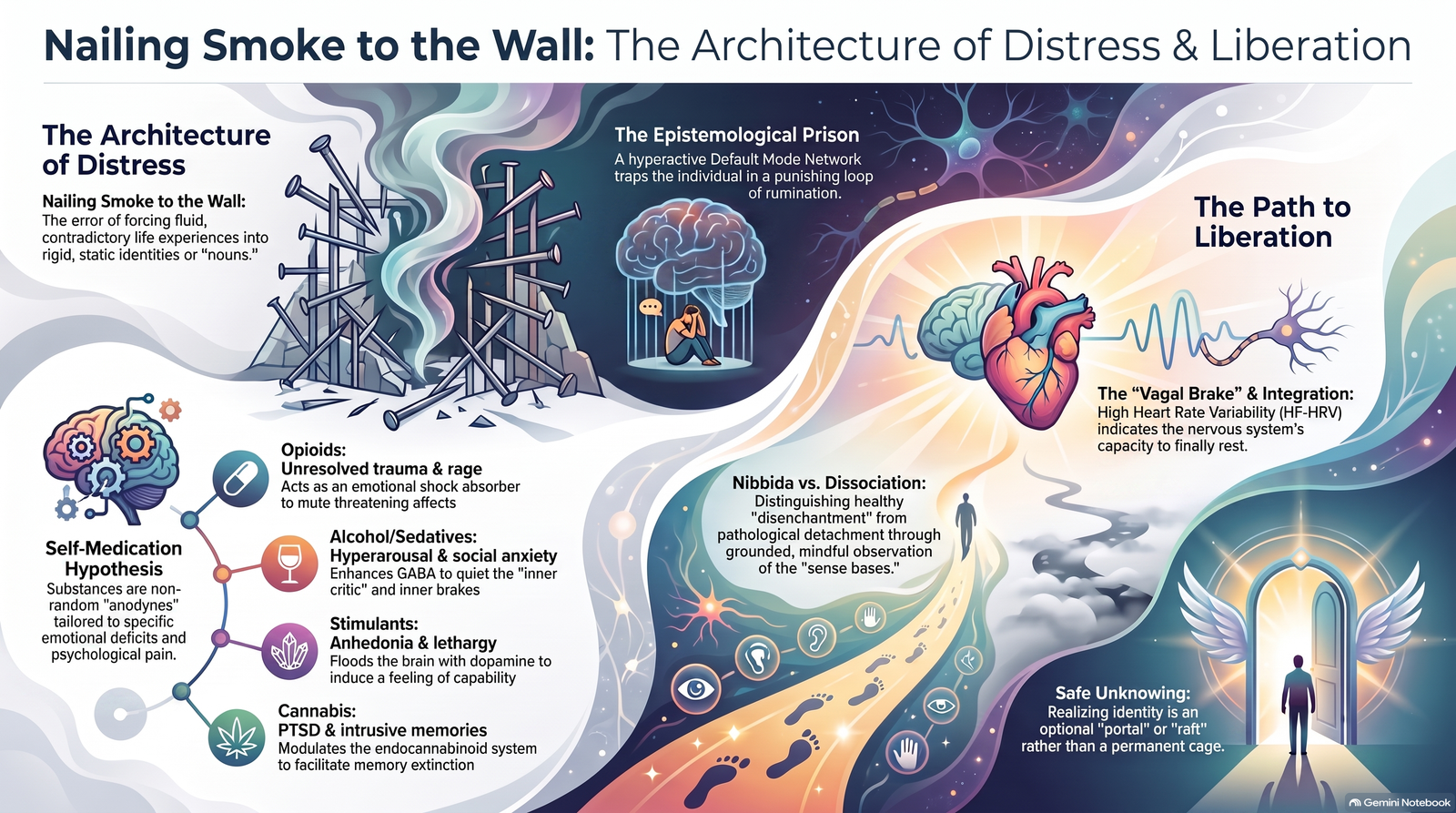
The opening image is “nailing smoke to the wall”. Human experience changes from moment to moment, yet language can turn a passing state into a fixed identity: not “failure is present”, but “I am a failure”; not “a craving has arisen”, but “this is what I am”. The discussion links that friction to Edward Khantzian’s self-medication hypothesis, which proposed that substance choice may sometimes reflect attempts to manage characteristic forms of distress. This is a compassionate interpretive lens, not a universal explanation and not evidence that every drug has one predictable psychological “fit”.
The biological centre of the episode is the separation of “wanting” from “liking”. Incentive-sensitisation theory proposes that repeated exposure can make cues unusually powerful in vulnerable individuals, so the motivational pull of a substance may intensify without a matching increase in pleasure. Withdrawal, habit learning, environment and impaired control can then sustain a loop that cannot be reduced to moral weakness. Ellen Langer’s lottery experiments supply a psychological analogy: even irrelevant choice can make a chance-governed situation feel more controllable. The episode extends this finding speculatively, asking whether a reliable change of state can function as a lever within an unpredictable inner world.
From there, the argument returns to identity, the default mode network, autonomic regulation and Buddhist images of the five hindrances, the raft and impermanence. Its proposed “pseudo-jhāna” is deliberately read here as metaphor: intoxication is not equivalent to meditative absorption, and heart-rate variability is not a meter of liberation. The closing movement is quieter. If a label is a useful tool rather than an essence, can it be put down long enough for an urge, emotion or self-story to be noticed as an event rather than obeyed as an identity?
How to read this episode: addiction has multiple biological, psychological and social determinants. The self-medication hypothesis and incentive-sensitisation theory are influential accounts, not complete explanations of every person or substance. The recording sometimes turns tendencies into certainties: substance effects are variable; alcohol does not simply “switch on” the parasympathetic system; default-mode activity is not a direct measure of metabolic exhaustion; and high-frequency heart-rate variability is a context-sensitive, indirect index of cardiac parasympathetic influence. The comparison between addiction, everyday scrolling and Buddhist practice is philosophical and heuristic, not proof of one shared mechanism.
Argument map
Six movements from urgent relief to a less rigid identity
Flux is forced into form
Changing sensations and emotions become fixed nouns, making an identity feel predictable while increasing the effort required to defend it.
Relief answers distress
The self-medication hypothesis reframes some substance use as an attempt at regulation, without making that attempt safe, effective or universal.
The body adapts
Tolerance, withdrawal and other neuroadaptations can make the original problem worse and turn repeated use into relief from consequences partly created by use.
Wanting outlives liking
Cues can acquire intense incentive salience, so motivational pull persists even when pleasure has diminished and conscious intention opposes the behaviour.
Control becomes a lever
Langer’s lottery studies become an analogy for the appeal of a predictable action inside an uncertain world—not an established causal theory of addiction.
The noun becomes optional
Defusion and impermanence suggest a different relation to labels: useful for navigation, but no longer treated as permanent owners of experience.
Navigate the discussion
Chapters
Selecting a chapter opens the published video at that point on YouTube.
- 00:00Introduction
- 00:30Turning a Fluid Life Into a Fixed Identity
- 05:48Addiction as an Attempt at Self-Regulation
- 09:18Homeostasis, Withdrawal and Rebound Distress
- 12:59Wanting Without Liking
- 15:45When Wanting Becomes Compulsion
- 19:32Trauma and the Illusion of Control
- 22:49Cognitive Fusion and the Cost of Fixed Identity
- 25:43The Vagus Nerve and Heart-Rate Variability
- 26:14The Trance Ego and the Limits of Language
- 28:18Leaving the Past and Future Outside the Room
Key language
Glossary
Self-medication hypothesis
Edward Khantzian’s clinical hypothesis that some substance use begins as an attempt to relieve painful emotions, impaired self-regulation or other psychiatric distress. It can support a less moralising understanding of addiction, but it is not a diagnosis, does not explain every case and does not establish a fixed match between a substance and one emotional problem.
Psychopharmacological specificity
The hypothesis that a person may prefer a substance partly because its effects alter a particular form of distress. The episode presents neat mappings between drug classes and emotional states; real patterns are more variable, can overlap and are influenced by availability, learning, biology, social context and co-occurring conditions.
Homeostasis, tolerance and withdrawal
Homeostasis is the body’s regulation of internal conditions. Repeated exposure to a substance can produce adaptations, including tolerance to some effects and withdrawal when use is reduced. These processes differ by substance and person; withdrawal is not merely the original distress returning, and alcohol withdrawal can be medically dangerous.
Incentive sensitisation
Robinson and Berridge’s theory that repeated drug exposure can, in susceptible individuals and circumstances, sensitise brain systems that assign motivational importance to drugs and their cues. The theory helps explain intense cue-triggered “wanting”, but it is one model within a wider science of addiction.
“Wanting” and “liking”
Technical shorthand used in reward research. “Wanting” refers to incentive motivation—the pull exerted by a reward or cue—while “liking” refers to hedonic impact or pleasure. They normally interact but can diverge. This distinction does not mean that all compulsion follows one dopamine mechanism or that pleasure necessarily disappears.
Illusion of control
Ellen Langer’s term for responding to chance-governed situations as if one’s actions influenced the outcome. In her 1975 lottery study, choosing a ticket increased its later selling price. Applying that finding to trauma and addiction is the episode’s analogy, not a direct result of Langer’s experiments.
Cognitive fusion and defusion
In Acceptance and Commitment Therapy, fusion describes becoming entangled with the literal content of thoughts; defusion changes one’s relationship to them so they can be noticed as mental events. Defusion does not require denying facts, erasing identity or treating serious symptoms as “only thoughts”.
Default mode network (DMN)
A set of interacting brain regions associated with internally directed cognition, including autobiographical memory, self-related processing and imagining the future. Its activity and connectivity can change in many conditions, but it is not simply an “ego network”, threat detector or gauge of how much energy a personal identity consumes.
Vagus nerve and high-frequency HRV
The vagus nerve contributes parasympathetic control of the heart. High-frequency heart-rate variability reflects beat-to-beat variation linked strongly to respiration and cardiac vagal influence. It is an indirect, context-dependent physiological measure—not a direct reading of the whole vagus nerve, emotional health, contemplative depth or the capacity to “finally rest”.
The five hindrances
In early Buddhist texts, sensual desire, ill will, sloth and torpor, restlessness and remorse, and doubt are qualities that obstruct clarity and concentration. Their temporary abandonment is associated with entry into jhāna. This doctrinal map should not be treated as a neuroscientific classification.
Jhāna and “pseudo-jhāna”
Jhāna names meditative absorptions described in Buddhist traditions, with interpretation and practice varying across lineages. “Pseudo-jhāna” is the episode’s metaphor for chemically produced relief or stillness. It is not a canonical Buddhist term, a clinical category or evidence that intoxication recreates contemplative absorption.
Impermanence, non-self and the raft
Anicca points to the changeability of conditioned phenomena; anattā denies an independent, permanent self within them. The Buddhist raft image warns against clinging even to useful teachings once their purpose is served. Together, they inform the episode’s invitation to use identity without treating it as an immutable essence.
Nibbidā and dissociation
Nibbidā is a Buddhist term often translated as disenchantment, disillusionment or revulsion towards conditioned phenomena. Dissociation is a psychological term covering disruptions in ordinarily integrated experience. Similar language of distance or detachment does not make them equivalent; context, functioning, distress and clinical assessment matter.
A two-minute observation
Let one noun become a process
Choose an ordinary, mildly uncomfortable label that has appeared today—perhaps “distracted”, “behind” or “not good enough”. Silently add: “I am noticing the thought that I am…” Then describe what is happening without turning it into an identity: “tightness is present”, “an urge to avoid is present”, or “planning is happening”. Feel your feet or another neutral point of contact. Nothing needs to disappear. Notice whether the label becomes slightly less like a verdict and more like an event passing through experience.
Reflection is not withdrawal treatment
This brief exercise is not therapy and is not a substitute for addiction treatment. Do not use it to test yourself against intense craving, withdrawal or trauma. If you are worried about drug use, the NHS explains how to find confidential support. If you may be physically dependent on alcohol, seek medical guidance before stopping suddenly, because withdrawal can be dangerous.
Continue the series