
Dialogues IV · Episode 14
Why Goodness Becomes the Final Attachment | Dialogues IV
What remains of ethical life when goodness is no longer an identity to defend, a rule to grasp or a possession of the self?
The central question
Can ethical action survive the disappearance of the person who needs to be good?
This episode enters the final three bhūmis of the ten-stage bodhisattva path and asks a deliberately unsettling question: must a practitioner eventually release even goodness? Its answer is not permission to abandon care. It is a distinction between ethical responsiveness and attachment to a self-image built from virtue—between acting well and needing to be “a good person”.
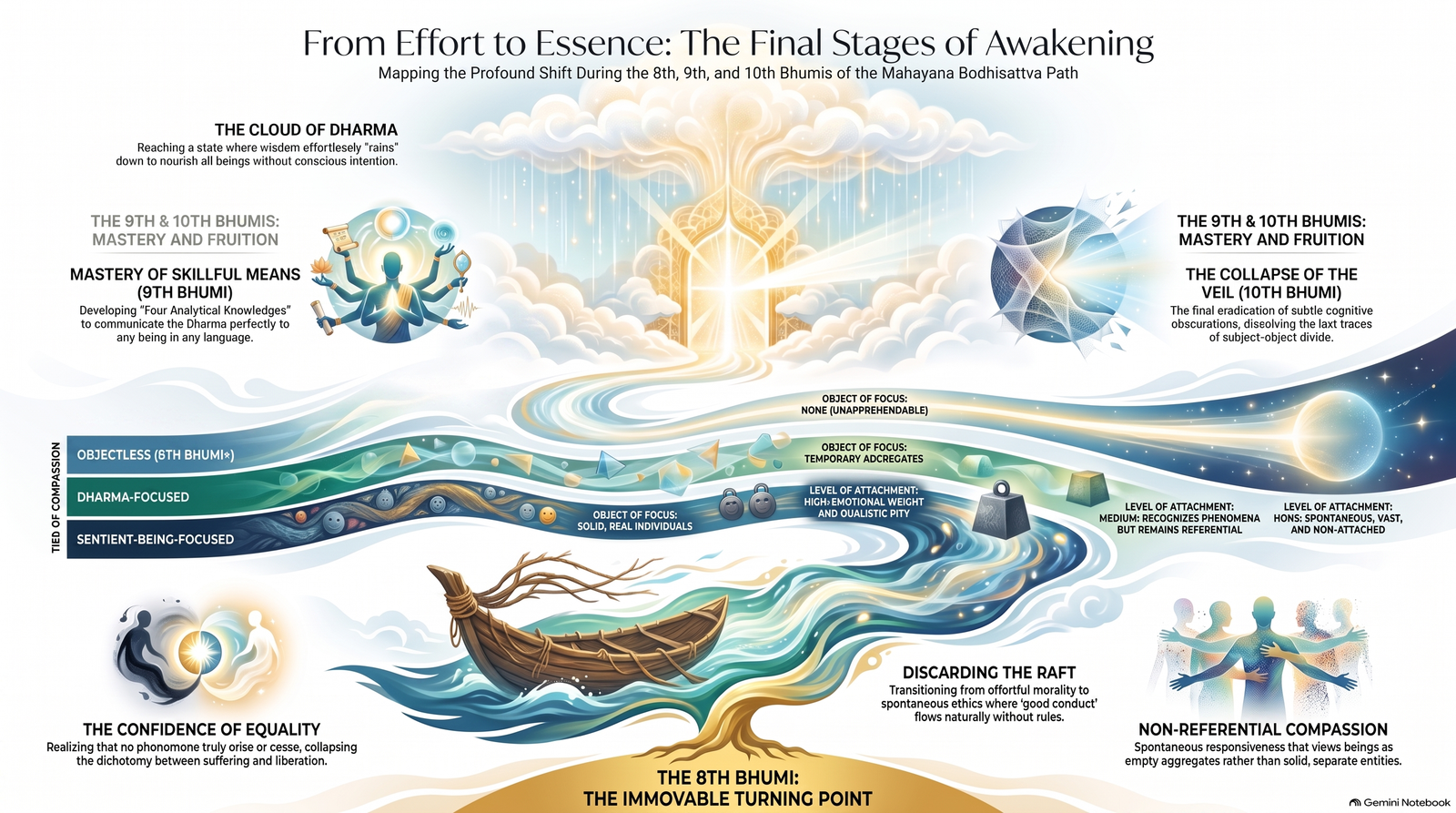
The eighth bhūmi, Acalā or “Immovable”, supplies the turning point. The discussion presents anutpattika-dharma-kṣānti—patient acceptance or confidence regarding the non-arising of phenomena—as a stable realisation that things do not possess independent, self-established essence. A threefold account of compassion then moves from compassion directed towards apparently solid beings, through attention to changing processes, towards non-referential compassion. The magician and illusory tiger express the paradox: seeing through the tiger does not erase the audience’s fear; it permits a response without sharing the delusion.
This becomes the basis for “effortless ethics”. Earlier discipline remains indispensable, but the episode imagines a stage at which generosity and restraint no longer have to be manufactured through self-command. Conventional conduct continues as compassionate upāya, while moral identity and attachment to spiritual achievement are released. The raft metaphor marks this delicate transition: teachings are used for crossing rather than turned into possessions. It does not mean that ethical consequences cease or that emptiness licenses harmful behaviour.
The ninth and tenth bhūmis carry the movement outward. “Good Intelligence” is associated with analytical knowledge and the ability to communicate Dharma appropriately; “Cloud of Dharma” evokes teaching that falls like rain without calculation. The episode culminates in the collapse of the final subject–object division and the emergence of dharmakāya. These are traditional soteriological descriptions, interpreted differently across Mahāyāna schools. Their practical challenge is nearer at hand: can care become less concerned with possessing goodness, while becoming more exact in its response to suffering?
How to read this episode: the ten bhūmis are a Mahāyāna map of the bodhisattva path, not an empirically validated scale for assessing oneself or other people. Terms such as the eradication of obscurations, irreversibility, omniscience and the emergence of dharmakāya receive different explanations in different textual and commentarial systems. “Non-arising” does not mean that nothing appears, that suffering is unreal in every sense or that actions lack consequences. The episode’s language of abandoning goodness concerns relinquishing grasping and moral self-ownership, not discarding ethical care, precepts or accountability.
Argument map
Seven movements from effortful virtue to unowned compassion
The path begins with necessary effort
Generosity, restraint, patience and attention are deliberately cultivated. The episode does not dismiss this groundwork; it asks what happens after it has become deeply embodied.
The eighth bhūmi becomes immovable
Within the traditional map, insight into emptiness and non-arising is no longer treated as an occasional meditative perspective but as a stable, irreversible orientation.
Compassion loses its solid object
Beings are understood as dependently arisen processes rather than sealed selves. Their suffering still calls for response, but the helper–helped divide is no longer granted ultimate status.
The magician enters the frightened crowd
Knowing the tiger to be illusory prevents panic, not compassion. Clear seeing allows the magician to comfort those whose fear remains experientially and conventionally real.
Ethics becomes less self-conscious
The ideal of effortless action describes responsiveness without the inner drama of earning purity, protecting an identity or calculating spiritual merit.
The raft is released without rejecting the crossing
Teachings and precepts remain effective conventional means. What is relinquished is the impulse to grasp them as inherently existing possessions or guarantees of superiority.
Wisdom becomes communication and rain
The ninth bhūmi refines skilful expression; the tenth pictures Dharma as a cloud nourishing beings without calculation, before the traditional transition to full Buddhahood.
Listen by theme
Chapters
Selecting a chapter opens the published video at that point on YouTube.
- 00:00Must Goodness Eventually Be Abandoned?
- 02:25The Bodhisattva Path and the Ten Bhūmis
- 04:35The Eighth Bhūmi: The Point of No Return
- 09:00Emptiness, Non-Arising and Saṃsāra
- 12:02Three Forms of Compassion
- 15:12The Magician, the Tiger and Objectless Compassion
- 18:27Effortless Ethics and Skilful Means
- 21:15When Being “Good” Becomes an Attachment
- 23:05The Diamond Sutra and Letting Go of the Raft
- 25:25The Ninth Bhūmi: The Mastery of Communication
- 29:04The Tenth Bhūmi and the Final Cognitive Veil
- 33:39Dharmakāya and What Remains When the Practitioner Disappears
Terms in context
Glossary
Bhūmi
Literally “ground” or “level”. In this episode it refers to the ten stages of the bodhisattva path described in Mahāyāna sources such as the Daśabhūmika Sūtra. The map is developed differently across traditions and should not be treated as a clinical or empirical scale.
Acalā — the eighth bhūmi
“Immovable”, the eighth bodhisattva ground. Textual and commentarial traditions associate it with irreversibility, effortless activity and a profound stabilisation of insight. The precise account of what has been abandoned or realised varies by doctrinal system.
Anutpattika-dharma-kṣānti
Often translated as acceptance, patient endurance or acquiescence regarding the non-arising of phenomena. It names a non-frightened receptivity to the emptiness of phenomena, not a claim that appearances simply cease or that conventional causality is abolished. “Confidence of equality” is the episode’s interpretive rendering rather than the only standard translation.
Śūnyatā and non-arising
Śūnyatā, emptiness, means that phenomena lack independent, intrinsic nature. In Madhyamaka, this is inseparable from dependent arising: things function conventionally because they arise through conditions. Non-arising concerns the absence of self-established origination under ultimate analysis, not the denial of ordinary experience.
Three forms of compassion
Mahāyāna sources and commentaries distinguish compassion focused on sentient beings, compassion focused on phenomena or dharmas, and objectless or non-referential compassion. The sequence describes increasingly non-reifying ways of responding; it need not imply coldness towards particular people.
Anālambana-karuṇā
Non-referential or “objectless” compassion: care not founded on grasping a helper, recipient or act of helping as independently real. “Objectless” does not mean indifferent or inactive; the episode uses the magician analogy to emphasise clear, responsive engagement.
Anābhoga
Effortlessness or action without deliberate exertion. In the later-bhūmi context, it describes awakened activity that no longer has to be constructed through self-conscious striving. It is presented as the fruit of extensive cultivation, not a shortcut around discipline.
Upāya-kauśalya
Skilful means: forms of teaching or action adapted compassionately to circumstances and capacities. It is not a general licence to ignore ethics; claims of skilful means remain especially vulnerable to self-deception when used to excuse avoidable harm.
The raft
A Buddhist image for teachings used to cross rather than to possess. The early raft simile appears in the Alagaddūpama Sutta; the Diamond Sutra invokes the same logic while warning against grasping either dharmas or non-dharmas. Releasing the raft is not rejecting practice before it has served its purpose.
Sādhumatī — the ninth bhūmi
Usually translated as “Good Intelligence” or “Good Mind”. It is associated with four analytical knowledges concerning teachings, meanings, language and eloquence, enabling skilful communication to varied audiences.
Dharmameghā — the tenth bhūmi
“Cloud of Dharma”, the tenth bodhisattva ground. The cloud suggests a vast capacity to receive and rain down teaching. Classical descriptions are richer than a single metaphor and differ from the episode’s simplified psychological narrative.
Two obscurations
A common Mahāyāna distinction between afflictive obscurations, associated with grasping and reactive emotions, and cognitive obscurations, which impede complete knowledge. Traditions disagree about precisely when and how these are removed across the paths and bhūmis.
Omniscience
A traditional quality of buddhahood. Buddhist philosophers and schools differ over its scope and mode. The episode stresses unobstructed knowledge of phenomena and their empty nature rather than an encyclopaedia of miscellaneous facts; that explanation remains doctrinal, not empirically testable.
Dharmakāya
The “Dharma body” or truth dimension of buddhahood. Depending on the Mahāyāna system, it can refer to the emptiness of awakened mind, its unobstructed knowing, or both. The episode’s image of its gradual emergence between the eighth and tenth bhūmis is an interpretive synthesis, not a universally shared formulation.
Read further
Connections and reference points
Within this website and course
- The BodhisattvaAn introduction to the Mahāyāna ideal that frames the episode’s account of wisdom, compassion and return
- EmptinessBackground for the distinction between dependent appearance and independent, inherent essence
- The Diamond SutraA concise companion to the episode’s concern with releasing attachment to teachings, identities and fixed concepts
- Citrinitas 3.1.10: The BodhisattvaThe course chapter most directly connected to compassion, skilful means and the later movement of the path
- Citrinitas 3.1.11: The Diamond Sutra, Part OneA longer course treatment of non-attachment and the danger of turning liberating concepts into new objects of grasping
External reference points
- 84000: The Ten BhūmisA complete scholarly translation of the principal sūtra describing the ten bodhisattva grounds
- Stanford Encyclopedia of Philosophy: MadhyamakaAn academic introduction to emptiness, intrinsic nature and the middle way between substantialism and nihilism
- Stanford Encyclopedia of Philosophy: The Two Truths in IndiaContext for how conventional efficacy and ultimate emptiness are related—and disputed—across Buddhist philosophical schools
- Majjhima Nikāya 22: The Simile of the RaftThe early Buddhist discourse that presents teachings as a means for crossing rather than an object to be grasped
- The Diamond That Cuts Through IllusionA contemporary Buddhist translation showing how the Diamond Sutra reuses the raft image while refusing attachment to “Dharma” and “non-Dharma”
A gentle reflective question
What happens when goodness is no longer owned?
Choose one small act of care you already perform. Notice whether the mind quietly turns it into evidence—“I am generous”, “I am patient”, “I am spiritually progressing”—or into a demand for appreciation. For a moment, let the action remain useful without making it proof of identity. This is not an invitation to abandon discernment or boundaries. It is simply an inquiry into whether care can be complete without being possessed.
Continue the series