
Catalogue reference 3.1.11 · Revised Edition (2026)
The Diamond Solvent
What happens when a teaching cuts through not only the self we defend, but also the spiritual understanding we hope to possess?
Watch the chapter discussion
The Diamond Sutra Explained | Ego Dissolution, Emptiness & No-Self
Open this video on YouTube · AI-generated two-host interpretation of the chapter; it is a learning companion, not an authoritative translation.
The chapter in brief
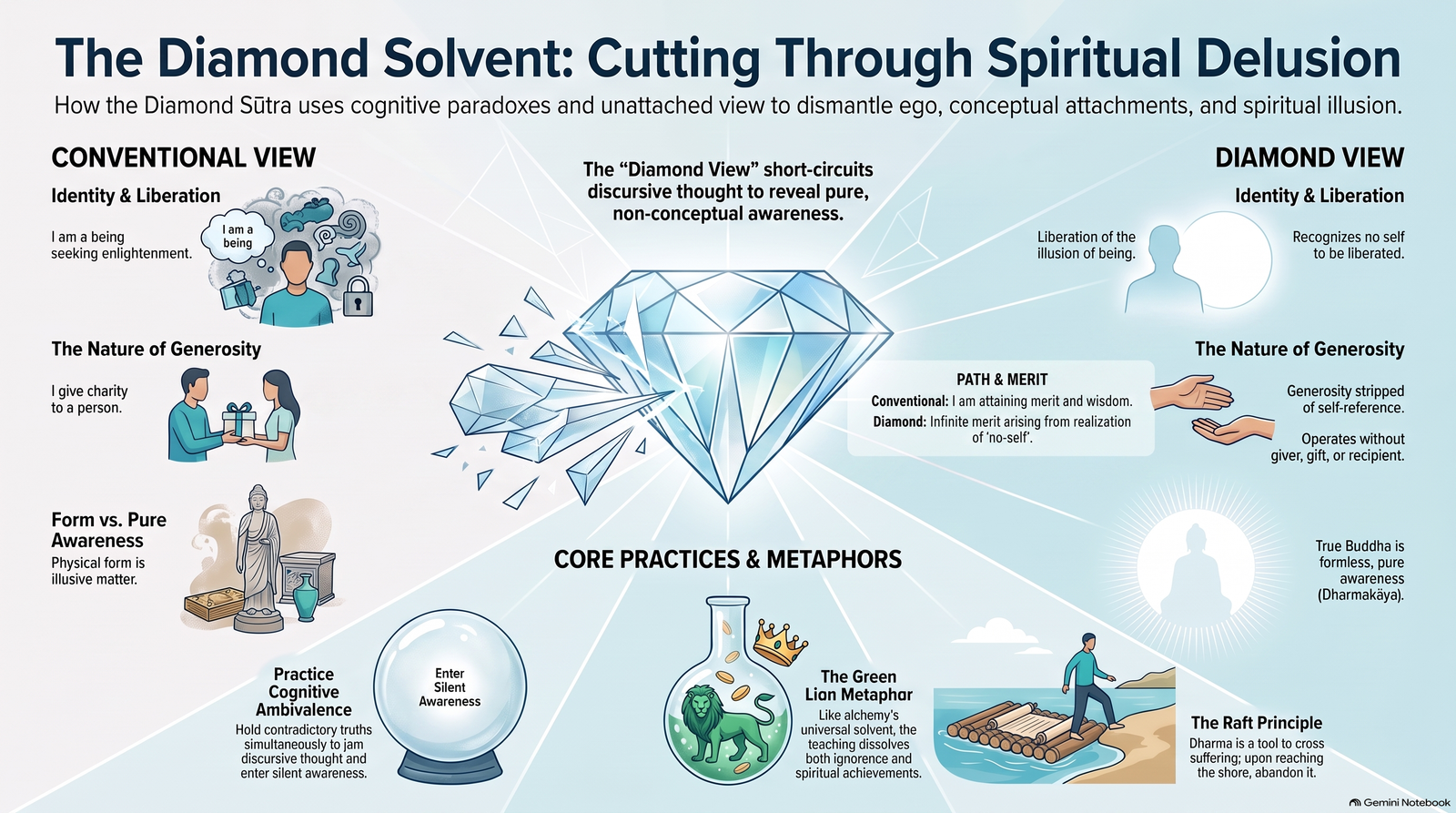
In the eleventh chapter of the revised Citrinitas, the Diamond Sūtra is presented as a solvent for the concepts through which a seeker constructs a spiritual identity. The Buddha’s ordinary routine opens into Subhūti’s questioning: beings are to be liberated, yet no independently existing being can be found. The teaching moves through generosity without possessiveness, the limits of physical form, emptiness without nihilism and merit without personal ownership. The chapter concludes with the Green Lion, a Western alchemical image of a solvent capable of consuming even gold. Here it represents the critique of attachment not only to ignorance but to insight and spiritual achievement. The comparison with alchemy, and the phrase “cognitive ambivalence”, belong to the author’s interpretive synthesis rather than to the ancient sūtra itself.
Video guide: the question behind the paradox
The 44-minute discussion begins with the deliberately extravagant image of an ultimate cognitive acid: something that dissolves our comforting beliefs and even the self-image of having grown wiser. It then turns to the Sanskrit vajra, linking the diamond’s cutting edge and the thunderbolt’s sudden force. The speakers contrast this forceful introduction with the Diamond Sūtra’s undramatic beginning: the Buddha puts on his robes, gathers alms, eats, washes his bowl and sits. The juxtaposition places a radical teaching against the simplicity of ordinary action. Subhūti’s subsequent question is about how the aspiration towards awakening can be sustained without becoming another occasion for restless grasping.
The discussion’s first major puzzle is the bodhisattva’s commitment to liberate all beings while refusing to treat any being as an independent, fixed essence. The presenters use the movement of a wave across the ocean to make this intelligible. Their analogy is helpful for questioning fixed selfhood, but should not be taken to show that people are unreal or that physical suffering vanishes when a belief changes. The inquiry immediately moves from ontology to conduct: how can anyone give generously without building an identity as a noble giver? The contrast between donor, gift and recipient is not a command to disregard recipients, but an invitation to examine attachment to praise, ownership and superiority.
Next, the presenters consider the Buddha’s physical form and the Mahāyāna notion of the dharmakāya. Their language occasionally moves beyond Buddhist doctrine into claims about physics, neuroscience and a universal underlying awareness. These are speculative analogies, not established findings. An especially important reversal follows: understanding emptiness can itself harden into an ideology. Declaring that nothing exists or nothing matters would be another fixed position, not the compassionate wisdom being discussed. The recording calls its response “cognitive ambivalence”, using the image of a calculator jammed by contradiction. This is the author’s striking interpretive metaphor, not a validated technique for interrupting neural circuitry or treating anxiety.
In its later movement, the discussion revisits teachings and merit as provisional means rather than possessions; it brings in the raft metaphor and the Green Lion devouring the sun. The alchemical image is used to explain why even spiritual “gold” — wisdom, merit and the role of the accomplished practitioner — can become an object of clinging. Near the end, the speakers advocate a direct “vajra cut” in moments of distress, including while driving. That suggestion is better understood here as a claim made in the recording rather than an instruction to follow: ordinary safety, attention and emotional support remain important. The lasting question is more modest and more useful: can understanding loosen self-importance while leaving care and responsibility fully intact?
The argument in seven movements
The solvent image
The recording asks whether even a cherished spiritual insight can become an object of grasping.
Ordinary life before doctrine
The Buddha’s alms round and washed bowl place a demanding teaching inside unremarkable actions.
Liberation without a fixed liberator
The pledge to help all beings is set beside the denial of an independently existing self.
Giving without self-display
Generosity tests whether insight produces less pride and more care, not disengagement.
No refuge in form or emptiness
The discussion challenges identification with physical appearance and with the doctrine of emptiness itself.
The limits of conceptual certainty
“Cognitive ambivalence” becomes the presenters’ image for the failure of either/or positions.
Dissolving the spiritual trophy
The Green Lion and raft metaphors question possessiveness about doctrines, merit and attainment.
Book and recording: what differs?
In the revised book
The sūtra is framed as the “Diamond Solvent”; doctrinal reversals lead into the Green Lion and the image of dissolving even spiritual gold.
In the recording
The two hosts amplify the text with everyday analogies: washing dishes, a wave, an apple tree, a frozen calculator, traffic and email. These belong to the spoken interpretation.
At the boundaries
The Buddhist source, Western alchemy and popular psychological language are related by the author’s analogy, not by a shared verified historical or scientific mechanism.
Video chapters
These are supplied timed estimates, not independently frame-checked edit points. They may require small corrections against the final upload.
- 00:00Opening: The Diamond Solvent
- 02:10What the Diamond Sūtra Actually Does
- 06:40The Paradox of Liberation
- 11:20The Illusion of “Beings”
- 16:10Unattached Giving Explained
- 21:00Why Form Is Not Real
- 25:40The Trap of Emptiness
- 30:10Cognitive Ambivalence
- 34:50The Teaching Beyond Teaching
- 38:20The Green Lion
- 41:30Final Reflections
Glossary of ideas and symbols
Diamond Sūtra
The Vajracchedikā Prajñāpāramitā Sūtra, a Mahāyāna Perfection of Wisdom text. Its repeated reversals question the tendency to make independent entities out of self, persons, virtue and even Buddhist teachings.
Vajra
A Sanskrit term associated with a thunderbolt or diamond. The title evokes a cutting or indestructible quality of wisdom; the author’s solvent imagery is a modern interpretive extension.
Prajñāpāramitā
The “perfection of wisdom” and the broader family of Mahāyāna literature exploring the absence of intrinsic nature in things. It is not identical to an experimentally measurable state of brain activity.
Śūnyatā
Emptiness: in Mahāyāna philosophical contexts, the lack of independent, intrinsic existence. It does not entail that conventional people, suffering, actions or ethical consequences are unreal or dispensable.
Subhūti
A Buddhist disciple who questions the Buddha in the Diamond Sūtra. Their dialogue frames the central paradoxes about beings, giving, teaching and attainment.
Bodhisattva
In Mahāyāna Buddhism, a being oriented towards awakening for the benefit of others. Insight into emptiness is joined to compassionate action rather than used to deny the needs of people.
Anātman / anattā
The Buddhist teaching of not-self: no permanent, independent owner can be established within changing experience. This is different from the claim that people do not exist conventionally or bear no responsibilities.
Dharmakāya
Often translated “truth body” or “dharma body” in Mahāyāna accounts of Buddhahood. Interpretations vary across traditions; identifying it with a cosmic physical field or literal brain mechanism goes beyond the text.
Merit
The positive value or beneficial potential associated with wholesome actions in Buddhist traditions. The sūtra challenges possessiveness about merit; it does not make generosity or ethics pointless.
Two truths
A Mahāyāna distinction between conventional descriptions that function in ordinary life and ultimate analysis that finds no self-sufficient essence. It is not a claim that harm and care cease to matter.
Cognitive ambivalence
The author’s expression for not settling prematurely on either pole of a conceptual opposition. The recording turns it into a proposed mental “short-circuit”; that mechanism is an analogy, not established clinical or neural science.
Green Lion
An alchemical emblem often shown devouring the sun, associated in varying historical contexts with dissolution and transformation. Its identification with the Diamond Sūtra and spiritual pride is the author’s symbolic comparison.
Raft simile
In the Pāli Majjhima Nikāya 22, a raft carries someone across dangerous water but should not become an object of permanent attachment. This is an illuminating parallel, not an assertion that the story originates in the Diamond Sūtra.
Related pathways on this website
- 3.1.10. The Three BodiesThe revised book’s preceding chapter, on Buddhist accounts of Buddhahood.
- 3.1.12. TrekchöThe following chapter, investigating another treatment of recognition and conceptual grasping.
- 3.1.7. The Heart SutraA related Perfection of Wisdom text on form and emptiness.
- Mythos — Part One of CitrinitasThe twelve-chapter section and its wider context.
- Citrinitas – Part ThreeThe complete third stage of the course.
- The Diamond SutraA shorter site essay on the same source text.
External reference points
These resources clarify textual traditions and interpretations; they are not a claim that a particular translation was used by the video.
- Majjhima Nikāya 22, The Water-Snake Simile — translated by Ṭhānissaro BhikkhuThe earlier Pāli raft analogy and why a teaching is to be used well rather than treated as a possession.
- Stanford Encyclopedia of Philosophy — NāgārjunaPhilosophical context for the Madhyamaka analysis of intrinsic existence, without equating it with the entire Diamond Sūtra.
- 84000 — Perfection of Wisdom texts in the KangyurScholarly context identifying the Diamond Cutter, Toh 16, within the Tibetan Perfection of Wisdom collection.
Question to carry forward
When an act of kindness matters, what changes if it is no longer used to confirm that you are a particularly kind, wise or spiritually accomplished person? How might the practical needs of the other person become more, rather than less, visible?