
Dialogues IV · Episode 16
When Awareness Stops Grasping | Dialogues IV
Profound quiet can be a lapse, an absorption or a different way of knowing; stillness alone does not tell us which map applies.
The central question
What—if anything—changes when awareness no longer seems to reach outward and grasp an object?
This episode begins at the edge of a map. Theravāda Abhidhamma analyses experience into discrete events of consciousness, each directed towards an object. Its later commentarial account of a sense-door process describes the passive life-continuum, or bhavaṅga, being disturbed and arrested as a stimulus becomes available to active cognition. When an object is too faint to sustain a complete process, only a slight disturbance may occur. The mind’s failure to apprehend an object can feel quiet—but quietness produced by incomplete cognition is not therefore liberating insight.
The discussion then moves to the opposite extreme: the highly refined formless absorptions. In the base of nothingness and the base of neither-perception-nor-non-perception, ordinary sensory and conceptual activity has been attenuated to an extraordinary degree. Yet these remain cultivated, conditioned attainments in Theravāda accounts. The episode uses this contrast to sharpen its question: is the absence of mental noise enough, or must freedom concern the structure of grasping itself?
At this point the vocabulary changes. Modern Thai Forest teachings sometimes speak of a purified or radiant citta, while Dzogchen distinguishes ordinary dualistic mind, sem, from recognition of rigpa. The mirror, lamp and water become alternative images for awareness that does not have to seize, reject or retain what appears. These are not simply extra stages added to the Abhidhamma sequence. They arise within traditions that make different philosophical commitments, including contested accounts of reflexive awareness—whether and how cognition can be evident to itself.
The episode’s “frictionless mind” is therefore best read as a disciplined metaphor. It names the possibility that thoughts and sensations may arise without being converted into an observer struggling with an observed world. It does not establish a physical mechanism, prove that distinct Buddhist schools secretly teach the same doctrine, or certify an experience as awakening. The practical challenge is quieter: can an appearance be known without immediately becoming something to possess, defend or escape?
How to read this episode: the seventeen-moment cognitive series is a later Theravāda scholastic model, not an experimentally timed account of brain function. Bhavaṅga is resultant, conditioned consciousness—not “pure awareness”—and the account of a very slight object belongs primarily to commentarial sense-door analysis. The formless attainments, Thai Forest language about the citta, Yogācāra theories of self-cognition and Dzogchen teachings on rigpa should not be flattened into a single mechanism. “Vibration”, “friction” and “physics” are analogies used by the discussion; they are not claims about measurable energy or neuroscience.
Argument map
Seven movements from a vibrating continuum to the limits of object-based language
The map dissolves under magnification
Useful categories depend upon scale. A map that works for streets may fail at another level, just as one vocabulary of mind may cease to clarify a radically different contemplative claim.
Consciousness is analysed into events
Theravāda Abhidhamma treats cognition as conditioned moments rather than the activity of a permanent observer. Bhavaṅga maintains continuity when an active cognitive process is absent.
A faint object fails to become known
In the commentarial model, an extremely weak sense-object may disturb the life-continuum without initiating a full process. Non-apprehension is a limit of cognition, not evidence of awakening.
Absorption refines the object
The formless attainments progressively quiet ordinary perception. Neither-perception-nor-non-perception is exceptionally subtle, but remains cultivated, conditioned and temporary.
The vocabulary of awareness changes
Thai Forest and Dzogchen sources may speak of purity, luminosity or non-dual recognition. Such language is powerful, but its doctrinal setting matters and eternalist readings remain a recognised danger.
The sword meets the lamp
Classical debates over reflexive awareness ask whether cognition can know itself. The sword that cannot cut itself challenges self-cognition; the lamp that illuminates itself offers a different model.
Friction becomes a question about grasping
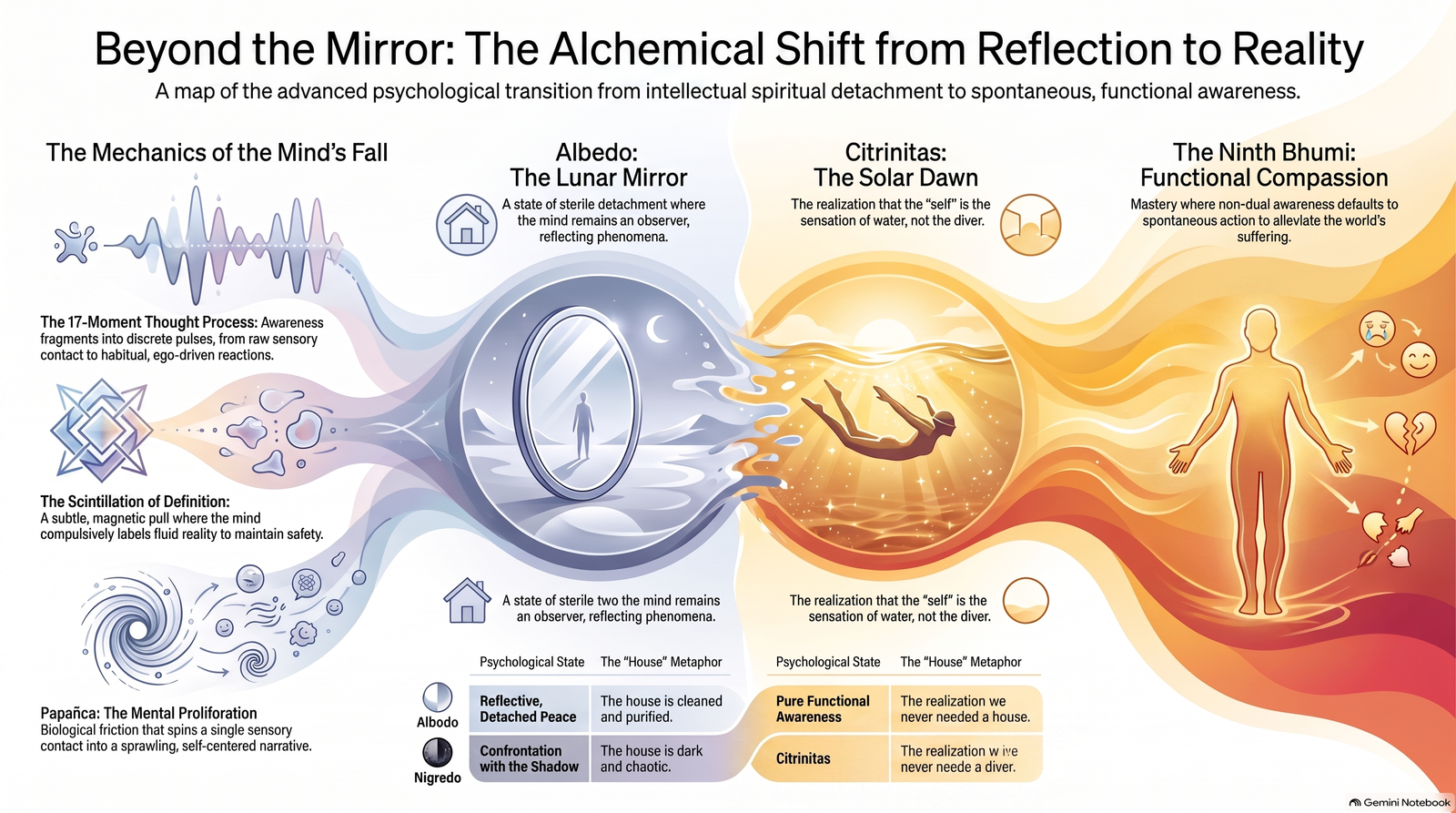
The final synthesis is deliberately metaphorical: perhaps suffering is sustained less by the presence of experience than by the repeated manufacture of a grasper standing over against it.
Listen by theme
Chapters
Selecting a chapter opens the published video at that point on YouTube.
- 00:00When the Map Stops Describing the Territory
- 02:53Abhidhamma: A Mechanics of Consciousness
- 04:15Citta and the Illusion of Continuity
- 05:30Bhavaṅga: The Resting Continuum
- 08:19The Seventeen-Moment Cognitive Process
- 10:57The Falling Mango
- 12:47When a Stimulus Barely Registers
- 16:57The Formless Jhānas
- 18:55Neither Perception Nor Non-Perception
- 22:34Thai Forest Buddhism and the Pure Citta
- 25:12Dzogchen: Sem, Rigpa and Primordial Awareness
- 31:30Can Consciousness Know Itself?
- 34:04The Sword and the Lamp
- 37:00Resolving the Friction Paradox
- 39:58When Awareness Stops Grasping
Terms in context
Glossary
Citta
A moment or event of consciousness in Theravāda Abhidhamma analysis. It is always consciousness of an object and arises with associated mental factors; it is not an enduring inner subject.
Bhavaṅga
The “life-continuum” of later Theravāda Abhidhamma: resultant consciousness occurring when no active cognitive process is taking place. It supports continuity within a life but remains conditioned and impermanent; it is not a Buddhist name for an eternal witness or awakened awareness.
Citta-vīthi and the seventeen moments
Citta-vīthi is a cognitive process or series. Later Theravāda manuals commonly analyse a complete five-sense-door process into seventeen thought moments. This is a scholastic explanatory model, not a neuroscientific measurement, and shorter or differently structured processes are also described.
Bhavaṅga-calana and bhavaṅga-upaccheda
Bhavaṅga-calana is the vibration of the life-continuum when an object impinges; bhavaṅga-upaccheda is its arrest before active adverting occurs. The “vibration” belongs to the traditional model and should not be treated as a measured physical oscillation.
Very slight object
Atiparitta ārammaṇa is an extremely weak object in the commentarial classification of five-sense-door processes. It may cause the life-continuum to vibrate without producing a full cognitive process. The episode uses this to distinguish failure to cognise from liberation through insight.
The falling-mango simile
A commentarial illustration of the stages of a sense-door process: a sleeping person, a falling fruit, waking, examining, eating and returning to sleep stand for the movement from bhavaṅga into active cognition and back again. It is a teaching analogy rather than a physiological account.
The formless attainments
Four refined meditative attainments based on infinite space, infinite consciousness, nothingness and neither-perception-nor-non-perception. Numbering them as the fifth to eighth jhānas is conventional in some later presentations; early discourses more often name them as four immaterial attainments following the four jhānas.
Neither-perception-nor-non-perception
The most subtle of the four formless attainments, in which perception is too attenuated to be called clearly present yet has not ceased. It remains conditioned and differs from the cessation of perception and feeling.
Thai Forest “pure citta”
Some modern Thai Forest teachers use language of a radiant, original or purified citta to indicate liberation. Its interpretation is debated: it may function as experiential teaching language, but should not be converted into the claim of an eternal metaphysical self.
Sem and rigpa
In Dzogchen vocabulary, sem commonly indicates ordinary dualistic mind, while rigpa refers to recognition or knowing of awareness’s empty, lucid nature. English phrases such as “primordial awareness” are interpretive translations and should be read within the lineage’s own instructions.
Ka dag and lhun grub
Ka dag is primordial purity: the emptiness of awareness from the beginning. Lhun grub is spontaneous presence or spontaneous perfection: the uncontrived display of appearance and responsiveness. Dzogchen holds these aspects together rather than treating awareness as a blank void.
Trekchö and self-liberation
Trekchö, often translated “cutting through”, is a Dzogchen mode of practice in which fixation is released through recognition of awareness. “Self-liberation” describes thoughts dissolving without suppression or elaboration; it is not the same as merely ignoring them.
Reflexive awareness: svasaṃvedana and rang rig
Terms used in major Buddhist debates about whether cognition is intrinsically evident to itself. Yogācāra and Buddhist epistemological traditions defend forms of self-cognition; Madhyamaka thinkers dispute or reinterpret them. Tibetan rang rig is not used identically by every school or in every context.
The sword and the lamp
Contrasting philosophical images. A blade cannot cut itself, suggesting that a cognition cannot take itself as its own object; a lamp illuminates itself while illuminating other things, suggesting that awareness can be self-present without a second act of knowing. Neither image settles the debate by itself.
Frictionless awareness
The episode’s metaphor for experience without grasping, resistance or a strongly maintained subject-object division. It is not a technical term shared by the traditions discussed and does not describe established physics, energetics or neuroscience.
Read further
Connections and reference points
Within this website and course
- Why Reality Lasts 17 Mind MomentsDialogues IV episode 12 develops the traditional cognitive sequence that forms this episode’s starting point
- The Jhāna of NothingnessBackground within the site’s meditation material for the third formless attainment
- The Jhāna of Neither Perception Nor Not PerceptionA companion account of the highly attenuated perception discussed in the middle of the episode
- The Great Mirror of WisdomA related exploration of the mirror as a Buddhist image of non-grasping cognition
- The Physics of a Frictionless MindAn earlier Dialogues IV page that develops the series’ metaphor of friction while marking its scientific limits
External reference points
- A Comprehensive Manual of AbhidhammaBhikkhu Bodhi’s English guide to the Abhidhammattha Saṅgaha, including cognitive processes, object intensity and bhavaṅga
- A Taste of Freedom: Selected Teachings of Ajahn ChahA primary collection of Thai Forest teaching that gives context to experiential language about mind, release and non-attachment
- Stanford Encyclopedia: Tibetan Epistemology and Philosophy of LanguageScholarly orientation to Tibetan debates about cognition, reflexive awareness and the language of knowing
- 84000: The Ten BhūmisA scholarly translation of a principal Mahāyāna source for the bodhisattva grounds invoked by the supplied infographic
A gentle reflective exercise
What does the next moment ask you to hold?
Choose an ordinary sound, bodily sensation or passing thought. Notice the appearance itself, then the almost immediate movement to name, evaluate, keep or remove it. Without trying to manufacture a special state, see whether that second movement can soften for one breath. If it does not, let that too be known without judgement. The exercise is an inquiry into grasping, not a test of attainment; stop if sustained attention becomes destabilising or distressing.
Continue the series