
Dialogues IV · Episode 15
Why Mapping Your Mind Keeps You Lost | Dialogues IV
A map can orient the traveller—but the wish to locate oneself upon it may quietly rebuild the self that practice was meant to question.
The central question
Can a spiritual map guide inquiry without becoming an identity, a rank or a hiding place from uncertainty?
This episode begins with a question that cannot safely be settled from the outside: where am I on the spiritual path? The wish for an answer is understandable. A map promises orientation, reassurance and perhaps protection from error. Yet a definitive answer can also become a badge worn by the very self whose construction is under examination. The dialogue therefore treats uncertainty not simply as a deficiency but as “personal protective equipment”: a continuing refusal to turn interpretation, productivity or unusual experience into proof of attainment.
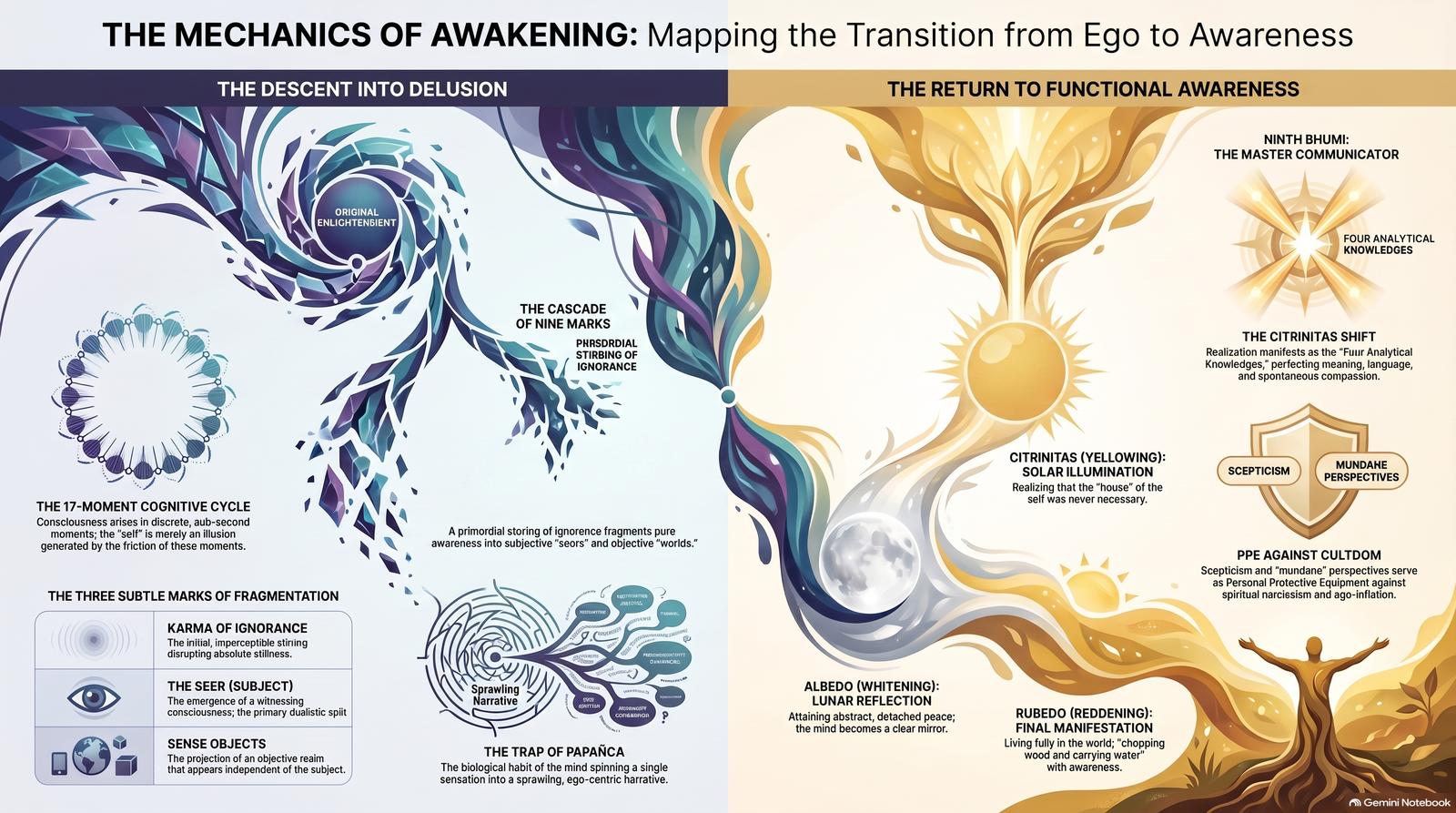
From this practical caution, the discussion opens several increasingly intricate maps. The Awakening of Faith supplies the East Asian Mahāyāna language of original enlightenment, initial awakening and the three subtle and six coarse marks through which non-enlightenment becomes an apparently divided world. Theravāda Abhidhamma offers a different analytical lens: cognition as conditioned moments rather than the activity of an enduring observer. The episode uses the traditional seventeen-moment sense-door process, together with contact, feeling and papañca, to imagine the instant in which a sensation becomes a story about “me”.
These systems do not describe one universally agreed mechanism, and neither is a measured account of neural processing. Their value here is diagnostic and metaphorical: each interrupts the impression that a solid passenger sits behind the eyes, owning experience. The question then returns in sharper form. If the ninth bodhisattva ground is associated in Mahāyāna literature with discerning knowledge and skilful communication, does an “explosion of material” establish spiritual location—or does using it that way merely allow the institutional architect of identity to rebuild?
The final movement passes through the four alchemical colours and C. S. Lewis’s Wood Between the Worlds. The pools become possible narratives; the temptation is to dive into another explanatory universe. The episode’s answer is not to destroy maps, language or thought. It is to notice the darting that seeks completion through them, to let a useful map remain provisional, and eventually to return to the unexceptional work of living: feet in the soil, head in the clouds, neither position possessed.
How to read this episode: the Awakening of Faith, the Theravāda commentarial model of a seventeen-moment cognitive process, the Mahāyāna bhūmis and the alchemical colour stages arise from distinct traditions. They should not be collapsed into one literal psychology. “Seventeen moments” does not mean seventeen experimentally measured milliseconds or nanoseconds, and the discussion’s biological language is interpretive rather than established neuroscience. Likewise, prolific writing or skilful communication cannot confirm ninth-bhūmi attainment. The Awakening of Faith is traditionally attributed to Aśvaghoṣa, but its authorship and Indian or Chinese origin remain disputed.
Argument map
Seven movements from spiritual coordinates to an ordinary return
The mind asks for coordinates
Psychological and spiritual maps promise relief from uncertainty. The desire to know one’s precise location can, however, turn practice into a performance review for the self.
The unanswered question becomes protective
Refusing to certify one’s own attainment preserves contact with ordinary perspectives. Doubt is not romanticised, but used to interrupt inflation and premature authority.
A map of delusion is unfolded
The Awakening of Faith describes a movement from original enlightenment through subtle and coarse marks of non-enlightenment. The episode reads this as a model of how subject, object and narrative seem to solidify.
The analysis moves into a thought
The Abhidhamma-derived cognitive series divides perception into conditioned functions such as adverting, receiving and impulsion. Its purpose here is to loosen the impression of a continuous inner owner.
A feeling becomes a world
Contact conditions feeling; perception and thought can then proliferate. The phrase “scintillation on the skin of hypnosis” names the felt pressure to define a bare event as threat, identity and story.
The problem is the turning, not the destination
Neither descent into form nor ascent into abstraction is blamed. What exhausts is the restless darting itself—the projector’s need to keep advancing towards another image or explanation.
The map is left in the shrine
The Wood Between the Worlds becomes a field of possible stories. Freedom is pictured not as choosing the perfect pool, but as no longer requiring a narrative to certify existence.
Listen by theme
Chapters
Selecting a chapter opens the published video at that point on YouTube.
- 00:00The Mind’s Need for a Map
- 03:55When Spiritual Progress Becomes an Identity
- 08:10The Ego as an “Institutional Architect”
- 11:56The Five Aggregates and Spiritual Identity
- 16:04The Awakening of Faith and the Construction of Delusion
- 20:39Abhidhamma and the Micromechanics of a Thought
- 24:57Contact, Feeling and Conceptual Proliferation
- 26:27Returning to the Question of Spiritual Progress
- 29:59Alchemy and the Restless Mind
- 32:11From Albedo to Citrinitas
- 35:01The Wood Between the Worlds
- 37:01When the Map Can Finally Be Abandoned
Terms in context
Glossary
Spiritual map
A framework for orienting practice, interpreting experience or describing development. The episode’s governing distinction is between using such a map provisionally and turning a position upon it into a fixed identity.
The five aggregates
Form, feeling, perception, formations and consciousness: a Buddhist analysis of the processes conventionally taken to constitute a person. The grouping is used to question an enduring self, not to deny the practical continuity or dignity of persons.
The Awakening of Faith
An influential East Asian Mahāyāna treatise known in Chinese as the Dasheng qixin lun. It presents one mind in terms of suchness and arising-and-ceasing, and develops the relation between original enlightenment and non-enlightenment. It is traditionally attributed to Aśvaghoṣa, but its authorship and place of composition are disputed.
Original and initial enlightenment
Benjue, original enlightenment, names the mind’s fundamental awakened character within the Awakening of Faith; shijue, initial or acquired enlightenment, describes awakening as it unfolds in practice. These are doctrinal categories, not measurements of a hidden neurological state.
Three subtle and six coarse marks
A ninefold analysis associated with the Awakening of Faith, describing how non-enlightenment develops from subtle activity into discrimination, attachment, naming, karmic action and suffering. The episode presents it as a cascade; interpreters differ over how literally or sequentially to read it.
Citta-vīthi and the seventeen moments
Citta-vīthi is a Theravāda Abhidhamma term for a cognitive process or series. Later manuals commonly analyse a complete five-sense-door process into seventeen thought moments. This is a traditional scholastic model, not an experimental clocking of cognition, and not every cognitive process is said to contain the same full sequence.
Bhavaṅga and javana
Bhavaṅga, often rendered “life-continuum”, is a Theravāda commentarial concept for the inactive flow of consciousness between active processes. Javana, “impulsion”, names a later phase in which an object is actively apprehended and ethically consequential volition may occur.
Phassa, vedanā and saññā
Phassa is contact: the meeting of sense faculty, object and corresponding consciousness. Vedanā is feeling tone—pleasant, painful or neutral—and saññā is perception or recognition. Calling the transition between them a biological “nanosecond” is the episode’s metaphor, not a claim established by neuroscience.
Papañca
Conceptual proliferation: the expansion through which perception and thought can become entangled in self-referential categories, conflict and obsession. The Madhupiṇḍika Sutta links contact, feeling, perception, thought and proliferation without presenting a modern neural mechanism.
Sādhumatī and the four analytical knowledges
Sādhumatī, often translated as “Good Intelligence”, is the ninth of the ten bodhisattva grounds in Mahāyāna literature. It is associated with discriminating knowledge of meaning, Dharma, language and eloquence. Communication can illustrate the ideal, but cannot by itself verify that a living person occupies this ground.
Nibbidā and uddhacca
Nibbidā can mean disenchantment, revulsion or turning away from conditioned experience. Uddhacca means restlessness or agitation and appears in several Buddhist classificatory contexts, including as one of the higher fetters in Theravāda teaching. The episode interprets it as the mind’s subtle “darting”.
Ālaya-vijñāna and bīja
In Yogācāra, ālaya-vijñāna is the storehouse consciousness and bīja are “seeds” that condition future experience. The episode compares them to the Wood Between the Worlds and its pools. This literary analogy should not be confused with the Theravāda concept of bhavaṅga, which belongs to another doctrinal system.
Nigredo, Albedo, Citrinitas and Rubedo
Colour terms used in varying ways across the history of alchemy. In A Course in Modern Alchemy they form an interpretive sequence of blackening, whitening, yellowing and reddening: breakdown, purification, illumination and embodied return. That fourfold psychological use is a modern synthesis rather than one universally fixed historical scheme.
The Wood Between the Worlds
The quiet forest of pools in C. S. Lewis’s The Magician’s Nephew, each pool providing passage to another world. The episode adapts it as a metaphor for the mind before it enters and identifies with one of its possible narratives.
Read further
Connections and reference points
Within this website and course
- Why Reality Lasts 17 Mind MomentsDialogues IV episode 12 develops the Abhidhamma-derived cognitive model used more briefly in this episode
- Citrinitas 3.2.5: PapañcaThe course chapter most directly concerned with the mind’s multiplication of a simple event into a self-involving world
- Citrinitas 3.2.9: The Metaphor of the Film ProjectorA companion image for the episode’s distinction between projected content, the observer and the continuing movement of projection
- Citrinitas 3.2.3: The Subtle FettersContext for the refined restlessness, conceit and attachment to becoming discussed near the end of the episode
- Citrinitas 3.3.11: The MagusThe course’s exploration of language, skilful expression and the responsibility that accompanies the power to name
External reference points
- The Nonduality of Initial Awakening and Original EnlightenmentThe video on the Awakening of Faith that prompted the original dialogue behind this episode
- BDK America: The Awakening of FaithYoshito S. Hakeda’s translation of the influential treatise, with introductory context and a free PDF edition
- Majjhima Nikāya 18: The Honey CakeAn early Buddhist discourse connecting contact and feeling with perception, thought and conceptual proliferation
- 84000: The Ten BhūmisA complete scholarly translation of the principal sūtra describing the ten bodhisattva grounds, including Sādhumatī
A gentle reflective exercise
Can the map remain open?
Bring to mind one label you use to locate yourself—spiritual, psychological, professional or moral. Notice what the label clarifies, then notice what it asks you to defend. For a few breaths, let it remain a provisional description rather than a verdict. The aim is not to become confused about ordinary responsibilities, nor to suppress thought, but to discover whether orientation is possible without converting the map into the traveller.
Continue the series