
Dialogues IV · Episode 17
Why Escaping the World Never Works | Dialogues IV
A wall may quiet the crowd, but withdrawal still takes its shape from what it tries to leave behind.
The central question
If every retreat remains defined by the world it rejects, where can genuine sanctuary be found?
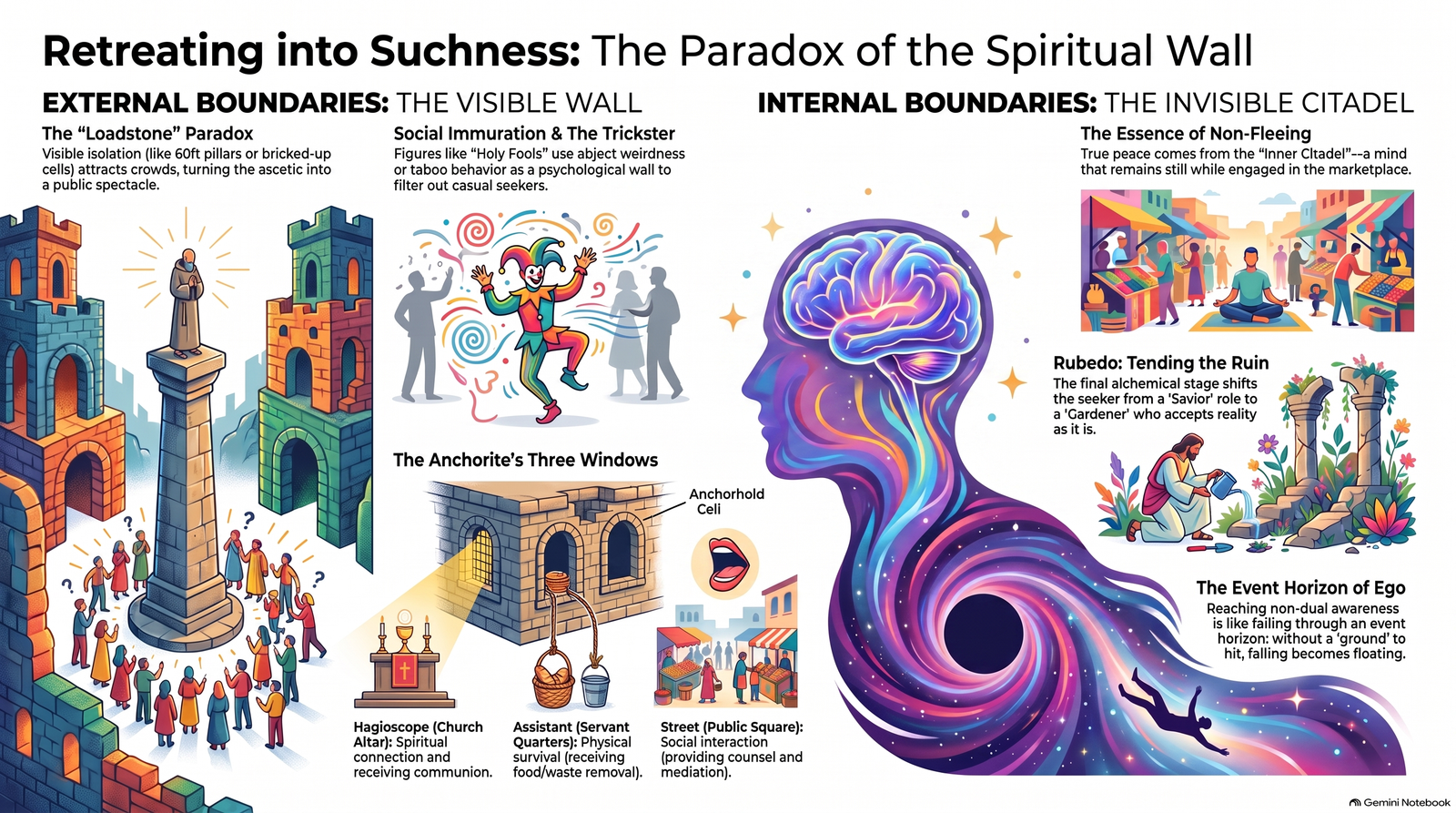
This episode begins with an ordinary wish: to put a wall between oneself and the incessant claims of work, communication and other people. It then follows that wish into one of its most arresting historical forms—the medieval anchoritic vocation. An anchorite or anchoress undertook stability in an enclosed cell, often attached to a church. The architecture restricted access without abolishing relationship: windows could connect the recluse to worship, household support and visitors. The wall did not simply erase the world; it reorganised the terms on which the world could enter.
That paradox widens through Diogenes, Christian holy fools and the pillar ascetic Simeon Stylites. A life intended to reject convention or withdraw from attention can itself become public theatre. The more conspicuous the refusal, the more powerfully it may attract stories, pilgrims and imitation. Marcus Aurelius introduces a different possibility: not a protected location beyond society, but the disciplined capacity to return inward while remaining answerable to life within it.
The discussion then moves from history into interpretation. Ernest Becker’s “immortality project” becomes a lens for asking whether careers, reputations and even spiritual perfection can defend the self against mortality. Jungian alchemy supplies images of blackening, clarification and return, while the episode’s own idea of Rubedo replaces the fantasy of a completed palace with a ruin that can be tended. In this synthesis, care becomes less heroic and more ordinary: no longer saving existence from impermanence, but meeting a temporary world without demanding that it become permanent.
The closing movement brings Julian of Norwich, Buddhist suchness, the black mirror and an astrophysical event horizon into a deliberately metaphorical constellation. These images do not establish one shared doctrine, and the physics does not prove the contemplative claim. Together they ask whether peace depends upon finding an unstained place outside experience—or upon releasing the compulsive division of life into what must be escaped and what must be attained.
How to read this episode: its history and metaphors need different kinds of confidence. Medieval enclosure varied; the dramatic language of funeral, burial and being “walled alive” should not be treated as a universal literal procedure for every anchorite. Accounts of Diogenes and Simeon survive largely through later literary or hagiographic traditions. “Inner citadel” is a modern interpretive label for a Stoic discipline, and the neat alchemical sequence is a modern psychological synthesis rather than a single historical doctrine. The black mirror and event horizon are contemplative images: a distant observer’s description of infall does not mean that physical time literally stops at a black-hole horizon, nor does astrophysics confirm non-dual awareness.
Argument map
Seven movements from the outer wall to the end of fleeing
The crowd creates the wish for a wall
Overwhelming demands make peace appear spatial: if enough distance can be created, the noise will surely remain outside.
Enclosure regulates contact
The anchorhold limits access through a small architecture of worship, sustenance and conversation; withdrawal becomes a boundary rather than total disappearance.
Visible refusal attracts attention
Diogenes, holy fools and stylites show how radical rejection can become spectacle: the attempt to evade the social gaze gives that gaze a new object.
The retreat moves inward
Stoic practice shifts sanctuary from an exceptional place to the capacity to examine judgement and recover agency while still participating in the world.
The defender fears impermanence
Through Becker, the search for status, purity or lasting significance appears as an “immortality project” built to protect a mortal identity.
The perfect destination becomes a ruin
The episode’s alchemical synthesis recasts Rubedo as return: the grand work of salvation softens into the modest care of what is incomplete and passing.
Sanctuary no longer requires elsewhere
Suchness, the black mirror and the event horizon converge as metaphors for experience without the reflexive demand to flee, perfect or permanently possess it.
Listen by theme
Chapters
Selecting a chapter opens the published video at that point on YouTube.
- 00:00The Fantasy of Escaping the World
- 05:15Medieval Anchorites and Voluntary Enclosure
- 10:58Three Windows and the Lodestone Paradox
- 16:28Hermits, Pilgrims and the Failure of the Wall
- 21:15Diogenes and Social Immuration
- 25:26Holy Fools and the Burden of Reputation
- 31:21Simeon Stylites: Escaping Upwards
- 38:36Marcus Aurelius and the Inner Citadel
- 43:04Ernest Becker and the Immortality Project
- 47:56Jung: Nigredo, Albedo and Rubedo
- 52:01Julian of Norwich, Suchness and the Ordinary
- 53:12The Black Mirror and the End of Fleeing
Terms in context
Glossary
Anchorite and anchoress
A person committed to a Christian life of prayer in stable enclosure; “anchoress” is the traditional feminine form. In medieval England such recluses often occupied cells adjoining churches and remained institutionally connected to clergy, servants and local communities. The practice was demanding, but neither its architecture nor its rites were identical in every time and place.
Anchorhold
The dwelling occupied by an anchorite or anchoress, often built against a church. Surviving rules and buildings show considerable variation. Openings could permit sight of worship, the receipt of necessities and limited conversation. It is therefore better understood as controlled permeability than as an absolutely windowless tomb.
Immuration
Literally, enclosure within walls. The word can describe punitive walling-up, but in this episode it is extended to voluntary religious enclosure and, more metaphorically, to social or psychological barriers. Those meanings must be kept distinct: anchoritic vocation should not automatically be equated with execution or forcible burial.
Ancrene Wisse
An early thirteenth-century Middle English guide originally associated with a small group of anchoresses. It distinguishes an adaptable “outer rule” governing practical life from an “inner rule” concerned with the heart. Its prescriptions are important evidence, but they cannot be assumed to describe every medieval recluse exactly.
Squint or hagioscope
A small opening through a wall, sometimes angled to provide a view into a church. The episode groups the anchorhold’s contacts as three “windows”. Ancrene Wisse does describe church, house and parlour windows, though names, layouts and functions varied; “street window” is a convenient modern simplification rather than a universal architectural term.
Cynicism and Diogenes
Ancient Cynicism opposed conventional status, luxury and reputation to a simpler life “according to nature”. Diogenes of Sinope is known mainly through later collections of anecdotes. His provocative public conduct functions in the episode as “social immuration”, but that phrase is the episode’s metaphor rather than an ancient Cynic category.
Holy fool
A religious figure whose apparently irrational, shameful or transgressive behaviour is interpreted as humility, prophecy or criticism of worldly convention. The best-known Christian examples belong to Eastern traditions, including the Russian yurodivy. The category is historical and theological; it should not be used casually to romanticise mental illness or disturbing behaviour.
Stylite
A Christian ascetic who lived upon a pillar; Simeon Stylites the Elder became the most famous early example. Hagiographic accounts associate his rising pillars with a desire for solitude, yet also record the pilgrims, teaching and mediation that gathered around him. Exact heights, dates and motives come through sources that mix history with sanctifying narrative.
The inner citadel
A modern phrase, strongly associated with Pierre Hadot’s interpretation of Marcus Aurelius, for the Stoic discipline of returning to one’s ruling faculty and examining judgements. It does not mean emotional numbness or complete independence from others. Marcus’ ethics remain embedded in duty, rational fellowship and participation in a common world.
Immortality project
Ernest Becker’s influential account of the symbolic systems through which people seek durable meaning and significance in the face of death. The episode applies it to careers, reputation and spiritual striving. It is a psychological interpretation, not proof that every ambition or religious practice is secretly nothing more than fear of mortality.
Nigredo, Albedo and Rubedo
Names associated with blackening, whitening and reddening in alchemical literature. Their meanings and sequence differ across texts and practices. Jung helped popularise psychological readings of alchemy; Dr Simon Robinson’s course develops its own four-part modern synthesis. The stages should not be treated as one universally fixed historical system or as objective measures of spiritual rank.
Saṃsāra and nirvāṇa
Saṃsāra names conditioned wandering marked by suffering and rebirth; nirvāṇa names liberation. Some Mahāyāna arguments undermine any ultimately inherent separation between them, but this does not make suffering irrelevant or collapse all Buddhist traditions into the same doctrine. Their “equality” in the episode belongs to a non-dual interpretation.
Suchness — tathatā
A Buddhist term for the “thusness” or suchness of phenomena, especially prominent in Mahāyāna thought. It points away from conceptual fabrication towards things as they are, but schools explain it differently. The episode uses suchness for ordinary experience before it is reduced to utility; this is an interpretive application, not a complete doctrinal definition.
Black mirror and event horizon
The black mirror symbolises awareness that reflects without clinging; the event horizon symbolises a point beyond the ego’s usual ground. Both are poetic devices. Obsidian mirrors have varied ritual and cultural histories, while a black-hole event horizon is a precisely defined physical boundary. Neither image supplies scientific evidence for an “unstained” consciousness.
Read further
Connections and reference points
Within this website and course
- When Awareness Stops GraspingThe previous dialogue asks whether experience can arise without the grasping that turns it into something to hold or escape
- The Messianic Trap of Saving the WorldAn earlier examination of the saviour identity and the personal cost of treating reality as a project one must complete
- Death and alchemyA site essay connecting mortality, transformation and the symbolic language through which alchemy approaches ending and renewal
- Thoughts on RubedoBackground to the author’s understanding of the reddening as integration and return rather than escape from embodied life
- SamsaraA companion page for the Buddhist term whose relation to nirvāṇa becomes central to the episode’s non-dual conclusion
External reference points
- British Library: Keeping a cat and other rules for anchoressesA manuscript curator’s accessible account of Ancrene Wisse, the three windows and the practical conditions of medieval enclosure
- Bodleian Text Archive: Introduction to Ancrene WisseBella Millett’s scholarly introduction clarifies the text’s audience, date, manuscript history, vows and distinction between outer and inner rules
- Stanford Encyclopedia: Ancient Ethical TheoryA scholarly account of Diogenes and the Cynic opposition between life according to nature and life governed by convention
- Stanford Encyclopedia: Marcus AureliusHistorical and philosophical context for the Meditations, Stoic judgement, mortality and Marcus’ obligations within public life
- Ernest Becker Foundation: Death denial and symbolic meaningAn introduction to Becker’s legacy and the role he assigned to fear and denial of death in individual and social behaviour
A gentle reflective exercise
A boundary without exile
For one minute, let one ordinary interruption remain unanswered: a notification, a sound beyond the room, or the thought of something waiting. Notice first the practical boundary you may need, then the inner argument that says peace can begin only when the interruption disappears. Without forcing calm or denying responsibility, ask: can this moment be allowed to exist before it is classified as an obstacle? This is an inquiry into the movement of fleeing, not a demand to tolerate harmful circumstances.
Continue the series