
Dialogues V · Episode 03
How Your First Words Shape Your Mind | Dialogues V
Words make experience shareable—and can hide the history and feeling that gave them meaning.
MAP. NOT MASTER.Open on YouTube ↗
The central question
How much of a word’s meaning comes from the life that learned it?
What makes a word mean what it means to you? A dictionary offers a shared definition, but it cannot reproduce the particular encounters, bodily feelings and earlier associations through which that definition became meaningful. This episode begins with a proposal from the source dialogue: human meaning may depend on the vocabulary available to us, the sequence in which we acquired it and the felt experience that preceded the label. Its image of early words as “semantic anchors” turns language from a filing cabinet into a landscape shaped by its own history.
The first movement connects this proposal to age-of-acquisition research and Jeffrey Elman’s “starting small” simulations. Earlier learning can influence later processing, and constraints can sometimes help a learning system find structure. Neither finding establishes that the first word a child learns permanently dictates adult perception. The discussion then reaches beneath language, using “J-space” as an informal name for the felt, embodied richness that words only partly express. Damasio’s work on emotion and bodily signals supplies one point of comparison; the proposed space itself is not a recognised neuroscientific measurement.
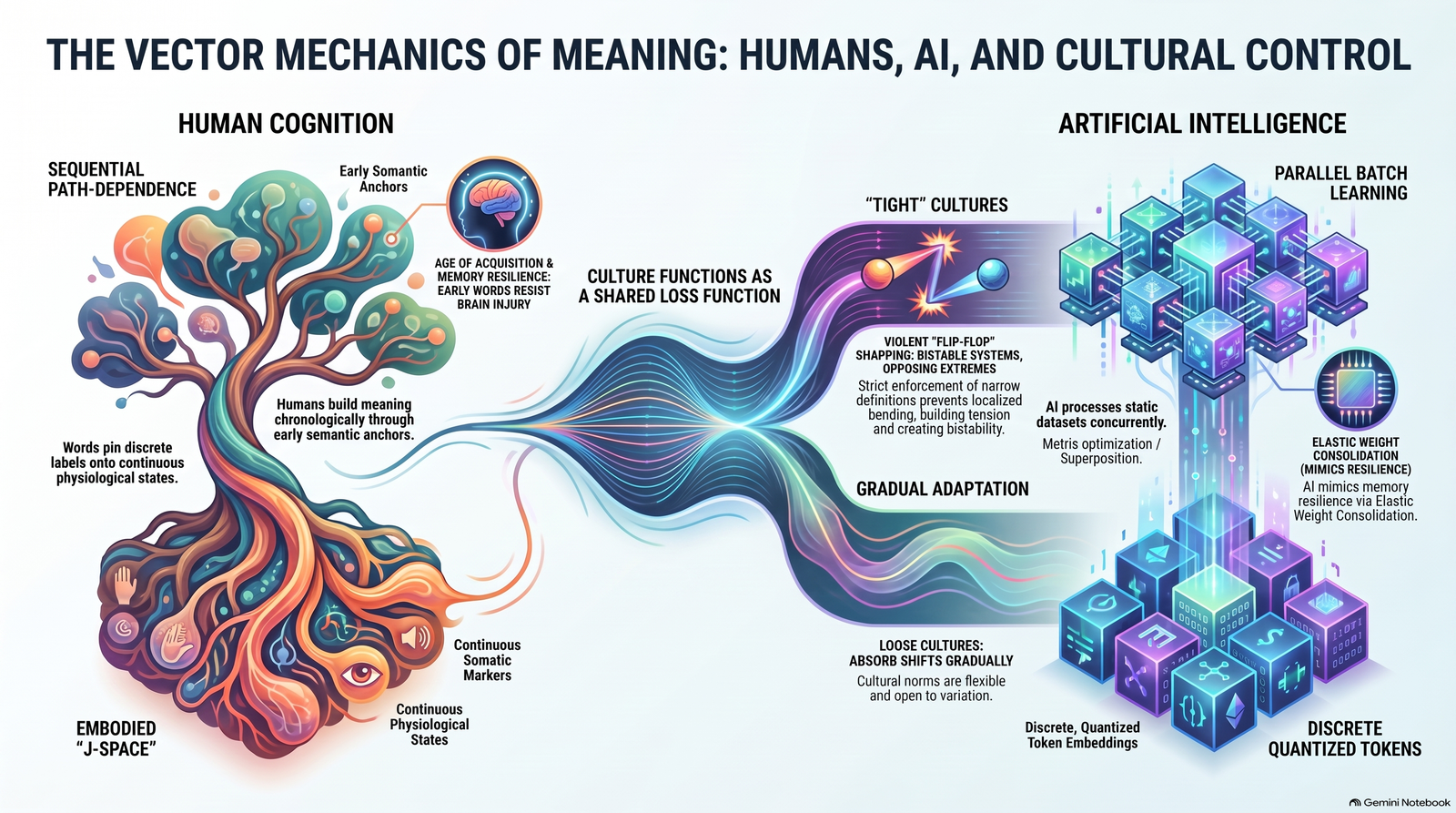
From private meaning, the argument moves to shared life. How can people cooperate when their associations differ? Culture is imagined as a “loss function” that rewards intelligibility and penalises deviation. Gelfand’s distinction between tight and loose cultures gives this inquiry an empirical foothold, while the proposed transition from rigidity to sudden “flip-flop” belongs to the episode’s speculative extension. The comparison with artificial intelligence then reverses the question: what can developmental constraints illuminate about machine learning, memory interference and representations that researchers struggle to interpret?
The closing movement turns the model back upon the listener. Through Metzinger’s self-model philosophy and research distinguishing narrative from experiential self-reference, it asks whether a label can be noticed as a label rather than obeyed as reality. That need not mean abandoning language or finding a perfectly unmediated world. It means allowing useful descriptions to remain revisable. The final question widens the stakes: as machine-generated language enters our shared environment, which patterns of meaning are we rehearsing—and how much of lived experience do those patterns leave out?
Argument map
From a first word to a shared world
Meaning has a history
The inquiry begins with the possibility that vocabulary, learning order and personal experience shape how a word is understood.
Constraint can support learning
Age of acquisition and “starting small” suggest ways that earlier experience and limited capacity can influence later learning.
The label compresses the feeling
“J-space” names the proposed gap between a rich embodied experience and the shorter description used to communicate it.
Culture makes meanings negotiable
Shared norms help people coordinate, while tightness and looseness describe differing tolerances for deviation.
Rigidity raises a question
The source proposes that restricted variation can produce abrupt cultural reversals, a hypothesis rather than a demonstrated law.
Machines reveal another geometry
Forgetting and interpretability research offer concrete AI problems against which the developmental analogy can be tested.
The map becomes visible
The discussion ends by questioning the authority of familiar labels and the growing influence of AI-generated language.
Chapter guide
Move through the episode
- 00:00How the First Words Shape Meaning
- 03:35Semantic Anchors and Path Dependence
- 05:15Why the Mind May Need to “Start Small”
- 07:45Before Language: The J-Space Vibe
- 09:30How Culture Aligns Private Meaning
- 13:50Tight and Loose Cultures
- 16:30The Proposed Flip-Flop Dynamic
- 19:25What Human Development Reveals About AI
- 21:35Catastrophic Forgetting and Machine Memory
- 24:15Untangling AI Meaning
- 25:55The Ego Tunnel and Reification
- 28:00Narrative and Experiential Self
- 29:40Meditation and Seeing the Model as a Model
- 32:20Is AI Rewriting the Human Dictionary?
Working vocabulary
Terms worth holding lightly
Age of acquisition
The age at which a person learns a word or other item. Earlier acquisition is associated with advantages in some language-processing tasks, alongside influences such as frequency and familiarity. This is a research finding about performance and development, not proof that early words fix an individual’s later worldview.
Semantic anchors
The source dialogue’s metaphor for early or strongly established meanings around which later learning develops. “Gravity” and “folding” make the proposal imaginable, but are not measured physical forces in the brain. The image is useful for asking how prior experience constrains interpretation; it does not specify a validated neural mechanism.
Path dependence
A process is path-dependent when its present outcome depends on the route by which it developed, rather than only its current inputs. The episode applies this idea to vocabulary and personal associations. It does not follow that every later meaning is permanently determined, or that two people cannot substantially understand one another.
“Starting small”
Jeffrey Elman’s proposal that initial limits on processing capacity or input complexity can help a neural network learn structure before encountering more complex material. His 1993 simulations explored particular networks and artificial language tasks. They are not a universal law of infant development or evidence that modern AI must reproduce a human childhood.
“J-space”
An informal term used in the original exchange for meaning as felt before, or beyond, its verbal description: bodily sensation, emotional tone and contextual richness. Here it is an exploratory image, not a standard scientific construct or defined mathematical space. It should not be equated with a measurable “pure reality” underneath cognition.
Somatic markers
In Antonio Damasio’s hypothesis, emotion-related bodily signals, including representations of such signals, help guide decisions. This is more specific than the claim that every word is a compressed bodily feeling. The episode borrows the idea to explore embodied meaning; that extension is not itself established by the somatic-marker hypothesis.
Cultural “loss function”
In machine learning, a loss function quantifies error relative to an objective. The episode transfers that language to social life: misunderstanding or deviation can carry costs, encouraging shared conventions. A culture has no single agreed numerical objective, however, and coordination also arises through learning, negotiation, institutions and cooperation rather than punishment alone.
Tight and loose cultures
In Michele Gelfand and colleagues’ research, tightness concerns strong norms and relatively low tolerance of deviation; looseness concerns weaker norms and greater tolerance. These are comparative tendencies within a multilevel social system, not permanent national personalities, diagnoses of individuals, or a ranking of cultures as inherently good or bad.
Bistability and “flip-flop”
Bistability describes a model with two stable states under specified conditions. The episode proposes an analogy with societies moving between opposing forms of control. Applying that model requires evidence and explicit assumptions. Cultural tightness alone does not establish two attractors or guarantee a violent reversal; the earthquake comparison is illustrative, not geophysical evidence.
Catastrophic forgetting
A substantial loss of previously learned performance when a neural network is trained on new tasks or data. Its severity depends on the model and training procedure; it is a risk, not an inevitable consequence of every update. It concerns changing learned parameters, which should be distinguished from temporarily using information in a conversation’s context.
Elastic Weight Consolidation (EWC)
A method that discourages changes to parameters estimated to be important for previously learned tasks, while permitting further learning. Kirkpatrick and colleagues used an approximation based on Fisher information to estimate importance. EWC is inspired by ideas about memory protection; it does not establish an equivalence with human word-acquisition order or freeze every important parameter absolutely.
Polysemanticity and sparse autoencoders
A polysemantic neuron responds to multiple features rather than one easily named concept. Sparse autoencoders are separately trained models that try to reconstruct activations using a relatively small number of active features. They can reveal useful structure, but do not provide a complete dictionary of a model’s thought or establish that human brains lack distributed representations.
Ego tunnel and reification
Thomas Metzinger’s “ego tunnel” describes experience through a self-model whose constructed character ordinarily remains unnoticed. Reification is treating an abstraction as though it were a self-standing thing. The episode brings these ideas together to question the apparent solidity of identity; neither phrase is a clinical diagnosis or proof that the external world is unreal.
Narrative and experiential self-reference
Narrative self-reference concerns enduring traits and one’s story across time; experiential self-reference attends to momentary experience. Farb and colleagues studied these attentional conditions using fMRI, including participants trained in mindfulness. Their findings concern patterns of recruitment and connectivity, not two separate persons, permanently severed neural connections, or perception entirely free of interpretation.
Related reading
Continue within the website
- How Language Creates the SelfA direct companion inquiry into naming, conceptual distinction and the construction of identity.
- Why Reality Can’t Be GraspedThe preceding episode examines what happens when provisional descriptions become possessions.
- Mistaking the Software for the SelfAn earlier software metaphor offers another route into the difference between a model and its apparent owner.
- The illusion of selfExtends the self-model question within the website’s philosophical and contemplative vocabulary.
- EmptinessA doctrinal route into the limits of reification, kept distinct from claims about neural mechanisms.
External reference points
Check the research beneath the analogy
These sources support particular components. Their inclusion does not certify the combined framework as an experimentally demonstrated theory.
- Jeffrey Elman: “The importance of starting small” (1993)The author’s UC San Diego publication record identifies the original computational study and its research context.
- Gelfand et al.: Tight and loose cultures (2011)Cornell’s record and paper for the 33-nation study; the empirical foundation, rather than proof of the proposed flip-flop.
- Kirkpatrick et al.: Overcoming catastrophic forgettingThe authors’ paper explains EWC and tests it on sequential tasks; it does not validate the whole human-development analogy.
- Bricken et al.: Towards Monosemanticity (2023)Primary interpretability research on extracting features with sparse autoencoders from a small language model.
- Farb et al.: Attending to the present (2007)The original fMRI study of narrative and experiential self-reference; useful for checking the limits of the episode’s claims.
A two-minute reflection
Notice what the word leaves out
Choose an ordinary object nearby—a cup, a pencil or a door. Notice its familiar name and what that name lets you do. Then attend briefly to its colour, weight, texture or sound, without trying to prevent words from arising.
Ask what part of your encounter is shared by the label, and what part belongs to this particular moment. If a personal association appears, notice it without needing to trace its origin. Return to the name and let it be useful again.
The aim is curiosity about descriptions, not the removal of thought or proof of access to a more authentic reality.
Continue the series