
Dialogues V · Episode 10
Why Thomas Covenant Cannot Accept Being Healed | Dialogues V
The habits that keep Covenant safe at home make a miracle difficult to trust.
The central question
What would Covenant risk by trusting his own recovery?
In Stephen R. Donaldson’s Chronicles of Thomas Covenant, a man who has learnt to inspect his hands and feet for injuries he cannot feel enters a world where sensation returns. The episode asks what it would cost him to believe the change. If the Land can send him back as abruptly as it brought him there, trusting his recovered senses could mean losing a habit on which he still depends at home. His Unbelief keeps that possibility open. It also makes it easier to discount the people who live in the Land and the consequences his choices have for them.
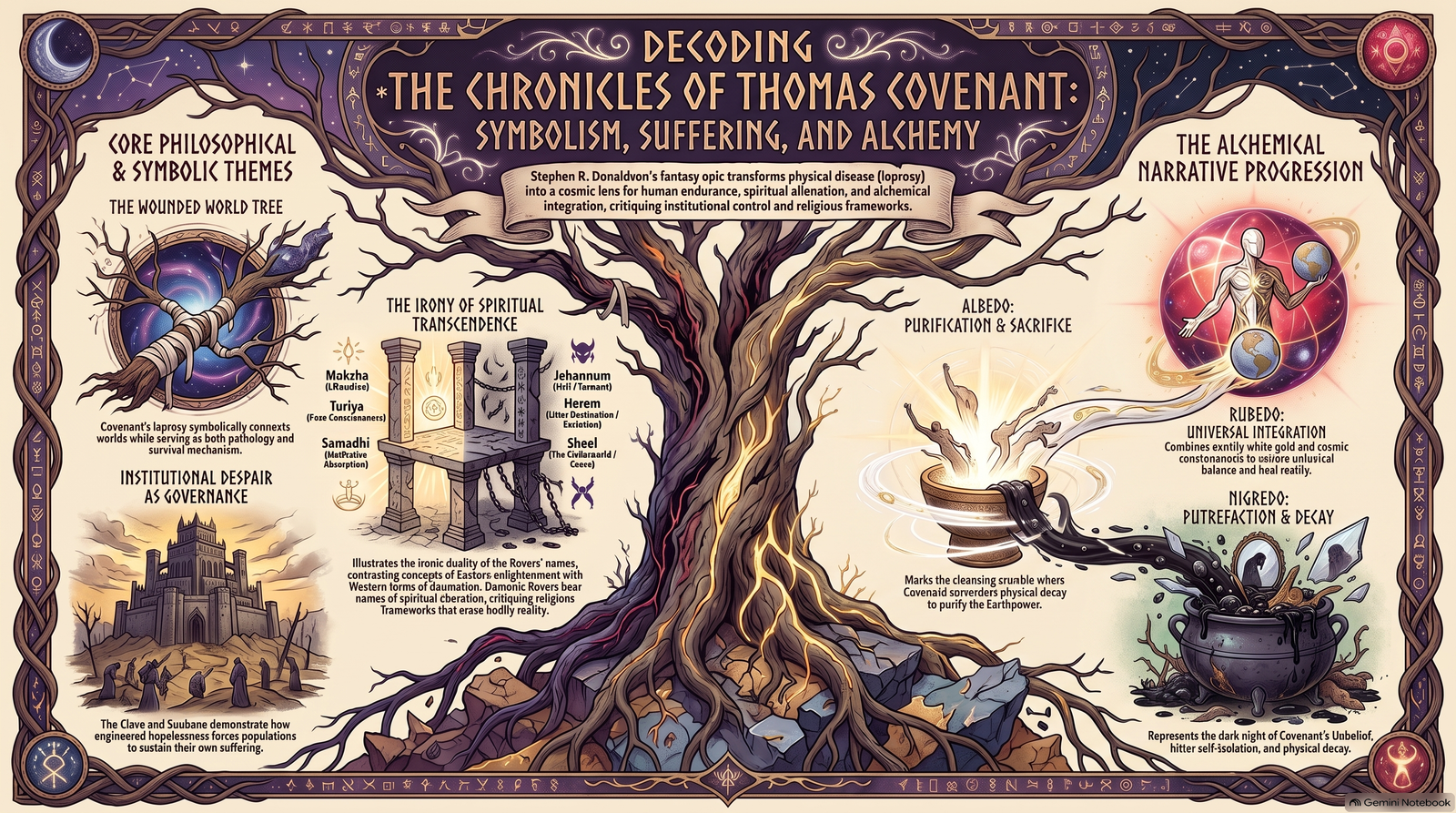
The hosts approach the difference between the worlds through Brigadoon, whose village reappears for a day every hundred years. From this story about time they turn to a question about the body. Donaldson’s childhood in India, where his father worked with people affected by leprosy, gives the discussion biographical context. Paul Brand’s work provides the medical connection: pain can warn of damage, and when that warning is lost, vigilance can take on part of its protective role. The image of the wounded World Tree extends the question into myth. What kind of hero can hold two worlds together when surviving in each seems to require a different response?
With the Ravers, the question of whose judgement can be trusted becomes a question of who gets to act. Their possession of others gives concrete form to the danger of imposing a single story on someone else’s suffering. The Clave extends that danger to public life. As the Sunbane turns the Land’s ecology against its inhabitants, the institution that promises protection makes their sacrifices serve the crisis itself. Despair becomes politically useful when people can no longer imagine what would happen if they stopped obeying.
The closing alchemical reading follows the saga from breakdown and sacrifice towards illumination and integration. Its challenge is to imagine wholeness capable of making room for a lasting injury and the skills learnt in living with it, while leaving open the possibility that some of those same habits can change.
How to read this episode. Hansen disease is a curable bacterial infection. Nerve damage can reduce protective sensation, and treating the infection and living with lasting nerve damage are distinct questions. Covenant’s illness carries no moral or spiritual obligation. The Sunbane offers an analogy for ecological destabilisation and institutional incentives. The unusual passage of time in Brigadoon and the Land works as a narrative device. Gerstäcker’s Germelshausen is a striking parallel whose status as a direct source was disputed by Alan Jay Lerner.
Argument map
Six movements through the episode
Two worlds, two clocks
Brigadoon gives the hosts a way to ask what happens when a visitor crosses into a world whose time runs differently.
Unbelief keeps Covenant alert
The possibility of returning to a body with reduced sensation makes Covenant reluctant to trust the relief he feels in the Land.
The wound changes the hero
The World Tree image and Paul Brand’s work on protective pain recast bodily vigilance as a strength that carries its own costs.
Possession puts agency at stake
The Ravers turn the language of liberation into literary irony by taking over the bodies and choices of others.
Despair narrows the Land’s choices
The Clave exploits the Sunbane by demanding sacrifices for a system that helps sustain the crisis.
Integration asks what can change
The alchemical reading follows Covenant from defensive isolation towards a wider responsibility that can make room for lasting vulnerability.
Chapters
Each chapter opens at its listed time in a new YouTube tab.
- 00:00When the wound becomes the power
- 03:38Brigadoon and worlds outside ordinary time
- 07:46Entering the Land: Unbelief as survival
- 11:07Covenant as the wounded World Tree
- 13:14Donaldson, leprosy and the necessity of pain
- 17:18Why the Creator chooses a broken saviour
- 19:13The Ravers: transcendence becomes possession
- 22:49The Sunbane, the Clave and ecological sickness
- 27:07Despair as a system of political control
- 30:21Reading the saga through alchemy
- 35:00Can the wound become part of wholeness?
Key language
Glossary
Unbelief
Covenant’s name for his refusal to accept the Land as real. Daily checks for injuries he may be unable to feel depend on taking his condition seriously. The episode reads his refusal as a protective stance that helps explain his conduct and raises the question of what he owes the people he encounters.
Fine-material plane
An esoteric term for a proposed level of reality subtler than the ordinary physical world. The hosts borrow this vocabulary to compare the passage of time in Brigadoon and the Land. The two stories give time different rules as part of their fictional settings.
Hansen disease
Also called leprosy, this is a curable bacterial infection which can affect the skin and peripheral nerves. Reduced sensation can leave burns, cuts and pressure injuries unnoticed. The episode draws on this protective function of pain to explain why Covenant treats his bodily checks as essential.
Jhāna and the five hindrances
In early Buddhist texts, jhāna refers to states of meditative absorption. The standard list of hindrances is sensual desire, ill will, dullness and drowsiness, restlessness and remorse, and doubt. The recording loosely paraphrases the first item. Its comparison with Covenant’s need for bodily vigilance is a literary analogy.
World Tree and axis mundi
Axis mundi means “world axis”, an image of a centre or link between realms. The hosts compare Covenant to Yggdrasil, the World Tree of Norse mythology. Their analogy puts the emphasis on a vulnerable figure who links worlds that make different demands on him.
White gold and wild magic
Covenant’s white-gold wedding ring is tied to wild magic in the Land. An ordinary object from his life at home gives him access to a power with consequences far beyond his intentions. The episode reads the ring as carrying this tension between the two worlds.
The Ravers
Three servants of Lord Foul who can possess other beings. They call themselves Moksha, Turiya and Samadhi. Donaldson says these names express how the Ravers see themselves, while their other names express how others see them. The episode uses that gap to ask how a promise of liberation can conceal coercion.
Mokṣa, turīya and samādhi
In Indian traditions, mokṣa commonly means liberation from the cycle of rebirth. Turīya, “the fourth”, is discussed in the Māṇḍūkya Upaniṣad in relation to waking, dreaming and deep sleep. Samādhi names forms of meditative concentration or absorption whose role varies across traditions. The three words have distinct histories and uses.
Sunbane, Clave and Banefire
In the Second Chronicles, the Sunbane throws the Land’s ecology into destructive cycles. The Clave claims authority through its promise of protection. Its sacrifices feed the Banefire, which in turn sustains the crisis. The episode uses this plot to ask how dependence on a damaging institution can come to seem unavoidable.
Solastalgia
Distress associated with unwelcome environmental change in a place where one still lives. The term describes how home can become unfamiliar around a person. The episode draws a parallel with Covenant’s return to a Land whose capacity to sustain its inhabitants has changed.
Magnum opus
Latin for “great work”, a name for the alchemical undertaking. Histories of alchemy include diverse material practices and symbolic readings. The episode uses a four-colour sequence to organise changes across Donaldson’s three narrative arcs, from the first trilogy through the final four books.
Nigredo, Albedo, Citrinitas and Rubedo
These Latin terms refer to blackening, whitening, yellowing and reddening. In this episode’s reading, they stand for breakdown, purification, illumination and integration. The colours are used as a critical vocabulary for the saga, drawing on the series’ movement from Citrinitas towards Rubedo.
One minute of reflection
What is the habit protecting?
Choose a small everyday habit, such as keeping a spare pen or checking the weather before setting out. Think of a situation where it helps and one where you could comfortably do without it. What would tell you which situation you are in? Bring that question back to Covenant as he moves between home and the Land.