
Dialogues V · Episode 11
Your LinkedIn Profile Is a Lego Castle | Dialogues V
A professional label can give someone a way to find you and still leave most of your life out of view.
The central question
How can we use labels without letting them define us?
A LinkedIn profile presents a small problem with surprisingly long reach. A few phrases have to make someone recognisable to a stranger, and even an accurate phrase can feel reductive when asked to stand for a whole life. The hosts imagine those phrases as Lego bricks. A profile has a practical use because it can be assembled for a purpose and rebuilt when that purpose changes. The ninth bhūmi, a Mahāyāna Buddhist account of an advanced stage of the bodhisattva path, brings a further question into view. Once you see how words are put together, can you use them with greater care? The person who prides themselves on having seen through the whole arrangement can build another identity out of that very insight.
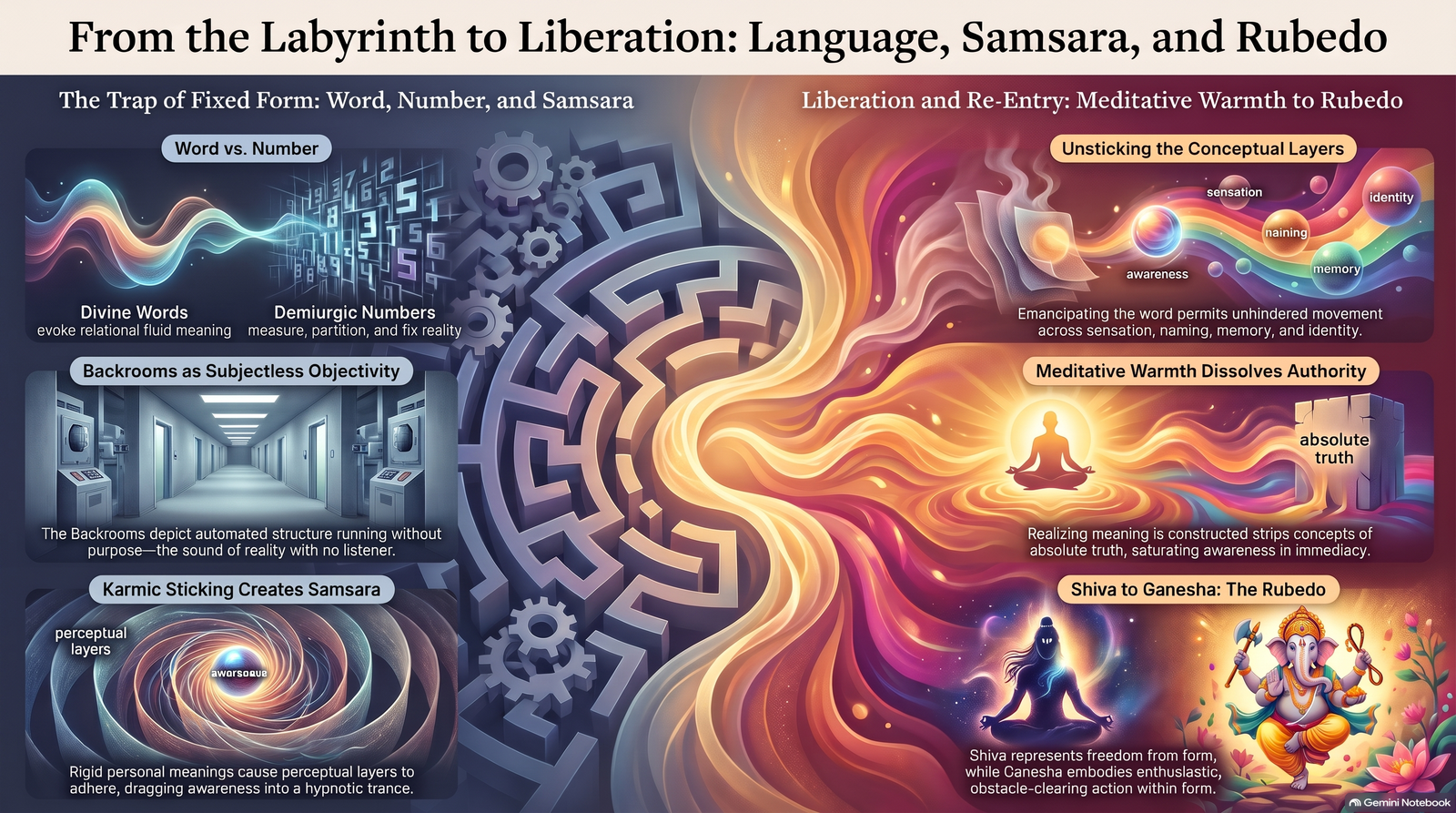
The discussion then moves from the profile to the labyrinth. Numbers can tell you where you are, and Ariadne’s thread gives you a route through. The hosts draw on Plato’s Craftsman and the imagery of the divine Word to explore the difference between ordering a space and giving someone a reason to move through it. The Backrooms, with their fluorescent corridors and absent occupants, imagine what a recognisable structure feels like when its purpose has gone missing. An unattended camera and the falling-tree question sharpen the distinction between an event, its record and someone’s experience of it.
From there the discussion returns to the person reading a work email. The word “performance” can arrive with a remembered mistake, a physical feeling and a story about being a failing employee. The hosts call the possibility of noticing those responses individually “unsticking”. Their phrase “entertaining the dream” carries the idea into ordinary life by allowing a description to do its work while remaining open to revision. In the closing move, the hosts read Shiva and Ganesha alongside Rubedo, Robinson’s alchemical image of returning to embodied life. The practical question is what you can say or do once a customary description no longer gets the final word.
Argument map
From the profile to ordinary life
Build a doorway
The Lego castle turns a professional profile into a practical point of contact that describes a person in one setting.
Give up the balcony
The ninth bhūmi prompts a question about skilful speech, and the image of the balcony shows how seeing through a label can become another claim to status.
Read the maze and follow the thread
The labyrinth distinguishes the work of measuring where you are from the work of deciding where to go.
Imagine the world without an audience
The Backrooms, the unattended camera and the falling tree let the hosts ask how physical events, recordings and lived experience relate.
Notice what a word recruits
The performance email shows how a single label can summon memories and expectations until it feels like a verdict.
Let the gears move
The image of unsticking gives sensation, naming, memory and feeling room to register before they become a single story about the self.
Return to the work at hand
The closing comparison between Shiva, Ganesha and Rubedo asks how that freedom might show up in an ordinary task.
Chapters
Each chapter opens at the corresponding point on YouTube in a new tab.
- 00:00The LinkedIn Profile and the Problem of the Label
- 03:05When Words Become Lego Bricks
- 05:01The Ninth Bhūmi and Language Without Captivity
- 09:40The Divine Word and the Demiurgic Number
- 13:55The Backrooms: Structure Without Meaning
- 16:21The Camera Beyond the Human Subject
- 18:34The Falling Tree and Subjectless Objectivity
- 21:11Samsara and the Karmic Charge of Words
- 26:19Unsticking the Gears of Experience
- 31:48Entertaining the Dream
- 34:09Shiva, Ganesha and the Rubedo Return
Glossary
Ninth bhūmi (Sādhumatī)
A bhūmi is a ground or stage of the Mahāyāna bodhisattva path. The ninth is rendered “Perfect Understanding” in the 84000 translation of The Ten Bhūmis, and its description stresses the capacity to teach in many ways. The episode draws on that ideal to explore skilful speech in a contemporary setting.
Skilful means (upāya)
A Buddhist term for adapting teaching or action to the circumstances and capacities of those it is meant to help. A story or formulation can be useful for a particular audience and purpose. In the episode this supplies an analogy for choosing words that serve the encounter and remain open to revision.
Logos
A Greek term whose meanings include word, reason and account. The opening of the Gospel of John uses it for the Word in a particular theological sense. The episode uses the image of a generative word to explore how speech can evoke and organise a shared field of meaning.
Demiurge
A word for a craftsman or maker. In Plato’s Timaeus, the divine Craftsman orders the cosmos after an intelligible model. The episode borrows that figure for the ordering work of measure and classification. Its phrase “demiurgic number” belongs to the dialogue’s own analogy.
The Backrooms
An internet horror setting built around apparently endless, eerily familiar interiors. The episode imagines the corridors as architecture whose original purpose has become unreadable. Its evolving Minotaur is a further invention within the dialogue, an image of a creature shaped by the maze it inhabits.
Subjectless objectivity
The dialogue’s phrase for imagining events or recordings continuing in the absence of an experiencer. The falling tree makes the distinction concrete. Pressure waves can travel through air, while hearing those waves is an experience. An unattended camera likewise records from a particular position even when no one is watching.
Saṃsāra and the “karmic charge” of words
In Buddhist traditions, saṃsāra refers to the round of conditioned existence and rebirth. Early Buddhist teachings centrally link karma to intention and intentional action. The dialogue’s “karmic charge” is a narrower metaphor for the associations and habits a word can call up in the present.
Ālayavijñāna (storehouse consciousness)
Yogācāra Buddhist thought uses this term to explain continuity and the ripening of dispositions, often called “seeds”. The hosts draw on it to think about learned patterns in perception. Its role in Buddhist philosophy is much broader than the modern example of remembering a difficult experience at work.
Unsticking
The dialogue’s image for loosening the apparent chain from sensation to naming, memory, feeling and identity. One part of the chain can become apparent without every other part automatically becoming a verdict. The gears illustrate what this might feel like in experience and carry no claim about brain anatomy.
Meditative warmth
“Warmth” names a preparatory stage in some Buddhist maps of the path. The episode uses the image more freely for the felt loosening of a concept’s grip, as when rain is felt alongside the thought “bad weather”. A feeling of warmth or immediacy alone gives no basis for assigning a stage.
Entertaining the dream
The discussion uses “entertain” in two senses, welcoming a guest and engaging in play. Applied to thoughts and social roles, the phrase suggests letting them arise and working with them provisionally. The “dream” here is a metaphor for the apparent finality of a description.
Rubedo
The “reddening” of the alchemical work, which Robinson uses in his course as an image of returning to embodied, ordinary life. The episode reads Ganesha’s obstacle-clearing role alongside that modern alchemical interpretation. Ganesha’s place in Hindu worship has its own religious context and history.
Related reading
- Words, Babble and AlchemyHow alchemical symbols use language while exposing the limits of literal reading.
- How Language Creates the SelfAn earlier dialogue on what speech makes possible in self-understanding and communication.
- Hacking the Grammar of PerceptionHow grammar supplies the positions of observer, action and object.
- 3.2.11. Returning to SaṃsāraThe Citrinitas chapter on the bodhisattva’s return to ordinary existence.
- Rubedo and the Red Work of Ordinary LifeThe course’s own account of reddening as a return to everyday responsibilities.
External reference points
- The Ten Bhūmis84000’s translation places the ninth ground and its teaching capacities in the wider bodhisattva path.
- Plato’s TimaeusThe Stanford Encyclopedia of Philosophy explains the Craftsman’s role in Plato’s account of cosmic order.
- Nibbedhika Sutta (AN 6.63)Ṭhānissaro Bhikkhu’s translation gives the early Buddhist formulation of karma as intention.
- YogācāraThe Stanford Encyclopedia of Philosophy explains storehouse consciousness and karmic seeds in their doctrinal context.
- GaneshaThe Met’s Chola-period sculpture introduces Ganesha’s traditional role in removing obstacles.
One-minute reflection
Rewrite one label as an action
Choose an everyday role you are comfortable thinking about, such as “meeting chair” or “new member”. Write one sentence about something you actually do in that role. “I help the group decide what to do next” could take the place of “I’m the chair”. Read both versions and notice what each helps someone understand. Is there one small action the second sentence makes easier to see?