
Dialogues VI · Episode 02
Was There Ever a Snake in Eden?
The serpent, the mirror and the coffin give the hosts three ways to ask whether the limits of embodied life are also what make experience possible.
What do we gain when we give experience a form?
The hosts open with a garden, a talking snake and the shiny red apple of popular illustration. Genesis leaves the fruit unnamed and calls the creature a serpent. The hosts ask what changes if we read the serpent as a guardian who offers knowledge at a threshold. They move from the curse of eating dust to Moses’ bronze serpent in Numbers. There, the image of what harms the Israelites becomes the object they look towards for healing. The reversal gives the episode a question it will put to writing at the end. How can the same thing harm and help?
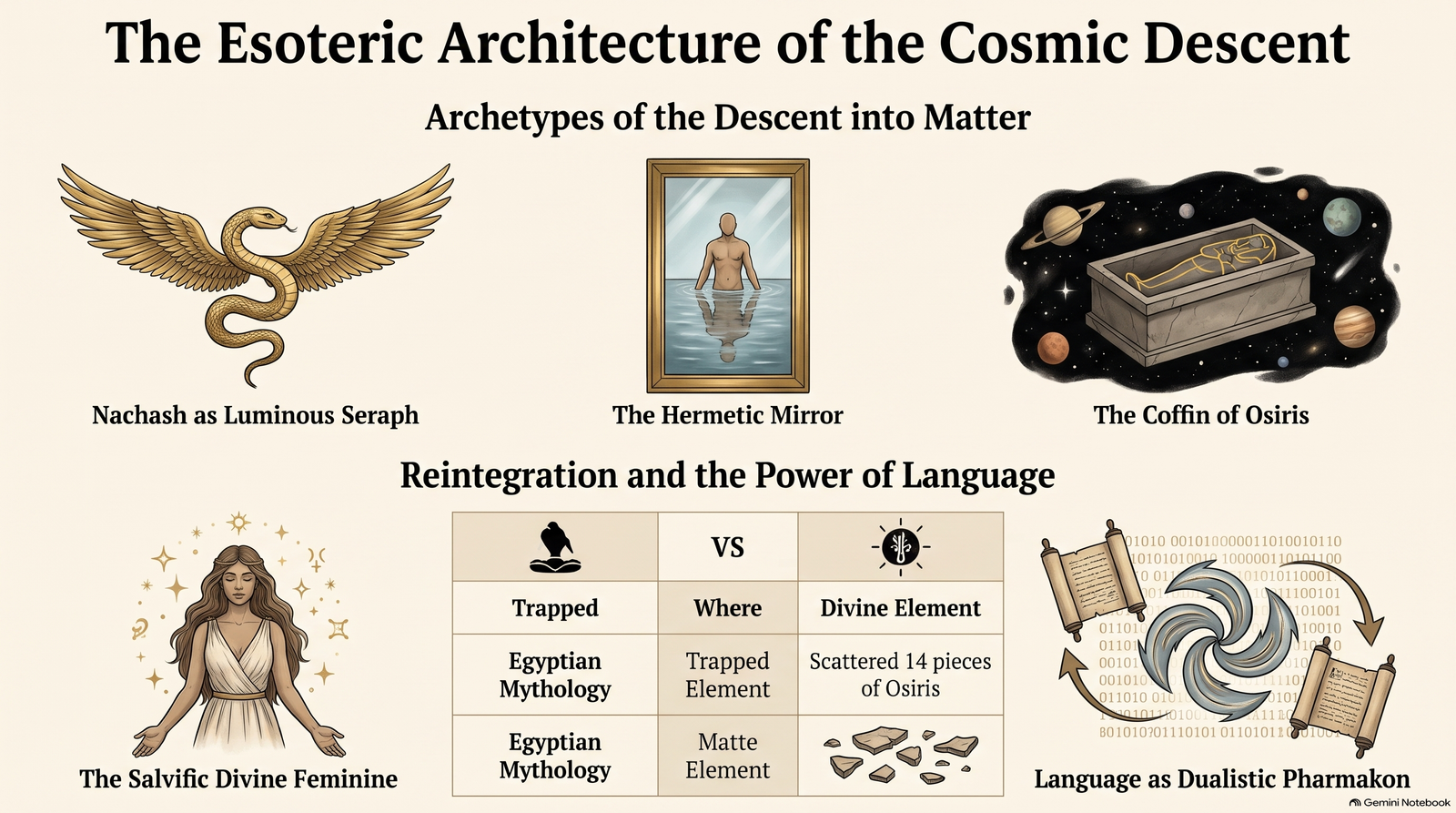
In the Hermetic Poimandres, the Primal Human sees its likeness in Nature and desires to dwell there. Nature sees the Human and embraces it. The mutual attraction gives embodiment a different emotional character from expulsion. The hosts then picture the seven planetary governors as layers of constraint, making Saturn stand for ageing and Mercury for the intellect that divides things into categories. The next image gives constraint a shape you can picture. Set builds a chest to Osiris’ measurements, so the very fact that it fits makes it a trap. Read together, the embrace and the chest raise the question of when a limit makes experience possible and when it becomes confinement.
Isis’ search for the scattered parts of Osiris shifts the conversation from descent to repair. The hosts set that search alongside stories of Sophia in Gnostic writings and the scattered sparks of Lurianic Kabbalah. Each tradition gives the work of restoration its own setting and meaning. The comparison gives the hosts a way to ask what it would mean to gather what has been dispersed while remaining in the world where the dispersal took place.
At the end the hosts propose that the Tree of Knowledge can stand for the human capacity to name and divide. Plato’s story of Theuth and Thamus gives that proposal a test. Writing keeps words available beyond the moment of speech, yet the written record can be mistaken for the understanding it helps us develop. The hosts’ example is a sunset turned into a filtered photograph and a caption. The caption can also send someone back outside to look. How do we tell whether a description has made us more attentive or merely more certain of what we think we saw?
Argument map
The serpent at the threshold
The hosts challenge the familiar account of temptation by reading the Eden serpent as a figure who mediates dangerous knowledge.
From curse to cure
The dust of Genesis and the healing image in Numbers let the hosts consider how one symbol can serve opposing purposes.
Nature sees and is seen
The Primal Human’s reflection and Nature’s embrace recast descent as mutual attraction, which the hosts then explore through the limits they associate with the seven governors.
A chest made to fit
Set’s trap gives the hosts an image of how a form that accommodates a body can also confine it.
Repair among the fragments
Isis’ search, Sophia narratives and Lurianic restoration bring different responses to fragmentation into conversation.
Words that divide and guide
The Tree of Knowledge and Plato’s story of writing lead to the closing invitation to notice how naming changes an ordinary experience.
Chapters
Chapter links open on YouTube in a new tab.
- 00:00 The familiar Fall: serpent, fruit and punishment
- 03:35 Nachash: serpent, divination and shining bronze
- 07:25 Seraphim and the divine council
- 10:40 Dust, descent and the bronze serpent
- 14:20 The Hermetic mirror and the Primal Human
- 16:20 Nature embraces her lover
- 18:05 The seven planetary governors
- 24:45 Osiris, Set and the measured coffin
- 29:00 Isis, Sophia and the gathering of fragments
- 32:05 Kabbalah: shattered vessels and restoration
- 35:40 The Tree of Knowledge and language
- 38:45 Thoth, Plato and writing as remedy and poison
- 42:05 The map, the territory and naming
Glossary
Naḥash
The Hebrew noun used for the serpent in Genesis 3. A Hebrew verb with the same consonants can refer to practising divination, and neḥoshet means copper or bronze. Those associations help explain the hosts’ reading. A deliberate threefold meaning in Genesis remains conjectural.
Seraphim and cherubim
Isaiah 6 presents seraphim as six-winged figures attending the divine throne. Forms of the word saraf also appear in biblical passages about dangerous serpents. Genesis 3:24 names cherubim as the guardians of the way to the Tree of Life. The hosts’ identification of the earlier serpent with a seraph is an inference.
The bronze serpent and Nehushtan
In Numbers 21:4–9, Moses sets a bronze serpent on a pole and those who have been bitten look at it and live. In 2 Kings 18:4 Hezekiah destroys the object, there called Nehushtan, after people have burned incense to it. The episode uses the healing image to bridge serpent and mirror.
Poimandres and Anthrōpos
Poimandres is the first treatise in the Corpus Hermeticum. Anthrōpos is Greek for “human”. In this narrative the Primal Human comes from divine Mind, sees its likeness in Nature and desires to inhabit it. The comparison with Narcissus brings out the reflection, while Nature’s own desire changes the encounter.
Seven planetary governors
The seven governors of Poimandres rule the circles of the sensible cosmos, and their rule is called fate. During the ascent, the human sheds dispositions at successive zones. The hosts elaborate the scheme with familiar planetary attributes and draw a parallel with chakra systems. These correspondences belong to their comparative reading.
Osiris, Set and Isis
In Plutarch’s account, Set appears under the Greek name Typhon. He traps Osiris in a chest made to measure, and later cuts his body into fourteen parts. Isis searches for the scattered pieces. The hosts read the chest as a figure of bodily constraint and Isis’ search as an image of gathering what has been dispersed.
Sophia and plērōma
Sophia is Greek for “wisdom”. In several ancient movements grouped under Gnosticism, Sophia figures in accounts of divine emanation, disruption or recovery. Plērōma means “fullness” and can denote the divine realm. Sophia’s role varies by text and school. The comparison with Isis belongs to the episode’s interpretation.
Tzimtzum, shattered vessels and tikkun
In Lurianic Kabbalah, tzimtzum is divine contraction or withdrawal. In the account of shevirat ha-kelim, vessels break and sparks of divine light are dispersed. Tikkun means repair or restoration. In this tradition it involves Jewish religious observance and intention, alongside a cosmic account of what restoration means.
Tree of the Knowledge of Good and Evil
Genesis distinguishes this tree from the Tree of Life and leaves its fruit unspecified. The hosts discuss “good and evil” as a possible merism, a figure in which two extremes can suggest a whole range, as in “high and low”. Their further proposal that the fruit represents naming or writing is a symbolic interpretation.
Theuth, Thamus and pharmakon
In Plato’s Phaedrus, Socrates recounts how Theuth offers writing and King Thamus distinguishes a reminder from memory cultivated by use. Theuth’s word pharmakon can mean a drug, remedy or poison depending on context. The hosts extend the double sense to the way language can preserve an insight and encourage confidence in an account of it.
Related reading
- 3.3.1. Poimandres, Shepherd of Man
The Citrinitas course chapter gives the Primal Human and the planetary spheres a fuller Hermetic context.
- The Garden of Eden in Your Mind
An earlier dialogue develops a reading of Eden in terms of how experience and the sense of separation take shape.
- The Garden of Paradise (Eden)
A companion essay explores Eden through the symbolism of the garden and the Fall.
- How Language Creates the Self
Continues the question of what happens when a useful word begins to organise the experience of being someone.
- Why the Mind Turns Everything Into Something.
The Dialogues V opener follows the mind’s habit of giving stable outlines to what it encounters.
External reference points
External references open in a new tab.
- Genesis 3 (Sefaria)
Hebrew text and translation for the serpent, the fruit, the curse and the cherubim.
- Corpus Hermeticum I, Poimandres (G. R. S. Mead translation)
Sections 9 and 12–15 describe the governors, the reflection and Nature’s embrace. Sections 24–26 describe the ascent.
- Plutarch, Isis and Osiris (LacusCurtius)
Sections 13 and 18 give the measured chest, its sealing with lead and the later scattering of Osiris’ body.
- Tikkun in Lurianic Kabbalah (My Jewish Learning)
Introduces contraction, the shattering of the vessels and the role of religious practice in restoring the sparks.
- Plato, Phaedrus (Internet Classics Archive)
In the account at 274c–275b, Theuth and Thamus disagree over what writing can do for memory and wisdom.
Reflection
Spend a minute with an ordinary sight, such as light on a wall. Give it the description that comes to mind. Look again and find one detail those words helped you notice and one they left out. Would a different description send your eye somewhere else?