
Dialogues VI · Episode 01
Why Your Mind Turns Everything Into a Thing
We need names to live together, yet the names that help us recognise one another can also keep us from seeing who has changed.
When does a useful name become a fixed identity?
The hosts begin in an ordinary room. Wood becomes a table, the person at the door a threat or a boss, and the person looking an employee. The labels help us get our bearings, but a judgement about an encounter can quietly become a claim about what someone is. The opening brings in the Buddhist idea of conceptual proliferation. The Diamond Sūtra then supplies a way of examining a name through the hosts’ own example, a microphone. Its parts, design and use explain why the word fits. It can record a voice while depending on all those conditions.
Applied to identity, the same inquiry can feel less comfortable. The hosts describe vertigo and lightness as possibilities and retell the Platform Sūtra’s account of Huineng hearing the Diamond Sūtra. Their image of a label maker on a riverbank asks what happens when our descriptions fail to keep pace with what they describe. Then one host raises the practical objection. People still have jobs, taxes to pay and roads to cross. The episode calls this shared world of roles and agreements the “assembly”. Nāgārjuna’s account of dependence and the two truths gives the hosts a way to retain ordinary distinctions. It also turns the inquiry back on itself. What happens when we treat emptiness as the final thing underneath everything else?
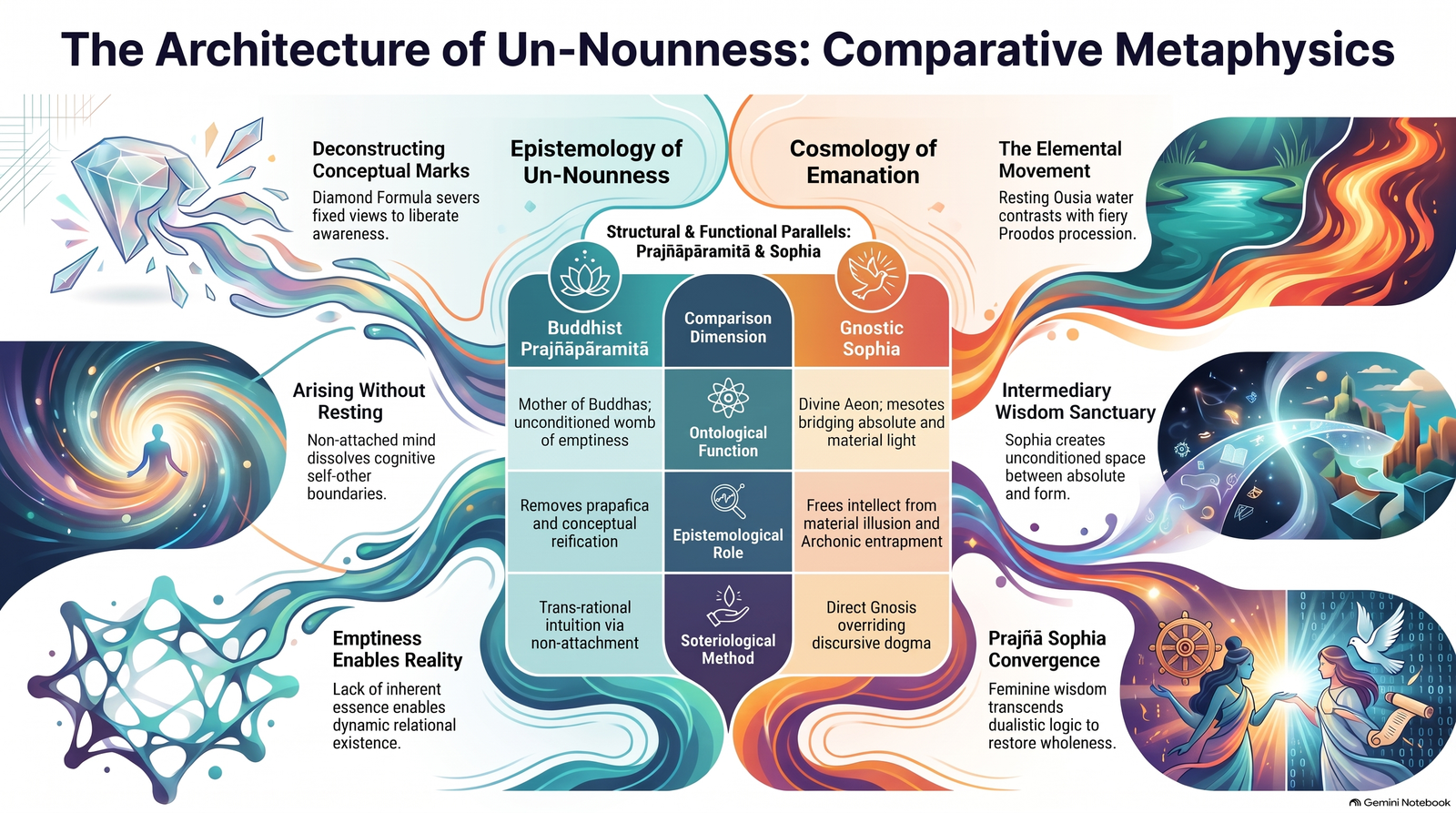
In the second half the hosts move from Greek questions about essence to Plotinus’s One and Proclus’s pattern of remaining, procession and return. Fire and water become images for the urge to take form and the capacity to accommodate it. The hosts read Sophia as a “parenthesis” within the noise of life, then ask what can be inferred from Edward Conze’s comparison of Buddhist and Gnostic wisdom. The strongest version of that question applies to the episode itself. If a resemblance can tempt us to make two traditions into one, can a description of someone we know tempt us to overlook what has changed? The closing invitation brings the question back into a room full of people.
Argument map
From perception to a fixed description
The opening room shows how a single label can bring a whole set of assumptions about an object, another person or ourselves.
Keep the name in use
The microphone and the hosts’ river of labels let the hosts ask whether words can remain useful when experience keeps moving.
Meet the demands of shared life
The assembly and Nāgārjuna’s two truths bring social obligations back into view and expose the temptation to turn emptiness into a creed.
Ask what exceeds definition
The search for essence gives way to Plotinus’s One, and Proclus’s account of procession prompts the hosts’ images of outward fire and receptive water.
Test the comparison of wisdom
Sophia’s “parenthesis” sets up a comparison with the perfection of wisdom, and one host asks what a structural resemblance can establish.
Let another person change
The discussion of Neoplatonic return leads back to an ordinary encounter and the possibility of revising a judgement about someone.
Chapters
Chapter links open on YouTube in a new tab.
- 00:00 Why the mind turns everything into nouns
- 02:35 Conceptual proliferation (papañca)
- 04:00 The Diamond Sūtra and the microphone
- 07:10 Identity, emptiness and existential groundlessness
- 09:40 Huineng and the river of labels
- 12:45 Why we still need names and distinctions
- 15:05 Nāgārjuna and inherent existence
- 18:30 The two truths and the danger of clinging to emptiness
- 21:00 Greek philosophy and the search for essence
- 24:00 Plotinus and the One beyond being
- 26:00 Proclus, procession and cosmic fire
- 29:40 Water, receptivity and the limits of form
- 31:50 Sophia and the parenthesis of wisdom
- 35:40 Comparing Buddhist and Gnostic wisdom
- 39:20 Neoplatonic return and the undescended soul
- 43:10 Letting other people exist beyond our labels
Glossary
Papañca and prapañca
Papañca is the Pāli form and prapañca the Sanskrit. “Conceptual proliferation” is one common rendering. In the Honey-Cake Discourse (MN 18), it occurs in an account that connects sense contact, perception and thinking with the ideas that beset us. The hosts’ label maker illustrates one aspect of that process.
Reification
To reify is to treat an abstraction, role or description as a thing with an independent reality of its own. Calling an item a microphone allows people to use it together. The hosts extend the example to identity, where a description that fits one situation may be taken as a permanent account of a person.
Prajñāpāramitā and the Diamond Sūtra
Prajñāpāramitā means “perfection of wisdom” and names a family of Mahāyāna texts that includes the Diamond Sūtra. The hosts illustrate the sūtra’s recurring pattern of loosening attachment to a designation while still using it. Several texts personify this wisdom as the mother of the Buddhas. The date 868 CE refers to the surviving printed Chinese scroll in the British Library.
Huineng and the Platform Sūtra
Huineng is honoured in Chan tradition as the Sixth Patriarch. The Platform Sūtra presents his hearing of the Diamond Sūtra within a traditional awakening narrative. The hosts draw on the teaching of giving rise to mind without fixing it on an object and illustrate it with the river and its drifting labels.
Svabhāva, emptiness and dependent arising
Svabhāva can mean intrinsic nature or own-being. Nāgārjuna interrogates the idea that anything exists through a nature wholly its own. Śūnyatā, emptiness, indicates the absence of such nature. The seed in the recording illustrates why dependence on conditions matters for change.
The two truths
Nāgārjuna distinguishes conventional truth, through which ordinary language and practice operate, and ultimate truth, which concerns the absence of intrinsic nature. The two do not require two separate worlds. The hosts’ example of a bus makes the practical point that ordinary causal consequences still matter.
The assembly
The underlying dialogue uses this term for the shared world made workable by roles, names, rules and agreements. Its examples include money and traffic signals. The term belongs to the episode’s vocabulary and describes how distinctions can be practically indispensable even when they are open to revision.
Ousia and the One
Ousia can be translated as being, substance or essence, depending on the Greek author and context. Plotinus, drawing on Plato’s Republic, places the One beyond being. The hosts use a slippery ladder to ask how concepts might guide an inquiry into what they cannot fully capture.
Remaining, procession and return
In Proclus, monē, proodos and epistrophē describe how an effect remains in its cause, proceeds from it and turns back towards it. These describe relations of dependence. The hosts picture procession as fire and return as a movement towards receptive water.
Sophia, plērōma and gnōsis
Sophia means wisdom, plērōma means fullness and gnōsis means knowledge. In the Valentinian account reported by Irenaeus, a distinction is made between Sophia within the fullness and her passion or offspring outside it, associated with Achamoth. The parenthesis within a noisy meeting is the dialogue’s metaphor for Sophia’s mediating role.
The undescended soul and henōsis
For Plotinus, an aspect of soul remains above its embodied life. Henōsis means unification and here refers to union with the One. Proclus treats the descent of the individual soul differently. Plotinus locates undescended soul in the intelligible realm. The Gnostic plērōma belongs to the Sophia myth discussed earlier.
Related reading
- 17. Papañca
The Citrinitas chapter gives the episode’s opening term its own place in the Buddhist course material.
- Emptiness
A companion explanation of emptiness on the site, useful alongside the microphone example and the two truths.
- Why the Mind Turns Everything Into Something
The similarly titled Series V opener asks how philosophical models can harden into the realities they were drawn to describe.
- Why Reality Can’t Be Grasped
Continues the inquiry into the gap between conceptual grasp and what it seeks to capture.
- Your LinkedIn Profile Is a Lego Castle | Dialogues V
Extends the episode’s closing question to the identities people assemble and present in public.
External reference points
External references open in a new tab.
- The Honey-Cake Discourse (MN 18)
Bhikkhu Sujato’s translation and notes place papañca in the sequence from sense contact to proliferating thought.
- The Diamond Sūtra and the British Library’s dated scroll
Max Müller’s translation gives the naming formula and the passage on non-abiding. The British Library identifies 868 CE as the date of its printed Chinese copy.
- The Theory of Two Truths in India
The Stanford Encyclopedia of Philosophy explains how Nāgārjuna relates dependent arising, conventional truth and emptiness.
- Plotinus and Proclus
These Stanford Encyclopedia of Philosophy entries explain the One, the disagreement over the soul’s descent and Proclus’s triad.
- Against Heresies, Book I, Chapter 4
Irenaeus gives a polemical ancient account of the distinction between Sophia within the fullness and Achamoth outside it.
Reflection
Take a minute after an ordinary conversation. Recall one description you applied to the other person. Try putting it into a sentence about what you actually observed. What room does that leave for the person to respond differently next time?