
Nigredo · Dharma · Chapter 22 of 48
1.2.10. The Cycle of Becoming
How does a changing stream of experience acquire the momentum, identity and future orientation of a sufferer?
Watch the chapter discussion
How You Create Your Own Suffering
The book
The chapter in brief
This tenth Dharma chapter turns from the Four Noble Truths to the conditional structure beneath them. It traces a movement from ignorance and volitional formation through consciousness, contact and feeling to craving, clinging and becoming. A river vortex provides its central image: recognisable and consequential, yet inseparable from the changing water that sustains it.
The chapter presents the sufferer not as an immutable entity but as a pattern repeatedly assembled through attachment, memory and imagined futures. Its account combines early Buddhist dependent origination, later Abhidhamma language and Dr Robinson’s own model of mind. These layers should be distinguished: the chapter is an interpretive course map, not a complete statement of every Buddhist school’s understanding.
Visual orientation
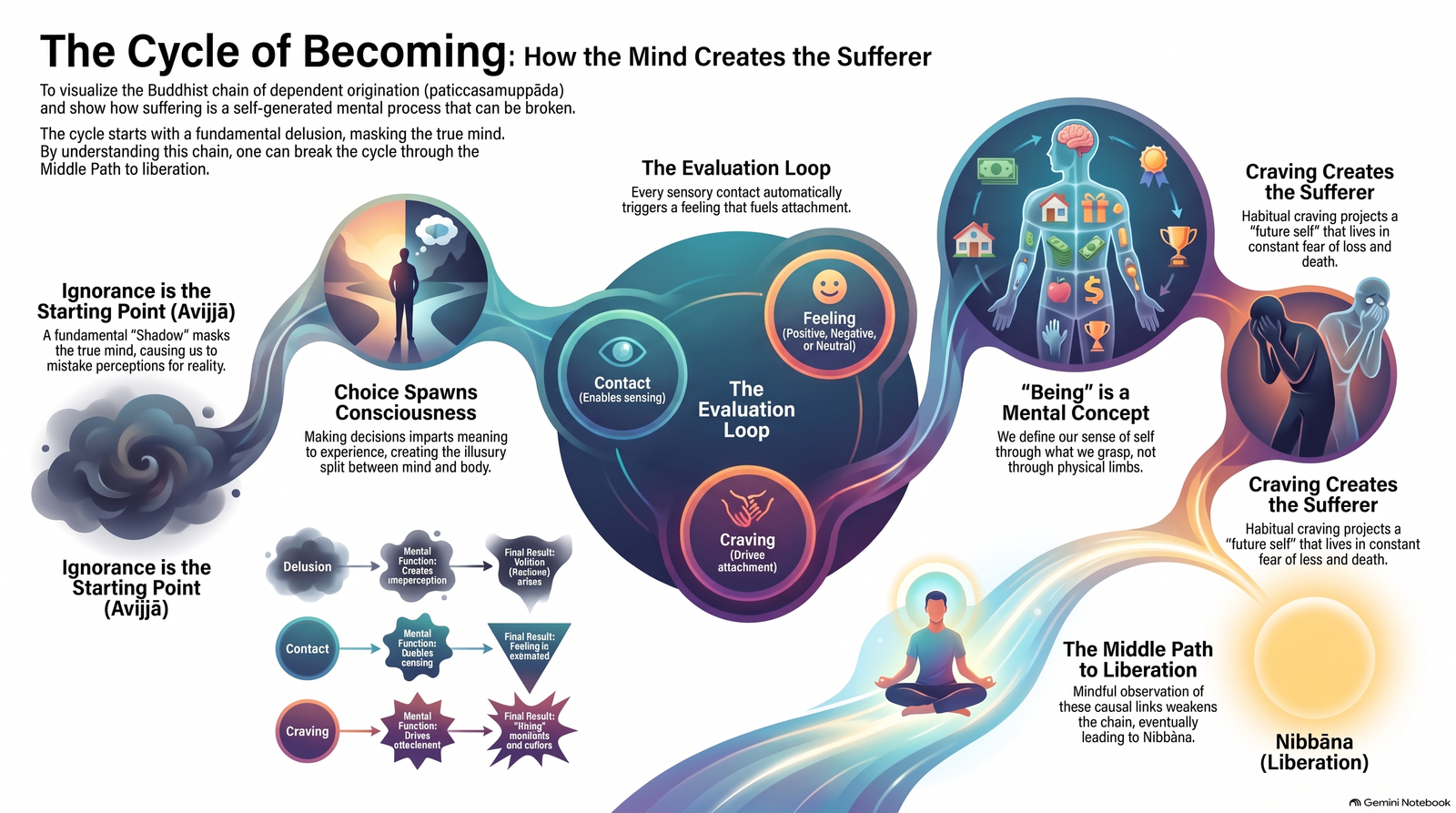
How the mind creates the sufferer
Video guide
Where does the sufferer enter the stream?
The recording opens with a whirlpool in a fast river. It has a location, shape and real effects, yet it cannot be lifted from the water as a separate object. This becomes the working image for a person: neither a permanent substance nor a mere nothing, but a conditioned pattern with continuity and consequences. The metaphor helps the discussion move away from two extremes—an unchanging inner owner and the conclusion that conventional persons, choices or responsibilities are unreal.
From there, the video reads saṃsāra as machinery rather than spectacle. Dependent origination is presented as an account of how one condition supports another, culminating in the repeated formation of suffering and renewed becoming. The canonical twelve-link formula is ignorance, volitional formations, consciousness, name-and-form, six sense bases, contact, feeling, craving, clinging, becoming, birth, and ageing-and-death. The recording concentrates on a shorter experiential arc: conditioned choice, consciousness, contact, feeling, craving, attachment and the projection of a future self.
Its centre of gravity is the movement from contact to feeling and from feeling to craving. A sight, sound, memory or thought is evaluated as pleasant, painful or neutral; the mind may then reach, resist or remain inattentive. Repetition gives the reaction momentum. The recording describes craving as constructing a sufferer who lacks something now and imagines fulfilment later. This is a valuable account of identity formation, provided “self-created suffering” is not confused with blame. Illness, bereavement, trauma, poverty and harm are not simply chosen, and Buddhist conditionality is broader than a claim that an individual mentally causes every difficulty.
The inner narrator is then treated as conditioned output: learned language, remembered associations and previous choices returning as apparently private thought. The provocative question is whether the voice that says “I” is the owner of experience or another event within it. The video’s final contrast between the “program” and a silent awareness that watches it belongs to the course’s contemplative interpretation. Early Buddhist not-self teaching does not require positing an unaffected true self behind the processes, and Buddhist traditions differ in how they speak about awareness, mind and liberation.
The practical turn is modest but important. The recording locates a possible interruption around feeling and craving: notice pleasantness or discomfort before the demand for more, less or escape becomes a projected identity. This is not a magical pause outside causality, nor proof of unrestricted free will. It is the cultivation of conditions—attention, restraint, understanding and ethical practice—that can weaken automatic reactions. The closing invitation is therefore not to destroy a person, but to notice how rigid selfhood is repeatedly fabricated and how experience may continue with less compulsive grasping.
Argument map
How the inquiry develops
Replace the object with a pattern
The river vortex introduces a self that is functional and consequential without being an independent, permanent substance.
Read saṃsāra as process
Dependent origination shifts attention from metaphysical spectacle to the conditions by which suffering and becoming continue.
Follow contact into evaluation
Sense or mental contact is accompanied by feeling tone, creating the setting in which attraction, resistance or indifference may arise.
Watch craving project a self
The mind imagines a future person who will possess, avoid or recover something and makes present experience answer to that image.
Question the internal narrator
Learned words, memories and reactions appear as inner speech, complicating the assumption that a separate owner stands behind thought.
Cultivate different conditions
Careful attention around feeling and craving can weaken repetition without turning liberation into suppression or self-blame.
Book, video and context
Three layers of the discussion
The written chapter
Moves from fundamental ignorance through volition, consciousness, contact, feeling, craving, clinging and becoming, with rebirth-linking consciousness completing the wider cycle.
The video’s expansion
Develops the vortex, source-code, internal narrator, cookie and future-self images, bringing the cosmological account into moment-to-moment experience.
The traditional framework
Dependent origination is a foundational Buddhist teaching, but its links, timescales and philosophical interpretation have been explained differently across traditions and historical periods.
The course synthesis
“True mind” behind a shadow, consciousness arising through choice, and silent awareness distinct from the program are interpretive claims rather than neutral definitions shared by all Buddhist schools.
Clickable chapters
Navigate the video
These markers come from the supplied YouTube catalogue and follow the recording’s principal movements. The final runtime was not separately supplied, so no duration is stated on this page.
Key language
Glossary
Paṭiccasamuppāda
Avijjā
Saṅkhāra
Viññāṇa
Nāma-rūpa
Phassa
Vedanā
Taṇhā
Upādāna
Bhava
Saṃsāra
Anattā
Citta
Continue through the course
Related pathways
- 1.2.9 The Four Noble TruthsThe preceding chapter supplies the diagnostic framework whose conditional machinery is examined here.
- 1.2.11. The Fetters that BindThe following chapter turns from the cycle itself to the attachments traditionally said to hold beings within it.
- 1.2.8 SaṃsāraProvides the immediate background of conditioned continuity, karma and rebirth within which becoming is discussed.
- 1.2.7 The Forces that Drive The MatrixIntroduces karma and conditional relations behind the present account of repeated patterns.
- 1.2.4 ConsciousnessSets out the course’s model of citta and viññāṇa, terms that return within the chain of dependent origination.
- Dharma — Part Two of NigredoThe section index for the twelve chapters analysing conditioned experience, suffering and liberation.
Context beyond the course
External reference points
- SuttaCentral — Dependent Origination (SN 12.1)A concise statement of the twelve-link sequence and its cessation.
- DhammaTalks — An Analysis of Dependent Co-arising (SN 12.2)A translation defining each of the twelve factors, useful for distinguishing the canonical terms from later analogy and synthesis.
- DhammaTalks — The Great Causes Discourse (DN 15)An extended early discourse on the depth of dependent co-arising, the reciprocity of consciousness and name-and-form, craving, social conflict and delineations of self.
- SuttaCentral — The Longer Simile of the Elephant’s Footprint (MN 28)The discourse containing the celebrated connection between seeing dependent origination and seeing the Dhamma.
A ninety-second observation
Follow one small moment of becoming
Choose a low-stakes urge already present—checking a message, repeating a pleasant taste or moving away from a mild irritation. Notice the contact, the pleasant or unpleasant tone, and the first thought of a future in which the urge has been satisfied. There is no need to resist it. Ask only: At what point did a sensation become something “I” needed? The exercise is observation, not a test of freedom or attainment.