
Nigredo · Dharma · Chapter 23 of 48
1.2.11. The Fetters that Bind
What holds a person within conditioned patterns when the most obvious forms of attachment have already begun to loosen?
Watch the chapter discussion
The 10 Fetters That Keep You Trapped
The book
The chapter in brief
This eleventh Dharma chapter introduces the ten fetters (saṃyojana): patterns of attachment and misunderstanding used in early Buddhist accounts of progressive awakening. It divides them into five lower and five higher fetters, then relates their abandonment to stream-entry, once-returning, non-returning and arahantship.
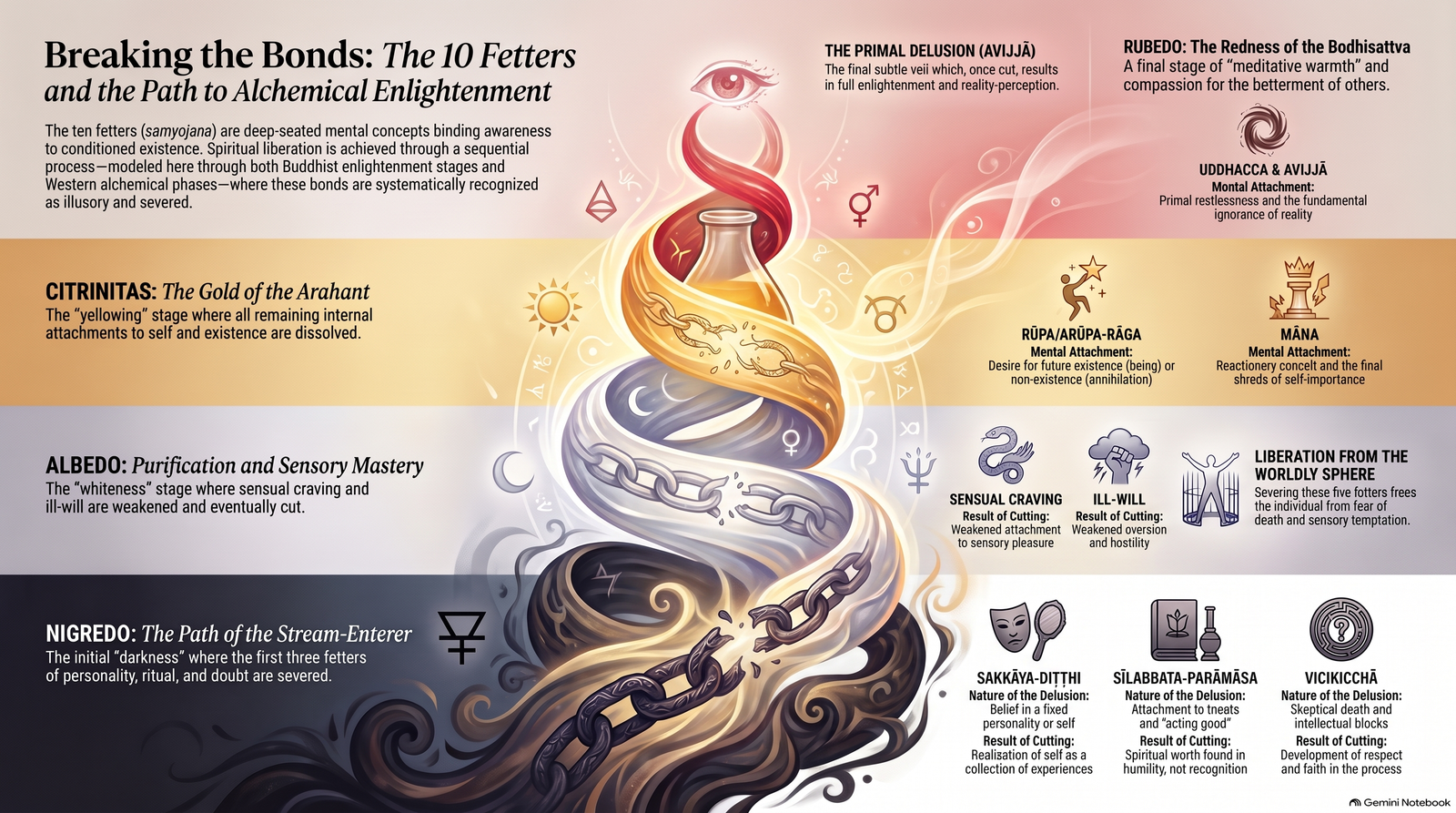
The chapter places that Buddhist map beside the four colours of the course’s alchemical work—Nigredo, Albedo, Citrinitas and Rubedo. That correspondence is Dr Robinson’s interpretive synthesis. It should not be mistaken for a historical equivalence recognised by Buddhist or alchemical traditions as a whole.
Visual orientation
Ten bonds, four alchemical colours
Video guide
From visible attachment to the residue of “I am”
The recording begins by setting early Buddhist renunciation beside Western alchemy. Its governing proposal is that the laboratory imagery of blackening, whitening, yellowing and reddening can be read as a psychological map: not the production of material gold, but the progressive recognition of the bonds mistaken for self. The comparison gives the discussion its structure, though it remains a modern interpretive juxtaposition rather than evidence that the two historical systems share one origin.
The first three fetters are presented as the threshold of stream-entry. Identity view is the assumption that changing experiences form an enduring person; attachment to rites and observances mistakes correct performance, status or recognition for transformation; doubt is treated not as careful inquiry but as an inability to entrust oneself to a path. The video’s language is deliberately forceful—personality as a “corrupted operating system”, comfort as a fortified mask, and intellectual control as a defence. Traditional accounts are more exact: stream-entry abandons specific identity views, debilitating doubt about the teaching, and the belief that mere observances are sufficient for purification. It does not erase conventional personhood, ethical responsibility or intelligent questioning.
The fourth and fifth fetters are sensual desire and ill will. The recording usefully distinguishes an immediate bodily reaction from the stories that prolong anger into resentment, while presenting craving as the magnetic pull towards food, sex, comfort, entertainment or other pleasant experience. In the early Buddhist map, a once-returner has attenuated passion, aversion and delusion; a non-returner has abandoned the five lower fetters. These are doctrinal categories, not conclusions that can responsibly be certified from mood, self-description or one unusual experience.
The higher fetters turn from familiar social and sensory attachments towards refined forms of becoming: passion for form, passion for the formless, conceit, restlessness and ignorance. The recording renders these as the wish for an exalted embodied existence, the wish to remain as pure consciousness, a last whisper of “I am”, agitation within a brilliant mind, and the primal failure to see reality clearly. Its language of wanting non-existence or annihilation should be treated cautiously: arūpa-rāga conventionally means passion for formless existence or attainment, not simply a wish to cease existing.
The final movement takes the course beyond the standard four-stage Theravāda map. Arahantship is associated with Citrinitas, while Rubedo becomes the compassionate return of the Bodhisattva. The video also speculates that meditative warmth, skin colour and reduced breathing may illuminate religious imagery. These are symbolic and physiological conjectures, not established historical or medical explanations. Early Buddhist arahant and Mahāyāna Bodhisattva ideals arise within different doctrinal settings; neither should be reduced to a simple choice between private escape and compassionate service.
The practical value of the discussion lies in observation rather than self-ranking. When criticism lands, when a good deed seeks recognition, when doubt becomes endless postponement, or when desire and anger acquire a story, the map asks what is being defended or fed. To notice a fetter is not to claim it has been cut. It is to see more clearly how identification, craving and resistance organise ordinary experience.
The traditional list
Five lower and five higher fetters
1. Sakkāya-diṭṭhi · identity view
Taking one or more of the five aggregates as self or belonging to self. This is more specific than denying the practical existence of persons.
2. Vicikicchā · doubt
Uncertainty that obstructs commitment to the Buddha’s path. It does not make evidence, discernment or honest questioning into faults.
3. Sīlabbata-parāmāsa · grasping at observances
Reliance on rules, vows or practices as sufficient in themselves for purification, rather than a rejection of ethics or disciplined practice.
4. Kāma-rāga · sensual desire
Passion directed towards the pleasures of the senses and the sensory realm.
5. Vyāpāda · ill will
Hostility, aversion or the wish that another being suffer. Together with sensual desire, it completes the five lower fetters.
6. Rūpa-rāga · passion for form
Attachment to refined form existence or meditative attainment; subtler than ordinary sensual desire.
7. Arūpa-rāga · passion for the formless
Attachment to formless existence or attainments. It should not be equated without qualification with annihilation or non-being.
8. Māna · conceit
The residual measuring of “I am”—better than, worse than or equal to another—after fixed identity views have been abandoned.
9. Uddhacca · restlessness
A refined agitation or lack of complete steadiness, not merely ordinary energy, curiosity or movement.
10. Avijjā · ignorance
Fundamental not-knowing regarding suffering, its arising, its cessation and the path; not simply a shortage of facts or education.
Argument map
How the inquiry develops
Join two symbolic maps
The video places a Buddhist account of bondage beside the colours of the alchemical work, establishing the course’s central comparison.
Define fetters as internal bonds
The chains are not imposed from outside; they are patterns of view, craving and misperception experienced as part of oneself.
Enter the stream
Identity view, obstructive doubt and grasping at observances are examined as the first three fetters abandoned in stream-entry.
Purify desire and aversion
Sensual passion and ill will are weakened in once-returning and abandoned with the five lower fetters in non-returning.
Recognise subtler becoming
Refined attachment to form, formlessness, conceit, restlessness and ignorance persists beyond ordinary sensory mastery.
Ask what liberation serves
The course moves from arahantship to a Rubedo of compassionate return, while acknowledging that this synthesis crosses traditions.
Book, video and context
Three layers of the discussion
The written chapter
Introduces the lower and higher fetters, relates their abandonment to the four stages of awakening, and places those stages beside the four colours of the course.
The video’s expansion
Adds the operating-system, addict, decorated-cage and expensive-hotel metaphors, and develops a practical contrast between reaction and the stories that sustain it.
The early Buddhist framework
AN 10.13 gives the tenfold list; AN 3.88 connects the first three and five lower fetters with stages of training; SN 22.89 explores residual “I am” conceit.
The course synthesis
The mapping of Nigredo through Rubedo, the contrast between arahant and Bodhisattva, and the physiological reading of redness belong to the author’s interpretive project.
Recording outline
The route through the video
The supplied catalogue markers conflict with the stated 24:59 final duration: its 27:40 and 32:50 markers cannot occur within this cut. To avoid publishing false links, this page preserves the supplied topic sequence without attaching unverified times.
- 01Opening: What Holds You
- 02What Are the Fetters?
- 03The Ten Constraints Explained
- 04The Lower Fetters: Identity, Doubt and Ritual
- 05Desire, Aversion and Attachment
- 06The Higher Fetters
- 07Why the Fetters Persist
- 08The Stages of Their Removal
Key language
Glossary
Saṃyojana
Lower and higher fetters
Sotāpanna
Sakadāgāmī
Anāgāmī
Arahant
Bodhisattva
Māna
Four alchemical colours
Continue through the course
Related pathways
- 1.2.10. The Cycle of BecomingThe preceding chapter examines the conditional processes within which craving, clinging and renewed becoming arise.
- 1.2.12. The Eightfold Noble PathThe following chapter turns from the bonds to the integrated training of view, conduct and cultivation.
- 1.1.9 The Rebis & Rejection of IdentityApproaches identity symbolically before the Dharma section gives it a more technical Buddhist vocabulary.
- 1.3.4 The Four Grades of RealisationDevelops the sequence of stream-enterer, once-returner, non-returner and arahant introduced on this page.
- 1.3.11 The Subtle FettersReturns later in Nigredo to the higher fetters that receive only an initial orientation here.
- Dharma — Part Two of NigredoThe section index for the twelve chapters analysing conditioned experience, suffering and liberation.
Context beyond the course
External reference points
- DhammaTalks — Fetters (AN 10.13)A concise early Buddhist enumeration of the five lower and five higher fetters.
- DhammaTalks — One in Training (AN 3.88)Connects the ending of the first three fetters, their attenuation with passion and aversion, and the ending of the five lower fetters with stages of training.
- DhammaTalks — About Khemaka (SN 22.89)Distinguishes freedom from explicit self-identification from the lingering residual “I am” conceit.
- DhammaTalks — Fetters (AN 4.131)A compact presentation of lower fetters, further bonds to becoming and the arahant whose effluents have ended.
A ninety-second observation
Notice the link before naming the stage
Recall a small moment today when you wanted approval, defended an identity, prolonged irritation or delayed action until every doubt disappeared. Without judging it, separate the immediate event from the story that followed. Ask: What did the story promise to protect? The exercise is an observation of conditioning, not a diagnosis of a fetter’s abandonment or a claim about attainment.