
Nigredo · Dharma · Chapter 14 of 48
1.2.2. The Matrix of Conditioned Reality
If experience is assembled from matter, awareness and mental factors, where does the apparently continuous person—and the world that person inhabits—begin?
Watch the chapter discussion
The Hidden Structure of Reality
The book
The chapter in brief
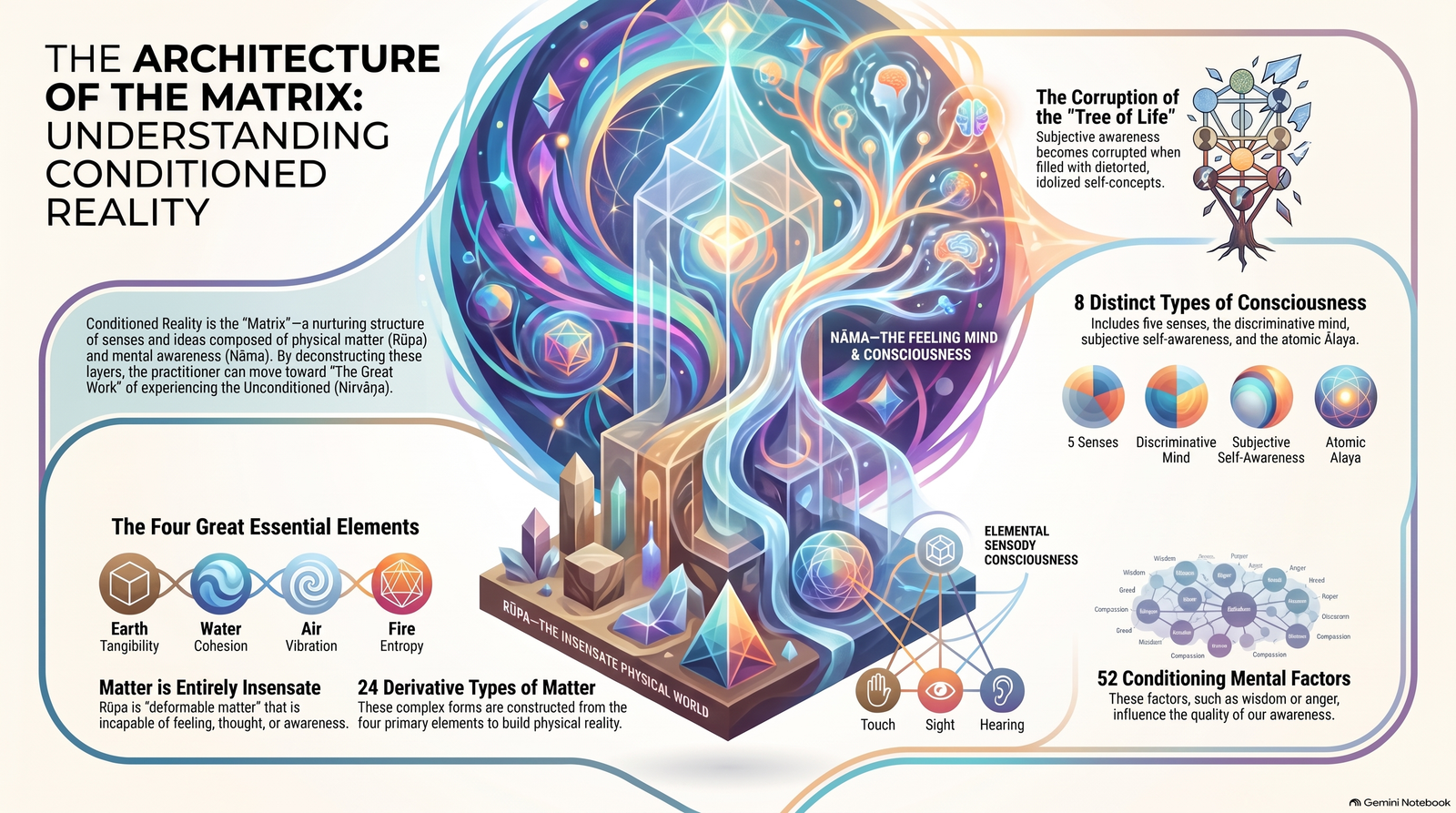
The Matrix of Conditioned Reality gives the Dharma section its first structural map. The chapter divides conditioned experience into rūpa, or material phenomena, and nāma, the mental side of experience; it then divides nāma into consciousness and associated mental factors. Matter is approached through the four great elements and their derivative forms, while consciousness is introduced through sensory awareness, discriminative mind, a sense of self and ālaya.
The chapter’s wider architecture is deliberately synthetic. Theravāda Abhidhamma classifications sit beside a Yogācāra model of eight consciousnesses, Gnostic imagery, Kabbalistic language and modern psychological interpretation. These traditions illuminate the course’s alchemical map, but they do not form a single historically standard doctrine. The model is offered as a way to examine experience and attachment—not as scientific proof that the universe is literally a simulation.
Video guide
Reading the code without mistaking the metaphor
The recording begins with the famous unease of The Matrix: the suspicion that ordinary reality may conceal a deeper structure. Rather than arguing for a computer simulation, it turns “matrix” into an image of the generative conditions that support embodied life. The maternal and Gnostic associations are evocative framing; they prepare the central question: what is an experienced world made from when familiar persons and objects are analysed into processes?
The first answer comes from Theravāda Abhidhamma. Conditioned experience is organised into consciousness (citta), associated mental factors (cetasika) and material phenomena (rūpa), while Nibbāna stands outside the conditioned categories. Matter is described through the four great elements—solidity, cohesion, temperature and movement—and derivative material phenomena. These are premodern analytical categories rather than chemical elements or an alternative physics. Saying that matter is insentient marks a distinction within this model: bodily tissue can be injured, while pain is a conscious experience arising through nervous and mental processes.
The video then changes frameworks. Its eightfold account of consciousness belongs to classical Yogācāra rather than to the Theravāda Abhidhamma taxonomy just introduced. Five sensory consciousnesses and mental consciousness are joined by an afflicted, self-appropriating mind and ālayavijñāna, commonly called store or substratum consciousness. The recording translates these into a modern story about discrimination, identity and accumulated tendencies. That reframing is central to Dr Robinson’s synthesis, but claims that self-consciousness begins around seven, that the seventh consciousness was originally “empty”, or that self-concepts corrupt a Kabbalistic Tree of Life are not standard Yogācāra teachings.
Mental factors provide the practical hinge. Consciousness is compared to illumination, while factors such as feeling, perception, volition, anger, mindfulness and wisdom shape the quality of each moment. The value of analysis is not to acquire a more elaborate cosmic inventory. It is to loosen identification: “anger is conditioning this moment” permits a different response from “I am an angry person”. Yet the computer language of hardware, operating systems and code remains analogy; it does not establish that minds are digital machines or that attention can simply overwrite every conditioned response.
The closing challenge is therefore subtractive. If continuity and a fixed self are partly constructed through rapidly changing processes, what happens when a person stops treating every sensation, thought and label as “me” or “mine”? The video presents understanding as preparation for liberation: learn the layout of the house before speaking about what lies beyond it. The map can clarify the machinery of attachment, but its competing taxonomies must remain visible if it is to open inquiry rather than become another total explanation.
Argument map
How the inquiry develops
From film image to existential structure
The Matrix becomes a metaphor for the nurturing yet confining conditions through which embodied existence perpetuates itself.
Conditioned and unconditioned
The recording brackets speculation about Nibbāna and first asks what can be analysed within ordinary conditioned experience.
Matter without sentience
Rūpa is organised through the four great elements and derivative forms, separating physical conditions from the awareness of them.
Consciousness without a single stream
Experience is reframed as changing cognitive events rather than one permanent, uninterrupted observer.
Eight layers and the construction of self
A Yogācāra model is used to trace sensory cognition, discrimination, self-appropriation and stored tendencies.
Mental factors colour the moment
Feeling, perception, volition and ethical qualities explain why awareness is never encountered as a neutral blank.
Analysis becomes a practice of release
Seeing processes as conditioned events may weaken identification and turn taxonomy into a practical map of freedom.
Book, video and traditions
What belongs to which layer?
The written chapter
Establishes the division between matter, consciousness and mental factors, then uses an eight-consciousness model to describe sensory awareness, discrimination, selfhood and ālaya.
The video’s expansion
Develops the Matrix, house, projector, unruly children, hardware and software metaphors to make the taxonomy vivid and practically relevant.
Traditional source systems
Theravāda Abhidhamma supplies the fourfold ultimate-reality taxonomy; Yogācāra supplies the classical eight-consciousness model. Their classifications and aims overlap without being interchangeable.
The course’s synthesis
Gnostic Pleroma, Kabbalistic Tree of Life and Qliphoth, alchemical transformation and a developmental account of identity are placed around the Buddhist maps by the author.
Clickable chapters
Navigate the video
Eight supplied markers fit within the final runtime of 34:36. The supplied 37:00 marker was omitted because it begins 2:24 after the video ends.
Terms for orientation
Expandable glossary
Abhidhamma / Abhidharma
Conditioned and unconditioned
Citta
Cetasika
Rūpa
The four great elements
Nāma-rūpa
Eight consciousnesses
Kliṣṭamanas
Ālayavijñāna
Papañca
Pleroma
Continue through the course
Related pathways
- 1.2.1. The RealitiesThe preceding chapter distinguishes apparent reality from the conditioned processes analysed more closely here.
- 1.2.3 The 72 Types of EntitiesThe next chapter develops the course’s inventory of conditioned and unconditioned categories.
- 1.2.4 ConsciousnessA closer examination of the knowing events that the present chapter introduces.
- 1.2.5 The Mental FactorsExtends the account of the qualities that accompany and condition moments of consciousness.
- Nigredo: DharmaThe section index for the twelve chapters that develop the course’s conceptual map of experience.
Context beyond the course
External reference points
- Stanford Encyclopedia of Philosophy — AbhidharmaAn academic account of Abhidharma’s distinct schools, its analysis of mental and physical events, and the Theravāda taxonomy used in the chapter.
- Stanford Encyclopedia of Philosophy — YogācāraA scholarly guide to the eight-consciousness model, afflicted mind, store consciousness and the continuing debate over Yogācāra idealism.
- SuttaCentral — Mahāhatthipadopama Sutta (MN 28)An early Buddhist discourse analysing the four great elements in the body and external world, providing canonical context for the chapter’s elemental vocabulary.
A two-minute observation
Notice the layers in one ordinary moment
Choose a neutral object within reach—a mug, book or key. Notice one physical quality such as weight, resistance or temperature. Then notice the kind of awareness involved: seeing, touching or thinking. Finally, notice any mental colouring that arrives—pleasantness, recognition, impatience, memory or the sense that it is “mine”.
You do not need to make any layer disappear. The exercise simply tests whether an apparently single encounter can be observed as several related processes.