
Nigredo · Object · Chapter 29 of 48
1.3.5. Realms of Existence
If experience is conditioned by earlier moments of mind, how much of the world we inhabit is discovered—and how much is carried into the present?
Watch the chapter discussion
Why Your Reality Feels the Way It Does
The book
The chapter in brief
This chapter places the Theravāda Abhidhamma categories of intentional, functional and resultant consciousness within Nigredo’s account of lived reality. Its central model is bhavaṅga, the “life-continuum” used in later Theravāda thought to explain continuity between active cognitive processes and across rebirth.
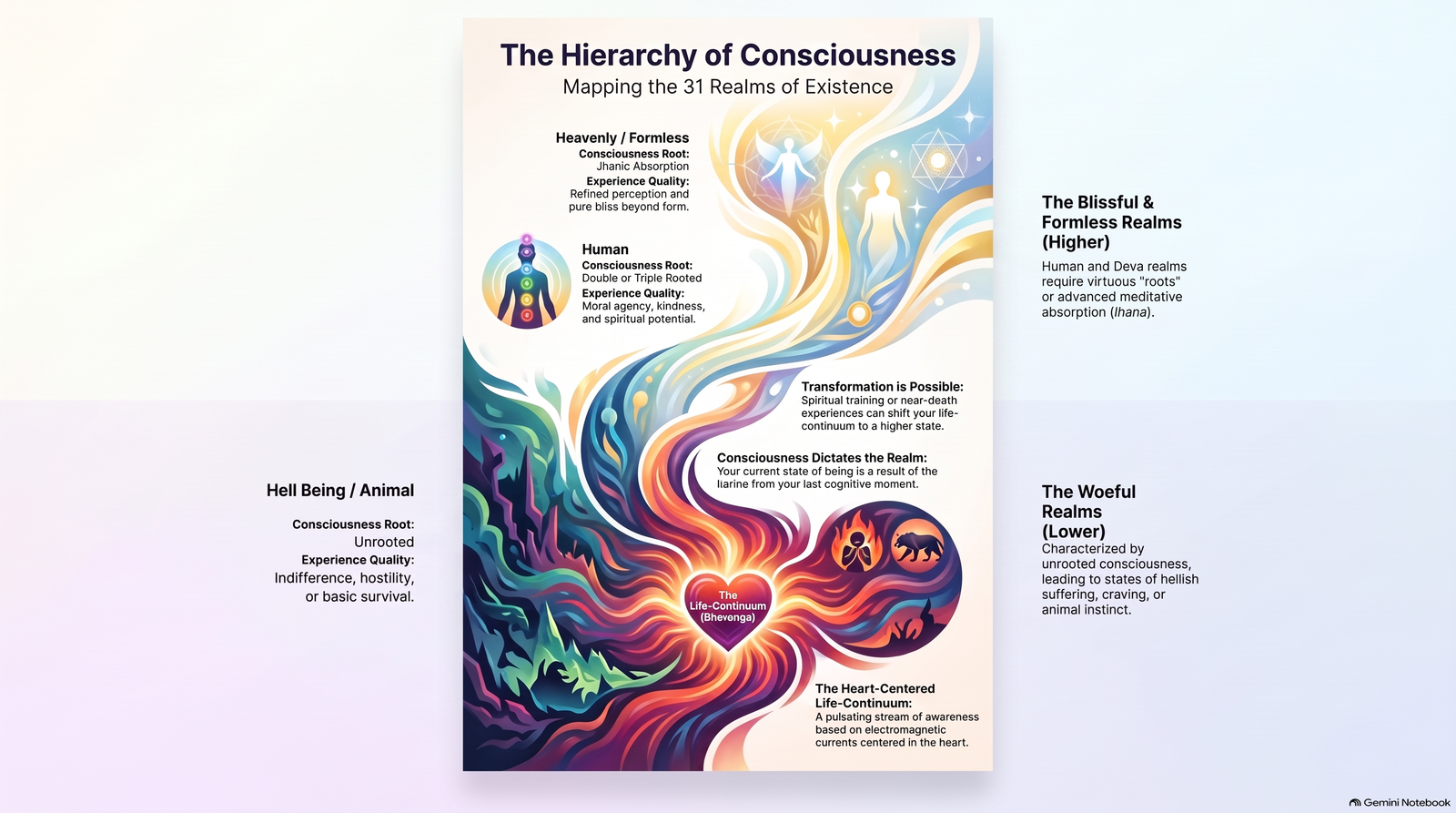
From there, the chapter connects nineteen kinds of rebirth-linking consciousness with human, animal, painful, form and formless modes of existence. Dr Robinson also reads these realms psychologically, as patterns that can colour a life here and now. That pairing of traditional cosmology with a modern therapeutic and alchemical interpretation is the author’s synthesis: it offers a map for reflection, not an empirically established account of consciousness, trauma or mental illness.
Visual orientation
A hierarchy of conditioned experience
Video guide
What builds the reality that feels immediate?
The recording begins with an ordinary act of recognition: seeing the colour blue. The first learning may require active discrimination, but later recognition seems instant. The discussion uses this as a model for vipāka, or resultant consciousness—the way earlier choices and learning can condition what is noticed and how it is interpreted now. It then turns to trauma, where a response formed under danger may be reactivated by reminders in safer circumstances. The analogy illuminates automaticity, but it does not make trauma a moral failure or prove that clinical symptoms are karmic consequences.
The inquiry then moves beneath active thought to bhavaṅga. In the Theravāda commentarial model, discrete moments of consciousness arise and cease in conditioned succession, while the life-continuum accounts for continuity when an active sense or thought process is absent. The recording imagines this as a pulsation and relates it to the physical heart, blood and electromagnetic activity. Those physiological correspondences belong to Dr Robinson’s speculative synthesis; bhavaṅga is not a structure detected by neuroscience, and the supplied sources do not establish a haemoglobin-based mechanism of mind.
From this foundation, the video climbs through the traditional cosmological map: painful realms, animal existence, the human realm, celestial form realms and formless attainments. It also turns the map inward. “Realm” can then name a quality of experience shaped by hostility, craving, confusion, generosity, goodwill, wisdom or meditative refinement. The recording’s demons and ghosts function partly as images for lives organised around threat, predation, shame or insatiable escape. These images can be evocative, but they should never become labels for people with addiction, post-traumatic symptoms or severe mental distress.
The practical challenge is therefore smaller and more demanding than choosing a place in a cosmic diagram: notice what the present response is preparing next. The video’s hope lies in trainability. Habit is powerful, but not identical with fate; a different relationship to perception, intention and action can alter the conditions that follow.
Argument map
How the recording develops
Begin with recognition
Learning “blue” shows how an initially active judgement can become an apparently effortless feature of later perception.
Distinguish three functions
Intentional consciousness creates karmic momentum, functional consciousness performs a task, and resultant consciousness bears conditioned effects.
Follow conditioning into fear
The same automaticity becomes painful when earlier danger shapes the reading of a present situation, though this analogy must not become blame.
Enter the life-continuum
The recording introduces bhavaṅga as the Theravāda model underlying continuity between active cognitive episodes and across lives.
Map the thirty-one realms
Types of rebirth-linking consciousness are related to painful, animal, human, form and formless planes of conditioned existence.
Turn cosmology inward
Hell, hunger, humanity and heaven become analogies for experiential worlds organised by different habits, roots and capacities.
Recover the possibility of change
The conclusion shifts from classification to cultivation: what is repeatedly noticed and enacted helps condition what becomes available next.
Book, tradition and interpretation
Four layers in the discussion
Abhidhamma analysis TRADITIONAL FRAMEWORK
The distinctions among wholesome, unwholesome, functional and resultant consciousness, together with momentary citta, come from a specifically Buddhist scholastic analysis of experience.
Realms of rebirth RELIGIOUS COSMOLOGY
The sensual, form and formless planes are traditional conditioned destinations within saṃsāra, not findings established by contemporary empirical science.
Realms as states of mind PSYCHOLOGICAL READING
The video uses cosmic images to illuminate hostility, craving, shame, ordinary moral agency and contemplative refinement within human life.
The embodied continuum AUTHOR’S SYNTHESIS
Links among bhavaṅga, the heart, circulating iron and electromagnetic resonance are speculative correspondences and should not be presented as physiology.
| Course category | Qualities emphasised | Experiential association |
|---|---|---|
| Triple-rooted | Non-greed, non-hatred and wisdom | Human consciousness with a traditional aptitude for deeper understanding |
| Double-rooted | Non-greed and non-hatred | Wholesome human consciousness without wisdom functioning as a root in that moment |
| Rootless | No ethical root accompanies the consciousness | Specific resultant or functional processes; “rootless” does not mean morally worthless |
| Jhānic resultant | Result of form or formless absorption | Traditional rebirth in corresponding refined planes |
Recording outline
The route through the video
The nine valid supplied markers below ascend from 00:00 to 35:20 and fall within the stated 35:43 final runtime. A supplied 39:10 closing marker was omitted because it exceeds that runtime.
- 00:00Opening: You Are Already in a Realm
- 02:10What Determines Your Experience?
- 06:00Karma and Resultant Consciousness (Vipāka)
- 10:20The Life-Continuum (Bhavaṅga) Explained
- 15:10How Perception Becomes Conditioned
- 20:00The Six Realms as States of Mind
- 25:30Trauma, Addiction, and Hellish Experience
- 30:40Rooted vs Rootless Consciousness
- 35:20Transformation and Hope
Key language
Glossary
Abhidhamma · Abhidharma
Citta
Kamma · karma
Kusala · akusala
Kiriya
Vipāka
Bhavaṅga · life-continuum
Paṭisandhi · rebirth-linking
Roots · hetu
Kāma-loka · sensual plane
Rūpa-loka and arūpa-loka
Jhāna
Saṃsāra
Continue into the ideas
Related reading and reference points
Within this course
- 1.3.4 The Four Grades of RealisationThe preceding chapter introduces rooted consciousness and the path-and-fruit framework from which this discussion continues.
- 1.3.6. Different Worlds and JhānaThe next chapter focuses on absorptive consciousness and the refined worlds traditionally associated with it.
- 1.2.4 ConsciousnessIntroduces the course’s wider classification of consciousness and the momentary structure used here.
- 1.2.7 The Forces that Drive The MatrixExamines how craving, aversion and confusion help perpetuate conditioned experience.
- 1.2.8 SaṃsāraPlaces repeated becoming and the realms within the larger cycle from which Buddhist practice seeks release.
- Object — Part Three of NigredoThe section index for the twelve chapters on paths, realisation and the apparent goal.
External reference points
- Stanford Encyclopedia of Philosophy — AbhidharmaA scholarly account of the emergence of multiple Abhidharma systems, momentary consciousness, causal conditioning and the difference between discourses and later systematisation.
- SuttaCentral — MN 130, The Messengers of the GodsAn early Buddhist discourse presenting moral consequence, judgement and hell imagery within the canonical religious setting.
- SuttaCentral — AN 4.123, First Discourse on DiversityA canonical reference connecting four meditative absorptions with rebirth among corresponding classes of devas while preserving their impermanence.
- NHS — Post-traumatic stress disorderClinical orientation to PTSD, including re-experiencing, avoidance, arousal and routes to professional assessment and treatment; this evidence base is distinct from karmic or cosmological explanation.
Grounded reflection
What did the mind add?
Choose one mild, ordinary moment from today—a delayed reply, a queue or a change of plan. Separate what was directly present from the interpretation that arrived with it. Without trying to erase the response, ask: what earlier expectation might have made this meaning feel immediate, and what small action would condition the next moment more helpfully? Avoid using this exercise with traumatic or destabilising material; it is reflection, not treatment or a test of spiritual development.