
Nigredo · Object · Chapter 30 of 48
1.3.6. Different Worlds and Jhāna
If consciousness can become absorbed in a world of its own making, is profound bliss a glimpse of freedom—or simply a more refined form of conditioned existence?
Watch the chapter discussion
Why Bliss Isn’t Enlightenment
The book
The chapter in brief
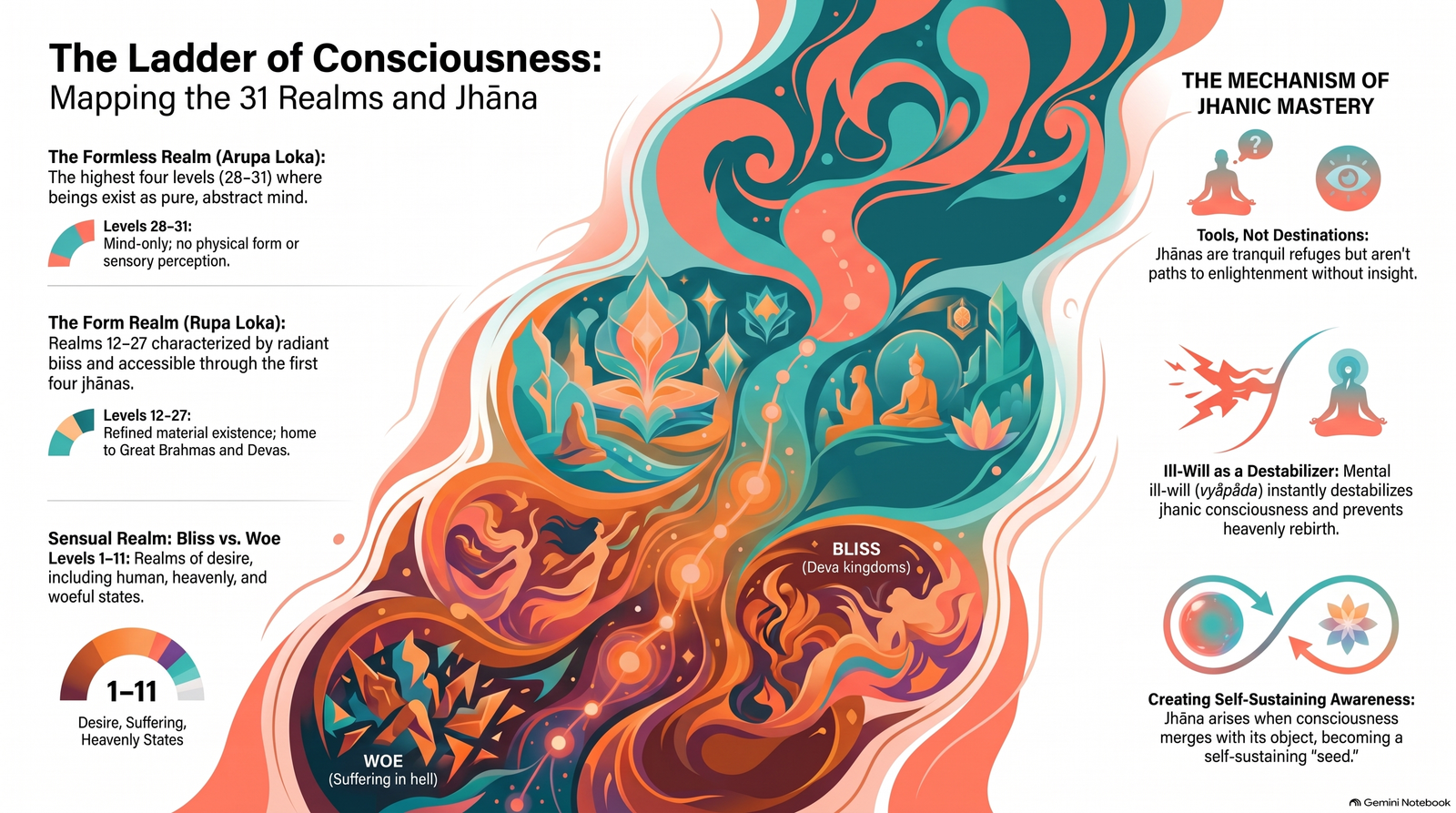
This chapter explores jhāna: meditative absorption in which attention becomes deeply unified around its object. Within the chapter’s Theravāda Abhidhamma framework, a sufficiently stabilised jhānic consciousness can support rebirth in refined form or formless planes. The thirty-one realms introduced in the preceding chapter are therefore connected here with distinct degrees of sensual, absorptive and abstract experience.
Yet the chapter’s decisive claim is cautionary. However tranquil, radiant or long-lasting an absorption may be, it remains conditioned. Jhāna can steady the mind and support insight, but bliss, altered perception and unusual abilities are not themselves liberation. The measure of awakening is not the intensity of an experience but the uprooting of greed, hatred and delusion.
Visual orientation
Mapping the ladder of consciousness
Video guide
A refuge that is not yet release
The recording begins with a radical proposal: consciousness might become sufficiently gathered to take its own stabilised activity as an object. Ordinary awareness is pictured as darting after sights, sounds, bodily sensations and thoughts; jhāna turns that movement inward until subject and object seem to merge. Artists, musicians, athletes and abstract thinkers are used as familiar points of comparison, although everyday flow and full meditative absorption should not be treated as identical.
The inquiry then connects this self-sustaining awareness with Buddhist cosmology. The sensual plane contains the human, deva and woeful realms. The form plane is associated with the four jhānas described in the early discourses—or with a fivefold analytical division in some Theravāda Abhidhamma presentations. The four formless attainments move through infinite space, infinite consciousness, nothingness, and neither-perception-nor-non-perception. These are religious and contemplative maps of conditioned experience; their corresponding realms are not locations established by empirical science.
The video’s physiological language is more speculative. It links ordinary consciousness with blood flow, iron and electromagnetic activity, interprets sensations of kuṇḍalinī through changes in sympathetic tone, and describes jhāna as switching the body into an unusually restful condition. Meditation can affect attention, arousal and autonomic state, but the supplied material does not establish that consciousness is electromagnetic, that it leaves the biological organism, or that heavenly existence is a demonstrated physiological consequence.
At the summit of the map, the argument changes direction. Formless absorption, temporal stasis and psychic powers may sound like mastery, but they do not dismantle the conditions that sustain saṃsāra. The recording contrasts jhānic consciousness with path and fruit consciousness, which in Theravāda analysis take nibbāna as their object. Concentration may suppress the defilements and provide a powerful basis for insight; liberation requires wisdom that sees conditioned experience as impermanent, unsatisfactory and not-self.
Argument map
How the recording develops
Ask whether mind can sustain itself
The inquiry opens by imagining consciousness gathered so completely around an object that it no longer depends on ordinary sensory activity.
Recognise absorption
Jhāna is presented as the mind’s unification with a chosen object, accompanied by the quieting of distraction and bodily stress.
Connect mind-state and world
The qualities stabilised in meditation are related to the form and formless planes of traditional Theravāda cosmology.
Climb through refinement
Rapture and happiness give way to equanimity, while the formless attainments progressively relinquish form, space and increasingly subtle objects.
Expose the danger of mastery
Absorption can become a compelling refuge, and concentration or unusual abilities can be cultivated without equivalent ethical or liberating insight.
Distinguish suppression from uprooting
Jhāna temporarily excludes many disturbances; awakening removes their roots through direct insight into conditioned reality.
Return to the actual aim
The conclusion treats tranquillity as a valuable support rather than a compulsory achievement or the destination of the path.
Book, tradition and interpretation
Four layers in the discussion
The four jhānas EARLY DISCOURSE FRAMEWORK
The early Buddhist formula moves from rapture and pleasure born of seclusion towards equanimity, mindfulness and purity beyond pleasure and pain.
Fivefold form absorption ABHIDHAMMA ANALYSIS
Some Theravāda analytical systems divide the first stage more finely, producing five form-sphere jhānas; this is an alternative enumeration rather than five additional cosmic destinations.
Thirty-one planes RELIGIOUS COSMOLOGY
The sensual, form and formless realms describe conditioned rebirth in traditional Theravāda cosmology, with jhānic mastery linked to refined destinations.
Self-sustaining mind AUTHOR’S SYNTHESIS
The chapter’s electromagnetic, cardiac and autonomic explanations are interpretive hypotheses and should not be presented as established mechanisms of consciousness.
| Domain | Levels in the chapter | Defining orientation |
|---|---|---|
| Sensual plane · kāma-loka | 1–11 | Experience organised around the senses and desire, ranging from woeful states through human life to deva realms |
| Form plane · rūpa-loka | 12–27 | Refined material existence traditionally associated with mastery of form-sphere jhāna |
| Formless plane · arūpa-loka | 28–31 | Mind-only existence associated with the four immaterial attainments |
| Unconditioned · nibbāna | Not another realm on the ladder | The ending of the conditioned round, not its most pleasant or abstract destination |
Recording outline
The route through the video
All ten supplied chapter markers fall within the stated 46:09 final runtime.
- 00:00Opening: Extraordinary States, Same Problem
- 02:20What Is Jhāna?
- 06:10Consciousness Turning Inward
- 10:30Self-Sustaining Awareness Explained
- 15:00The Structure of Heavenly Realms
- 20:10Form vs Formless Jhānas
- 25:40Bliss, Love, and Absorption
- 30:20The Risks: Distraction and Attachment
- 35:10Why Jhāna Is Not Liberation
- 39:00Closing Reflections
Key language
Glossary
Jhāna · dhyāna
Citta
Rūpa-jhāna
Arūpa-jhāna · immaterial attainments
Pīti and sukha
Ekaggatā
Kāma-loka, rūpa-loka and arūpa-loka
Vyāpāda
Brahmavihāra
Abhiññā
Magga-citta and phala-citta
Samatha and vipassanā
Nibbāna · nirvāṇa
Continue into the ideas
Related reading and reference points
Within this course
- 1.3.5. Realms of ExistenceThe preceding chapter establishes the thirty-one-plane cosmology and the karmic framework developed here.
- 1.3.7. Path ConsciousnessThe next chapter turns from refined mundane awareness to the supramundane citta that takes nibbāna as its object.
- 1.2.4 ConsciousnessIntroduces the course’s classification of consciousness and mental factors.
- 1.2.7 The Forces that Drive The MatrixExamines the greed, aversion and delusion that concentration may quiet without necessarily uprooting.
- 1.2.8 SaṃsāraPlaces every sensual, form and formless destination within the larger round of conditioned becoming.
- Object — Part Three of NigredoThe section index for the twelve chapters on paths, realisation and the apparent goal.
External reference points
- SuttaCentral — DN 2, The Fruits of the Ascetic LifeA canonical presentation of the four jhānas within a gradual path that continues through higher knowledge to liberation.
- SuttaCentral — AN 4.123, First Discourse on DiversityConnects mastery of the four jhānas with rebirth among corresponding classes of devas while emphasising that these lives remain impermanent.
- Stanford Encyclopedia of Philosophy — AbhidharmaA scholarly account of Buddhist analytical systems, including sense-sphere, form-sphere, formless and world-transcending consciousness.
- Bhante Henepola Gunaratana — The Jhānas in Theravāda Buddhist MeditationA detailed Theravāda guide to absorption factors, the immaterial attainments and the relationship between concentration and wisdom.
Grounded reflection
What happens when pleasure becomes a destination?
Choose one ordinary, harmless pleasure from today: warmth, music, a quiet room or a satisfying task. Notice the difference between the pleasure itself and the mind’s next movement—grasping, comparing, claiming or worrying about its end. Without trying to reproduce an altered state, ask whether ease is helping you see experience more clearly or becoming another place to hide. This is a reflection on attachment, not an instruction for inducing jhāna or judging contemplative attainment.