
Nigredo · Object · Chapter 28 of 48
1.3.4 The Four Grades of Realisation
If awakening unfolds through distinct breakthroughs, what changes at each threshold—and why is the first glimpse said to redirect the whole journey?
Watch the chapter discussion
The Four Stages of Awakening Explained
The book
The chapter in brief
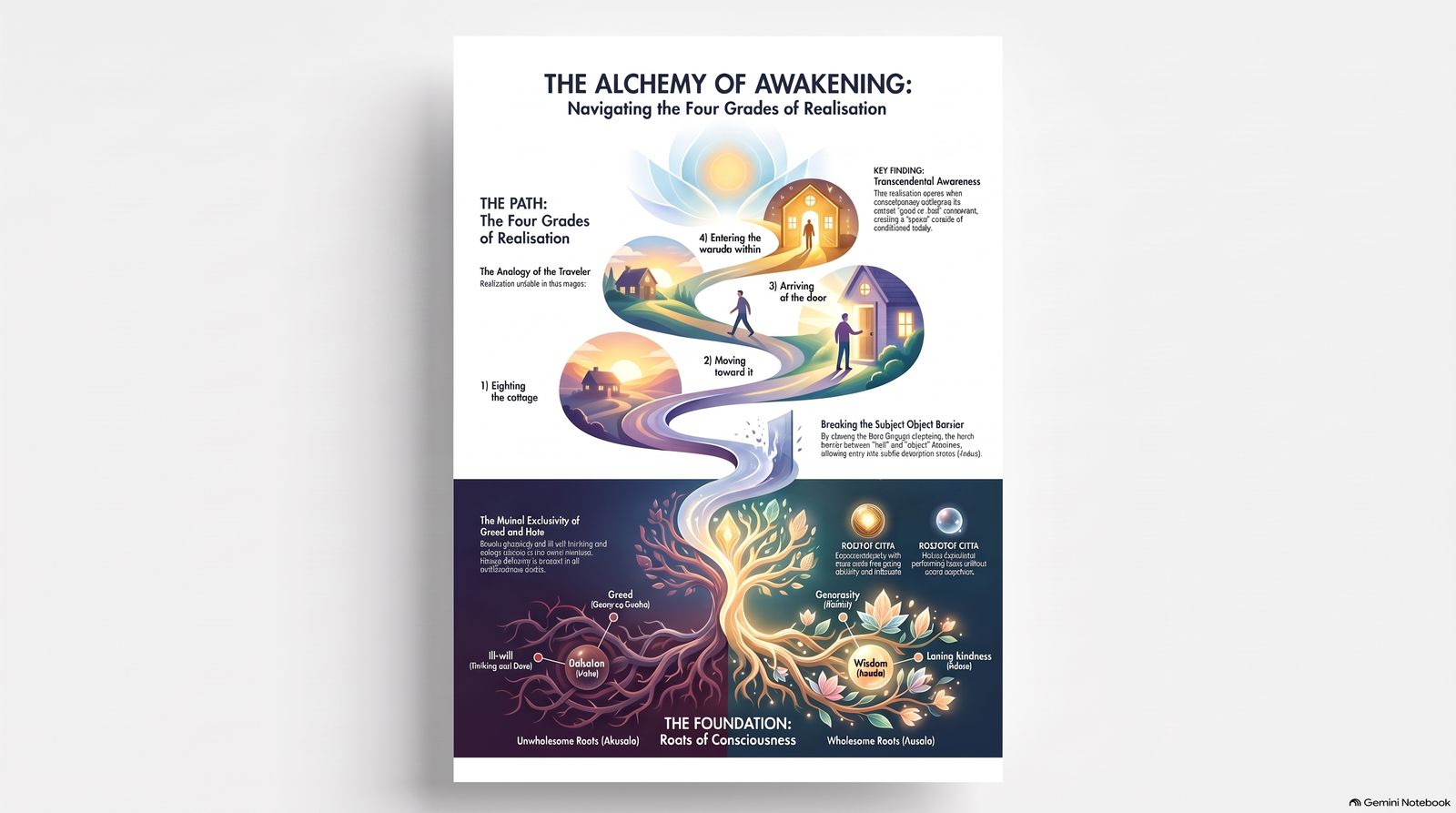
This chapter introduces the Theravāda map of four paths and four fruits through the mechanics of consciousness. It begins with rooted and rootless citta, contrasts greed, ill will and delusion with generosity, loving-kindness and wisdom, and asks how karmically productive mental activity might give way to a moment directed towards the unconditioned.
The traveller and cottage analogy then turns a technical sequence into a human journey: seeing shelter, moving towards it, reaching it and entering it. The course reads this progression alchemically, while the page keeps that synthesis distinct from the historical Buddhist frameworks it draws upon.
Visual orientation
From the roots of consciousness to the fourfold path
Video guide
How can conditioned consciousness encounter the unconditioned?
The recording begins with Thomas Vaughan’s seventeenth-century alchemical dragon: poisonous and medicinal, male and female, dark and bright. The dragon becomes an image of materia prima, the contradictory material already present in ordinary life. Placed beside an Abhidhamma-style analysis of mind, it allows the speakers to compare alchemical separation of the “thick” and “thin” with discriminating wholesome and unwholesome mental roots. This is a thematic comparison, not evidence that early modern alchemy and Buddhist scholasticism share a single historical system.
The video’s analytical centre is the citta, a moment of consciousness directed towards an object and accompanied by mental factors. Greed (lobha) grasps, ill will (dosa) pushes away, and delusion (moha) obscures; the corresponding wholesome roots are non-greed or generosity (alobha), non-hatred or goodwill (adosa) and non-delusion or wisdom (amoha). When a complex emotion seems to contain attraction and aversion at once, the recording explains it as rapid alternation between moments rather than both roots occupying a single citta. That is a traditional analytical model, not a neuroscientific measurement of billions of objectively detected mental events.
Karma is then presented as the momentum by which intentional activity conditions what follows. Attention supplies the practical pivot: consciousness is trained to observe its own activity instead of remaining wholly captured by its objects. The discussion moves from settled attention into jhāna, but refuses to make absorption the goal. Jhāna may steady and refine the mind; within Buddhist traditions it is not automatically identical with liberating insight, and claims about psychic powers remain religious or contemplative claims rather than established scientific findings.
The decisive movement is described as a citta that no longer produces karma and takes the unconditioned as its object. In Theravāda Abhidhamma language, a supramundane path moment is followed by fruit consciousness; the four paths are associated with progressive relinquishment of fetters. The course renders this through the traveller: first seeing the cottage, then moving towards it, arriving at it and finally sitting safely within. The image conveys increasing intimacy with liberation, but it should not be used as a checklist for diagnosing one’s own or another person’s attainment.
The recording closes by returning to daily frustration as workable material. The “dragon” is not somewhere outside ordinary life: grasping, rejection and confusion appear in mundane encounters, and those encounters can become occasions for observing the mind rather than mechanically extending its reactions. The practical question is therefore smaller than the attainment map and more testable in experience: when irritation appears, can its texture be known clearly before it becomes the next action?
Keep the languages distinct
What the chapter brings together
| Source language | How the recording uses it | Editorial boundary |
|---|---|---|
| Theravāda Abhidhamma | Momentary citta, wholesome and unwholesome roots, bhavaṅga, karmic result, functional consciousness, path and fruit | This is a developed Buddhist scholastic system. It should not be presented as contemporary experimental psychology or as the only Buddhist account of mind. |
| Early Buddhist path teaching | The four grades of stream-enterer, once-returner, non-returner and arahant, described through the progressive abandonment or weakening of fetters | The categories are religious and doctrinal attainments. They are not clinical diagnoses, personality types or externally validated measures of development. |
| Meditative practice | Attention settles on an object, experience becomes subtler and jhāna offers concentration, shelter and power | Absorption and unusual experience are not by themselves liberation. Traditions disagree about the precise relationship between concentration and insight. |
| Western alchemy | Vaughan’s dragon represents contradictory first matter whose poison and medicine must be discriminated and transformed | The psychological reading is interpretive. Early modern alchemical texts also belonged to material, religious and cosmological settings of their own. |
| The course synthesis | The dragon, roots of consciousness and cottage journey are presented as complementary maps of one transformative work | The correspondence can clarify the course’s architecture without proving that the traditions are historically identical or interchangeable. |
The foundation
Six roots that give consciousness its direction
Greed LOBHA · GRASPING
The mind reaches towards, appropriates or clings to its object. The chapter pairs it with non-greed, expressed as generosity and the capacity to release.
Ill will DOSA · REJECTION
The mind strikes against or pushes away its object. Its wholesome counterpart is non-hatred: goodwill, patience and loving-kindness.
Delusion MOHA · NOT SEEING CLEARLY
Confusion about the nature of experience underlies unwholesome states. Non-delusion is associated with discernment and wisdom.
Rootless and functional citta A TECHNICAL DISTINCTION
Not every citta is karmically productive. The chapter uses rootlessness and functional action to ask how activity might occur without perpetuating the usual chain of appropriation and result.
Argument map
How the recording develops
Meet the dragon
Vaughan’s paradoxical creature supplies an alchemical image for raw consciousness containing destructive and transformative possibilities.
Separate the roots
Abhidhamma vocabulary distinguishes grasping, rejection and confusion from generosity, goodwill and wisdom.
Follow karmic momentum
Intentional moments condition later experience, producing a loop in which habitual responses help shape what arises next.
Turn attention towards knowing
Meditative discipline allows mental activity itself to become observable rather than leaving awareness wholly absorbed in its usual objects.
Do not mistake shelter for freedom
Jhāna may be profound and useful, yet the recording warns against confusing bliss, concentration or extraordinary claims with liberation.
Interrupt conditioned production
The course describes a path moment that takes the unconditioned as its object and is followed by resultant fruit consciousness.
Walk the fourfold journey
The cottage analogy gives the four grades an intuitive sequence: glimpse, approach, arrival and dwelling within safety.
The traveller analogy
Four changing relationships to the cottage
1. Seeing the cottage SOTĀPANNA · STREAM-ENTERER
A lost traveller glimpses a warm refuge. In the traditional map, the first three fetters are abandoned and the direction of the path becomes irreversible.
2. Moving towards it SAKADĀGĀMĪ · ONCE-RETURNER
The traveller stops wandering and moves towards the refuge. Sensual desire and ill will are traditionally described as weakened rather than fully abandoned.
3. Arriving at the door ANĀGĀMĪ · NON-RETURNER
The safety of the cottage is directly confirmed. The five lower fetters, including sensual desire and ill will, are traditionally said to have been abandoned.
4. Entering and resting ARAHANT · WORTHY ONE
The traveller sits within the refuge. In the Theravāda map, the remaining higher fetters are abandoned and no new rebirth-producing karma is generated.
Recording outline
The route through the video
The nine valid supplied markers below ascend from 00:00 to 35:10 and fall within the stated 35:43 final runtime. A supplied 39:00 closing marker was omitted because it exceeds that runtime.
- 00:00Opening: Awakening Has Stages
- 02:20What Is a Path Moment?
- 06:10Karma and the Flow of Consciousness
- 10:40Wholesome vs Unwholesome Roots
- 15:20Using Attention to Break the System
- 20:30Jhāna: Power and Danger
- 25:40Collapse of Subject and Object
- 30:20The Four Stages Explained (Traveller Analogy)
- 35:10Why the First Breakthrough Is Hardest
Key language
Glossary
Citta
Roots · hetu
Kusala · akusala
Lobha · dosa · moha
Alobha · adosa · amoha
Bhavaṅga · life-continuum
Karma · kamma
Jhāna
Abhiññā
Path and fruit consciousness
Saṃyojana · fetter
Sotāpanna · Sakadāgāmī · Anāgāmī · Arahant
Nibbāna · Nirvāṇa
Materia prima · the dragon
Continue into the ideas
Related reading and reference points
Within this course
- 1.3.3 The Golden Middle PathThe preceding chapter asks how conditioned choice can give way to a path beyond the divided self.
- 1.3.5. Realms of ExistenceThe next chapter expands the cosmological and experiential setting in which karmic consciousness is traditionally understood.
- 1.3.7. Path ConsciousnessReturns in greater detail to the supramundane path moment introduced here.
- 1.3.8. SotāpannaBegins the course’s separate treatment of the four attainment grades with stream-entry.
- 1.3.11. The Subtle FettersExamines the higher bindings that remain after the five lower fetters have been abandoned.
- Object — Part Three of NigredoThe section index for the twelve chapters on paths, realisation and the apparent goal.
External reference points
- SuttaCentral — AN 3.86, A Certain MendicantAn early Buddhist discourse describing trainees in relation to ethical conduct, immersion and wisdom, including once-returning, non-returning and arahantship.
- SuttaCentral — SN 55.1, A Wheel-Turning MonarchA discourse from the collection on stream-entry, placing the stream-enterer’s qualities above even sovereign worldly power.
- Stanford Encyclopedia of Philosophy — AbhidharmaA scholarly account of Abhidharma’s development, its moment-by-moment analysis of experience, citta, conditioning and differences among Buddhist schools.
- Insight Meditation Center — The Bodhisattva and the ArhatGil Fronsdal distinguishes the arhat, bodhisattva and buddha ideals while reflecting on how liberation and compassion can be understood together.
Grounded reflection
Can the reaction become the object?
Choose one mild irritation from ordinary life rather than a traumatic or destabilising experience. Before explaining it, notice whether the mind is pulling something closer, pushing something away or failing to see clearly. Then ask what generosity, goodwill or clearer understanding would change—not as a performance of virtue, but as a different way for the next moment to be conditioned. This is an exercise in observation, not a test of meditative attainment.