
Albedo · Dharma · Chapter 22 of 48
2.2.10. Types of Karma
If karma is not a moral ledger, what gives one intention priority over another when a life reaches its end?
Watch the chapter discussion
How karma determines rebirth
Book orientation
The chapter in brief
This chapter moves from the formation of karma in the cognitive series to a later Theravāda Abhidhamma classification of which kamma may generate rebirth. It presents four levels of precedence: weighty (garuka), death-proximate (āsanna), habitual (āciṇṇaka) and residual or reserve (kaṭattā). The framework is used to show why karma is not simple arithmetic in which good deeds cancel bad ones. In the author’s Albedo synthesis, purification therefore means changing the mind’s structure and habits rather than balancing an invisible account. The hierarchy and rebirth-linking consciousness are traditional doctrinal claims, not empirically verified mechanisms. They are also more specific than the early-discourse statement that intention is kamma and should not be treated as a definition shared unchanged by every Buddhist tradition.
Transcript-led guide
What takes precedence when many actions could bear fruit?
The recording begins by rejecting the popular picture of karma as cosmic scorekeeping. A kindness does not simply erase a cruelty, and the outcome of action is not portrayed as a verdict delivered by an external judge. Instead, the video develops the chapter’s “priority queue” image: accumulated volitions differ in force, proximity and repetition, so the traditional model assigns some a stronger role than others in conditioning the next birth. The language of “physics” and “mechanics” is metaphorical; it expresses impersonality and conditionality rather than a scientifically measured law.
Weighty kamma comes first. In the Theravāda commentarial scheme, this includes the five deeds of immediate consequence on the unwholesome side and meditative absorption on the wholesome side. The recording uses this contrast to make a difficult point: concentration is not moral cancellation. A refined state does not rewrite a past deed as though it had never occurred. Claims that particular actions guarantee a specific rebirth, obstruct jhāna or prevent awakening in that life belong to the traditional doctrinal framework and are not conclusions that can be clinically diagnosed or empirically confirmed in another person.
If no weighty kamma determines rebirth, the account moves to death-proximate kamma: the action, memory, sign or mental object prominent near death. This gives compassionate significance to a calm environment and wholesome recollection, but the video occasionally makes the final moment sound more mechanically decisive than the wider tradition warrants. The point is not that panic during a painful death condemns an otherwise kind person, nor that relatives can engineer a destination. End-of-life experience is complex, and care should prioritise the dying person’s comfort, wishes and appropriate clinical support.
The last two categories return the lesson to everyday life. Habitual kamma is the groove made by repeated responses; residual kamma names what remains when no stronger class takes precedence. The video’s comparisons with neuroplasticity and autopilot are illuminating analogies, not demonstrations that ancient kamma theory and modern neuroscience describe the same mechanism. Its practical conclusion is nonetheless grounded: repeated irritation, patience, grasping or generosity trains what becomes readily available. Albedo is framed as repairing the instrument—reducing the conditions for harmful action and cultivating clearer habits—without claiming that the past can be made not to have happened.
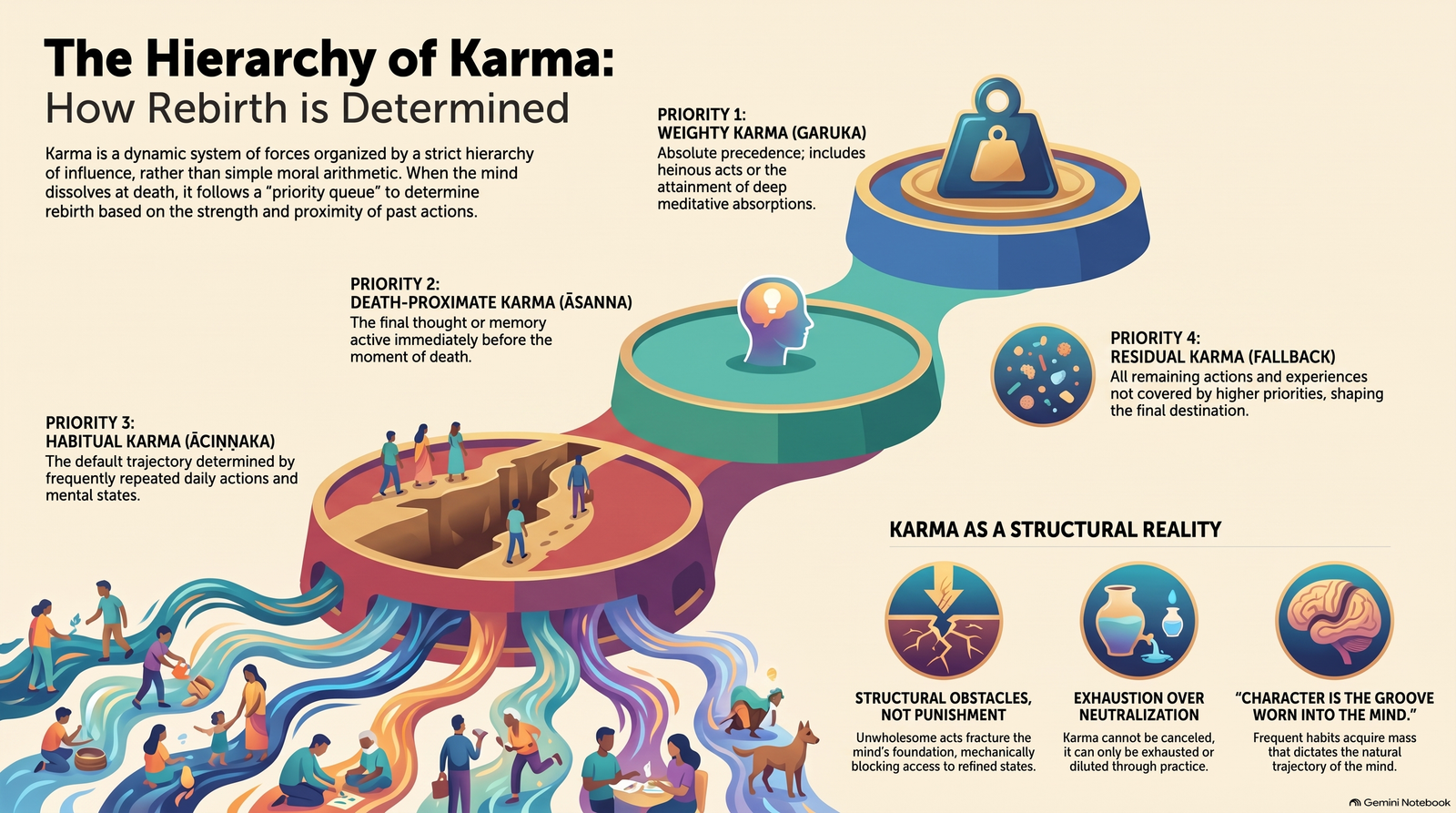
| Priority | Traditional category | Function in the model | Careful reading |
|---|---|---|---|
| 1 · Weighty | Garuka-kamma | Exceptionally powerful wholesome or unwholesome kamma takes precedence as rebirth-generative. | “Absolute” describes the traditional hierarchy, not an observable natural law or a licence to declare another person’s destiny. |
| 2 · Death-proximate | Āsanna-kamma | A potent action, recollection or sign near death operates when weighty kamma is absent. | A peaceful deathbed may support wellbeing, but fear, pain, medication and consciousness cannot be reduced to a moral final exam. |
| 3 · Habitual | Āciṇṇaka-kamma | Frequently repeated conduct and mental tendencies supply the default trajectory when stronger priorities are absent. | The “groove” analogy usefully describes conditioning, but it is neither a fixed personality nor a direct equivalence with neural pathways. |
| 4 · Residual | Kaṭattā-kamma | Other accumulated kamma serves as the reserve when none of the preceding categories is operative. | This is a category in a rebirth model, not evidence for a measurable store, substance or cosmic archive. |
Argument map
How the recording develops its case
Dismantle the scorecard
The familiar idea that good and bad deeds cancel each other is replaced by conditional forces of unequal strength and proximity.
Introduce precedence
The chapter’s fourfold hierarchy explains how later Theravāda analysis orders possible rebirth-generating kamma.
Test the limit case
Weighty deeds and meditative absorption show why concentration cannot be treated as payment that erases grave action.
Approach the final cognitive series
Death-proximate kamma gives special importance to what becomes prominent near death, while calling for care rather than prediction.
Return to daily training
Habitual kamma makes repeated ordinary reactions central: character becomes the groove most readily followed when control weakens.
Complete the causal account
Residual kamma supplies the fallback within the rebirth model, ensuring that the hierarchy always has a possible conditioning factor.
Redefine purification
The conclusion shifts from balancing past deeds to repairing the instrument that keeps producing harmful intention and response.
Book, video and interpretive frame
Three layers of the lesson
The chapter establishes
A concise hierarchy of weighty, death-proximate, habitual and residual kamma, with the emphasis on precedence rather than arithmetic cancellation.
The video expands
A queue, waterfall, riverbed, autopilot, noise-cancelling headphones and a musical instrument turn a technical classification into an account of habit and training.
Albedo reframes
The author’s synthesis treats unwholesome kamma as a present structural constraint and purification as repair, while retaining responsibility without divine punishment.
Video chapters
Navigate the discussion
- 00:00Opening: Karma Is Not Arithmetic
- 02:10The Hierarchy of Karmic Precedence
- 06:20Weighty Karma (Garuka) Explained
- 11:40Jhāna and Its Limitations
- 15:30Death-Proximate Karma (Āsanna)
- 20:10The Power of the Final Moment
- 24:00Habitual Karma (Āciṇṇaka)
- 28:20Character as Conditioning
- 31:40Residual Karma (Kaṭattā)
- 34:10Why Karma Cannot Be Neutralised
- 36:00Karma as Structural Constraint
Glossary
Terms used in the chapter
Kamma / karma
Vipāka
Garuka-kamma
Āsanna-kamma
Āciṇṇaka-kamma
Kaṭattā-kamma
Ānantariya-kamma
Jhāna
Paṭisandhi-citta
Javana
Arahant
Albedo
Related pathways
Continue within the course
- 2.2.9. The Cognitive SeriesReturns to the sequence in which the course locates karmically active impulsion.
- 2.2.11. Transcendental ConsciousnessMoves from conditioned cognitive processes towards the Theravāda category of supramundane consciousness.
- 2.2.4. VolitionExplores intention as the ethically decisive feature of action.
- 2.2.7. Unwholesome KarmaExamines actions rooted in greed, aversion and delusion before this chapter orders their possible precedence.
- 2.2.8. Wholesome KarmaConsiders beneficial intention and the limits of treating goodness as a final spiritual destination.
- Albedo · Dharma — The Mechanics of RealityBrowse all twelve chapters in the Dharma section.
Reference points
Sources for context and comparison
- Aṅguttara Nikāya 6.63 · PenetrativeAn early-discourse basis for understanding intention as kamma; useful for distinguishing this core claim from the later fourfold priority scheme.
- Majjhima Nikāya 135 · The Shorter Analysis of DeedsAn early Buddhist discourse connecting intentional conduct with differing results and rebirths within the tradition’s moral cosmology.
- Aṅguttara Nikāya 3.100 · A Lump of SaltA valuable counterweight to rigid arithmetic: the same minor deed is described as ripening differently according to the development and scope of the person.
- A Comprehensive Manual of AbhidhammaBhikkhu Bodhi’s edited guide to the Abhidhammattha Saṅgaha; Chapter V provides the developed Theravāda context for rebirth, death and kamma by order of ripening.
- Stanford Encyclopedia of Philosophy · AbhidharmaA scholarly overview that places Abhidharma taxonomies, causation and later commentarial developments within their historical and philosophical setting.
A two-minute practice
Notice the groove, not the verdict
Choose one ordinary situation that recurs—a delay, a message, a household task or a minor disagreement. There is no need to revisit anything overwhelming.
- Name the response that appears most readily: irritation, avoidance, grasping, patience, humour or care.
- Ask what repeatedly strengthens that response: fatigue, speed, expectation, rehearsal, attention or environment.
- Choose one small condition you could alter next time, such as pausing before replying or making the helpful action easier.
This is not a test of purity or a prediction about rebirth. It uses the chapter’s habit model to make one recurring pattern more visible and workable.