
Dialogues II · Episode 14 of 18
When Neo Stops Running
At the top of the subway stairs, Neo turns towards the threat he has always fled. Is this awakening—or a film giving visible form to an inner freedom it cannot prove?
Central question
What changes when the thing you fear is seen as conditioned?
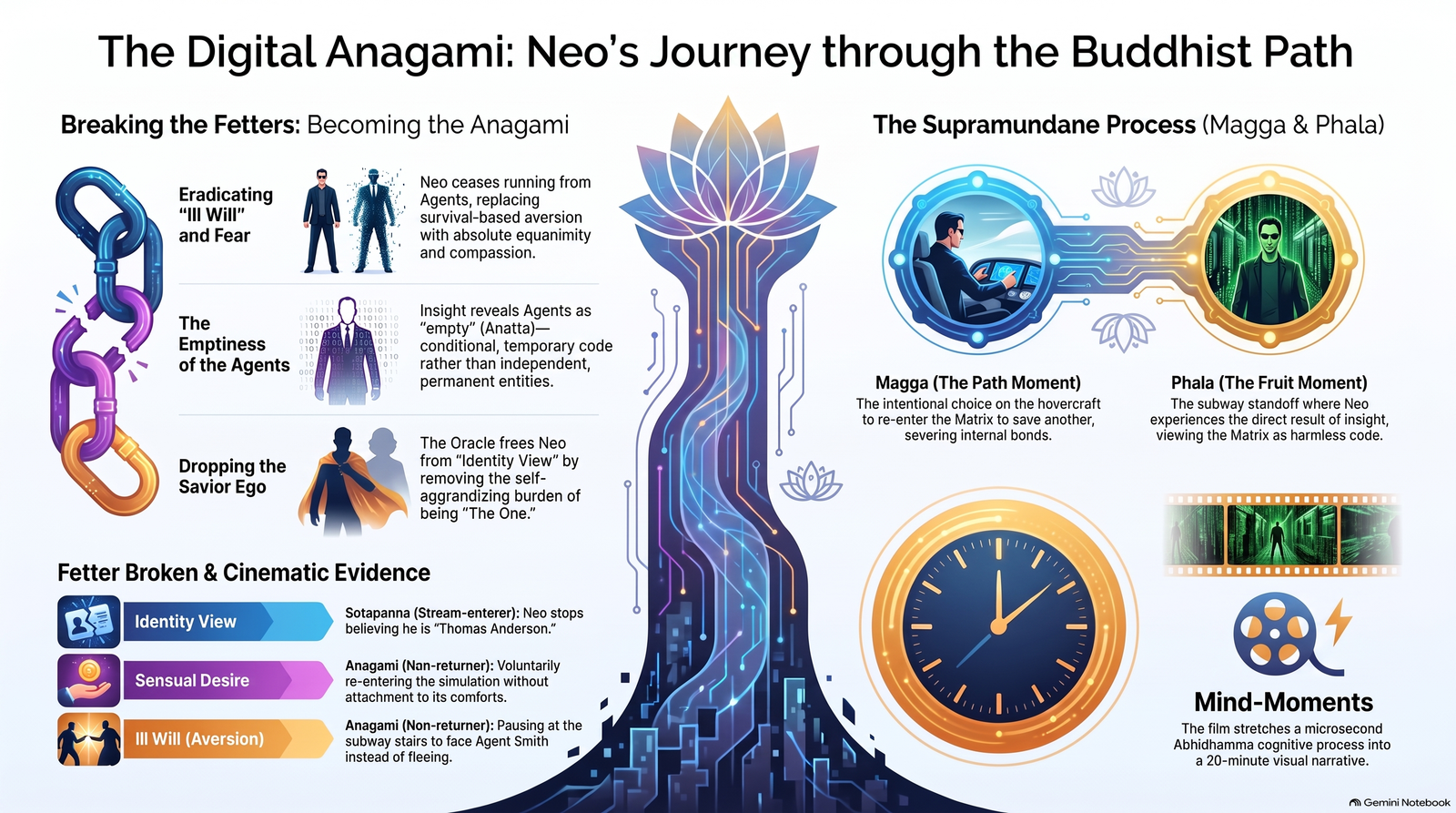
The climax of The Matrix is usually read as the moment Neo begins to believe that he is “the One.” This episode proposes a different lens. What if his decision to re-enter the simulation, rescue Morpheus and finally turn towards Agent Smith can be read as a cinematic enlargement of Buddhist path and fruit consciousness—a microscopic shift in relation to fear, desire and identity stretched across the scale of an action film?
The discussion first recasts the Matrix as digital saṃsāra: a sensory world held together not only by cables and code, but by craving, aversion and ignorance. Thomas Anderson’s unease becomes an image of dukkha; the instability of the simulation suggests impermanence; and the Agents become a vivid metaphor for conditioned processes mistaken for solid, autonomous enemies. Cypher and the resistance crew then reveal an important difficulty. Intellectually knowing that a world is constructed does not by itself end one’s longing for its comforts or one’s fear of its threats.
From there, the episode follows Neo through the first five Buddhist fetters and into a precise Theravāda vocabulary. The Oracle’s refusal to confirm his heroic identity is read as the loosening of a saviour ego. Neo’s choice to return becomes the magga, or path, moment; the rescue and subway confrontation become its cinematic phala, or fruit. The mirrored choreography with Smith, their exchange “You’re empty” / “So are you,” and the slowed perception of bullet time are gathered into a single symbolic reading of emptiness and non-aversion.
The claim is deliberately larger than the evidence. The Matrix gives us images through which to think; it does not document a Buddhist attainment or a measurable neural event. The practical question is therefore quieter than the spectacle: when a familiar threat appears, can we see the conditions that lend it solidity without denying the danger, abandoning ethical action or pretending that fear has already vanished?
Argument map
From imprisonment by appearances to a different kind of action
- The prison recruits the prisoner. The Matrix endures because sensation, comfort, fear and habit make its world compelling from within; its deepest restraints are psychological as well as technological.
- Seeing construction is not yet freedom. Cypher knows the steak is simulated and still longs for it, while the resistance knows Agents are code and continues to flee them. Insight can remain intellectual while craving and aversion retain their force.
- The enemy loses independent solidity. Agents arise only through the system and its hosts. Read through dependent origination and non-self, their power is conditional—although conditional threats can still have real consequences within the story.
- The heroic identity is loosened. By telling Neo that he is not the One, the Oracle can be read as removing the burden of performing a guaranteed destiny. His return for Morpheus then appears as chosen responsibility rather than self-confirmation.
- The decision precedes the spectacle. The episode locates the path moment in Neo’s quiet decision to re-enter the Matrix. The later action becomes an expanded visual metaphor for the fruit of that changed orientation.
- Turning around changes the relationship. When Neo stops on the subway stairs and faces Smith, the threat has not disappeared. What changes is the reflexive structure of flight, resistance and self-protection through which the threat had governed him.
- Freedom remains ethically situated. Recognising conditions can make action less reactive, but it does not make violence harmless, consequences unreal or interpretation infallible. The metaphor succeeds only when those limits remain visible.
Interpretive lenses
How the sources are used
The film and screenplay
The choices, dialogue and visual choreography supply the primary cinematic evidence. The subway exchange about being “empty” occurs in the screenplay, but its Buddhist meaning is an interpretation rather than an explicit explanation supplied by the film.
Early Buddhist fetter teaching
The first five fetters define the traditional threshold of non-return: identity view, doubt, mistaken grasping at observances, sensual desire and ill will. This framework is doctrinally specific and cannot be reduced to fearlessness or heroic self-sacrifice.
Theravāda Abhidhamma
Path and fruit cittas, the seventeen-moment sense-door process and functional consciousness come from a scholastic analysis of mind. They are traditional phenomenological categories, not timings established by contemporary neuroscience.
The episode’s synthesis
Digital code, Jung’s shadow, bullet time and Buddhist liberation are combined to make an invisible change dramatically visible. The synthesis is valuable as a thinking instrument without becoming a historical claim about authorial intention.
Chapters
Follow the complete discussion
- 00:00Opening: The Matrix as an Enlightenment Blueprint
- 03:10Saṃsāra, Simulation, and the Sensory Prison
- 07:00The Three Marks of Existence in The Matrix
- 11:10Agents, Emptiness, and Dependent Origination
- 15:00Why Knowing the Matrix Is Fake Isn’t Enough
- 18:20Neo, the Red Pill, and the First Three Fetters
- 22:00Cypher and the Danger of Partial Awakening
- 26:10Fear, Aversion, and the Resistance Fighters
- 29:30The Oracle and the Collapse of the Saviour Ego
- 34:00Abhidhamma, Mind Moments, and Path Consciousness
- 38:10Magga and Phala: The Subway Fight Reinterpreted
- 41:40Bullet Time as Vipassanā
- 43:30Violence, Symbolism, and Functional Action
- 44:30Closing Reflection: Main Character Energy as a Fetter
Fact-sensitive notes
Where the cinematic map needs firmer edges
A useful textual clarification. The subway exchange “You’re empty” / “So are you” does occur in the film’s screenplay after both guns click empty. Its literal reference is ammunition. Reading the line as a recognition of non-self or emptiness is a resonant secondary interpretation, not the scene’s only or historically verified meaning.
Non-return is not fearlessness
In early Buddhist formulations, non-return follows the abandonment of all five lower fetters. Ill will is not simply identical with fear, and one courageous confrontation cannot demonstrate that sensual desire, aversion or identity view has been eradicated.
Path and fruit are not film scenes
In Theravāda Abhidhamma, a path citta is followed immediately by fruition. Assigning Neo’s decision to magga and a long action sequence to phala is therefore cinematic dilation: an analogy explicitly unlike the traditional temporal account.
Seventeen moments are a traditional model
Abhidhamma manuals analyse a complete sense-door process as seventeen cittas. That number should not be treated as a neuroscientific measurement, a fixed duration for every mental event or evidence of a hidden mathematical structure in the film.
Non-self does not make danger harmless
Calling the Agents dependently arisen or empty does not mean they are absent or causally powerless. Buddhist non-self challenges independent, permanent essence; it does not erase conventional persons, consequences or the need for wise response.
Bullet time is an interpretive image
The visual effect can suggest the contemplative examination of change, but it is a filmmaking technique rather than evidence that vipassanā reveals physical reality in literal slow motion or discloses subatomic entities to unaided perception.
Functional action is not moral exemption
Theravāda uses kiriya or functional consciousness especially for the ethically inoperative actions of an arahant. Neo is not an arahant within the episode’s own analogy, and symbolic interpretation does not render the film’s violence karmically neutral.
Glossary
Terms used in the episode
Saṃsāra
The recurring round of conditioned existence, birth and death in Indian religious traditions. In Buddhism it is sustained by ignorance, craving and clinging. The episode uses the Matrix as a digital metaphor for saṃsāra; this does not imply that Buddhist cosmology teaches computer simulation theory.
Kāma-loka
The sense-desire realm in Buddhist cosmology, encompassing forms of life organised around sensory experience and desire. The episode associates the simulated world’s pleasures and pains with this realm. The comparison is symbolic, not a claim that the Matrix reproduces a canonical cosmological map.
The three marks
Impermanence (anicca), unsatisfactoriness (dukkha) and non-self (anattā) are characteristics used in Buddhist analysis of conditioned phenomena. The episode places Thomas Anderson’s unease, the instability of code and the conditional identity of the Agents beside these three lenses.
Dependent origination
The Buddhist principle that phenomena arise through causes and conditions rather than from an isolated, self-sufficient essence. It is more precise than the vague claim that “everything is connected.” The Agents illustrate conditional appearance within the film, but code is only an analogy for dependent arising.
Anattā and emptiness
Anattā denies a permanent, controlling self in persons and conditioned processes. Emptiness is developed differently across Buddhist traditions; in Mahāyāna it often concerns the absence of intrinsic nature in all phenomena. Neither teaching means that people or consequences simply do not exist.
The five lower fetters
Identity view, doubt, mistaken grasping at rules and observances, sensual desire and ill will. Early Buddhist accounts distinguish stages of awakening by their abandonment or attenuation. The episode maps Neo’s development onto this structure, while the page treats that mapping as cinematic analogy.
Anāgāmī
A non-returner, the third of four noble stages in early Buddhist traditions. A non-returner has abandoned the five lower fetters and is said not to return to birth in the sense-desire realm. Courage, unusual perception and reduced fear are not sufficient evidence for this attainment.
Citta
A moment or occasion of consciousness in Buddhist psychological analysis. Abhidhamma classifies cittas by their objects, roots, ethical quality and function. A citta is not a neuron, particle or cinematic frame, and traditional accounts should not be presented as experimentally measured brain timings.
Magga and phala
Magga is path consciousness at one of the four stages of awakening; phala is the fruition that follows it. Theravāda Abhidhamma presents them as immediately successive cittas. The episode spatialises this sequence across Neo’s decision and the film’s extended climax.
Bhavaṅga
In Theravāda Abhidhamma, the life-continuum: a passive mode of mind occurring when an active cognitive process is absent. It belongs to a particular scholastic account of mental continuity and should not be equated straightforwardly with the neurological resting state or the unconscious.
Vipassanā
Insight practice concerned with seeing conditioned experience in terms such as impermanence, unsatisfactoriness and non-self. The episode treats bullet time as a visual metaphor for perceptual deconstruction. The effect does not represent a literal meditative superpower or a scientific model of perception.
Kiriya citta
Functional or inoperative consciousness in Theravāda Abhidhamma. The term is used especially for an arahant’s actions, which do not generate fresh karmic results because greed, hatred and delusion have ended. It does not mean that enlightened action lacks ethical form or worldly consequences.
Study paths
Continue into the ideas
Related reading on this site
- The Matrix as a Spiritual Trojan HorseEpisode 13 establishes the preceding map of apparent reality, alchemical transformation, the fetters and the limits of cinematic teaching.
- The ten fettersAn introduction to the Buddhist scheme that structures the episode’s account of progressive release.
- 3.2.1. The Threshold of Non-ReturnThe wider course treatment of the transition associated with abandoning the five lower fetters.
- The AbhidhammaBackground to the analytical Buddhist framework from which cittas, path and fruition are drawn.
- 1.3.7. Path ConsciousnessA course chapter exploring the supramundane path moment within the author’s larger alchemical map.
- Functional ConsciousnessA closer look at action described as functional rather than productive of new karmic result.
External reference points
- Fetters Sutta — SuttaCentralA translation of the early Buddhist discourse enumerating the five lower and five higher fetters.
- The Longer Discourse with Māluṅkyaputta — SuttaCentralAn early Buddhist account of the lower fetters, their abandonment and the non-returner.
- The Abhidhamma in Practice — Access to InsightA concise traditional introduction to citta, cognitive processes and the seventeen thought-moment sense-door model.
- Mind in Indian Buddhist Philosophy — Stanford Encyclopedia of PhilosophyScholarly context for dependent arising, non-self and Buddhist analyses of mental continuity.
- The Matrix: how the Wachowskis changed sci-fi — BFIFilm-historical context for the cyberpunk influences, action choreography and revolutionary bullet-time technique.
- The Matrix screenplay — Daily ScriptA screenplay text for checking the subway action and the literal “You’re empty” / “So are you” exchange.
A grounded reflection
Before the next reflex
Recall one ordinary moment in which you automatically withdraw, defend or rush to explain: an unread message, a difficult name on the screen or a familiar criticism. Without trying to eliminate the reaction, notice three conditions that strengthen it—perhaps memory, bodily tension, expectation or uncertainty. Then ask: what response remains available if I do not have to obey the first impulse? This is not a test of fearlessness. It is a brief inquiry into how conditions become choices.
Continue the sequence